
On this page
Start here
Quick answer
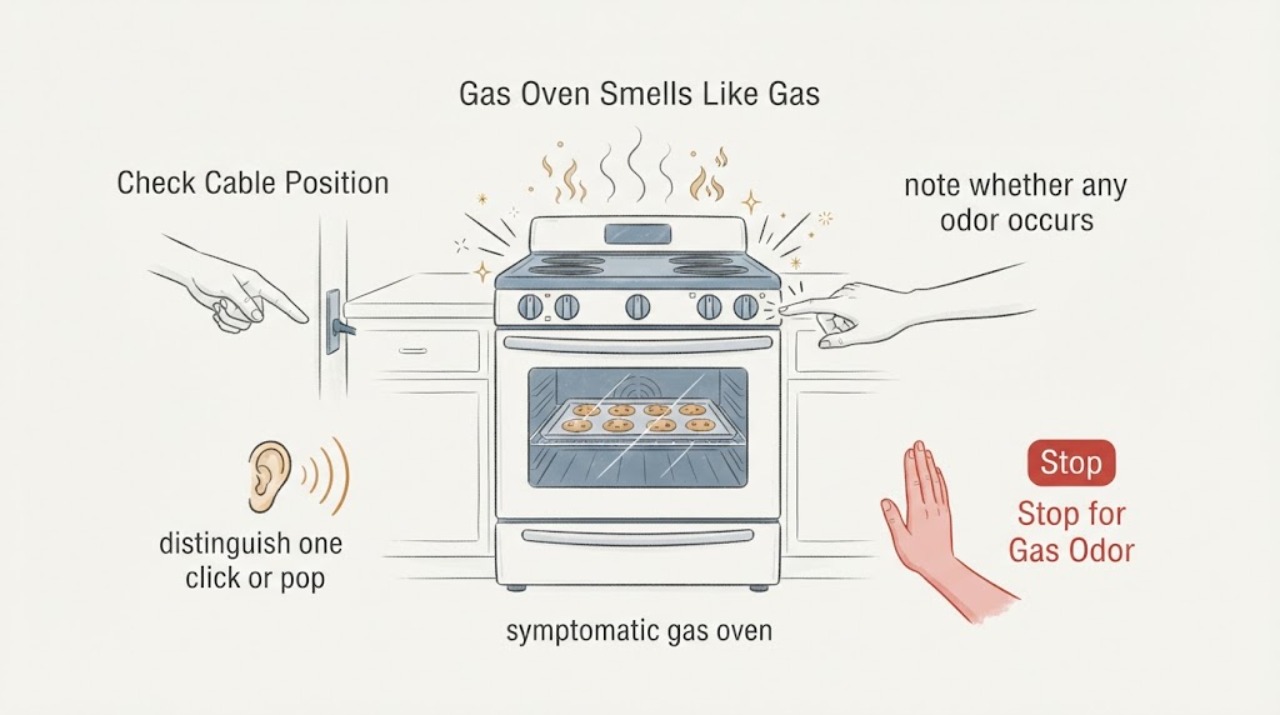
Treat an active or persistent rotten-egg or gas smell as a gas-safety event: stop using the Whirlpool gas oven, do not keep troubleshooting or operate switches near the smell, leave the home, and contact emergency or gas-leak assistance from a safe distance. Whirlpool says a brief odor during ignition can occur and that clicking, popping, or a whoosh/poof when the bake or broil burner ignites can be normal, but the smell should fade. A constant sizzling sound can come from accessible food or liquid residue only when the oven is cool; it does not explain a continuing gas smell. Do not remove panels, inspect the burner while operating, test repeated ignitions, or replace an igniter or gas part based on sound alone.
Work through in order
Diagnostic checks
Use only checks that match the exact appliance or system and its official guide.
-
Check 1
If you smell gas now, or the smell is persistent, leave the oven and home without operating nearby switches, fans, knobs, or ignition controls; call 911 or the applicable gas emergency service from outside or another safe location.
Expected result: The odor fades only after leaving, or it remains noticeable with the oven off or is accompanied by hissing, headache, dizziness, or a strong rotten-egg smell.
Next step: Do not re-enter to test the oven or search for the leak. Wait for emergency or gas personnel to declare the area safe, then arrange qualified appliance service if the oven is implicated.
Why this matters
Why: A continuing or symptomatic odor cannot be safely distinguished from a leak by a user-level oven test. Whirlpool treats a suspected gas leak as an immediate evacuation and emergency-contact situation.
-
Check 2
After the appliance has been cleared for observation, note whether any odor occurs only for a short time at bake or broil ignition and then fully fades; do not repeatedly restart the oven to reproduce it.
Expected result: There is a brief ignition odor that fades, or the odor continues during baking, returns after the oven is off, or becomes stronger when the door is opened.
Next step: If the smell does not clearly fade or returns with the oven off, stop using the appliance and request gas-appliance service after any emergency concern has been handled. Do not self-diagnose the igniter or gas line.
Why this matters
Why: Whirlpool says a quick whiff during preheating can occur as gas ignites, but it says an oven should not smell like gas when off and a persistent smell may indicate a leak or part needing service.
-
Check 3
From outside the closed oven, distinguish one click or pop followed by ignition from a whoosh or poof that occurs as the bake or broil burner cycles; do not remove the oven bottom or inspect the flame while operating.
Expected result: The sound is a brief, repeatable ignition sound with stable heating, or it is a loud bang, repeated failed ignition, delayed heating, or a sound paired with gas odor or smoke.
Next step: For a loud bang, failed ignition, smoke, flame disturbance, persistent odor, or poor heating, turn the oven off, leave it unused, and arrange qualified gas-appliance service. Do not adjust the burner, valve, igniter, or air mixture.
Why this matters
Why: Whirlpool describes clicking, popping, and whoosh/poof sounds at burner ignition as normal operating sounds, but the sound alone does not prove that ignition, combustion, or gas delivery is safe when the surrounding symptoms are abnormal.
-
Check 4
Only when the oven is fully cool and there is no active gas concern, inspect the visible cavity floor, racks, and vent opening for food, liquid, foil, or heavy residue; clean only an identified accessible residue according to the exact model manual.
Expected result: A visible spill or residue is present with no gas smell, smoke, flame problem, or exterior seepage, or the sizzling continues without an identifiable accessible residue.
Next step: If no clear residue explains the sound, or if any gas smell, smoke, or flame abnormality occurred, keep the oven out of service and request qualified inspection. Do not run a cleaning or heating cycle to test the result.
Why this matters
Why: Whirlpool lists food residue and blocked liners or vents as possible odor sources, but an unexplained sizzling sound or a gas smell cannot be assigned to food without a clear, cool, external observation.
-
Check 5
Provide the technician with the model number, fuel type if known, exact sound pattern, odor timing, whether the oven was baking cookies, and whether the oven was new, recently moved, or recently serviced.
Expected result: The model and symptom timeline are available, or the model remains unknown and the odor/noise cannot be reproduced safely.
Next step: Use Whirlpool's model-specific manual or qualified service channel; do not order a part or authorize internal gas work from a generic sound description.
Why this matters
Why: Whirlpool's product-help pages use the model number to locate the correct literature, and the symptom timing helps service distinguish normal ignition cycling from an unresolved gas or combustion concern.
Use your observations
Decision map
Find the observation that best matches what you see, then follow the next safe action.
-
PATH 01Next step
What you see
Gas odor is present with the oven off, persists after ignition, grows stronger, or comes with hissing, headache, or dizziness.
Do this next
Leave the home, avoid switches and ignition, and contact emergency or gas-leak assistance from a safe distance. Do not return to test the appliance until cleared.
Why this path and its safety boundary
Why it matters: This is an unresolved gas-leak or combustion-safety concern, not a normal-noise diagnosis.
-
PATH 02Next step
What you see
The odor is only a brief whiff during ignition, fully fades, and there is no hissing, smoke, flame disturbance, or heating problem.
Do this next
Do not repeat-start the oven to test it. Record the timing and use the exact model manual or qualified service if the odor changes, returns, or lasts beyond the brief ignition period.
Why this path and its safety boundary
Why it matters: Whirlpool documents a brief preheating odor as possible during gas ignition, but this does not establish that every model or recurring odor is safe.
-
PATH 03Next step
What you see
A click, pop, whoosh, or poof occurs at burner ignition and the oven heats normally without a continuing gas smell.
Do this next
Continue only if the sound and odor match the documented brief ignition pattern; stop use and arrange service if the sound becomes a bang, ignition fails, or heating becomes abnormal.
Why this path and its safety boundary
Why it matters: Whirlpool describes these ignition sounds as normal operating noises for gas ovens and ranges.
-
PATH 04Next step
What you see
The oven is cool and a visible food spill or residue explains the sizzling, with no active gas odor or flame problem.
Do this next
Clean only the cool accessible area according to the exact model manual. Keep the oven unused and request service if the sound or odor returns without a visible residue.
Why this path and its safety boundary
Why it matters: Accessible residue can sizzle or produce odor when heated, but the observation does not diagnose any gas component.
-
PATH 05Next step
What you see
The sizzling is constant, the source is not visible, the oven heats poorly, or any noise is paired with smoke, a strong odor, or abnormal flame.
Do this next
Turn the oven off, keep it out of service, and have a qualified gas-appliance technician inspect it. Do not open the cabinet or attempt gas-component repair.
Why this path and its safety boundary
Why it matters: The user observations do not safely distinguish residue from ignition, burner, venting, or gas-supply trouble.
Helpful context
Understand the symptom
Handle the gas smell before interpreting the noise
If the rotten-egg or gas smell is present now, is getting stronger, continues after the oven is off, or occurs with hissing, headache, or dizziness, stop using the oven and leave the home. Do not turn lights, fans, knobs, or other electrical controls on or off near the smell, and do not stay inside to locate the leak. Whirlpool says not to troubleshoot or repair a suspected gas leak yourself; call 911 or the applicable gas emergency service from a safe distance. The fact that a burner may have ignited before does not clear a new or persistent odor.
Separate a brief ignition odor from a continuing leak concern
Whirlpool says a gas oven can give a brief whiff during preheating as the burner ignites, and that the smell typically fades after a few minutes. That limited description applies only when the odor is brief and the appliance otherwise operates normally; it does not make a persistent smell during or after baking safe. Do not repeatedly start the oven to reproduce the symptom. Record whether the odor occurred only at ignition, whether it faded, and whether it was present with the oven off, then use the service boundary below if it did not clearly fade.
Interpret the pop, click, or poof without opening the oven
Whirlpool identifies clicking or popping at gas ignition as normal and says a whoosh or poof can occur when the bake or broil burner ignites, including periodically during a cycle. A single repeatable ignition sound followed by stable heating is therefore different from a loud bang, repeated failed ignition, a sound accompanied by a continuing gas smell, or an oven that fails to heat. Observe only from outside the closed oven; do not remove the bottom panel, watch the burner while gas is flowing, or attempt a burner, igniter, valve, or air-mixture adjustment.
Check a possible sizzling residue only after the gas concern is cleared
If there is no current gas smell and the oven is fully cool, look through the opening for visible food, spilled liquid, foil, or residue on the accessible cavity floor and racks. Whirlpool notes that caked-on food can smoke or smell as it heats and that liners or foil can block vents or interfere with combustion. Wipe only an identified, accessible residue with the oven cool and follow the exact model manual for cleaning; do not reach behind panels, remove burner parts, or use a cleaning cycle as a diagnostic test. If the sizzling was accompanied by gas odor, smoke, flame disturbance, or continued wetness, leave the oven out of service instead of assuming it was food.
Give the gas-appliance technician useful observations
Once the area is safe, record the Whirlpool model number, whether the appliance uses natural gas or propane if known, whether the noise occurs at bake ignition, broil ignition, or temperature cycling, how long any odor lasts, whether the oven reaches temperature, and whether smoke, flame discoloration, or hissing occurred. Whirlpool directs owners to use the model number for the correct manuals and to contact service when the concern remains. A technician can evaluate ignition, burner, venting, gas pressure, and installation without relying on a sound-based part guess.
When checks do not resolve it
Need a professional?
Leave immediately and contact emergency or gas-leak assistance from a safe distance for a current or persistent gas smell, hissing, headache, dizziness, or any suspected leak. Arrange qualified Whirlpool or gas-appliance service for a loud bang, repeated failed ignition, smoke, abnormal flame, poor heating, unexplained constant sizzling, or an odor that returns or does not clearly fade. Do not perform internal gas or ignition repairs.
Common questions
FAQ
Is a pop or poof from a Whirlpool gas oven always a failure?
No. Whirlpool describes clicking, popping, and a whoosh or poof when the bake or broil burner ignites as normal operating sounds. A loud bang, repeated failed ignition, poor heating, smoke, or any persistent gas smell changes the safety decision and requires the oven to remain unused until qualified service checks it.
Can I keep baking if I smell gas only when I open the door?
Do not assume that is safe. Whirlpool says a brief ignition odor may fade during preheating, but it also says an oven should not smell like gas when off and directs people with a suspected leak to leave and call 911 from a safe distance. Stop using the oven if the smell is persistent, strong, unexplained, or accompanied by hissing or illness symptoms.
Could the constant sizzling be cookie residue or liquid?
A visible food spill or residue can sizzle when heated, and Whirlpool lists caked-on food and blocked liners or vents as possible odor sources. Check only the cool accessible cavity after any gas concern is cleared. If the source is not visible, or if there was gas odor, smoke, abnormal flame, or continued wetness, leave the oven off and request qualified service instead of running another test.
Should I replace the igniter because the oven smells like gas?
No. Whirlpool notes that a damaged igniter can delay ignition, but a gas smell can also signal a leak or another installation or combustion problem. A sound and odor report is not enough to select a part; stop using the oven when the smell is persistent or abnormal and have qualified service evaluate it.
Read the exact guide
Official sources
- Pop or Popping Noise in Oven - RangeWhirlpool Product Help · General Whirlpool range guidance; supports external sound interpretation only and does not establish a part fault.
- Whirlpool gas oven - smell and noisesReddit r/appliancerepair · Used only to verify the assigned Whirlpool, baking-cookie, poof, gas-smell, and sizzling context. Community replies are not used as proof of normal operation or a component diagnosis.
- Why Does My Oven Smell Like Gas?Whirlpool · Whirlpool consumer guidance for gas ovens and ranges; it supports safety and external symptom distinctions, not a diagnosis for an unidentified model or a permission to repair gas components.
- Whoosh or Poof Noise in Oven - RangeWhirlpool Product Help · General Whirlpool gas-range guidance; supports the normal ignition-sound branch but not a claim that every loud or changing sound is safe.
- Odors and Smells of Newly Installed Range or OvenWhirlpool Product Help · General Whirlpool range/oven first-use guidance; applies only to a genuinely new or recently installed appliance and does not override gas-leak safety instructions.
- Popping or Cracking - RangeWhirlpool Product Help · General Whirlpool range guidance; supports normal click/pop at gas ignition and the service boundary, not an exact model diagnosis.
Community feedback
Share a repair observation
Share a plain-text repair observation. Accepted observations are published automatically; this page may take a moment to update.