
On this page
Start here
Quick answer
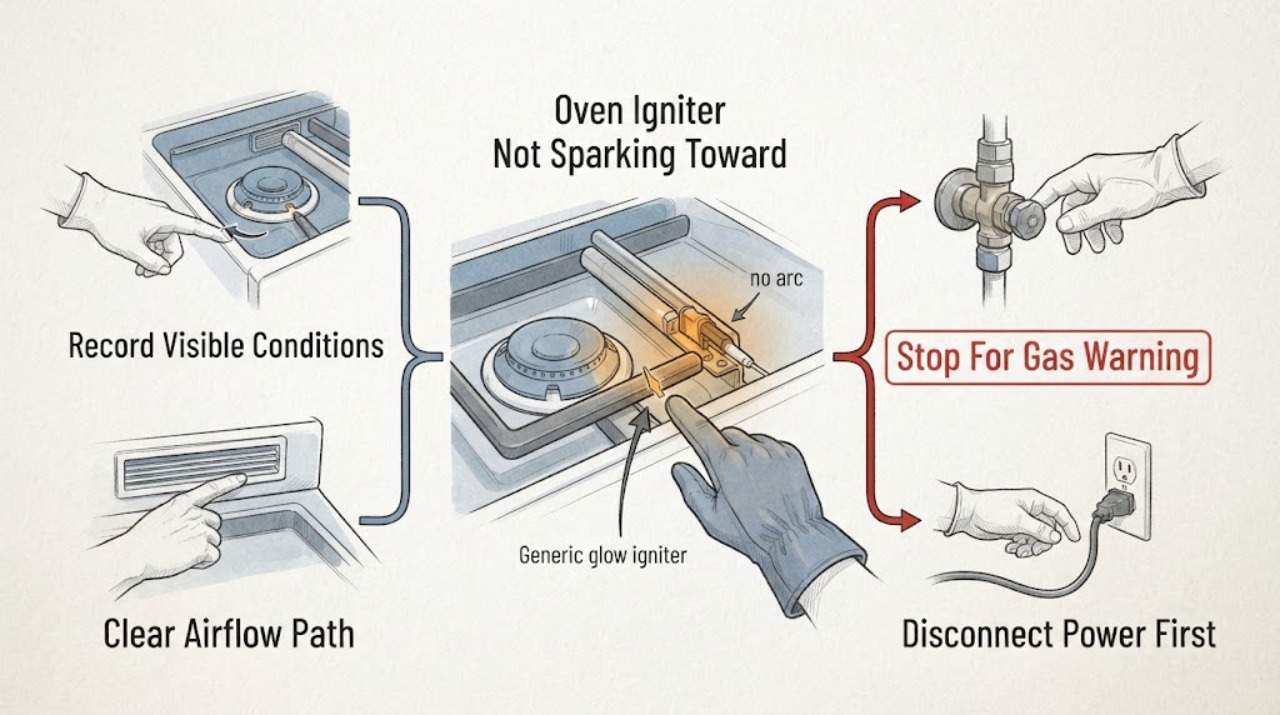
“Igniter not sparking toward gas” does not identify the ignition design or prove which internal part failed. Record the complete Whirlpool model number and separate a no-ignition symptom from a gas odor or delayed ignition. With no gas odor, keep the oven off while checking only safe external conditions: the door is fully closed, no foil or liner is blocking the oven bottom, the storage drawer is not packed against the oven, the accessible main gas valve is on, and the oven has a working grounded 120 V supply without an adapter or extension cord. If the oven was recently installed or reconnected, air in the gas line is a possible setup condition, but do not deliberately repeat ignition attempts. If you smell rotten-egg gas, hear hissing, feel ill, see delayed ignition or a flare/boom, stop immediately, leave the building, and call the gas supplier or emergency services from a safe location. Igniter, regulator, wiring and control work require model-matched qualified service.
Before you begin
Safety first
- Do not remove panels, probe live wiring, open gas compartments, bypass ignition or door safety devices, clean an internal burner, or keep retrying a gas appliance to reproduce the symptom.
Work through in order
Diagnostic checks
Use only checks that match the exact appliance or system and its official guide.
-
Check 1
With the oven off and cool, record the complete Whirlpool model number, whether the display is lit, whether the oven clicks, whether any flame appears, whether the cooktop works, and whether the complaint is no ignition, no heat, odor or delayed ignition.
Expected result: You can classify the visible symptom without removing a panel or reaching toward a burner.
Next step: Use the matching branch below and the exact model manual; do not repeat an ignition attempt to collect more evidence.
Why this matters
Why: These observations distinguish a general oven ignition complaint from a gas-safety event and from a model-specific ignition-design question; they do not identify a failed igniter.
-
Check 2
If there is a rotten-egg gas smell, hissing, headache, dizziness, a delayed ignition boom, a flare or gas that persists, stop using the appliance immediately. Do not light anything, touch switches, use a phone in the building or attempt another test.
Expected result: The warning sign is present or gas is suspected.
Next step: Leave the building and call the gas supplier or 911/fire service from a safe location or a neighbor’s phone.
Why this matters
Why: Whirlpool treats a suspected gas leak or unsafe gas condition as an emergency, not as an igniter troubleshooting branch.
-
Check 3
Only when no gas warning is present, confirm the oven door closes fully and look from the outside for foil, a liner or other material covering the oven bottom or visibly obstructing the oven opening.
Expected result: The door is fully closed and the oven bottom is unobstructed, or a blockage is visible.
Next step: Remove only a loose, accessible obstruction without touching the burner; if the path is clear and the symptom remains, stop external checks and arrange service.
Why this matters
Why: Whirlpool says the door and unobstructed oven/gas path affect operation; this check does not test an internal igniter.
-
Check 4
If the range has a storage drawer, inspect the visible drawer contents while the appliance is cool and remove only items that are visibly overpacked or pressing into the rear area; do not reach through the drawer or remove panels.
Expected result: The drawer is overloaded or clear.
Next step: Close the empty/clear drawer and use the exact model instructions; do not run repeated tests if the oven remains unlit or any gas odor appears.
Why this matters
Why: Whirlpool identifies overloaded storage-drawer contents as a possible interference condition for an oven that does not click; it does not prove a burner or igniter failure.
-
Check 5
Only if there is no gas odor and it is safe to do so, verify that the accessible main gas shutoff is on and that the oven power cord is in a working grounded 120 V outlet; do not use an adapter or extension cord.
Expected result: The gas valve is on and the outlet/power arrangement matches Whirlpool’s guidance, or a supply issue is found.
Next step: Correct only an obvious accessible setup condition; leave gas/electrical work to a qualified professional, and arrange model-matched service if the oven still will not ignite.
Why this matters
Why: A closed valve, failed outlet or missing ground can prevent operation, but a correct supply does not establish which internal ignition component is at fault.
-
Check 6
If the oven was just installed or reconnected, tell the installer or qualified servicer that the symptom began after reconnection; do not deliberately cycle the oven to purge the line.
Expected result: The appliance is new, recently moved or had gas service disconnected/reconnected.
Next step: Use the exact model installation guidance through the installer or qualified service; keep the oven off if ignition is abnormal or any odor persists.
Why this matters
Why: Whirlpool notes that air in a gas line can follow installation or reconnection, but resolving that condition is not a reason to perform repeated ignition tests.
-
Check 7
Arrange Whirlpool or qualified gas-appliance service when safe external checks do not restore normal ignition, the igniter is suspected, the oven lights late, the display faults, or the supply/grounding condition cannot be confirmed.
Expected result: The symptom persists or requires an internal ignition, regulator, wiring or control inspection.
Next step: Provide the full model number and the exact observed sequence; keep the appliance off for abnormal ignition, smoke, burning smell, gas odor or repeated breaker trips.
Why this matters
Why: The opened Whirlpool material supports service and model-specific documentation, not homeowner access to internal gas or electrical parts.
Use your observations
Decision map
Find the observation that best matches what you see, then follow the next safe action.
-
PATH 01Next step
What you see
There is no gas odor, the door is closed, and a visible foil/liner or storage-drawer obstruction is found.
Do this next
Remove only the accessible obstruction with the appliance cool, then use the exact model manual; if the oven still will not ignite, arrange service without repeated testing.
Why this path and its safety boundary
Why it matters: Whirlpool identifies these external conditions as possible causes of an oven that does not click or light; this is not proof of a failed igniter.
-
PATH 02Next step
What you see
The cooktop works but the gas oven does not click or light.
Do this next
Check only the accessible door, bottom and drawer conditions and the main valve/power arrangement; do not open the regulator or ignition system. Escalate persistent failure by model number.
Why this path and its safety boundary
Why it matters: Whirlpool notes that an oven-specific regulator shutoff or ignition/power path can differ from cooktop operation, and storage or airflow conditions can matter.
-
PATH 03Next step
What you see
The appliance was recently installed, moved or reconnected and there is no gas warning.
Do this next
Contact the installer or qualified servicer rather than repeatedly cycling ignition or attempting a gas-line repair.
Why this path and its safety boundary
Why it matters: Air in the gas line is a possible post-reconnection condition in Whirlpool’s general gas-oven guidance, but the task does not identify a model-specific purge procedure.
-
PATH 04Next step
What you see
A periodic whoosh is heard during normal operation, with no gas odor, delayed ignition or flame abnormality.
Do this next
If the oven heats normally and there is no unsafe symptom, record the model and observe normally; if ignition is late, fails, or odor appears, stop and arrange service.
Why this path and its safety boundary
Why it matters: Whirlpool says a whoosh as gas ignites can be normal on a range; the sound alone does not confirm that this no-spark complaint is resolved.
-
PATH 05Next step
What you see
Gas odor persists, gas smells rotten-egg-like, there is hissing, illness, a delayed boom or a flare.
Do this next
Do not light or switch anything and do not use a phone in the building; leave and call the gas supplier or emergency services from outside or a neighbor’s phone.
Why this path and its safety boundary
Why it matters: This is a gas-safety emergency and not a homeowner igniter diagnosis.
Helpful context
Understand the symptom
Clarify what the symptom proves
The phrase “not sparking towards gas” is not a Whirlpool model number or a documented universal code. It may describe an oven that never lights, an observation made through the oven opening, or a conclusion about the igniter. The model determines whether the oven uses a spark or hot-surface ignition design and which user checks are allowed. Record the model number, whether the display works, whether the oven clicks, whether any flame appears, how long gas is noticed, and whether the cooktop still works. Do not remove covers or watch the ignition system from inside the burner area.
Use the safe external branch
When there is no gas odor or other emergency sign, confirm that the door is fully closed and that foil or a liner is not covering the oven bottom. Remove only visibly overpacked items from the storage drawer if they can be taken out without reaching into the burner area. Whirlpool also directs owners to verify a working grounded 120 V outlet and the accessible main gas valve; do not use an adapter or extension cord and do not open electrical or gas compartments.
Know when the check ends
A newly installed or reconnected appliance can have air in the gas line, and Whirlpool mentions this as a possible reason for an oven not working. That is a setup/service issue, not permission to keep cycling the oven or to purge gas deliberately. If the external conditions are correct and the oven still will not ignite, the model-matched manual and qualified service must determine whether the ignition circuit, regulator, wiring or control needs attention.
Treat gas odor or delayed ignition as a stop condition
A rotten-egg smell, hissing, headache or dizziness, gas that continues after a brief preheat odor, a delayed “boom,” flare or flame outside its normal area changes the response. Do not light anything, touch switches, use a phone in the building, or repeat the test. Leave immediately and call the gas supplier or emergency services from a safe location. Whirlpool describes damaged ignition as a possible source of delayed ignition, but that does not make a component diagnosis safe for a homeowner.
When checks do not resolve it
Need a professional?
Request model-matched Whirlpool or qualified gas-appliance service when the oven still will not ignite after safe external checks, the igniter is suspected, ignition is delayed, or the symptom needs an internal regulator, wiring, control or burner inspection. Give the servicer the complete model number and the exact sequence observed.
Safety scope: Do not remove panels, probe live wiring, open gas compartments, bypass ignition or door safety devices, clean an internal burner, or keep retrying a gas appliance to reproduce the symptom.
Have this ready
- Provide the full model number, whether the display and cooktop work, whether the oven clicks, whether any flame appears, whether the oven was recently installed/reconnected, and whether there was odor, hissing, delayed ignition or a boom.
Common questions
FAQ
Does “not sparking toward gas” prove the Whirlpool igniter is bad?
No. The task has no model number and does not establish whether the oven uses spark or hot-surface ignition. Treat it as an oven-not-lighting symptom, record the exact model and use safe external checks; an internal ignition diagnosis belongs to qualified model-matched service.
What if the cooktop works but the gas oven will not ignite?
Whirlpool notes that oven and cooktop gas paths can differ. With no gas warning, check only the closed door, unobstructed oven bottom, accessible storage drawer and safe power/main-valve conditions. Do not open a regulator or ignition compartment; persistent failure needs service.
What should I do if I smell gas while investigating?
Stop. Do not light an appliance, operate switches or use a phone inside. Leave and call the gas supplier or emergency services from outside or a neighbor’s phone. Do not return to repeat the test until the situation is cleared.
Can a whoosh be normal?
Whirlpool says a periodic whoosh as gas ignites can be normal on a range, but a whoosh does not prove a no-spark complaint is safe. Delayed ignition, a boom, abnormal flame or gas odor requires immediate stop-use and service/emergency handling.
Read the exact guide
Official sources
- Oven Not Working - GasWhirlpool Product Help · Official general gas-oven support page; model number is still required for model-specific instructions.
- Oven Not Working - Cooktop Working - Not ClickingWhirlpool Product Help · Official gas-oven support page for the narrower cooktop-works/oven-does-not-click symptom; applied only to external door, foil/liner and storage-drawer checks.
- Why Does My Oven Smell Like Gas?Whirlpool · Official Whirlpool safety article; used for odor, delayed-ignition warning and emergency boundary, not for a model-specific igniter procedure.
- Oven Not Working - Gas and Dual Fuel RangeWhirlpool Product Help · Official range-level support page covering door, post-reconnection air, grounded outlet, main valve and service; it does not identify the task’s internal ignition type.
- Whirlpool Range User Instructions - Gas SafetyWhirlpool · Official Whirlpool-hosted gas-range safety instructions used only for the generic emergency response because the task has no exact model.
- Whoosh or Poof Noise in Oven - RangeWhirlpool Product Help · Official Whirlpool range-noise page used only to distinguish a periodic normal ignition whoosh from an unsafe delayed-ignition event.
Community feedback
Share a repair observation
Share a plain-text repair observation. Accepted observations are published automatically; this page may take a moment to update.