
On this page
Start here
Quick answer
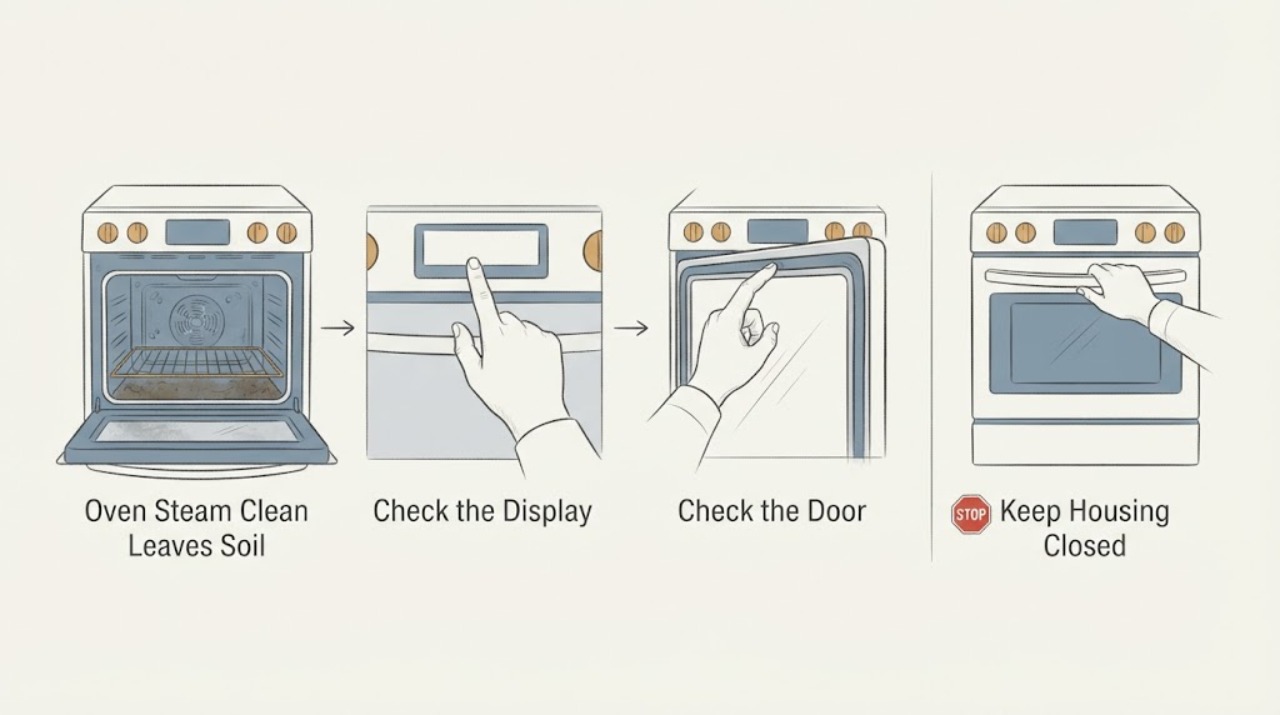
Whirlpool's Steam Clean or AquaLift-style cycle is intended to loosen light soil so it can be wiped away, not to make heavy baked-on residue disappear without manual cleaning. First confirm the exact model's cleaning instructions, allow the cavity to cool, remove racks and accessories, use only the water amount and placement specified for that model, and let the cycle finish before wiping the loosened soil with a soft or non-abrasive tool. Do not add oven cleaner, vinegar, baking soda, or another additive to a Steam Clean cycle, and do not mix cleaning chemicals. If your model has a separately documented high-temperature Self-Clean cycle, use it only as the owner's manual permits; otherwise keep to cool, manual-approved cleaning or arrange service for a cycle that will not start, heat, finish or unlock normally.
Work through in order
Diagnostic checks
Use only checks that match the exact appliance or system and its official guide.
-
Check 1
Read the complete Whirlpool model number from the rating plate and identify whether the control offers Steam Clean, AquaLift, Self-Clean, or another cleaning mode. Open the matching owner's manual or Whirlpool Product Help page before choosing a water amount, cycle or cleaner.
Expected result: The model has a documented Steam Clean/AquaLift procedure, a separately documented Self-Clean cycle, both, or neither can be confirmed.
Next step: Follow only the confirmed model procedure. If the model or cleaning mode cannot be identified, stop before adding water, chemicals or high heat and obtain the manual or qualified support.
Why this matters
Why: Whirlpool says the exact steam-clean process varies by model. A feature label alone does not establish that another Whirlpool model's water amount, temperature or cleaning product is safe for this oven.
-
Check 2
With the oven at room temperature, remove the racks and accessories that the exact manual says to remove. Inspect the cavity for loose crumbs and wipe only what is safely reachable with a damp cloth; do not scrape the coating, gasket or concealed heating area.
Expected result: The residue is fresh/light and loose, or it is a thick, dried or carbonized deposit that remains attached.
Next step: For light soil, continue with the model's documented steam cycle. For heavy soil, use only a manual-approved cool hand-cleaning method or a separately documented Self-Clean cycle; do not improvise with a scraper, spray or high heat.
Why this matters
Why: Whirlpool describes Steam Clean as a light-soil and minor-spill aid. Dried heavy residue is outside what that cycle alone is expected to remove and does not prove that the appliance is malfunctioning.
-
Check 3
Run Steam Clean only as the matching manual directs: use its specified water type, quantity and placement, close the door, and do not open the door while hot water or steam is present. Do not add oven cleaner, vinegar, baking soda or another additive to the Steam Clean cavity.
Expected result: The cycle starts and completes, refuses to start because the oven is still hot, or stops with a display message, no heat or no completion.
Next step: If the manual's conditions are not met, let the cavity cool and correct only the documented setup. If it is cool and correctly set but still will not start, heat or finish, stop repeated attempts and arrange Whirlpool service with the model and display state.
Stop if: Do not defeat a door lock, pour water into an unapproved location, or open the hot cavity to inspect it.
Why this matters
Why: Whirlpool's general Product Help instructions require room-temperature conditions, no additives and model-specific water instructions; they also state that a hot cavity can prevent activation. A failure to start or complete is a cycle or appliance issue, not a reason to add more chemicals or water.
-
Check 4
After the cycle has fully ended and the cavity is completely cool, wipe out loosened water and soil with a damp cloth or the non-abrasive tool allowed by the exact manual. Keep any separately permitted hand-cleaning product out of the Steam Clean cycle and never mix products.
Expected result: The residue wipes away, remains as a thin film, or remains hard-baked after the permitted cool wipe-down.
Next step: Repeat only the manual-approved cool cleaning interval or use the model's separately documented Self-Clean option if appropriate. If the manual forbids the needed product or the surface/coating is damaged, stop and request service.
Why this matters
Why: Whirlpool says steam softens soil and requires wiping afterward; a remaining hard deposit means more model-approved manual cleaning or a documented deep-clean cycle may be needed. It does not identify a failed part.
-
Check 5
Stop and arrange qualified service if the oven will not start or finish a documented cleaning cycle, shows an unexpected hot/lock condition, produces smoke or an unusual chemical odor, has damaged coating or gasket, or the door will not operate normally. Do not remove panels or troubleshoot wiring, sensors or locks.
Expected result: The oven has a repeatable control, heat, door, lock, smoke, odor or visible-damage problem beyond residue that can be wiped from a cool cavity.
Next step: Keep the oven off until safe, record the exact model and display behavior, and contact Whirlpool or a qualified appliance technician. If there is active smoke or fire, use local emergency/fire guidance.
Stop if: Do not keep restarting the cycle, bypass a lock, spray into a hot oven or remove the outer cover.
Why this matters
Why: The symptom has crossed from cleaning effectiveness into an appliance or safety condition. Public cleaning instructions do not identify an internal component or authorize user-level repair.
Use your observations
Decision map
Find the observation that best matches what you see, then follow the next safe action.
-
PATH 01Next step
What you see
The model manual confirms Steam Clean/AquaLift, the cycle completes, and the remaining soil is light or softened but still visible.
Do this next
Wait for complete cooling and wipe with the manual-approved soft or non-abrasive method. Keep cleaners and additives out of the Steam Clean cycle.
Why this path and its safety boundary
Why it matters: This is consistent with the intended function: the cycle loosens light residue and the user must wipe the cool cavity afterward; it is not evidence of a failed oven part.
-
PATH 02Next step
What you see
The residue is thick, carbonized or baked onto the walls/door after a correctly completed Steam Clean cycle.
Do this next
Use only a separately documented Self-Clean cycle if the exact model has one and its manual permits it, or use the manual's cool hand-cleaning method. Do not invent a high-heat or chemical workaround.
Why this path and its safety boundary
Why it matters: Whirlpool distinguishes light steam cleaning from a deeper self-clean cycle. The soil level exceeds what Steam Clean alone is intended to remove.
-
PATH 03Next step
What you see
The oven is cool and correctly prepared but Steam Clean will not start or finish, the door/lock behaves abnormally, smoke or an unusual chemical odor appears, or the cavity coating/gasket is damaged.
Do this next
Stop repeated cycles, keep the oven out of service as appropriate and arrange Whirlpool or qualified service. For active smoke or fire, leave the area and use emergency/fire guidance.
Why this path and its safety boundary
Why it matters: The issue is no longer just cleaning performance; an appliance or safety fault is possible and cannot be narrowed to a component from public cleaning guidance.
Helpful context
Understand the symptom
Why steam cleaning can look ineffective
Whirlpool separates routine steam cleaning from a deeper self-clean cycle. Steam uses heat and water to soften light grime or minor spills, while heavier baked-on residue can need manual wiping or, only on models that document it, a separate Self-Clean cycle. Soil that has dried for a long time is harder to remove, so poor results do not by themselves prove a failed heater, sensor or control.
Treat the model manual as the boundary
Whirlpool's public Steam Clean instructions show that the water amount, timing and cavity design are model-dependent. The assigned topic has no model number, so do not copy a cup or 12-ounce measure, a temperature, or an AquaLift procedure to an unidentified oven. Use the full model from the rating plate to select the matching manual before adding water or choosing another cleaning mode.
Keep chemicals and heat controlled
Whirlpool's Product Help page explicitly says not to use oven cleaners or other additives with Steam Clean. A hand-cleaning method may be allowed by a particular manual, but it must stay separate from the steam cycle and must use only the documented, non-abrasive method. Never combine cleaners, spray an unknown product into the cavity, or use a high-temperature cycle as an improvised substitute.
Common questions
FAQ
Why does Whirlpool Steam Clean leave baked-on spots behind?
Whirlpool describes Steam Clean as a lower-temperature routine cycle that softens light grime and minor spills so they can be wiped away. Thick or dried residue may need the manual-approved cool hand-cleaning method or a separately documented Self-Clean cycle on models that have one.
Can I add oven cleaner, vinegar or baking soda to Steam Clean?
Do not add oven cleaner or another additive to the Steam Clean cycle. Whirlpool's Product Help warning says not to use oven cleaners or other additives with Steam Clean. Keep any separately permitted hand-cleaning method outside the cycle and never mix cleaning products.
Can I copy Whirlpool's water amount from another oven?
No. Whirlpool says the exact process varies by model, and the Product Help instructions apply to a documented feature context. Read the complete model manual before adding water or choosing where it goes.
When is poor cleaning a service problem instead of a soil problem?
Arrange service when the exact documented cycle will not start, heat, finish or unlock normally, or when there is smoke, unusual chemical odor, visible coating or gasket damage, or abnormal door behavior. Do not open panels or bypass a lock to investigate.
Read the exact guide
Official sources
- Steam Cleaning the OvenWhirlpool · Model-family support for a Whirlpool Steam Clean feature; exact model instructions remain controlling.
- How to Clean an Oven Inside and Out | WhirlpoolWhirlpool · General cool-cavity hand-cleaning and rack-care guidance; do not transfer products to a Steam Clean cycle without the exact manual.
- Self-Clean vs. Steam-Clean Ovens: How to Choose | WhirlpoolWhirlpool · General distinction between light steam cleaning and deeper self-cleaning; exact model feature and safety instructions still control.
- Steam Clean Ovens: How to Clean Your Oven With Steam | WhirlpoolWhirlpool · General Whirlpool explanation of light-soil limits, model-specific procedure and cool wipe-down; not a substitute for an unidentified model's manual.
Community feedback
Share a repair observation
Share a plain-text repair observation. Accepted observations are published automatically; this page may take a moment to update.