
On this page
Start here
Quick answer
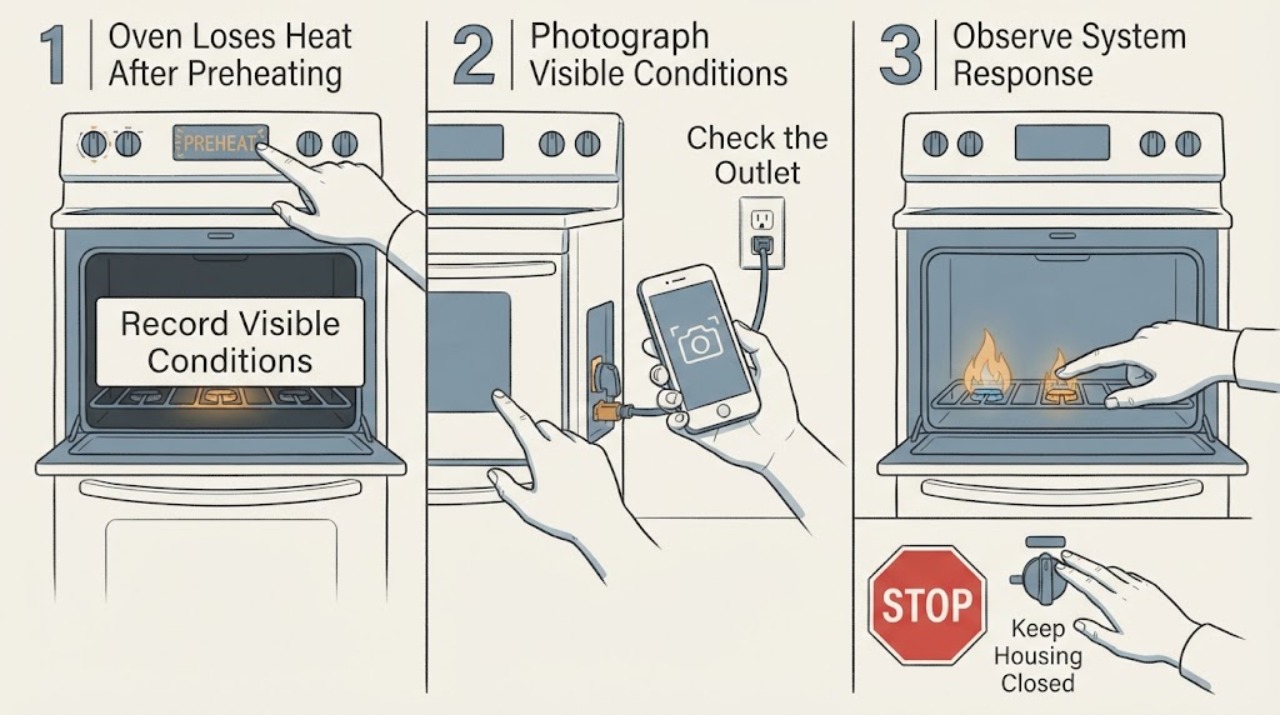
The Whirlpool WFGS7530RZ0 is a smart gas range in the WFGS7530R family, so reaching preheat once does not prove that the oven can maintain temperature. Gas ovens normally cycle heat, but an oven that quickly falls toward room temperature and rarely reignites needs a reproducible service diagnosis. First document the actual temperature with an oven thermometer, the selected Bake or Air Cooking mode, whether the display and timer remain active, and whether the burner visibly reignites only from a safe position. Because this is a new-build installation, also have the installer or qualified technician verify the grounded, correctly polarized electrical supply and the gas shutoff/regulator/connection; Whirlpool's installation instructions make grounding, polarity, gas connections, and qualified installation part of the safety boundary. Do not move the range, open a gas fitting, adjust pressure, bypass ignition, or relight repeatedly after odor, delayed ignition, a boom, smoke, or abnormal flame.
Before you begin
Safety first
- Owner checks are limited to recording the exact model and temperature pattern, using an oven thermometer, confirming visible mode/timer state, checking an accessible breaker or outlet from a dry safe position, and noting the accessible gas-supply state without moving or opening the range. Do not move the range, open gas fittings, adjust pressure, remove panels, bypass ignition or door safety, or make live electrical or combustion tests.
Work through in order
Diagnostic checks
Use only checks that match the exact appliance or system and its official guide.
-
Check 1
With the oven cool and no gas or fire warning present, place an oven thermometer where it can be read without reaching into a hot cavity. Record the starting temperature, the selected mode and set point, the time preheat completes, and the temperature after 10–15 minutes of normal closed-door operation. Do not use the test to justify opening the door repeatedly.
Expected result: The oven reaches the target area and cycles normally; it reaches preheat then falls rapidly and does not recover; it remains cold; or the thermometer and display disagree.
Next step: Stop the single observation if heat is not maintained or any odor, smoke, unusual flame, or electrical symptom appears. Save the temperature/time record and arrange qualified Whirlpool service; do not repeat cycles to force a failure.
Stop if: Do not touch the burner, open a hot door to inspect the flame, or place a thermometer near wiring or the burner opening.
Why this matters
Why: A normal cycle is different from a rapid loss of heat after preheat. A repeatable fall with no recovery supports a service investigation of ignition, gas delivery, temperature sensing, control, or installation rather than an assumption that the range is merely energy-efficient.
-
Check 2
Before another heating attempt, photograph the full model and serial label and write down the exact mode—Bake, Air Bake, Air Roast, Broil, No Preheat Air Fry, or another menu choice—the set temperature, timer state, remote-start state if used, and whether the display remains active after preheat.
Expected result: Only one mode fails; several modes fail; the timer or remote mode changes the result; the display goes blank; or the controls remain active while the cavity loses heat.
Next step: Use only the exact WFGS7530RZ0-family manual for a visible timer or mode correction, then make no more than one controlled observation. If the same temperature loss returns, stop using the oven and request service.
Stop if: Do not enter hidden diagnostics, bypass the timer or door switch, or leave the range running unattended to collect more evidence.
Why this matters
Why: Whirlpool lists multiple modes with different airflow and heating behavior. A mode-specific failure can narrow the service conversation, while a display or timer change may indicate a control-state issue; none of these observations selects a component by itself.
-
Check 3
From a dry, safe position, check only the accessible electrical state: whether the range display is alive, whether the breaker has tripped, and whether the range is connected to its proper grounded outlet without an adapter or extension cord. Do not remove a cover or probe the outlet or range terminals.
Expected result: The display is dead or flashing; the breaker or GFCI has tripped; the outlet, ground, or connection is uncertain; or the display and power appear normal.
Next step: For an uncertain, wet, damaged, or repeatedly tripping supply, stop and use a qualified electrician or appliance installer. If power is normal, continue to the installation gas-supply check without opening the range.
Stop if: Do not reset a breaker repeatedly, substitute an adapter, use an extension cord, or make energized electrical measurements.
Why this matters
Why: Whirlpool states that the electronic ignition system requires proper grounding and polarity and warns against adapters and extension cords. A live display does not prove that the ignition or heating circuit has the correct supply, while a recurring trip is an electrical fault signal.
-
Check 4
If there is no gas odor and the range is not being moved, note whether the accessible household gas shutoff is intended to be open and whether the range was recently connected, converted, or serviced. Do not touch the regulator, disconnect the connector, loosen a fitting, or move the range to inspect behind it.
Expected result: The new-build range was recently connected or converted; the accessible shutoff state is unknown or abnormal; the cooktop works while the oven loses heat; or the installation appears normal.
Next step: Ask the builder, gas installer, or authorized Whirlpool technician to verify the installation and oven ignition path. Keep the range off if the supply is abnormal or uncertain.
Stop if: Do not open gas fittings, adjust pressure, move the range, apply a flame to a connection, or repeat ignition after a delayed ignition or gas odor.
Why this matters
Why: Whirlpool treats gas supply, regulator, connector, pressure, and electronic ignition as installation-dependent. A working cooktop does not prove that the oven burner can safely receive and re-ignite gas, and an unknown installation state cannot be diagnosed by cycling the oven.
-
Check 5
From outside the closed oven, note only whether ignition is immediate and quiet, whether the burner appears to reignite during a normal cycle, and whether there is a delayed whoosh, boom, soot, smoke, abnormal flame, or gas odor. Do not open the door during ignition or remain nearby to watch a hazardous event.
Expected result: The oven ignites and cycles normally; it preheats but does not visibly or audibly re-ignite while temperature falls; ignition is delayed or abnormal; or ignition cannot be observed safely.
Next step: End the test after one safe observation. For persistent temperature loss, provide the record to qualified Whirlpool service; for odor, delayed ignition, boom, smoke, soot, abnormal flame, or a carbon-monoxide alarm, leave the area and contact the gas supplier or emergency service from a safe location.
Stop if: Do not relight repeatedly, inspect under the burner, remove panels, or test the gas valve, igniter, sensor, or board yourself.
Why this matters
Why: A repeatable failure to recover heat after preheat is different from normal cycling and needs service assessment of the ignition, gas, temperature-sensing, and control path. Delayed ignition or combustion warning signs are safety events, not diagnostic opportunities.
Use your observations
Decision map
Find the observation that best matches what you see, then follow the next safe action.
-
PATH 01Next step
What you see
The oven reaches preheat but repeatedly loses measured heat and does not recover, while the display and selected mode remain active.
Do this next
Stop repeated cooking tests, preserve the temperature/time and mode record, and request Whirlpool service with the exact model and new-build installation details. Do not replace an igniter or sensor from the symptom alone.
Why this path and its safety boundary
Why it matters: This matches the important symptom pattern reported for the exact WFGS7530RZ0 and is not explained by one normal preheat or by the range's efficiency claim alone. Ignition, gas delivery, temperature sensing, electronic control, or installation can remain in the service differential.
-
PATH 02Next step
What you see
The oven warms and maintains temperature after a visible timer/mode correction, with no gas, combustion, or electrical warning.
Do this next
Use the exact manual's normal mode and timer procedure, monitor one normal cooking cycle, and request service if the temperature loss returns.
Why this path and its safety boundary
Why it matters: A control-state or operating-mode issue becomes more plausible than a proven hardware failure, although one successful cycle does not certify the range.
-
PATH 03Safety boundary
What you see
The new-build outlet, grounding/polarity, gas shutoff, regulator, connector, or installation history is unknown, abnormal, or recently changed.
Do this next
Keep the oven out of use and ask the builder, gas installer, or authorized Whirlpool technician to verify the installation and document the result before parts are selected.
Why this path and its safety boundary
Why it matters: The installation path is unresolved. Whirlpool requires qualified handling of the grounded electrical supply and gas connection, so an owner cannot safely distinguish installation error from an internal ignition or control fault.
Safety stop: Do not move the range, open fittings, adjust pressure, or make live electrical tests.
-
PATH 04Safety boundary
What you see
Gas odor, delayed ignition, a boom or whoosh, soot, smoke, abnormal flame, carbon-monoxide alarm, arcing, hot wiring, or repeated breaker operation occurs.
Do this next
Stop using the range and leave the area as appropriate without operating switches or ignition sources. Contact the gas supplier, emergency services, or qualified electrical help from a safe location.
Why this path and its safety boundary
Why it matters: This is a gas, combustion, fire, carbon-monoxide, or electrical emergency boundary, not a preheat troubleshooting branch.
Safety stop: Do not remain near the range to reproduce the event or attempt an internal inspection.
Helpful context
Understand the symptom
The important symptom is not simply “the oven is hot” or “the oven is cold.” The exact-model community report describes a new-build WFGS7530RZ0 that reaches preheat, then often fails to reignite and quickly loses heat, while occasionally working normally. That is a useful pattern to document, not proof of a particular igniter, sensor, valve, or board failure. The same Whirlpool range family offers several cooking modes, so record the exact mode and cavity behavior rather than comparing an Air Cooking mode with Bake as if they were identical.
A new-build installation adds a separate gate: Whirlpool's manual states that electronic ignition depends on correct grounding and polarity, and that the gas connection, shutoff, regulator, and pressure installation require qualified handling. A working cooktop or a single successful preheat does not certify the oven's supply or re-ignition path. Treat the appliance as a gas-and-electrical system; do not open the rear, move the range, adjust gas pressure, or reproduce a hazardous ignition event.
Only after diagnosis
Potential parts
- gas oven ignition or burner ignition assembly
Consider only if a qualified technician reproduces the failed re-ignition and confirms an ignition component fault after the gas and electrical installation are verified.
Confirm the exact WFGS7530RZ0 suffix, gas type, service diagnosis, and part fitment before ordering; do not treat a single failed cycle as proof. - oven temperature sensor or electronic control
Consider only when service testing supports a sensing or control fault after the oven's measured temperature, ignition behavior, grounding, and gas supply are checked.
Do not select a sensor or control from temperature loss alone; verify exact model and technician findings.
When checks do not resolve it
Need a professional?
Use Whirlpool appliance service for repeated heat loss after preheat, failure to reignite, mode-dependent no-heat, an unresolved display/timer issue, or any internal ignition, burner, sensor, control, wiring, regulator, or valve concern. Use the builder or qualified gas installer for new-build connection, regulator, shutoff, gas-type, or pressure questions; use qualified electrical help for grounding, polarity, outlet, or repeated breaker concerns.
Safety scope: Owner checks are limited to recording the exact model and temperature pattern, using an oven thermometer, confirming visible mode/timer state, checking an accessible breaker or outlet from a dry safe position, and noting the accessible gas-supply state without moving or opening the range. Do not move the range, open gas fittings, adjust pressure, remove panels, bypass ignition or door safety, or make live electrical or combustion tests.
Have this ready
- Provide WFGS7530RZ0, full serial and market, new-build and installation date, gas type if known, measured temperature and time after preheat, selected mode and timer/remote state, display behavior, whether the cooktop works, whether reignition was seen, and any odor, delay, sound, flame, smoke, carbon-monoxide, or breaker symptom.
Common questions
FAQ
Is it normal for a Whirlpool gas oven to lose heat after preheating?
Gas ovens can cycle heat, but a measured rapid fall toward room temperature with no recovery is not explained by one successful preheat. Document the mode, temperature, timing, and ignition behavior, then arrange service rather than accepting the symptom as efficiency without a diagnosis.
Could a new-build installation cause the WFGS7530RZ0 oven to lose heat?
It can affect the diagnostic path. Whirlpool requires a correctly grounded and polarized electrical circuit for electronic ignition and qualified gas-supply, shutoff, regulator, and pressure installation. Have the builder or qualified installer verify those conditions; do not move the range or adjust gas components yourself.
Does a working cooktop prove the oven gas supply and ignition are good?
No. The cooktop and oven can have different gas delivery and ignition behavior. A working cooktop does not rule out an oven burner, re-ignition, sensor, control, regulator, or installation issue, so report the oven's measured temperature pattern separately.
Can I replace the igniter or sensor based on this symptom?
Not safely from the symptom alone. A repeated post-preheat heat loss can involve ignition, gas delivery, temperature sensing, control, grounding, or installation. Have qualified service reproduce and diagnose it before selecting a component.
Read the exact guide
Official sources
- Freestanding Gas Range Owner's Manual — WFGS7530R familyWhirlpool · Opened the official Whirlpool owner and installation manual used for the WFGS7530R family, including the WFGS7530RZ0 task variant. It provides the grounded/polarized electrical requirement for electronic ignition, qualified gas-supply and regulator boundary, shutoff access, and installation safety conditions.
- 30-inch Smart Gas Range with Air Cooking Technology, No Preheat Air Fry, Steam/Self Clean and High Speed Preheat — WFGS7530RZWhirlpool · Opened Whirlpool's official product page for the WFGS7530R family. It identifies the smart gas range, its ten cooking modes, Air Cooking features, and the WFGS7530RZ product suffix; the exact WFGS7530RZ0 serial suffix must remain with the service request.
- Whirlpool oven won't keep temperatureReddit r/appliancerepair · Exact Reddit post opened because it names WFGS7530RZ0 and a new-build home. It is used only to preserve the reported symptom pattern and does not establish the cause or a repair outcome.
Community feedback
Share a repair observation
Share a plain-text repair observation. Accepted observations are published automatically; this page may take a moment to update.