
On this page
Start here
Quick answer
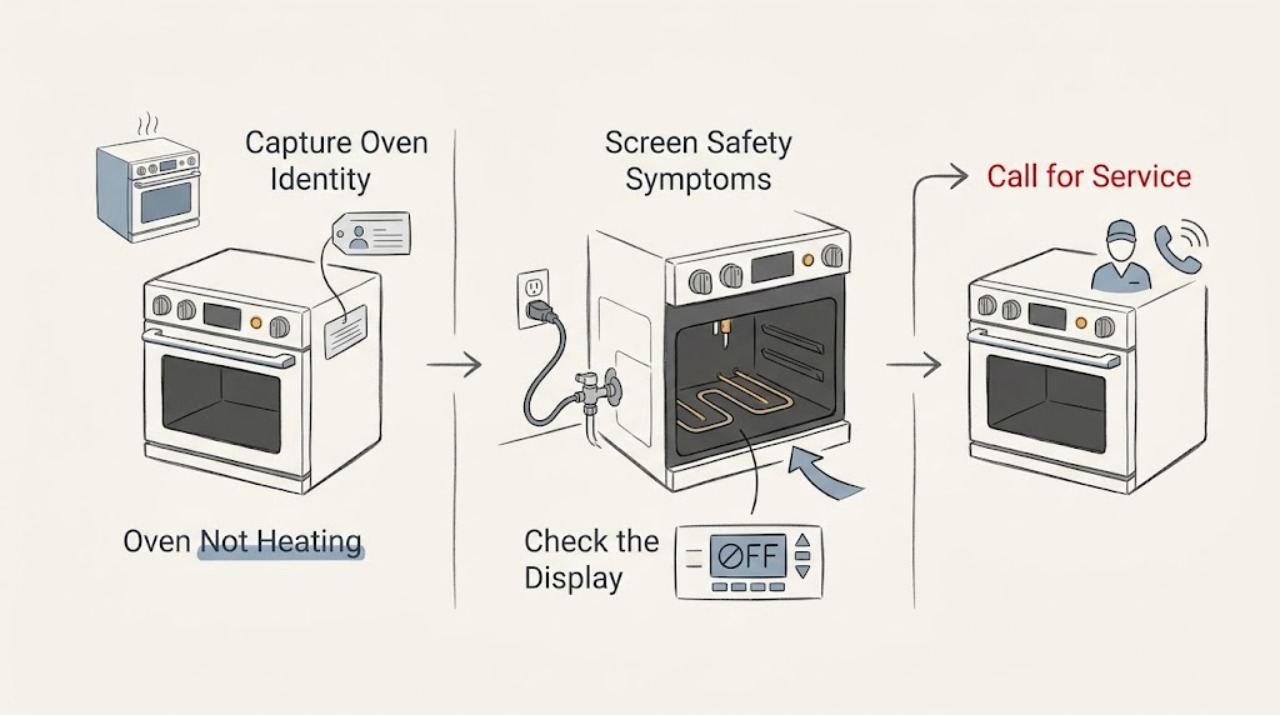
A Whirlpool oven that is not heating needs a fuel-type and symptom split before any part is suspected. Confirm whether it is electric, gas, or dual fuel, then record whether the display works, whether a normal mode and temperature were selected, whether the door closes, whether preheat is merely slow, and whether an error is shown. With no hazard signs, check only the accessible control, door, power, gas-supply, and airflow conditions supported by the exact Whirlpool guidance. A gas odor, delayed whoosh or boom, abnormal flame, smoke, burning odor, carbon-monoxide alarm, electrical arcing, repeated trip, or heating that will not stop is an immediate stop condition. Do not open panels, test an element or igniter, adjust gas hardware, or bypass a lock; use qualified appliance, gas, or electrical service.
Work through in order
Diagnostic checks
Use only checks that match the exact appliance or system and its official guide.
-
Check 1
Record the Whirlpool model, oven cavity, electric, gas, or dual-fuel identity, selected mode, temperature setting, display state, error text, and whether the cavity is cold, warm, or eventually reaches heat.
Expected result: The display is blank or flashing, responds normally, shows a control message or complete code, or shows a normal mode while the cavity remains cold.
Next step: Use the exact Whirlpool manual and matching Product Help page. If the event included an unsafe sign, keep the oven off and arrange service instead of reproducing it.
Stop if: Do not start another cycle solely to make an unreadable code reappear.
Why this matters
Why: The fuel type and symptom stage determine whether the next branch concerns supply, controls, element, ignition, sensor, or preheat behavior. A partial code or wrong manual can send the diagnosis to the wrong path.
-
Check 2
Before any power or heating check, note from a safe position whether there is gas odor, hissing, delayed ignition, a whoosh or boom, abnormal flame, soot, smoke, burning odor, a carbon-monoxide alarm, visible arcing, a hot cord or connection, uncontrolled heat, or a repeated breaker trip.
Expected result: One or more gas, combustion, smoke, heat, carbon-monoxide, or electrical warning signs is present, or the oven heats when it should be off.
Next step: Stop using the oven. For suspected gas danger leave immediately without operating switches or ignition sources and contact the gas supplier or emergency service from a safe location. For smoke, flame, or arcing use the local fire and electrical emergency route.
Stop if: Do not reset, relight, open a hot door to inspect, search for a leak, move the appliance, or remain nearby to watch it.
Why this matters
Why: An active gas, fire, carbon-monoxide, or electrical hazard overrides routine troubleshooting. Delayed ignition can allow unburned gas to collect before ignition.
-
Check 3
If no hazard sign exists and the oven is cool, compare the display with the exact manual; confirm the intended Bake, Broil, or other mode, temperature, clock, delayed start, Control Lock or Sabbath setting when applicable, and that the door closes fully without forcing it.
Expected result: The oven is locked, delayed, in a special mode, missing a clock setting after power loss, has a door that is not fully closed, or has normal controls but no heat.
Next step: Apply only the manual's documented control or clock action. If the door, lock, or control does not respond normally, stop and arrange qualified appliance service.
Stop if: Do not force the door, bypass a lock, or enter hidden diagnostics.
Why this matters
Why: A control state or door condition can prevent a cycle without proving a failed element, igniter, or control. Normal controls with no heat shift the path to supply or service evidence.
-
Check 4
Without opening panels, check whether the display or clock shows a power interruption and whether an accessible breaker or fuse is abnormal; for a gas range, confirm only from a safe position that the control has a grounded operational supply as the exact guidance requires.
Expected result: The display is blank or flashing, a breaker has tripped, the outlet or grounding is uncertain, a power code appears, or power appears normal while the oven remains cold.
Next step: If no hazard exists, follow the model manual for one safe breaker check. Use qualified electrical service for uncertain supply, wiring, grounding, or a circuit that trips again.
Stop if: Do not use an adapter or extension cord, remove a cover, probe terminals, or perform energized electrical checks.
Why this matters
Why: Whirlpool's electric and gas guidance treats power, grounding, and the heating or ignition path as separate checks. A live display does not prove that every heating circuit is healthy.
-
Check 5
For a confirmed gas or dual-fuel model with no current odor, observe only the accessible main gas supply state and whether the range was recently installed or reconnected; do not move the appliance or touch the pressure regulator, connector, burner, or valve internals.
Expected result: The gas supply is intentionally off, the range was recently reconnected, the cooktop works but the oven remains cold, or the accessible supply state appears normal.
Next step: Follow only the matching model's safe installation or operation guidance. If gas supply is abnormal, the oven clicks without heat, or the source is uncertain, arrange qualified gas-appliance service.
Stop if: Do not open gas fittings, move the range, adjust pressure, or repeat ignition after odor or delayed ignition.
Why this matters
Why: Whirlpool notes that trapped air after reconnection and a separate regulator shutoff can affect oven gas delivery, even when a cooktop may work. These observations do not authorize gas adjustment.
-
Check 6
With no hazard sign and the oven cool, compare the observed delay with the exact Whirlpool manual and inspect only visible conditions: unused racks, an open door during preheat, food or pans blocking airflow, or foil or a liner covering the oven bottom or rack.
Expected result: The oven eventually warms, preheat is merely slow, the door was left open, unused racks or crowded pans are present, or foil or a liner blocks airflow; alternatively the cavity stays cold.
Next step: Correct only a visible condition permitted by the manual and monitor normal operation once. If the oven stays cold or a hazard sign appears, stop and call qualified service.
Stop if: Do not cover the oven floor, remove hidden elements, open gas components, or continue a cycle with odor, smoke, abnormal flame, or uncontrolled heat.
Why this matters
Why: Whirlpool identifies racks, door use, pan placement, oven design, and airflow as performance factors. A cavity that remains cold after normal settings is different from a longer preheat and needs component or supply diagnosis.
-
Check 7
If a complete error display accompanies no heat, search Whirlpool Product Help with every character and the exact model, then apply a reset only when the matching page permits it and no gas, smoke, heat, or electrical hazard exists.
Expected result: There is an exact model page, only a broad code family, or no match; after the documented one-minute power removal the code clears, returns, or the display does not recover.
Next step: Use only the matching low-risk instruction. If the code returns, the oven remains cold, or operation is abnormal, keep it off and give the complete code and model to qualified service.
Stop if: Do not repeat resets, enter diagnostics, test a component, or keep operating a tripping or overheated oven.
Why this matters
Why: Whirlpool publishes model-specific code guidance and a limited reset procedure for selected conditions. A reset cannot identify a bad element, igniter, sensor, or gas component and cannot make an active hazard safe.
-
Check 8
For a returning, unexplained, or unsafe no-heat result, leave the oven off and prepare the exact model and serial information, fuel type, cavity, mode, temperature, display, power and gas observations, preheat behavior, and any odor, flame, smoke, arc, heat, or trip history for qualified service.
Expected result: The symptom is reproducible, intermittent, tied to one mode or cavity, follows an outage or reconnection, affects only gas or electric heating, or cannot be safely reproduced.
Next step: Keep the oven out of service until qualified service identifies the cause and confirms safe operation. Use gas or emergency assistance first after a gas or combustion event.
Stop if: Do not remove panels, bypass an interlock, adjust gas pressure, or replace a part from the symptom alone.
Why this matters
Why: The history helps service separate a control, sensor, element, igniter, burner, valve, wiring, door, or supply branch without asking the user to open the appliance.
Use your observations
Decision map
Find the observation that best matches what you see, then follow the next safe action.
-
PATH 01Next step
What you see
Gas odor, hissing, delayed ignition, a whoosh or boom, abnormal flame, soot, smoke, a carbon-monoxide alarm, or related symptoms are present.
Do this next
Stop using the oven and leave immediately for suspected gas or combustion danger without operating switches or ignition sources. Contact the gas supplier or emergency service from a safe location and arrange qualified service before reuse.
-
PATH 02Next step
What you see
Smoke, visible arcing, electrical crackle, burning odor, a hot connection, uncontrolled heat, or repeated breaker trips are present.
Do this next
Stop use and keep clear. Isolate power only from a dry safe position when possible, use the local fire route for smoke or flame, and arrange qualified electrical or appliance service. Do not reset and retest.
-
PATH 03Next step
What you see
The display shows a documented lock, delay, clock, Sabbath, or other control state, or the door is not fully closed, with no hazard sign.
Do this next
Use the exact Whirlpool manual's documented control or clock action and close the door normally. Escalate if the state persists or the oven remains cold.
-
PATH 04Next step
What you see
The display is blank or flashing, a power code appears, the breaker trips, or supply and grounding are uncertain.
Do this next
Follow the exact manual for one safe breaker check only when no hazard exists. Use qualified electrical service for uncertain supply or another trip.
-
PATH 05Next step
What you see
A confirmed gas or dual-fuel oven remains cold or clicks without stable heat while the accessible control state appears normal.
Do this next
Stop the ignition check and arrange qualified gas-appliance service. Do not adjust gas hardware, move the range, or relight repeatedly; use emergency handling first for odor or delayed ignition.
-
PATH 06Next step
What you see
The oven eventually warms and the only issue is a longer preheat with normal controls and no hazard sign.
Do this next
Check the manual's rack, door, pan, room, oven-design, and airflow factors. If performance remains abnormal after the permitted visible changes, request service rather than guessing an element or sensor.
-
PATH 07Next step
What you see
The oven remains cold after normal controls, accessible supply checks, and a model-permitted single reset, or a code returns.
Do this next
Keep the oven off and provide the exact model, fuel type, mode, code, and observations to qualified appliance service. Heating element, igniter, sensor, control, burner, valve, wiring, or supply work is not a user-level repair.
-
PATH 08Next step
What you see
A supported check clears the display and normal operation has no odor, smoke, arc, abnormal flame, uncontrolled heat, or repeat trip.
Do this next
Record what changed and use the oven only as directed. Stop and request service if no heat, a code, or an unsafe symptom returns.
Helpful context
Understand the symptom
First decide whether it is slow or truly cold
A longer preheat is not the same as no heat. Whirlpool says preheat depends on oven design, desired temperature, room conditions, racks, door use, and airflow. Record whether food eventually warms, whether the display reaches the set point, and whether the oven is cold throughout. Do not use a guessed part or a generic code definition to bridge those different symptoms.
Fuel type controls the diagnostic path
An electric model uses heating elements and a high-power supply; a gas model uses gas delivery and ignition plus electrical controls; a dual-fuel model may combine both. Confirm the model documentation before applying a check. The user-level boundary is the same: visible damage, smoke, gas odor, abnormal flame, arcing, or a circuit that trips means stop and escalate.
Keep internal heating work professional
A sensor, element, igniter, burner, valve, control, or wiring harness can produce similar no-heat symptoms. Do not remove panels, probe terminals, bypass a door interlock, adjust gas pressure, or relight a burner repeatedly. A qualified appliance technician or electrician can match the fault to the exact Whirlpool model safely.
Only after diagnosis
Potential parts
- electric oven heating element
Consider only after qualified diagnosis confirms an electric model and identifies the element as the cause of the no-heat result.
Confirm the exact Whirlpool model, cavity, element style, and electrical rating before ordering; a cold oven alone does not establish fit. - gas oven igniter or burner ignition assembly
Consider only after qualified diagnosis confirms a gas model and links absent or delayed heat to the model-specific ignition assembly.
Gas-path and ignition work requires qualified service and exact model matching. Do not replace this part after odor, smoke, or delayed ignition by guesswork. - oven temperature sensor or electronic control
Consider only when model-specific qualified diagnosis identifies a sensor or control fault after supply, mode, door, and heating-path checks.
Match the exact model, cavity, and control generation. Do not perform energized checks or infer compatibility from an error family.
When checks do not resolve it
Need a professional?
Contact qualified Whirlpool appliance service for an oven that stays cold after safe checks, a returning or unexplained code, a failed element or igniter indication, control or door failure, or any condition beyond the exact manual. Use qualified electrical service for supply or grounding concerns and gas or emergency assistance first for gas odor, delayed ignition, a boom, smoke, a carbon-monoxide alarm, or symptoms.
Have this ready
- Provide the exact model and serial information, cavity, fuel type, mode, temperature, complete display, preheat behavior, power and gas observations, and safe notes about odor, flame, smoke, heat, sound, arcing, and trips.
Common questions
FAQ
Why is my Whirlpool oven not heating even though the display works?
A live display does not prove that the correct mode, door interlock, high-power supply, electric element, gas supply, igniter, or sensor path is working. Confirm the model and fuel type, perform only safe accessible checks, and use qualified service for a cold oven.
Could a long preheat be mistaken for no heat?
Yes. Whirlpool identifies oven design, desired temperature, racks, door use, room conditions, pan placement, and airflow as preheat factors. If the cavity never warms or an unsafe symptom appears, stop and request service.
What should I check on a Whirlpool gas oven that is cold?
Confirm the mode and door, then observe the accessible power and main gas-supply states only as the exact model guidance permits. Do not move the range, adjust gas hardware, or repeat ignition attempts; absent or abnormal ignition needs qualified service.
Can a Whirlpool oven error code be reset?
Some selected Whirlpool pages describe a one-minute power reset followed by monitoring, but codes are not universal. Record the complete code and model, use only matching guidance, and arrange service if it returns or no heat remains.
When should I stop using a Whirlpool oven that is not heating?
Stop immediately for gas odor, delayed ignition, a boom, abnormal flame, smoke, burning odor, carbon-monoxide alarm, electrical arcing, a hot connection, uncontrolled heat, or repeated circuit trips. Leave or isolate the appliance only from a safe position and use the appropriate emergency or qualified service route.
Read the exact guide
Official sources
- Oven Not Working - GasWhirlpool Corporation · Use for Whirlpool gas models; exact installation and owner instructions take precedence.
- Oven Not Working - ElectricWhirlpool Corporation · Use for Whirlpool electric models and confirm the exact model manual before applying instructions.
- gasU.S. Consumer Product Safety Commission · General gas-appliance safety; qualified professionals should inspect connectors and users should leave for a suspected leak.
- Oven Temperature Incorrect (Too Hot or Too Cold)Whirlpool Corporation · Use for temperature-performance symptoms rather than an active gas or electrical hazard.
- Nothing Is Working - No Power - Wall OvenWhirlpool Corporation · Use for Whirlpool wall ovens when the model and installation match; do not infer requirements for another model.
- Error Codes for Cooking AppliancesWhirlpool Corporation · Use the exact model and complete code; examples and reset instructions are not universal across models.
- Long PreheatWhirlpool Corporation · General Whirlpool range or wall-oven preheat guidance; exact model instructions take precedence.
- CookingU.S. Fire Administration · General cooking-fire safety, not Whirlpool-specific diagnosis.
- Oven Not Working - Cooktop Working - ClickingWhirlpool Corporation · Use for the documented Whirlpool gas-oven clicking symptom and confirm model-specific instructions.
- owners-manual-w11702310-reva.pdfWhirlpool Corporation · Use only when the exact Whirlpool model matches this manual family; otherwise use the correct manual.
- Gas Range Delayed Ignitions - Tests and Examinations of RangesU.S. Consumer Product Safety Commission · General safety research for gas ovens; it does not identify a Whirlpool model or part.
Community feedback
Share a repair observation
Share a plain-text repair observation. Accepted observations are published automatically; this page may take a moment to update.