
On this page
Start here
Quick answer
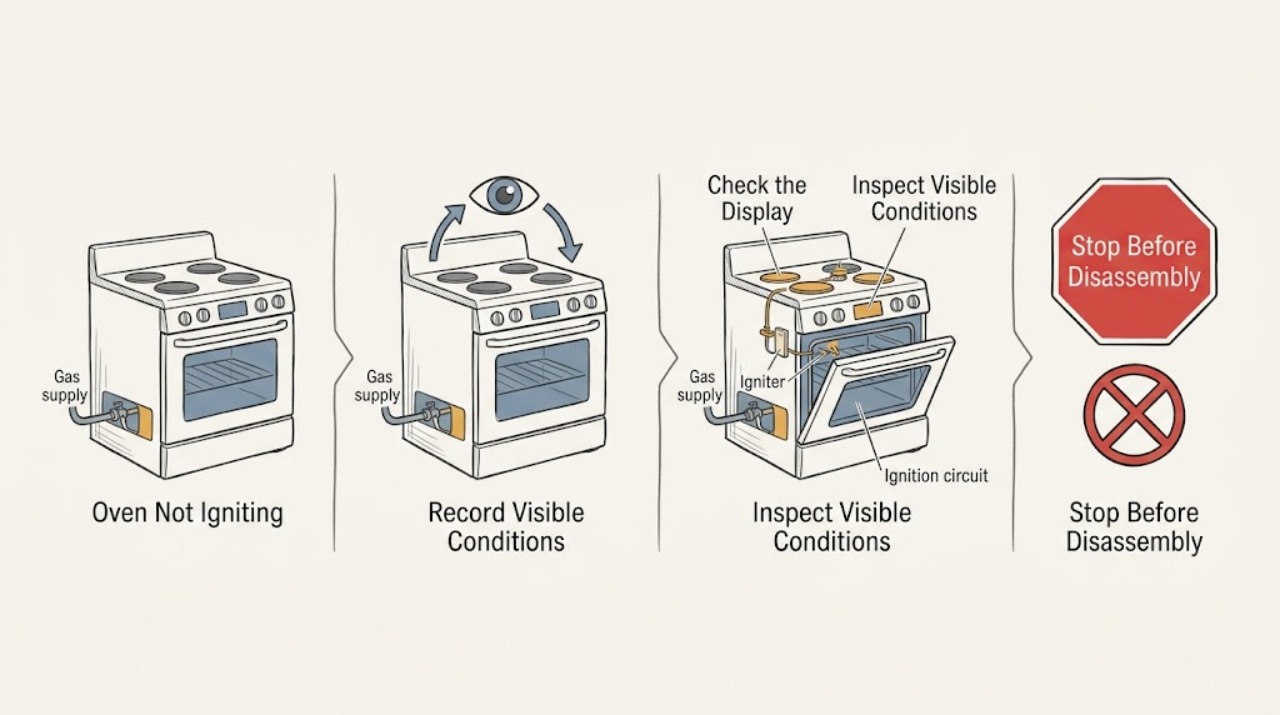
First confirm that this is a Whirlpool gas oven and record whether the display works, the oven starts a countdown, you hear ignition clicking, and a flame appears. A delayed-start or locked control, an open door, a power or grounding problem, a gas shutoff state, or a failed igniter can all look like “not igniting.” Perform only the external, model-manual checks and one normal ignition attempt when there is no gas odor. If it clicks without a flame, clicks continuously, ignites late with a bang, shows an abnormal flame, smells of gas, produces carbon-monoxide concern, smoke, arcing, or trips power, turn the controls off, leave the appliance unused, and get qualified help. Never use a match or lighter to test the oven, search for a gas leak, open the gas path, or repeat failed ignition attempts.
Before you begin
Safety first
- A qualified technician should diagnose the igniter, burner, gas valve or regulator, control, grounding, and combustion path before selecting any replacement component.
Work through in order
Diagnostic checks
Use only checks that match the exact appliance or system and its official guide.
-
Check 1
Confirm from the rating label, manual, or known appliance history that the Whirlpool range or wall oven uses gas for the oven. Record the model number, Bake or Broil selection, temperature, display state, whether the cooktop works, and whether the oven ever clicks or shows a flame.
Expected result: A gas oven with a live display but no ignition is a different path from a completely unpowered appliance or an electric oven being treated as gas. A cooktop that works does not prove the oven igniter or oven gas supply works.
Next step: Continue to the control and door checks when there is no gas odor. If the model or fuel type is uncertain, stop and use the model manual or qualified service rather than opening or testing the gas system.
Why this matters
Why: Fuel type and the exact ignition symptom determine which safe checks apply; do not apply a surface-burner procedure to the oven or assume a pilot exists.
-
Check 2
With all controls off and no gas odor, check the display for Control Lock, Demo or Showroom mode, Delayed Start, an active timer, or an error message. Confirm the oven door is fully closed and the selected function and temperature were actually started according to the model manual.
Expected result: A locked control, delayed start, demo mode, open door, or an unstarted function can prevent the ignition sequence without a failed igniter. A normal start command with no response moves the diagnosis to power or ignition.
Next step: Use only the model manual to clear a lock, demo mode, delay, or code. Do not keep pressing Start or changing modes if a gas smell, smoke, abnormal heat, or electrical symptom appears.
Why this matters
Why: The oven must receive a valid function and door state before it can call for heat; changing parts before checking those states can misdiagnose a normal control condition.
-
Check 3
If the display is blank or the igniter is silent, check the power connection only from a dry, safe position. Look for a tripped breaker or a clearly accessible, operational grounded outlet without using an adapter or extension. Do not touch a wet plug, outlet, cord, or panel.
Expected result: If the outlet or circuit is also unavailable, the household supply is the branch. If the outlet is sound but the oven remains blank or has no ignition response, the range's electrical or ignition circuit needs service.
Next step: Use a qualified electrician for an outlet or wiring problem. For a range-only power or ignition failure, keep it out of use and arrange qualified appliance service. Do not repeatedly reset a breaker that trips.
Why this matters
Why: A gas oven still needs electricity for its controls and electronic ignition; no click does not prove that gas is absent.
-
Check 4
If there is no gas smell and the supply is clearly installed, look from outside at the appliance gas shutoff or regulator indicator only if it is readily visible and safe to observe. Do not move the range, loosen a connector, remove a regulator cover, or manipulate a valve you cannot positively identify. Note whether a recent installation or reconnection preceded the failure.
Expected result: A shutoff state, recent reconnection, or a gas-supply change can explain an oven that has electrical power but cannot ignite. A supply that appears normal does not rule out pressure, valve, or burner faults.
Next step: If the supply condition is uncertain, the oven was recently connected, or the oven still will not ignite, stop and arrange licensed gas or appliance service. Never use an open flame or household appliance to find a leak.
Why this matters
Why: Supply and ignition are linked but distinct; a visible setting is only an observation, not a gas-flow or leak test.
-
Check 5
Only when the controls, room, and appliance are free of gas odor or other hazards, perform one normal Bake ignition attempt exactly as the Whirlpool manual describes while remaining outside the oven cavity. Observe whether there is no click, a regular click without flame, a flame that lights and goes out, or a delayed ignition.
Expected result: No click suggests an electrical control or igniter path. Clicking without a flame suggests that ignition or gas delivery needs diagnosis. A delayed flame, bang, unstable flame, or flame that will not remain lit is unsafe to keep testing.
Next step: Turn the control off after the single attempt. For no click, repeated clicking, no flame, delayed ignition, or an abnormal flame, leave the oven unused and arrange qualified service. Do not retry with a match or lighter.
Why this matters
Why: Clicking and flame timing are diagnostic observations, but they do not identify a serviceable part or authorize access to the burner.
-
Check 6
From outside the appliance, note whether the cooktop works while the oven does not, whether the oven door is closed, whether the storage area or visible vent is obstructed by an item, and whether the oven bottom has been covered with foil or a liner. Do not remove oven panels or reach toward an igniter or burner.
Expected result: Whirlpool identifies an oven-only gas shutoff or regulator condition, an open door, storage interference, and blocked burner airflow as model-dependent causes of an oven that does not ignite even when another function works.
Next step: Remove only a plainly external storage obstruction or foil that the manual says should not be present, while the appliance is cool and off. If ignition still fails or the obstruction is not safely reachable, arrange service.
Why this matters
Why: A difference between cooktop and oven narrows the branch but does not prove that the oven igniter, valve, or regulator is defective.
-
Check 7
Record every error code, light pattern, ignition sound, flame result, and whether the failure occurs in Bake, Broil, or both. Compare the code only with the complete model manual; do not borrow a code meaning from another Whirlpool model. If the manual authorizes one reset, perform it once only when there is no gas, heat, smoke, or electrical hazard.
Expected result: A recurring code, failure in both oven functions, no ignition after a valid start, or a breaker that trips again indicates a model-specific fault needing service rather than another ignition attempt.
Next step: Keep the oven out of use and provide the model, code, selected function, click or flame behavior, cooktop result, and any gas odor, bang, smoke, or heat damage to a qualified technician.
Why this matters
Why: The record distinguishes controls, supply, igniter, burner, valve, and electrical paths without guessing at a component or compatibility.
Use your observations
Decision map
Find the observation that best matches what you see, then follow the next safe action.
-
PATH 01Next step
What you see
The display is blank, the oven is unresponsive, or the igniter is silent.
Do this next
Use qualified electrical service for a supply fault or qualified appliance service for an oven-only power or ignition failure. Do not reset a breaker repeatedly.
Why this path and its safety boundary
Why it matters: Use only a dry, safe external power observation; a gas oven still requires electricity for controls and electronic ignition.
-
PATH 02Next step
What you see
The display works but the oven will not start the ignition sequence.
Do this next
If the controls are correct but the sequence still does not start, keep the oven out of use and arrange service rather than changing parts or repeating commands.
Why this path and its safety boundary
Why it matters: Check the model-specific function, temperature, door closure, Control Lock, Demo mode, Delayed Start, timer, and exact error indication.
-
PATH 03Next step
What you see
There is no gas odor, the oven has power, and the igniter clicks but no flame appears.
Do this next
Turn controls off and arrange licensed gas or appliance service. Do not manually light the oven, clear a burner, open the gas path, or repeat attempts.
Why this path and its safety boundary
Why it matters: Stop after the one normal observation and treat gas delivery, igniter, valve, or burner access as a professional diagnosis.
-
PATH 04Next step
What you see
The oven lights late, produces a bang, has an unstable or abnormal flame, or lights and goes out.
Do this next
Turn the control off if it is safe to do so without approaching a hazard, leave the oven unused, and arrange qualified service.
Why this path and its safety boundary
Why it matters: Treat the ignition as unsafe and stop immediately; do not seek a better result with another attempt.
-
PATH 05Next step
What you see
The cooktop works but the oven does not ignite, or a recent installation or reconnection preceded the problem.
Do this next
If the supply state is uncertain or the oven remains unlit, arrange licensed gas or appliance service without moving the range or loosening its connector.
Why this path and its safety boundary
Why it matters: Use only visible, model-manual supply and setup information; an oven-specific regulator or trapped-air condition may differ from the cooktop.
-
PATH 06Next step
What you see
An exact error returns, both oven functions fail, one safe reset does not help, or the breaker trips again.
Do this next
Keep the appliance out of use and provide the full model, code, function, sound, flame behavior, and power symptoms to a qualified technician.
Why this path and its safety boundary
Why it matters: Treat the problem as a model-specific control, ignition, valve, or electrical fault rather than a guessed part replacement.
-
PATH 07Next step
What you see
Gas odor, suspected gas leak, CO concern, smoke, visible arcing, melted material, excessive heat, or a repeated trip occurs.
Do this next
From a safe location, use the appropriate gas emergency, fire, electrical, or qualified appliance service channel. Do not re-enter or relight until professionals say it is safe.
Why this path and its safety boundary
Why it matters: Stop all testing, leave the area for gas or fire danger, and do not operate lights, switches, phones, or other electrical equipment inside the affected area.
Helpful context
Understand the symptom
“Not igniting” is a symptom, not a diagnosis. A gas oven may have no display, may accept a setting but not start, may click without a flame, or may light late and shut down. Before touching anything, note the complete model number, selected function, temperature, door position, display message, clicking pattern, flame behavior, and whether the cooktop works. Keep the oven off if any gas smell or electrical hazard is present.
The checks below stay on controls, the closed door, clearly visible supply conditions, and model-authorized instructions. They do not include manual lighting, leak testing, removing the oven bottom, accessing the burner, opening a regulator, measuring live voltage, or dismantling the gas path.
A useful result changes the next decision: a delayed or locked control points to setup, a dead outlet points to electrical service, no click points to the ignition circuit, clicking without flame points to gas or ignition service, and a delayed bang or gas odor ends all testing.
Safety boundary
Stop conditions
- Stop immediately for a gas odor, suspected leak, delayed ignition, bang, abnormal flame, or concern about combustion gases; do not relight or repeat the test.
- If gas is smelled, leave the area and do not operate lights, switches, phones, matches, lighters, or other electrical equipment inside; seek help from a safe location.
- Stop for smoke, visible arcing, burning odor, melted material, excessive heat, or a repeated circuit trip; do not reset the breaker repeatedly.
- Stop if the oven door will not close, the door glass or seal is damaged, or a hot surface or flame cannot be controlled safely.
- Do not manually ignite the oven, use a match or lighter for testing, search for a gas leak, move the range to inspect its connector, open gas or electrical panels, or remove the burner or igniter.
- Keep the appliance out of use if a code returns or the oven still will not ignite after the single safe model-authorized observation.
Only after diagnosis
Potential parts
- oven igniter assembly
Consider only when service diagnosis confirms an ignition-path fault for the complete model.
Confirm the complete Whirlpool model and manufacturer fit information; do not infer fit from a no-flame symptom. - oven gas valve or regulator component
Consider only after a licensed professional confirms a gas-supply or valve fault and identifies the exact component.
Gas-path components require qualified installation and exact model verification. - oven control or ignition circuit component
Consider only when the oven has a confirmed electrical or control fault after safe power observations.
Do not open panels or select a control component without qualified diagnosis and model fit confirmation.
When checks do not resolve it
Need a professional?
A gas-oven ignition, control, supply, door, or electrical branch remains after safe external checks, or any stop condition is present.
Safety scope: A qualified technician should diagnose the igniter, burner, gas valve or regulator, control, grounding, and combustion path before selecting any replacement component.
Have this ready
- Complete Whirlpool model number, fuel type, Bake or Broil function, temperature, exact display code, door state, cooktop result, no-click or clicking behavior, flame timing, recent installation history, and any smell, bang, smoke, heat, or trip.
Common questions
FAQ
Why does my Whirlpool gas oven click but not ignite?
Clicking without a flame can involve the gas supply, oven igniter, valve, or another ignition-path fault. Make only one normal model-authorized observation when there is no gas odor, then turn the control off and arrange qualified service rather than manually lighting or repeating attempts.
Why does the Whirlpool cooktop work but the oven will not ignite?
The cooktop and oven can have different gas-control or ignition paths. Check the door, selected function, visible model-specific supply state, and power only from a safe position; if the oven remains unlit, use licensed gas or appliance service.
Can a Whirlpool gas oven fail to ignite because of the controls?
Yes. Control Lock, Demo mode, Delayed Start, an unstarted function, an open door, or an exact error can prevent an ignition request. Use only the complete model manual to clear those states and do not continue testing if a safety symptom appears.
Can I light a Whirlpool gas oven with a match if the igniter fails?
Do not use a match or lighter as a test or workaround. A failed electronic ignition, delayed gas ignition, or abnormal flame requires the oven to remain unused until qualified service diagnoses it.
When is a Whirlpool oven ignition problem an emergency?
Treat gas odor, suspected leak, delayed ignition or a bang, abnormal flame, combustion-gas concern, smoke, arcing, excessive heat, melted material, or repeated electrical trips as an immediate stop. Leave the area for gas or fire danger and seek help from a safe location without operating switches or phones inside.
Read the exact guide
Official sources
- Oven Not Working - GasWhirlpool Product Help · Whirlpool gas ranges and ovens; gas supply, grounded power, ignition, and service guidance
- What to do if your gas oven is not heatingWhirlpool · Whirlpool gas ovens; electrical connection, gas connection, igniter, temperature, model manual, and licensed professional guidance
- Oven Not Working - Cooktop Working - Not ClickingWhirlpool Product Help · Whirlpool gas range oven with working cooktop and no oven ignition click; door, regulator, storage, airflow, grounding, and service context
- Oven Not Working - Cooktop Working - ClickingWhirlpool Product Help · Whirlpool gas range oven with working cooktop and oven clicking; door, gas supply, regulator, storage, airflow, and model manual context
- Freestanding Gas Range Quick Start GuideWhirlpool Brand Home Appliances · Whirlpool freestanding gas range operating and safety guidance, including oven start sequence, electronic ignition, visible ignition result, and oven vent
- Certain Older Gas Connectors May Be DangerousU.S. Consumer Product Safety Commission · Gas-appliance connector and suspected gas-leak safety; professional inspection and evacuation guidance
- Nothing is Working - GasWhirlpool Product Help · Whirlpool gas ranges; main gas, breaker, control lock, delayed start, Demo mode, and model-specific service guidance
Community feedback
Share a repair observation
Share a plain-text repair observation. Accepted observations are published automatically; this page may take a moment to update.