
On this page
Start here
Quick answer
A Whirlpool oven that is not working can have a power problem, a locked or delayed control, an open-door interlock, an electric heating issue, or a gas-supply or ignition issue on a gas model. First stop for gas odor, smoke, a burning smell, arcing, a hot connection, repeated breaker trips, or uncontrolled heating. From a safe, dry position, record the model and exact display message, confirm the oven has power, check the model's Control Lock, Demo Mode, clock, Delay Start, and door guidance, then follow only the branch that matches what you observe. Whirlpool's electric guidance specifically identifies power, Control Lock, Demo Mode, Delay Start, and door status; its gas guidance adds the grounded outlet and gas supply path. If a safe check does not restore operation, use the model manual and arrange qualified appliance service.
Before you begin
Safety first
- Keep the oven off for gas odor, delayed ignition, abnormal flame, smoke, carbon-monoxide concern, burning or electrical odor, arcing, uncontrolled heating, hot connections, water near electrics, or repeated trips. Do not bypass interlocks or perform internal gas or electrical work.
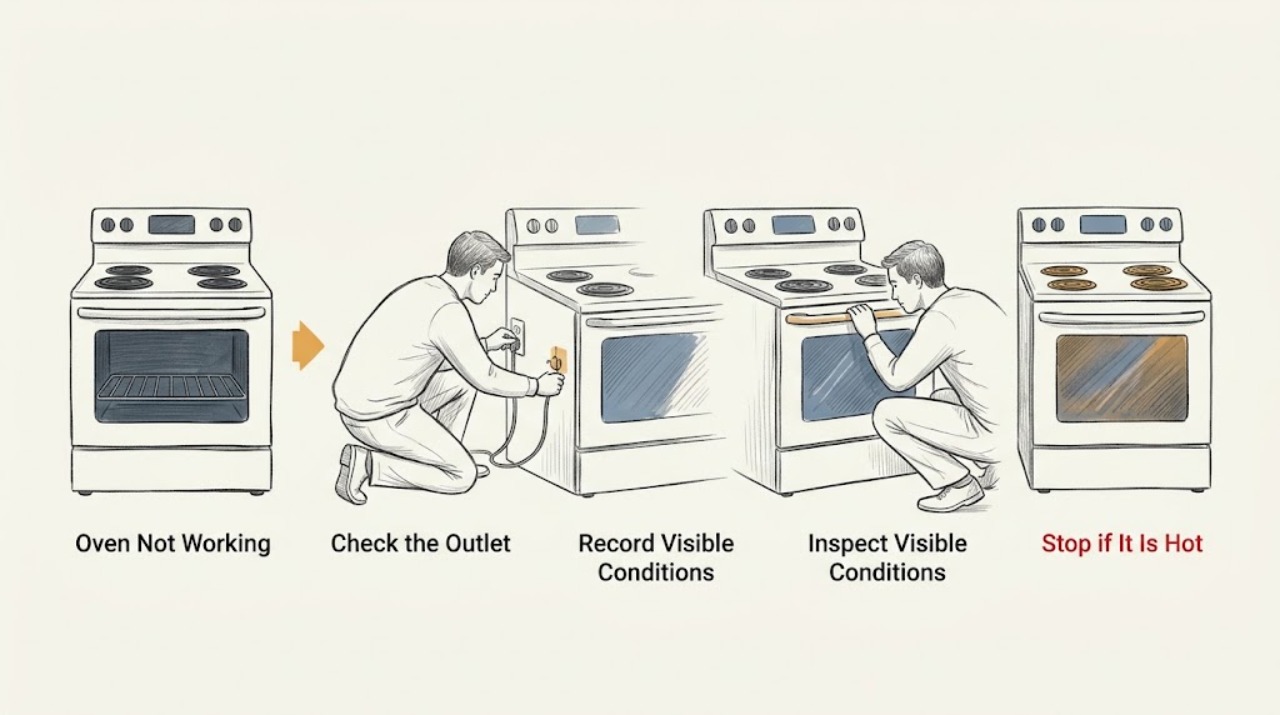
Work through in order
Diagnostic checks
Use only checks that match the exact appliance or system and its official guide.
-
Check 1
Stop using the oven and look from a safe position for gas odor, smoke, a burning or electrical smell, visible arcing, a hot plug or outlet, a leak near electrical parts, uncontrolled heating, or a breaker that trips again. Do not continue a heating or ignition attempt while any of these conditions is present.
Expected result: No hazard symptom is present, or one of the listed odor, smoke, heat, arc, leak, uncontrolled-heating, or repeated-trip conditions is present.
Next step: If a hazard is present, keep clear, stop operating the oven, isolate power or gas only from a safe dry location without touching a hot or damaged connection, and contact the appropriate emergency service, utility, electrician, or qualified appliance technician. If none is present, continue with the identity and power checks.
Stop if: Stop immediately for gas odor, smoke, burning or electrical odor, visible arcing, a hot connection, a leak near electrics, uncontrolled heating, or repeated breaker trips; do not restart to reproduce it.
Why this matters
Why: A hazard symptom takes priority over troubleshooting; it is not evidence that the oven merely needs a setting changed.
-
Check 2
Record the exact model number, fuel type, display or error text, selected cooking mode, temperature setting, whether the interior light or fan responds, and whether the cooktop works. Compare the symptom with the model-specific Owner's Manual rather than applying a code meaning from another Whirlpool series.
Expected result: The display is blank, the display is active but Start does nothing, the cycle starts but does not heat, only the oven fails while the cooktop works, or a repeatable message appears.
Next step: Use the matching branch below and keep the exact code and model available if service is needed.
Stop if: Stop if the display reports a condition accompanied by smoke, burning odor, arcing, uncontrolled heating, or repeated trips; do not clear it by repeated operation.
Why this matters
Why: These observations select different branches: supply and controls, start interlocks, heating or ignition, or a model-specific fault.
-
Check 3
For a blank display or a recent power event, observe whether other household loads work and whether the oven's breaker or fuse is visibly in its normal state. If the appliance was newly installed, use the installation instructions to have the supply connection checked by a qualified person; do not open the appliance.
Expected result: The breaker or fuse is tripped, the display returns after a single safe reset, the display stays dead, or an F9/F9 E0 message returns after power is restored.
Next step: Only if there is no hazard and the device can be reached safely, follow Whirlpool's single power reset guidance for the model. If the display remains dead, the device trips again, or the code returns, leave the oven off and arrange an electrician or appliance technician; do not keep resetting it.
Stop if: Stop for a hot or damaged plug or outlet, smoke, burning odor, arcing, water near electrics, or any repeated trip. Do not use an adapter or extension cord for the oven.
Why this matters
Why: A tripped protection device or returning power-related code points to the household supply, connection, or control path rather than a cooking setting. Whirlpool warns that a recurring F9 or F9 E0 can indicate a miswired outlet.
-
Check 4
If the display is on but the oven will not begin, inspect the console for Control Lock, Demo Mode, a clock requirement, or Delay Start. Cancel a displayed delayed program and select a simple cooking function exactly as the Owner's Manual describes; use only the model-documented control-lock sequence.
Expected result: A lock indicator, demo presentation, delayed time, unset clock, or other start-state message is visible, or a normal start still does nothing.
Next step: Clear only the setting identified by the display and manual, then make one normal start attempt. If the control remains unresponsive or the same message returns, record it and request service rather than bypassing the interlock.
Stop if: Stop for smoke, burning odor, arcing, uncontrolled heating, a hot control, or repeated breaker trips; do not bypass Control Lock or a door interlock.
Why this matters
Why: A lock, demo, clock, or delayed-start state can prevent heating without a failed heater. A normal start that remains unresponsive after the documented setting is cleared needs service diagnosis.
-
Check 5
With the oven cool, observe whether the door closes fully and whether the hinges, seal, latch area, or frame appear damaged or obstructed. On a model that requires the door closed for heating or broiling, make one normal start with the door fully closed and do not force or defeat the latch.
Expected result: The door is open or misaligned, a visible obstruction or damage is present, the oven responds only when the door is correctly closed, or it still does not respond.
Next step: Remove only a plainly visible, cool obstruction, close the door normally, and retry once if no hazard exists. If alignment, latch, seal, or response remains abnormal, keep the oven off and request model-specific service.
Stop if: Stop for a hot door that will not close, broken glass, a damaged latch, uncontrolled heating, smoke, or any need to force the door.
Why this matters
Why: Door position can prevent the heating elements from energizing and can also indicate an interlock or mechanical problem; a damaged latch is a service condition.
-
Check 6
For an electric model that powers on but does not heat, observe whether the selected mode begins preheating and whether the bake or broil element cycles normally. Remember that Whirlpool says electric elements may cycle on and off to limit temperature; compare the result with the model manual instead of judging heat from a brief glance.
Expected result: The oven heats and cycles normally, the door is open, the oven runs with no heat, or only one function fails after the controls and power are normal.
Next step: Use the model's heating troubleshooting and request service if the oven does not heat, the same error returns, or only one element or mode fails. Do not remove the rear panel or handle internal terminals.
Stop if: Stop for smoke, burning odor, visible arcing, an element that remains red or heating after the control is off, a hot connection, or repeated trips.
Why this matters
Why: Normal cycling is not the same as no heat. A persistent no-heat or single-function failure after safe external checks suggests a heating, sensing, or control fault that needs qualified diagnosis.
-
Check 7
For a gas Whirlpool model, distinguish no spark, spark without ignition, and a burner that lights but the oven does not heat. Without a gas odor and only from a safe, accessible position, confirm the model's grounded outlet is operational and that the main gas valve and the oven-side regulator shutoff described in the installation guidance are in the expected position; do not remove a burner or attempt to find a leak.
Expected result: The outlet is not operational, the main gas supply is off, the cooktop works but the oven does not, the oven sparks without flame, the flame is abnormal, or the symptom remains after the external checks.
Next step: If the external supply state is clearly wrong and there is no odor or hazard, follow the installation manual or have a qualified person correct it. Otherwise stop using the oven and request qualified appliance service for the ignition, regulator, valve, sensor, or control path.
Stop if: For gas odor, delayed ignition, a boom, abnormal yellow or noisy flame, smoke, carbon-monoxide concern, continuous sparking, or any uncertainty about the gas path, stop, avoid switches or flames, leave the area, and contact emergency or gas professionals from a safe location.
Why this matters
Why: Gas oven ignition depends on both electrical grounding and the gas path. A cooktop that works does not prove the oven-side regulator path or igniter is healthy; abnormal flame or ignition behavior is not a DIY adjustment.
Use your observations
Decision map
Find the observation that best matches what you see, then follow the next safe action.
-
PATH 01Next step
What you see
The display and interior light are dead, or a breaker or fuse is abnormal.
Do this next
Perform at most the single safe reset described for the model. Leave the oven off and call a qualified electrician or appliance technician if it stays dead, trips again, or the power code returns.
Why this path and its safety boundary
Why it matters: Start with household power and installation-specific supply checks; a returning power code can require electrical service.
-
PATH 02Next step
What you see
The console lights, but Start does nothing or a lock, demo, clock, or delayed-start indication is present.
Do this next
Follow the exact manual sequence for that model, clear the identified state once, and request service if the control remains unresponsive or the message returns.
Why this path and its safety boundary
Why it matters: The control state or door interlock may be blocking a start rather than a failed heating part.
-
PATH 03Next step
What you see
The cycle starts but there is no heat, or the door is open, misaligned, or damaged.
Do this next
Close the cool door normally and make one safe start. If no heat remains, keep the oven off and arrange qualified service; do not disassemble it.
Why this path and its safety boundary
Why it matters: Door status can inhibit heating; once door and settings are correct, persistent no-heat points toward a model-specific heating or sensing fault.
-
PATH 04Next step
What you see
The model is gas and the cooktop works but the oven does not ignite or heat.
Do this next
Check only the safe external supply conditions documented for the model. Escalate persistent no-ignition or abnormal flame to a qualified appliance technician.
Why this path and its safety boundary
Why it matters: The oven still needs its own electrical ground, gas path, and ignition sequence; cooktop operation does not clear the oven branch.
-
PATH 05Next step
What you see
An exact error message or code returns after the model-authorized reset.
Do this next
Record the complete display, model, fuel type, and stage, then use the Owner's Manual or request qualified service.
Why this path and its safety boundary
Why it matters: The code is model- and series-specific; repeating it is evidence for service, not permission to substitute a different code explanation.
Helpful context
Understand the symptom
Treat “not working” as a symptom, not a diagnosis
The first useful distinction is whether the display and interior light are completely dead, whether the controls light but a cycle will not start, or whether a cycle starts without heat. Gas and electric Whirlpool models do not share every check. Write down the model number, fuel type, selected mode, whether the cooktop works, the exact code or message, and when the failure appears. The model's Owner's Manual is the authority for button sequences and for features that vary by series.
Keep the checks external and reversible
These checks are limited to controls, visible door position, household power indications, and the externally accessible gas shutoff only when there is no gas odor and the control is safe to reach. Do not remove panels, defeat a door or control interlock, disturb internal wiring or gas parts, or repeatedly operate an oven showing a hazard symptom.
Safety boundary
Stop conditions
- Stop immediately for gas odor, delayed ignition, a boom, abnormal flame, smoke, carbon-monoxide concern, or continuous sparking. Avoid switches and flames, leave the area, and contact emergency or gas professionals from a safe location.
- Stop for visible arcing, a burning or electrical smell, a hot or damaged plug or outlet, a water leak near electrical parts, uncontrolled heating, or a breaker that trips again. Keep the oven off and arrange appropriate qualified help.
- Do not force a hot or damaged door, defeat a door or control interlock, remove panels, disturb wiring or gas parts, or repeat a hazardous start attempt.
Only after diagnosis
Potential parts
- electric heating element
Only consider this part if the exact model documentation and qualified diagnosis identify a failed bake or broil heating circuit after power, door, and control checks.
Confirm the complete model number and the manufacturer's parts information; Whirlpool oven designs and elements vary by series. - gas oven ignition component
Only consider an ignition-related component when a qualified diagnosis on an applicable gas model confirms the supply path is safe and the ignition sequence fails.
Do not infer fit or gas compatibility from a symptom. Confirm the exact model and use qualified service for gas-path work. - oven temperature sensor
Only consider this class after the model-specific error or temperature evidence points to sensing rather than power, settings, door, or supply.
Confirm model-specific fit and service instructions before any replacement; do not open the appliance for a speculative part change.
When checks do not resolve it
Need a professional?
Arrange service for a persistent blank display, repeated breaker trip, returning error, failed door or control interlock, no heat after correct settings and power, or gas ignition that does not complete normally.
Safety scope: Keep the oven off for gas odor, delayed ignition, abnormal flame, smoke, carbon-monoxide concern, burning or electrical odor, arcing, uncontrolled heating, hot connections, water near electrics, or repeated trips. Do not bypass interlocks or perform internal gas or electrical work.
Common questions
FAQ
Why is my Whirlpool oven not working but the display is on?
Check the model's Control Lock, Demo Mode, clock, Delay Start, and door guidance first. If the console remains unresponsive after the documented setting is cleared, record the model and message and arrange qualified service.
Why is my Whirlpool oven dead after a power outage?
Observe the oven breaker or fuse and follow only the model's single safe reset instruction. If the display stays dead, the breaker trips again, or F9 or F9 E0 returns, leave the oven off and have the supply evaluated by a qualified professional.
Why does my Whirlpool gas oven not work while the cooktop works?
The oven has its own ignition and gas path. Whirlpool identifies the grounded outlet, main gas valve, oven-side regulator shutoff, door position, and model-specific ignition path as separate checks. Do not attempt gas-path repair; stop for odor, delayed ignition, or abnormal flame.
Is it normal for a Whirlpool electric oven element to turn off and on?
Yes, Whirlpool says electric bake and broil elements can cycle to limit temperature. That normal cycling is different from an oven that never heats, stays cold, or continues heating after the control is off; those symptoms need the model-specific service path.
When should I stop troubleshooting a Whirlpool oven?
Stop for gas odor, delayed ignition or a boom, abnormal flame, smoke, burning or electrical odor, visible arcing, a hot connection, water near electrics, uncontrolled heating, or repeated breaker trips. Keep clear and contact the appropriate emergency, gas, electrical, or appliance professional from a safe location.
Read the exact guide
Official sources
- Oven Not Working - ElectricWhirlpool Product Help · Whirlpool electric ranges and wall ovens; controls and reset behavior vary by model.
- Oven Not Working - GasWhirlpool Product Help · Whirlpool gas ranges; gas controls and installation details vary by model.
- Circuit Breaker Tripped or Fuse Blown - Electric RangeWhirlpool Product Help · Whirlpool electric ranges; installation-specific wiring must follow the model instructions.
- Whirlpool Manuals & LiteratureWhirlpool · Use the exact model number and region; this landing page does not replace the model manual.
- Oven Elements Turning On/Off - Electric RangeWhirlpool Product Help · Whirlpool electric ranges; behavior depends on the model and cooking mode.
- Oven Not Heating - Powering On - ElectricWhirlpool Product Help · Whirlpool electric ovens; exact controls and features vary by model.
- Oven Not Working - Cooktop Working - ClickingWhirlpool Product Help · Whirlpool gas ranges where the cooktop works and clicking is heard; exact installation differs by model.
Community feedback
Share a repair observation
Share a plain-text repair observation. Accepted observations are published automatically; this page may take a moment to update.