
On this page
Start here
Quick answer
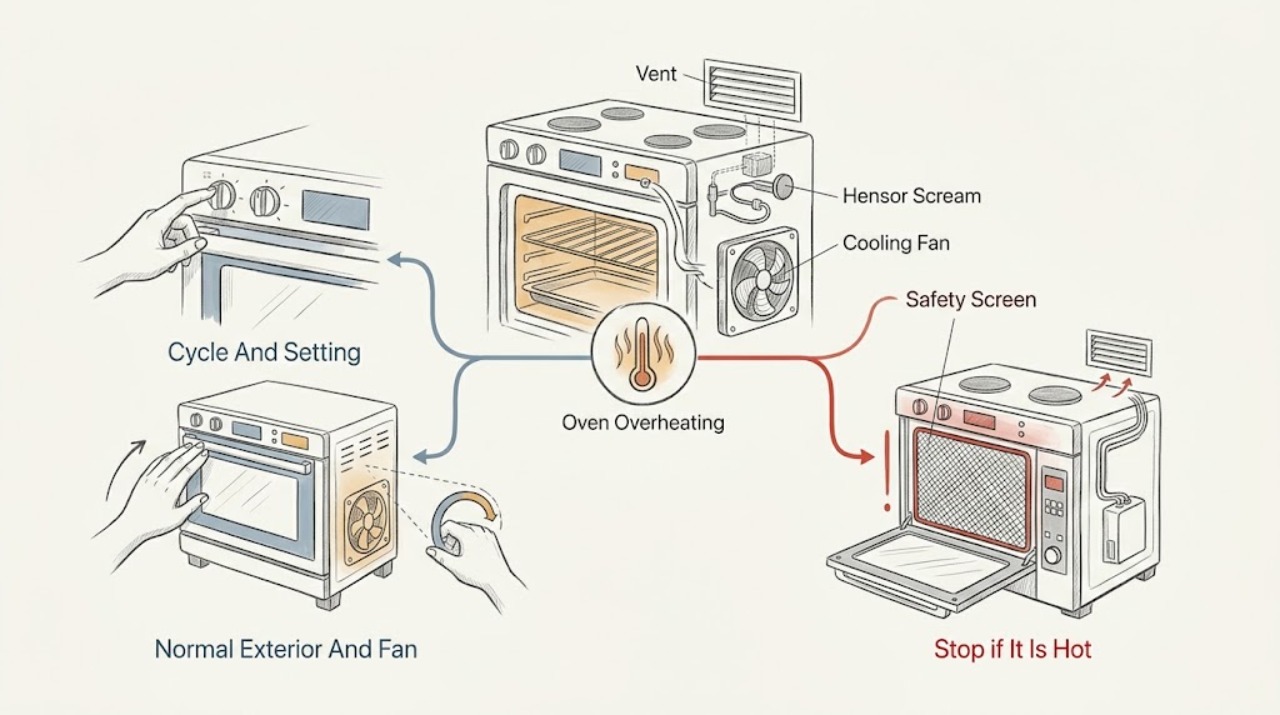
A Whirlpool oven door, window, cooktop, and vent area can become hot during normal operation, and a cooling fan may continue after a cycle while the appliance reaches a safe temperature. Overheating is more concerning when food burns or smokes at a normal setting, the oven keeps heating after it should stop, the display or controls become abnormally hot, or the temperature is consistently higher than the selected setting. First record the cycle, setting, rack and pan arrangement, and whether the fan is cooling normally; do not cover the rack or oven bottom with foil. Use the exact Whirlpool model manual for any bake-performance test or calibration, and do not open panels or adjust a sensor, thermostat, element, gas system, or control yourself. Stop for smoke, fire, a gas odor, suspected carbon monoxide, a damaged cord or outlet, electric arcing, a burn hazard, or heating that will not stop, then arrange qualified appliance service.
Work through in order
Diagnostic checks
Use only checks that match the exact appliance or system and its official guide.
-
Check 1
Stop the oven and observe from a safe position without touching hot surfaces, opening panels, or moving cookware near a flame or heating element.
Expected result: Record smoke, fire, a gas odor, suspected carbon-monoxide alarm or symptoms, electric arcing, a damaged cord or outlet, severe scorching, an unusually hot control area, or heating that will not stop.
Next step: Leave the oven off; if gas odor, smoke, fire, or suspected CO is present, move people to safety and use the appropriate emergency or gas-safety route from outside the hazard area. Isolate power only from a dry safe position when that is safe to do.
Stop if: Do not relight, restart, open the door into a fire, operate switches near a gas odor, or keep testing after a safety symptom.
Why this matters
Why: These signs exceed a normal temperature or calibration question and can involve fire, burn, shock, combustion, or CO risk.
-
Check 2
With the oven operating normally and from a safe distance, note whether the complaint is a warm door, window, cooktop, vent area, or a fan that continues after the cycle.
Expected result: Warm exterior surfaces and a cooling fan that runs during or after a cycle can be normal; a surface that is scorching, a fan with grinding or smoke, or heat that continues with no cycle is not a normal explanation.
Next step: If the heat is limited to normal surfaces and the fan stops after the model's cooling period, continue with cycle and cooking-result checks; otherwise keep the oven off and arrange service.
Stop if: Do not touch the vent, fan opening, door glass, or control area to compare temperatures by hand.
Why this matters
Why: The oven releases heat and may cool its controls after cooking, but normal cooling does not account for uncontrolled cavity heating or a safety hazard.
-
Check 3
Record the exact cycle, temperature, preheat state, mode, rack position, and whether the oven was on Bake, Broil, Convection, Warm, Clean, or another function.
Expected result: A wrong mode, a high-heat or cleaning cycle, or a setting that differs from the recipe changes what heat and fan behavior is expected; the same overheating symptom across ordinary modes keeps a control fault possible.
Next step: Use the exact owner's manual to confirm the selected function and its expected fan or element behavior, then continue only if no safety symptom exists.
Stop if: Do not use a cleaning or broil cycle as a test for an oven already overheating or producing smoke.
Why this matters
Why: Cycle selection is a separate cause from a failed thermostat or sensor and must be confirmed before calibration or parts.
-
Check 4
With the oven cool enough to handle safely, check that pans are placed on the manual's recommended rack, are not touching one another or the oven walls, and that no foil or liner covers an entire rack or the oven bottom.
Expected result: Crowded pans, contact with the walls, a blocked rack, or covered airflow can create hot spots and faster cooking; an unobstructed setup with continuing temperature runaway points elsewhere.
Next step: Correct only the accessible rack, pan, and airflow setup according to the manual, then compare one ordinary cook; stop rather than retest if smoke or uncontrolled heat returns.
Stop if: Do not scrape a hot element, remove a stuck liner while hot, or place foil against an element or vent.
Why this matters
Why: Air circulation and the chosen cookware can make food brown or cook unevenly without the oven actually exceeding its control target.
-
Check 5
After the oven is off and cool, inspect only visible vent openings, the door seal area, knob or control damage, and obvious food or grease residue without removing panels or disturbing wiring.
Expected result: A blocked vent, damaged seal, cracked knob, or heavy residue can affect heat behavior; a clear exterior with overheating across settings leaves sensor, control, element, fan, or gas-service paths possible.
Next step: Clean only as the Whirlpool manual allows and keep the oven off if a vent, seal, knob, or component is damaged; provide the observation to service.
Stop if: Do not remove the back panel, reach into the vent, straighten a sensor, or work near gas or live wiring.
Why this matters
Why: The visual check documents an external clue but cannot prove that a component is good or safe.
-
Check 6
Confirm from the model label or owner's manual, only when safe, whether the Whirlpool appliance is electric, gas, or dual-fuel and whether the complaint is in the oven cavity, cooktop, or controls.
Expected result: Electric models keep the investigation around elements, sensors, controls, airflow, and power; gas or dual-fuel models add fuel supply, ignition, burner flame, venting, and combustion risks.
Next step: For a gas model with abnormal flame, odor, soot, delayed ignition, or suspected CO, leave it off and arrange qualified gas-appliance service; for either fuel type, preserve the exact model information.
Stop if: Do not move the appliance, inspect a gas connector, light a burner to test it, or operate a gas oven with odor, soot, or abnormal combustion.
Why this matters
Why: The same word overheating does not justify applying electric checks to a gas system or assuming every Whirlpool model uses the same control path.
-
Check 7
If the oven is cool, stable, free of smoke or odor, and the exact manual provides a bake-performance assessment, follow that manual procedure once and record the selected setting, cycle, elapsed state, and result.
Expected result: A repeatable offset under the manual's test may support model-authorized calibration; a rapidly rising temperature, large unexplained difference, continuous element or burner operation, or inconsistent result supports service instead.
Next step: Use only the exact manual's calibration control if its conditions are met; otherwise keep the oven off and arrange appliance service.
Stop if: Do not improvise a thermometer test contrary to Whirlpool's model guidance, open the control area, adjust hidden screws, or repeat a high-heat test after unsafe behavior.
Why this matters
Why: Calibration is appropriate only for a measured, repeatable control offset; it is not a substitute for a failed sensor, thermostat, relay, element, burner, or fan.
-
Check 8
After cancelling a normal cycle, observe the cooling fan from outside and note whether it moves air, stops after the model's cooling period, or runs with unusual noise or heat.
Expected result: A fan that continues until the appliance reaches a safe temperature can be normal; a fan that is obstructed, noisy, smoking, absent when controls become abnormally hot, or running indefinitely points to service.
Next step: Do not access the fan; arrange qualified service when its behavior is abnormal or the oven remains unusually hot after the documented cooling state.
Stop if: Do not insert tools, fingers, or cleaners into a vent or fan opening, and do not run another cycle to provoke the fault.
Why this matters
Why: The cooling fan protects controls on equipped models, but fan behavior varies with cycle, temperature, duration, and surroundings.
-
Check 9
Only when the oven is cool, safe, and not showing gas, smoke, fire, arcing, or uncontrolled-heating symptoms, follow the exact Whirlpool manual's single power-reset instruction.
Expected result: A normal return to standby can indicate a temporary control state; an immediate recurrence, an error display, a fan or element that remains active, or a protection trip means the fault remains.
Next step: Stop after one authorized reset and arrange service if overheating returns or the oven does not enter a normal safe state.
Stop if: Do not repeatedly cycle power, restore power to a wet or damaged appliance, or reset after smoke, arcing, gas odor, or a trip.
Why this matters
Why: A reset can clear a temporary control state but cannot validate a sensor, thermostat, relay, element, fan, gas valve, or wiring.
-
Check 10
Prepare a service record with the complete model number, fuel type, cycle and temperature, rack and pan arrangement, display, fan state, cooking result, manual test or calibration state, visible damage, and every safety symptom.
Expected result: A precise record distinguishes normal exterior heat, airflow or cookware effects, a repeatable calibration offset, a sensor or control fault, cooling failure, heating-element issue, or gas-combustion service path.
Next step: Keep the oven out of service until the cause is resolved when overheating is repeatable, uncontrolled, unsafe, or not explained by the exact manual's normal behavior.
Stop if: Do not order or replace a sensor, thermostat, element, fan, knob, relay, control, or gas component from the symptom alone.
Why this matters
Why: The technician can inspect the correct system without exploratory panel removal or repeated high-temperature testing.
Use your observations
Decision map
Find the observation that best matches what you see, then follow the next safe action.
-
PATH 01Safety boundary
What you see
There is smoke, fire, a gas odor, suspected CO or an alarm, electric arcing, a damaged cord or outlet, severe scorching, a burn hazard, or heating that will not stop.
Do this next
Leave the oven off, move people to safety, use the appropriate emergency or gas-safety route from outside the hazard area, and arrange qualified service.
Why this path and its safety boundary
Why it matters: The oven may present fire, shock, combustion, burn, or carbon-monoxide risk.
Safety stop: Do not operate switches near a gas odor, relight, open panels, restart, or perform another test.
-
PATH 02Safety boundary
What you see
Only the door, window, cooktop, or vent area feels warm or hot during an active cycle, and the oven regulates normally with no smoke or damage.
Do this next
Keep hands away from hot surfaces, use the manual's handling guidance, and observe whether the cooling fan completes its normal post-cycle operation.
Why this path and its safety boundary
Why it matters: Exterior heat can be normal during operation and is not by itself cavity overheating.
Safety stop: Stop if the surface is scorching, the controls overheat, smoke or odor appears, or heat persists with no cycle.
-
PATH 03Safety boundary
What you see
The fan runs during or after cooking and stops after the oven reaches a safe temperature without other symptoms.
Do this next
Do not interrupt the cooling path; consult the exact manual or service if the fan is noisy, obstructed, smoking, or runs abnormally long.
Why this path and its safety boundary
Why it matters: Whirlpool describes automatic cooling-fan operation during or after a cycle as normal on equipped models.
Safety stop: Do not insert anything into the vent or fan opening or run another cycle to test it.
-
PATH 04Safety boundary
What you see
The complaint follows a wrong cycle, crowded pans, pan-to-wall contact, unusual rack placement, foil, liner, or blocked airflow.
Do this next
Correct the accessible setup according to the model manual and compare one ordinary cycle only when no safety symptom exists.
Why this path and its safety boundary
Why it matters: Mode, cookware placement, and airflow can cause hot spots or faster cooking without a failed temperature-control component.
Safety stop: Do not cover an entire rack or oven bottom, touch hot elements, or use a high-heat cycle as a test.
-
PATH 05Safety boundary
What you see
A safe, model-authorized bake-performance assessment shows a repeatable temperature offset while the oven cycles normally and has no hazard symptom.
Do this next
Use only the owner's manual's calibration control and record the change; arrange service if the offset persists or the manual provides no safe calibration path.
Why this path and its safety boundary
Why it matters: The setting may need the exact model's calibration adjustment rather than a guessed part replacement.
Safety stop: Do not improvise a calibration range, alter hidden controls, or calibrate an oven that heats continuously or smokes.
-
PATH 06Safety boundary
What you see
An element or gas burner remains active after the target or cancellation, the temperature keeps rising, or the oven cannot stop heating normally.
Do this next
Keep the oven off and arrange qualified appliance service; preserve the model, cycle, and exact timing for diagnosis.
Why this path and its safety boundary
Why it matters: A thermostat, sensor, relay, control, element, burner, valve, or other fault may be preventing regulation.
Safety stop: Do not repeatedly cancel and restart, open the control area, or test a suspected component live.
-
PATH 07Safety boundary
What you see
A cool external inspection finds a visibly damaged knob, displaced or damaged sensor, blocked vent, damaged seal, or heavy residue.
Do this next
Follow only the manual's safe cleaning or external-check instructions and arrange service for damage or recurring overheating.
Why this path and its safety boundary
Why it matters: The observation can explain incorrect control or heat release, but it does not prove which component failed.
Safety stop: Do not straighten, remove, replace, or electrically test a sensor, element, fan, thermostat, or control.
-
PATH 08Safety boundary
What you see
The model is gas or dual-fuel and there is an abnormal flame, soot, delayed ignition, gas odor, suspected combustion problem, or CO concern.
Do this next
Leave the oven off, avoid ignition or electrical switching near odor, move to safety if gas or CO is suspected, and arrange qualified gas-appliance service.
Why this path and its safety boundary
Why it matters: Fuel supply, ignition, burner, venting, and combustion require qualified assessment and may create fire or CO risk.
Safety stop: Do not light a burner to test it, search for a leak, move the range, remove panels, or keep operating it.
-
PATH 09Safety boundary
What you see
The cooling fan is absent when controls overheat, has abnormal noise or smoke, is obstructed, or continues abnormally after the documented cooling state.
Do this next
Keep the oven off and arrange qualified appliance service without accessing the fan or back panel.
Why this path and its safety boundary
Why it matters: Cooling airflow or its control may be faulty and can allow components to overheat.
Safety stop: Do not insert tools into vents, remove guards, or run the oven to force a fan diagnosis.
-
PATH 10Safety boundary
What you see
The oven still runs too hot across ordinary cycles after safe setting, airflow, and model-authorized calibration checks.
Do this next
Stop repeated testing and arrange qualified Whirlpool appliance service with the full service record.
Why this path and its safety boundary
Why it matters: A temperature sensor, thermostat, heating element, control, fan, vent, gas, or installation fault remains possible.
Safety stop: Do not substitute parts or continue cooking while the temperature is uncontrolled.
Helpful context
Understand the symptom
Decide whether the heat is normal or uncontrolled
Heat around the door, window, cooktop, and vent openings is expected during an active cycle, especially at a high setting or after a long cook. A cooling fan can also run during or after a cycle to protect the controls. That is different from food scorching at an ordinary setting, a temperature that keeps rising, controls that become unusually hot, or an oven that continues heating after the selected function is cancelled. Write down the exact cycle, setting, display, timing, and symptoms before changing anything.
Start with cycle, rack, pan, and airflow checks
Whirlpool's product guidance says cycle selection, rack position, pan placement, the number of pans, and airflow can change baking results. Confirm that the selected function and temperature are the intended ones, leave the clearance described by the manual around pans, and remove any foil, liner, or other material covering an entire rack or the oven bottom. These checks can explain hot spots or fast browning; they cannot explain smoke, an active fire, or heating that will not stop.
Treat calibration as a model-specific measurement decision
A Whirlpool temperature-support page says the elements cycle on and off and cautions that a generic thermometer may not give an accurate reading during that cycling. If the manual for the exact model provides a bake-performance test, follow that procedure; only then use the manual's calibration control, if one exists. Calibration can address a consistent offset, but it is not a repair for an oven that runs continuously, has a damaged sensor or knob, loses control, or shows a safety symptom.
Sensor, fan, element, gas, and controls are service branches
An accessible visual check can document a visibly displaced sensor, damaged knob, blocked vent, or obvious residue only when the oven is off, cool, and safe to inspect. Internal cooling fans, temperature controls, heating elements, wiring, gas valves, igniters, and control boards are not ordinary-user repairs. A gas model also needs a fuel and combustion assessment by a qualified technician; do not remove panels, test flames, or repeatedly run a malfunctioning oven.
Safety boundary
Stop conditions
- Stop immediately for smoke, fire, gas odor, suspected carbon monoxide or an alarm, electric arcing, a damaged cord or outlet, severe scorching, a burn hazard, or heating that will not stop.
- Do not open panels, test wiring, adjust hidden controls, remove heating or gas components, inspect a gas connector, or perform live electrical or combustion tests.
- Do not cover an entire rack or oven bottom with foil or liners, block the vent, use a high-heat cycle to provoke the fault, or touch hot elements and vents.
- Use temperature calibration only when the exact Whirlpool manual authorizes a bake-performance assessment and the oven is otherwise safe; calibration is not a repair for uncontrolled heating.
- Do not repeatedly reset or operate the oven while overheating is unexplained; arrange qualified appliance or gas service and preserve the model-specific record.
Only after diagnosis
Potential parts
- temperature sensor or thermostat
Only consider this class after a qualified diagnosis or a documented model-specific test shows a sensing or temperature-control fault rather than a mode, airflow, or calibration issue.
Confirm the complete Whirlpool model and the exact part fit through the manufacturer's documentation before ordering; do not infer fit from the symptom. - cooling fan assembly
Only relevant when the model has a cooling fan and service confirms absent, obstructed, noisy, damaged, or abnormal fan operation.
Fan type and fit are model-specific and may require panel access; qualified service should confirm the part and installation. - heating element or gas temperature-control component
Only relevant after a technician identifies a damaged electric element or an applicable gas burner, valve, igniter, or control fault.
Fuel type, model, voltage, control design, and safety requirements must be confirmed; gas and electrical components are not interchangeable or user-selected from overheating alone.
When checks do not resolve it
Need a professional?
Arrange qualified Whirlpool appliance service when the oven heats continuously, remains too hot across ordinary cycles, has an abnormal cooling fan, damaged sensor, knob, seal, element, vent, control, or gas symptom, or does not improve after the exact manual's safe settings and calibration path. Treat smoke, fire, gas odor, suspected CO, arcing, damaged wiring, or a burn hazard as an immediate stop and safety-service situation.
Common questions
FAQ
Is it normal for the outside of a Whirlpool oven to get hot?
The door, window, cooktop, and areas near the vent can become warm or hot during operation, especially at a high setting or during a long cycle. Do not judge safety by touching them. Smoke, scorching, abnormally hot controls, or heat with no cycle is not explained by normal exterior warmth.
Why does my Whirlpool oven fan keep running after I turn it off?
An automatic cooling fan may continue after a cycle while the appliance and controls reach a safe temperature. The exact duration depends on the model, cycle, temperature, and surroundings. A noisy, smoking, obstructed, or abnormally persistent fan needs service rather than a test with another hot cycle.
Should I calibrate a Whirlpool oven that seems too hot?
Only after confirming the cycle, rack and pan setup, airflow, and a repeatable result using the exact model's bake-performance guidance. Whirlpool says calibration controls and procedures vary by model. Do not use calibration to mask continuous heating, smoke, a damaged sensor, a gas symptom, or another safety fault.
Can foil make a Whirlpool oven overheat?
Foil or a liner covering an entire rack or the oven bottom can block airflow and change cooking behavior. Remove it only when the oven is cool and the manual permits, and do not use foil against an element or vent. Blocking airflow does not explain a fire or heating that will not stop.
When should I stop using a Whirlpool oven that is overheating?
Stop for smoke, fire, a gas odor, suspected carbon monoxide or an alarm, electric arcing, damaged wiring or outlet, severe scorching, a burn hazard, a fan that smokes or fails while controls overheat, or heating that will not stop. Leave the oven off and obtain qualified appliance, gas, electrical, or emergency help as appropriate.
Read the exact guide
Official sources
- Carbon Monoxide Poisoning BasicsCenters for Disease Control and Prevention · Carbon-monoxide hazards and qualified service for fuel-burning household appliances
- Oven Overheating: Possible Causes and SolutionsWhirlpool · Whirlpool oven overheating causes, normal exterior heat, airflow, calibration, fan, sensor, and gas/electric troubleshooting guidance
- Protect Your Family from Carbon Monoxide PoisoningU.S. Consumer Product Safety Commission · Carbon-monoxide safety and gas range or oven warnings
- Oven Temperature Incorrect (Too Hot or Too Cold)Whirlpool Product Help · Whirlpool oven temperature accuracy, cycling, rack/pan placement, airflow, and model-specific calibration
- Oven Too Hot - Calibrated - Wall OvenWhirlpool Product Help · Whirlpool wall oven cycle, airflow, bake-performance, and calibration guidance
- Oven Not Shutting OffWhirlpool Product Help · Whirlpool oven fan operation after a cooking cycle
- Fan is Running During Non Convection Cycles - Product Help | WhirlpoolWhirlpool Product Help · Whirlpool range and oven convection and automatic cooling-fan behavior
- Oven Too Hot - Needs Calibration - RangeWhirlpool Product Help · Whirlpool range and oven model-specific temperature calibration controls
Community feedback
Share a repair observation
Share a plain-text repair observation. Accepted observations are published automatically; this page may take a moment to update.