
On this page
Start here
Quick answer
A Whirlpool refrigerator may run for long periods after warm food, frequent door openings, or a warm room, and some inverter compressors vary speed continuously. Check the temperature setting, door seal, blocked vents, load, room heat, and ventilation before judging a fault. If it runs continuously while cooling poorly, is unusually noisy, repeatedly trips power, or has heavy frost, protect food and arrange service.
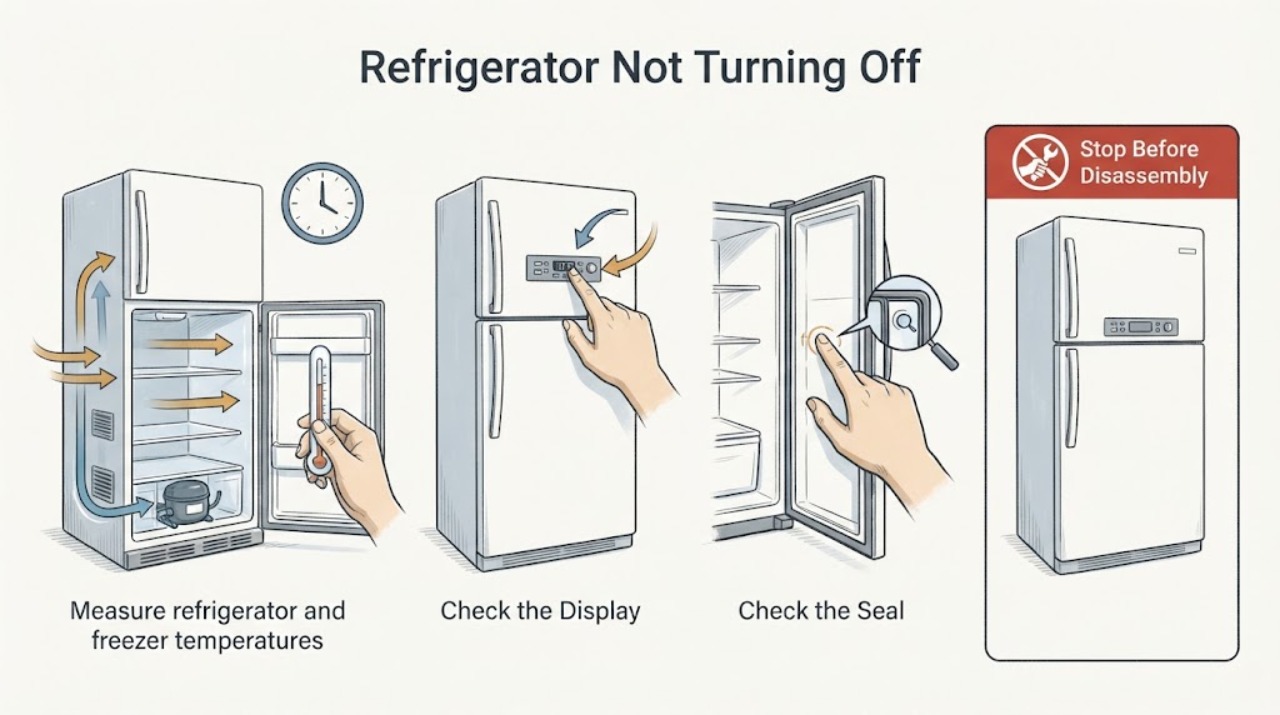
Work through in order
Diagnostic checks
Use only checks that match the exact appliance or system and its official guide.
-
Check 1
Measure refrigerator and freezer temperatures and note how long the unit has run after startup or a large load.
Expected result: Temperature is normal, falling, or remains warm.
Next step: Keep doors closed and continue external checks.
Why this matters
Why: Long operation can be normal during pull-down; constant running with warmth is a system symptom.
-
Check 2
Check the temperature controls and disable any temporary modes only as the manual describes.
Expected result: Setting is unusually cold, warm, or normal.
Next step: Restore the recommended setting and allow stabilization.
Why this matters
Why: An incorrect setting changes compressor duty cycle and can mimic a control fault.
-
Check 3
Inspect doors, gaskets, and food for gaps or obstruction.
Expected result: A door leaks or cannot close, or seals normally.
Next step: Clear visible obstructions and service a damaged gasket.
Why this matters
Why: Warm humid air forces longer operation.
-
Check 4
Clear internal vents and external ventilation space without opening panels.
Expected result: Airflow is restricted or clear.
Next step: Restore accessible clearance and monitor.
Why this matters
Why: Poor airflow raises workload and may reduce cooling.
-
Check 5
Note room heat, warm food, frequent openings, frost, and unusual compressor or fan noise.
Expected result: A load or environment explains demand, or symptoms persist.
Next step: Allow one stable cycle, then service persistent symptoms.
Why this matters
Why: Demand factors differ from sealed-system, fan, sensor, or control faults.
-
Check 6
Stop and arrange service for poor cooling, heavy frost, repeated trips, burning odor, or abnormal noise.
Expected result: Cooling normalizes or the issue recurs.
Next step: Protect food and provide the run history and temperatures to service.
Why this matters
Why: Recurrence after external checks requires internal diagnosis.
Use your observations
Decision map
Find the observation that best matches what you see, then follow the next safe action.
-
PATH 01Next step
What you see
The refrigerator runs long after warm food or frequent door openings but temperatures recover.
Do this next
Keep doors closed and reassess after stabilization.
Why this path and its safety boundary
Why it matters: High temporary cooling demand is likely.
-
PATH 02Next step
What you see
A gasket, vent, or ventilation clearance is abnormal.
Do this next
Correct the visible condition and monitor one cycle.
Why this path and its safety boundary
Why it matters: Air leakage or heat rejection is prolonging operation.
-
PATH 03Next step
What you see
The compressor runs continuously while both compartments remain warm.
Do this next
Arrange qualified service.
Why this path and its safety boundary
Why it matters: Fan, sensor, compressor, control, or sealed-system fault is likely.
-
PATH 04Next step
What you see
Noise, heavy frost, odor, or breaker trips accompany constant running.
Do this next
Stop use for a safety warning and obtain service.
Why this path and its safety boundary
Why it matters: The symptom exceeds routine checks.
Helpful context
Understand the symptom
Record cabinet temperature and whether the compressor sound changes. Running is not itself a fault if the refrigerator is pulling down after a warm load, but poor cooling with constant operation needs diagnosis.
Use the exact Whirlpool manual for controls, vents, and model-specific service information.
When checks do not resolve it
Need a professional?
A technician may test fans, sensors, controls, compressor, airflow, and sealed-system performance. Provide temperatures and run pattern.
Common questions
FAQ
Is continuous Whirlpool refrigerator operation always a fault?
No. Pull-down, warm rooms, loads, and inverter control can extend operation. Continuous running with poor cooling or abnormal symptoms needs service.
Can a door gasket make the compressor run constantly?
Yes. A gap admits warm air. Check closure and gasket condition, then service a damaged seal.
What temperature should I record?
Measure both compartments with a reliable thermometer and record the timing; the exact manual supplies model-specific targets.
Should I unplug a constantly running refrigerator?
Protect food and arrange service if cooling is poor. Disconnect power for burning odor, damaged cord, or repeated breaker trips.
Read the exact guide
Official sources
- Temperature is too Warm/Not Cooling Properly - Wine CellarWhirlpool · Use for general Whirlpool refrigeration operating factors; exact refrigerator model guidance remains in its manual.
- Whirlpool Manuals & LiteratureWhirlpool · Use to identify exact refrigerator controls and service guidance.
Community feedback
Share a repair observation
Share a plain-text repair observation. Accepted observations are published automatically; this page may take a moment to update.