
On this page
Start here
Quick answer
A Whirlpool refrigerator that trips a breaker should be isolated from repeated resets while you determine whether the issue is the outlet or circuit, a one-time power event, or a repeatable appliance fault. Check the plug and supply at the accessible level, reset household protection once only if safe, and observe whether the refrigerator immediately trips again. A repeat trip, hot or damaged cord, burning smell, smoke, water near electrical parts, or a breaker that will not hold requires qualified appliance or electrical service.
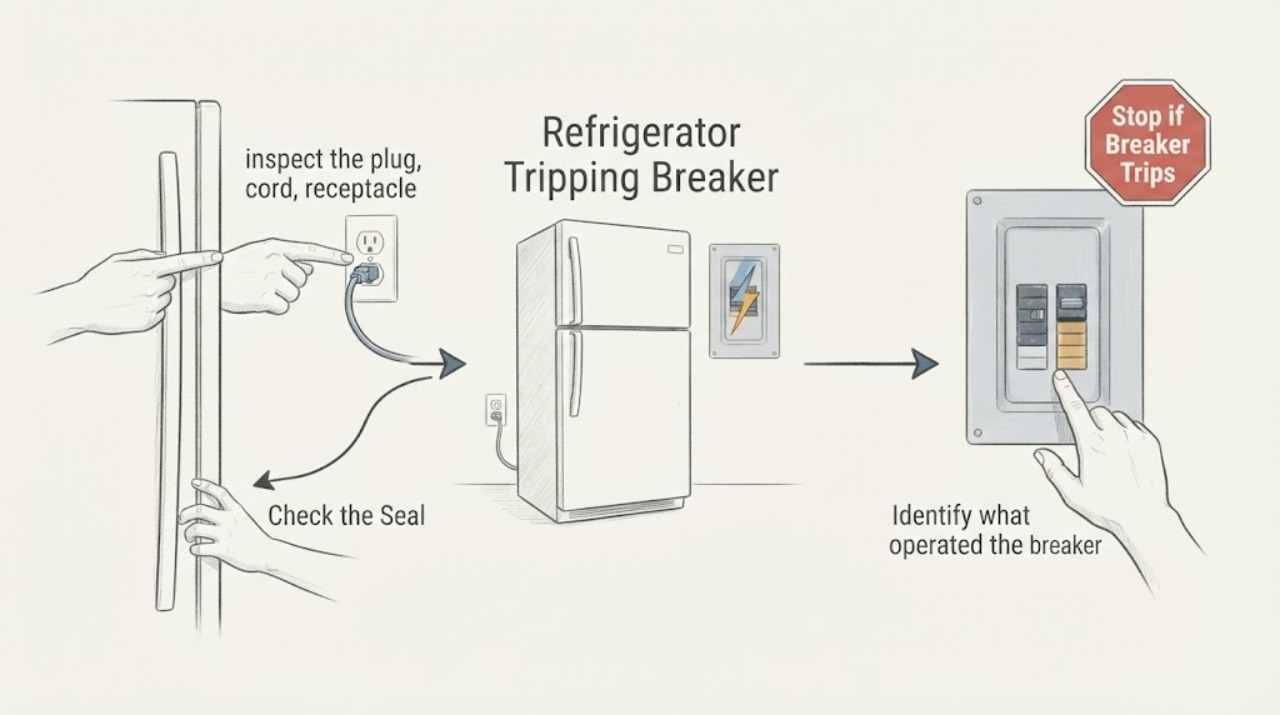
Work through in order
Diagnostic checks
Use only checks that match the exact appliance or system and its official guide.
-
Check 1
With the refrigerator stopped, inspect the plug, cord, receptacle, and surrounding floor for looseness, heat, scorch marks, moisture, or visible damage.
Expected result: The plug is secure and dry, or the cord/receptacle is warm, damaged, wet, or scorched.
Next step: Do not energize a damaged or wet connection; arrange qualified electrical service.
Why this matters
Why: A normal-looking connection permits a controlled supply check; heat, damage, or moisture points to an electrical hazard.
-
Check 2
Identify what operated the breaker: note whether the trip occurred when the refrigerator was plugged in, when it started cooling, or after another appliance was used on the circuit.
Expected result: The breaker trips immediately with the refrigerator, only after a delay, or only when another load is added.
Next step: Leave the refrigerator unplugged if the trip repeats and have the circuit assessed.
Why this matters
Why: Immediate or repeat trips increase concern for an appliance or circuit fault; a trip only with another load suggests circuit loading.
-
Check 3
Check the household breaker or fuse from the user-accessible panel without opening the refrigerator or sealed compartments.
Expected result: The breaker resets once, will not reset, or trips again when the refrigerator is connected.
Next step: If safe, restore power once; stop on another trip, smell, heat, or noise and call service.
Why this matters
Why: A breaker that will not hold or trips again indicates an unresolved electrical condition.
-
Check 4
Reconnect for one controlled retest only after the supply is dry and intact, and observe whether the refrigerator stays powered through a cooling start.
Expected result: The refrigerator stays powered, or it trips again during startup or after running.
Next step: Record timing and contact Whirlpool or a qualified technician for a repeat fault.
Why this matters
Why: Stable operation after one event differs from a repeatable trip during cooling; repeatability points to service.
-
Check 5
Record the outlet, breaker behavior, other loads, trip timing, and any odor, heat, or moisture for service.
Expected result: The same breaker repeatedly opens or the refrigerator shows damage or abnormal heat.
Next step: Keep the unit off and provide the record to the service professional.
Why this matters
Why: These observations distinguish supply protection from an appliance-side fault.
Use your observations
Decision map
Find the observation that best matches what you see, then follow the next safe action.
-
PATH 01Next step
What you see
The breaker trips again immediately when the refrigerator is connected or begins cooling.
Do this next
Leave the refrigerator disconnected and arrange qualified diagnosis.
Why this path and its safety boundary
Why it matters: A repeatable appliance-side or circuit fault is more likely than a one-time interruption.
-
PATH 02Next step
What you see
The breaker holds after one safe reset and no heat, smell, damage, or moisture is present.
Do this next
Monitor one normal cooling start and stop use if the breaker trips again.
Why this path and its safety boundary
Why it matters: A transient interruption is possible, but the fault is not proven gone.
-
PATH 03Next step
What you see
The plug, cord, receptacle, or panel is hot, wet, scorched, damaged, or will not hold the breaker.
Do this next
Do not touch damaged wiring or continue testing; obtain qualified electrical service.
Why this path and its safety boundary
Why it matters: The electrical supply presents an immediate safety boundary.
Helpful context
Understand the symptom
Whirlpool’s own refrigerator guidance starts with the power connection and household breaker or fuse. Use the pattern of the trip—immediate, delayed, or only after another load starts—to choose the next safe boundary.
When checks do not resolve it
Need a professional?
Stop for a repeat trip, hot or damaged electrical parts, smoke, sparks, burning odor, water near electrical components, or a breaker that will not hold. Do not open sealed system or electrical housing.
Common questions
FAQ
Should I keep resetting the breaker?
No. A repeat trip is a stop signal for qualified diagnosis rather than a reason to keep resetting protection.
What if the breaker trips only when another appliance runs?
That pattern makes circuit loading or protection behavior more likely; avoid overloading the circuit and have it evaluated.
Can I order a compressor or control board from the symptom?
No. Trip timing does not establish a part or compatibility. Let service identify the fault first.
Read the exact guide
Official sources
- Tripping Breaker - Refrigerator - Product HelpWhirlpool · Whirlpool refrigerators
Community feedback
Share a repair observation
Share a plain-text repair observation. Accepted observations are published automatically; this page may take a moment to update.