
On this page
Start here
Quick answer
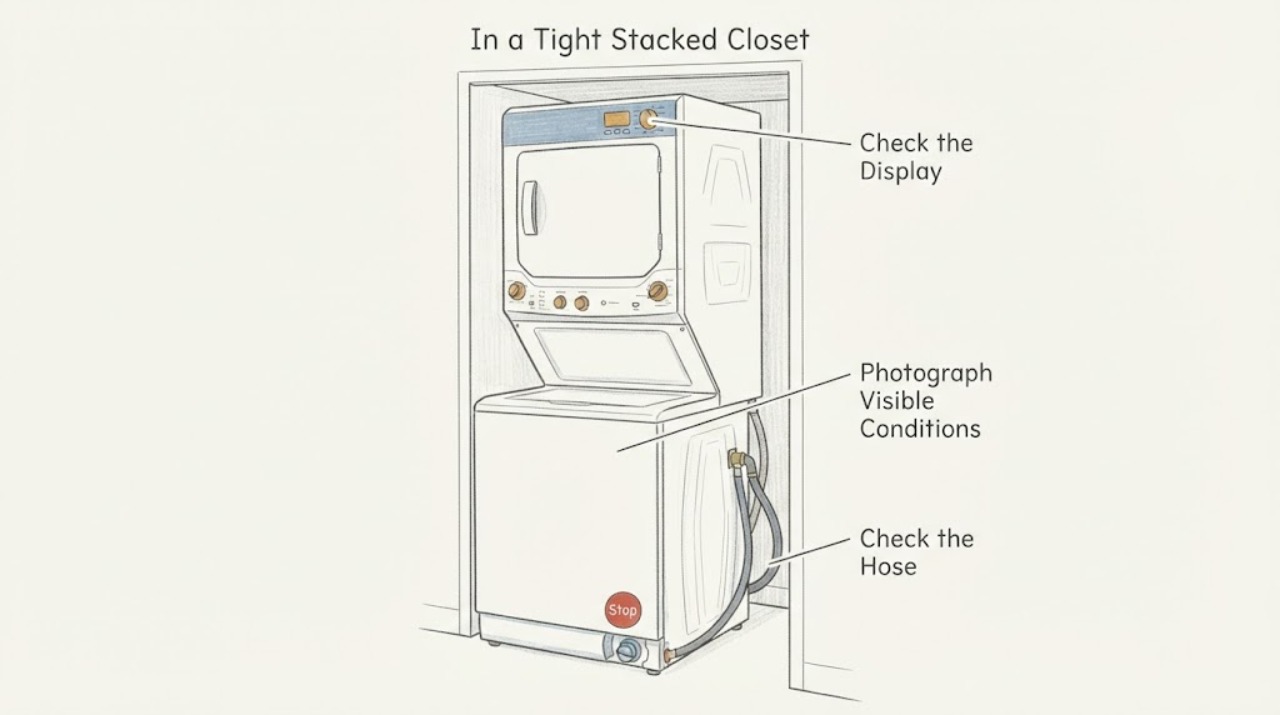
On the Whirlpool WFW70HEBW1 front-load washer, F9 E1 is Whirlpool's long-drain indication, not proof that the drain pump itself has failed. In a stacked installation inside a tight closet, begin with the full display, water left in the drum, and external observations that can be made without pulling the stack forward: a kinked or crushed drain hose, a hose pushed too far into the standpipe, a sealed drain connection, an obviously blocked household drain, or excessive suds. Whirlpool's front-load guidance says the hose should not extend more than about 4.5 inches (113 mm) into the drain and gives a maximum height of 96 inches from the washer bottom. Do not pull the stack, tilt it, remove a pump cover or filter, or dismantle the lower access just to prove a pump theory. If water remains, the door will not unlock normally, a leak is present, or the closet leaves no safe access, turn off the water and arrange qualified service; a stacked unit may need professional disconnection and movement before internal drain work.
Before you begin
Safety first
- Do not pull or tilt the stacked unit, detach the dryer or stack kit, remove a lower panel or pump cover, reach into standing water, disconnect internal hoses, bypass the door lock, or choose a drain pump, filter, sensor or control part from F9 E1 alone. Keep water and power off as appropriate for leaks, electrical hazards, smoke, heat, odour or repeated trips.
Work through in order
Diagnostic checks
Use only checks that match the exact appliance or system and its official guide.
-
Check 1
Stop the cycle and triage from the front without pulling the stacked unit forward. Note whether water is visible in the drum or on the floor, the door is locked, the display shows exactly F9 E1 or F9E1, there is foam, or there is a leak, burning smell, smoke, spark, or repeated electrical trip.
Expected result: The washer is dry with only a drain-code complaint, or water, a leak, an unsafe locked door, smoke, smell, spark, heat, or electrical trouble is present.
Next step: For a hazard, stop operation, turn off the water, disconnect power only from a dry accessible point when safe, and arrange qualified service. Otherwise keep the unit stopped while recording the exact code and water state.
Stop if: Do not force the door, reach into standing water, run another cycle to empty it, or touch wet electrical areas.
Why this matters
Why: A dry unit with a readable F9 E1 can receive limited external drain checks. Water damage, a door that cannot be handled normally, or an electrical or fire sign is a stop condition.
-
Check 2
Photograph the rating plate and display from ordinary access. Confirm Whirlpool WFW70HEBW1 and record the cycle stage, whether the code appeared while draining or at the end, the amount and temperature of water left, detergent and foam observations, and whether the dryer or upper unit blocks the washer's service access.
Expected result: The plate confirms WFW70HEBW1, the display is a different code or unclear, or the model and drain path cannot be confirmed without moving the stack.
Next step: Use the WFW70HEBW1 literature or provide the photos to service. If the code cannot be matched or access requires moving the stacked units, stop at symptom-level guidance and arrange service.
Stop if: Do not infer the model from the upper appliance, substitute F9 E1 advice from another product line, or move the stack to read a hidden label.
Why this matters
Why: The exact model and code formatting determine which Whirlpool literature applies. A code from another washer or from a dryer cannot supply a pump diagnosis, and blocked service access is itself a professional-movement boundary.
-
Check 3
Inspect only the visible portion of the external drain hose and standpipe or laundry-tub connection. Look for a kink, crushing, a hose pushed unusually far into the drain, tape or seal closing the air gap, or a visibly blocked household drain. Whirlpool's F9 E1 guidance calls for no more than about 4.5 inches (113 mm) of hose in the drain and a maximum height of 96 inches from the washer bottom; use the exact installation instructions if the route cannot be seen clearly.
Expected result: The visible hose is kinked or crushed, extends too far, is sealed into the drain, the household drain is visibly blocked, or the external route looks correctly loose and clear.
Next step: Only correct a plainly visible external routing issue without moving the stack or disconnecting plumbing. If the route is inaccessible, the code returns, or water remains, stop and arrange service.
Stop if: Do not pull the stack, disconnect a water-filled hose, seal the standpipe, reach behind the dryer, or remove the pump or lower cover.
Why this matters
Why: A visible routing or air-gap defect can delay draining or cause siphoning and is a different first branch from an internal pump failure. A clear route does not prove the pump, filter, pressure sensing or internal hose path is clear.
-
Check 4
After the drum has stopped and only if the exact manual permits a user-accessible check, inspect from normal front access for excessive suds or a visibly dirty door-seal drain opening. Do not reach behind the stack or open a filter drawer or pump cover if the installation does not leave safe ordinary access.
Expected result: There is heavy foam, lint or debris visibly blocking a door-seal drain opening, no visible foam or blockage, or the relevant filter or lower access is hidden by the stack.
Next step: Use only the exact model's user-care procedure for a plainly accessible seal or filter. If access is blocked, water remains, or F9 E1 returns, leave the washer stopped for qualified service.
Stop if: Do not remove the lower panel, unscrew a pump cover, put a hand into standing water, or run the washer with an access cover removed.
Why this matters
Why: Whirlpool lists excess suds and, on some models, a clogged pump filter or door seal among causes of poor draining. A hidden filter is not permission to dismantle the stack, and a clean visible seal does not rule out an internal restriction.
-
Check 5
Compare the drain result without deliberately repeating multiple cycles: note whether water drains after an approved external correction, whether F9 E1 returns immediately, whether the household standpipe backs up, and whether suds remain. Do not use a heated cycle or repeated resets as a pump test.
Expected result: The code clears once after a visible routing correction, returns with the route clear, the household drain backs up, or the drum still contains water.
Next step: Keep the unit out of use for a returning code, retained water or plumbing backup and provide the result to service. If the stack must be moved, have the installer or qualified technician handle disconnection, movement, leveling and reconnection.
Stop if: Do not keep running cycles to reproduce F9 E1, force a drain, tilt the washer, or order a pump from the code alone.
Why this matters
Why: A one-time improvement after a visible routing correction supports an installation or household-drain branch. A returning code or retained water means the drain result is unresolved; it does not identify a pump part without controlled inspection.
-
Check 6
Prepare the service handoff. Give the provider WFW70HEBW1, the exact F9 E1 display, the cycle and timing, water level and temperature if safely observed, hose and standpipe visibility, foam or seal observations, stack and closet constraints, and whether any prior drain work or movement occurred. State that the user did not pull, tilt or disassemble the stacked unit.
Expected result: The code is unresolved, the pump or filter area cannot be reached safely, the stack blocks the service route, or there is a leak, door problem, backup or repeat code.
Next step: Leave the washer stopped and arrange qualified Whirlpool appliance service or an installer experienced with stacked laundry. Have the provider plan safe disconnection and movement before internal drain work.
Stop if: Do not remove the dryer, detach the stack kit, open lower access, or reconnect a moved appliance without qualified installation and safety checks.
Why this matters
Why: A complete external record lets a technician separate hose installation, household plumbing, suds, retained water and internal drain investigation. The tight closet changes who can safely obtain access; it does not change F9 E1 into a confirmed pump failure.
Use your observations
Decision map
Find the observation that best matches what you see, then follow the next safe action.
-
PATH 01Next step
What you see
F9 E1 follows a visible kink, crushed hose, excessive insertion into the standpipe, sealed drain connection, or obvious household-drain blockage, and there is no leak or electrical hazard.
Do this next
Correct only the plainly visible external condition without moving the stack, then follow the exact model's permitted drain check once. If F9 E1 returns, call service.
Why this path and its safety boundary
Why it matters: The external drain route or plumbing is a stronger first explanation than a confirmed failed pump, because Whirlpool lists those conditions under long-drain guidance.
-
PATH 02Next step
What you see
The hose and visible drain connection look correct, but the standpipe backs up, the drum retains water, or F9 E1 returns.
Do this next
Leave the washer stopped and arrange qualified appliance or plumbing service. Do not access the pump or filter through a blocked stack.
Why this path and its safety boundary
Why it matters: The problem is not cleared by an external visual check. Household plumbing, an inaccessible filter or seal path, sensing, or an internal pump path may remain, but the code still does not select one part.
-
PATH 03Safety boundary
What you see
The washer is stacked in a tight closet and the drain filter, pump cover, hose connection, or lower access cannot be reached without pulling or lifting the dryer or stack.
Do this next
Stop at external observations and arrange a qualified technician or installer to plan safe disconnection, movement, leveling and reconnection before drain work.
Why this path and its safety boundary
Why it matters: The installation changes the safe first check: the user can record and inspect visible routing, but internal access and movement become an installation or service task. Whirlpool warns that stack compatibility, kit and clearances are model-dependent.
Safety stop: Do not pull the washer out, tilt it, detach the stacking kit, or ask another person to hold the dryer while you work underneath.
-
PATH 04Next step
What you see
Heavy suds are present, but the hose route is clear and there is no leak, hot water, smoke, smell or electrical hazard.
Do this next
Stop adding detergent and follow the exact model's user-care guidance for the next safe rinse or service decision. If water remains or F9 E1 returns, arrange service rather than repeating cycles.
Why this path and its safety boundary
Why it matters: Whirlpool says excess suds can delay draining; this is a detergent and drain-result branch, not proof of pump damage.
-
PATH 05Safety boundary
What you see
There is a leak, water near electrical parts, a door that cannot be handled normally, smoke, burning smell, spark, repeated trip, or water that may be hot or contaminated.
Do this next
Keep clear, turn off water and disconnect power only from a safe dry point when possible, and arrange qualified appliance service. Do not run the stacked unit to locate the leak or empty the drum.
Why this path and its safety boundary
Why it matters: This is an immediate safety branch, not a routine F9 E1 hose check.
Safety stop: No forced door opening, repeated reset, wet electrical handling, stack movement, panel removal or pump access.
Helpful context
Understand the symptom
F9 E1 describes a drain-time result. It does not tell a homeowner whether the restriction is at the hose, standpipe, household plumbing, suds, an accessible filter on a model that has one, or an internal pump path. The WFW70HEBW1 parts literature identifies the exact model and lists its installation, use-and-care and technical documents, but the exact manual still controls any model-specific access instruction.
The tight stacked installation is a safety constraint. Whirlpool says not every pair is stack-compatible, the correct manufacturer-approved kit and model-specific clearances matter, and movement or re-leveling is an installation task. If the washer cannot be reached without moving the dryer or stack, stop at external checks and give that limitation to the service provider.
When checks do not resolve it
Need a professional?
Call qualified Whirlpool appliance service for a returning F9 E1, retained water, drain backup, inaccessible pump or filter, abnormal door state, or any suspected internal drain fault. Call a qualified installer or technician to plan safe movement when the stacked WFW70HEBW1 cannot be serviced in place.
Safety scope: Do not pull or tilt the stacked unit, detach the dryer or stack kit, remove a lower panel or pump cover, reach into standing water, disconnect internal hoses, bypass the door lock, or choose a drain pump, filter, sensor or control part from F9 E1 alone. Keep water and power off as appropriate for leaks, electrical hazards, smoke, heat, odour or repeated trips.
Have this ready
- Provide the exact WFW70HEBW1 model, full F9 E1 or F9E1 display photo, cycle and timing, water level and temperature if safely observed, hose and standpipe route, visible kink or insertion, drain backup, suds, door state, stack and closet access limits, prior movement, and any leak, heat, odour, smoke, spark or trip history.
Common questions
FAQ
Does F9 E1 mean the drain pump is bad on WFW70HEBW1?
No. Whirlpool describes F9 E1 as a long-drain result. A kinked or badly routed hose, siphoning, a blocked household drain, excess suds, an accessible filter or seal path, or an internal drain problem can produce the same result. The code alone does not select a pump.
Can I pull the stacked washer out to clean the pump filter?
Not as a homeowner troubleshooting step in a tight closet. Whirlpool says stacking compatibility, kit and clearances vary by model, and movement is an installation task. If lower access is blocked, leave the stack in place and have a qualified technician plan disconnection and movement.
What should I look for on the drain hose?
From the visible front or side only, look for crushing, a kink, a hose pushed too far into the standpipe, tape sealing the drain, or an obvious household-drain blockage. Whirlpool's F9 E1 guidance uses about 4.5 inches (113 mm) as the maximum insertion and 96 inches from the washer bottom as the maximum height; exact installation instructions control when the route is unclear.
Could too much detergent cause F9 E1?
Yes, Whirlpool lists excess suds as a possible reason draining takes longer. Record whether foam remains, but do not keep running cycles to clear a code when water is retained or the drain path is inaccessible. Follow the exact model's care guidance or arrange service.
What if the door is locked with water inside?
Do not force it. Keep the washer stopped, turn off the water, and use only the exact model's safe user procedure if it is accessible without moving the stack. Otherwise arrange qualified service, especially if the water may be hot or contaminated.
Read the exact guide
Official sources
- How to Stack a Washer and DryerWhirlpool Corporation · Opened official Whirlpool installation guidance. It explicitly directs readers to model-specific instructions; it supports the no-user-movement boundary for a tight closet, not WFW70HEBW1-specific fitment or a stacking-kit part claim.
- Stack Kit Installation InstructionsWhirlpool Corporation · Opened official Whirlpool stack-kit instructions. They apply to the stack-kit installation class, not as proof that every kit fits WFW70HEBW1; the article uses them for the safety and installation boundary around a tight stacked closet.
- Error Codes in Front Load WashersWhirlpool Corporation · Opened official Whirlpool code guide. It warns that the generic list may not contain every model's codes; its F9 E1 entry supports long-drain, hose-routing and excess-suds branches without claiming an internal part.
- F9 E1 - Front Load WasherWhirlpool Corporation · Opened official Whirlpool Product Help page for front-load washers. It is used for the F9 E1 meaning and external drain guidance while exact WFW70HEBW1 literature remains the model identity authority.
- Repair Part List - W10613369 - Rev AWhirlpool Corporation · Opened official Whirlpool PDF whose model heading is WFW70HEBW1. It lists W10441093 installation instructions, W10441073 use-and-care guide and W10441082 tech sheet for this exact model; it is used to lock identity and avoid treating a generic code page as a complete manual.
Community feedback
Share a repair observation
Share a plain-text repair observation. Accepted observations are published automatically; this page may take a moment to update.