
On this page
Start here
Quick answer
Do not guess from the word error alone. Photograph the exact Whirlpool washer-dryer display, including spaces such as F8 E1 versus F8E1, and record the model, whether the unit was washing or drying, water level, door state, and what happened immediately before the code. Whirlpool's all-in-one pages are code- and cycle-specific: for example, F0E4 concerns wash-water over-temperature, F0E3 concerns excessive dry-cycle temperature, F8E1 concerns no detected water flow, F9E1 concerns draining, and F1E4 concerns a main relay. Whirlpool warns that its general washer and dryer code lists may not include every model's codes, so use the exact Owner's Manual before applying a remedy. Safe user checks are limited to external water valves and non-kinked hoses for a water-flow code, lint screen and vent condition for a dryer airflow code, removing items during a Clean Washer cycle when the model says so, and a model-approved power reset. Stop and arrange service for a code that returns, an electrical or relay fault, overheating, a leak, burning odor, smoke, sparking, a door that will not safely unlock, or any need to open the cabinet or bypass a lock.
Before you begin
Safety first
- This article supports recording the display and model, checking named external water, drain, lint, vent, or load conditions, and performing one model-approved reset when safe. It does not authorize cabinet disassembly, live electrical testing, heater or relay replacement, door-lock bypass, internal plumbing work, or operation during an unsafe condition.
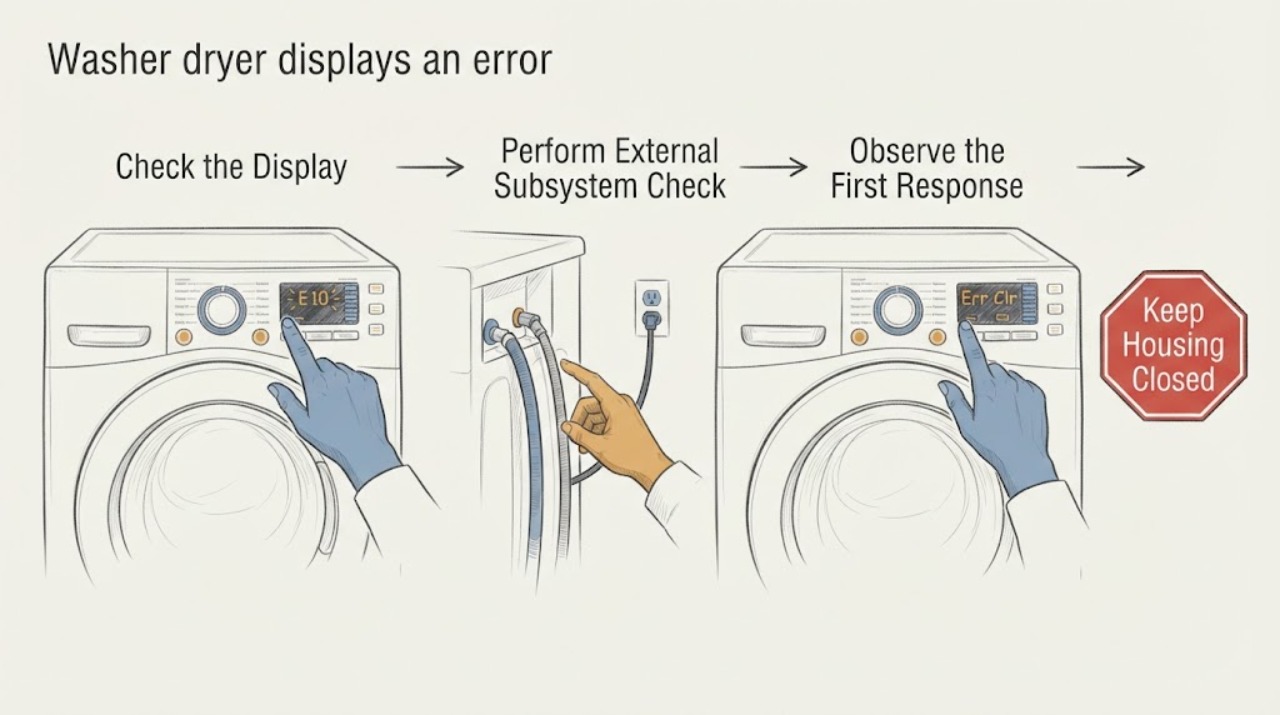
Work through in order
Diagnostic checks
Use only checks that match the exact appliance or system and its official guide.
-
Check 1
Photograph the complete Whirlpool display and record the exact code formatting, model and serial information, cycle name, stage, door state, water present, load, and any sound, odor, heat, leak, or power interruption that preceded it.
Expected result: The code is a documented F/E code, AF or F4E3, L2, PF, LOC or LC, dET, Int, Sud or Sd, or another code not present in the generic list; the code appeared during wash, drain, spin, or dry.
Next step: Use the exact model manual or Whirlpool support page for the recorded code and cycle. Keep the appliance stopped if the display is accompanied by overheating, a leak, smoke, sparking, burning odor, or an unsafe door condition.
Stop if: Stop immediately for smoke, fire, sparking, burning insulation odor, hot water or steam escaping, a major leak, a drum that cannot safely stop, or a door that will not unlock without force.
Why this matters
Why: The display pattern and stage narrow the relevant subsystem, but Whirlpool says generic washer and dryer lists may not contain every model's codes. A code not matched to the exact manual is unresolved, not permission to substitute another code's remedy.
-
Check 2
Match the photographed code and model to the exact Whirlpool Owner's Manual or the matching Whirlpool support article before changing settings, opening a drain, or starting another cycle.
Expected result: The code is F0E4, F0E3, F0E2, F1E4, F8E1, F9E1, F3E1, AF or F4E3, L2, PF, or a different model-specific code.
Next step: Follow only the matching article or manual for the captured model and stage. If no exact match is available, record the code and arrange service rather than trying a neighboring code's procedure.
Stop if: Do not guess a code from a blurry display, apply a washer remedy to the dryer side, apply a dryer remedy to the washer side, or continue if the unit is hot, wet externally, smoking, or electrically abnormal.
Why this matters
Why: Whirlpool's opened articles assign different meanings: F0E4 is wash over-temperature, F0E3 is dry-cycle over-temperature, F0E2 is excess suds, F1E4 is a possible main relay, F8E1 is no detected water flow, F9E1 is a drain issue, and F3E1 concerns water pressure. AF/F4E3 indicates dryer airflow restriction, L2 concerns dryer line voltage, and PF indicates drying-cycle power failure. These labels are not interchangeable across models.
-
Check 3
With the machine stopped and safe to approach, perform only the external check named by the matching code: verify the cold-water supply and inspect the inlet hose for a kink for F8E1 or F0E4; inspect the external drain hose and model-approved filter access for F9E1; check the lint screen and visible vent path for AF or F4E3; or remove items from the drum for rL/F34 during a Clean Washer cycle when the manual says to do so.
Expected result: A water valve is closed, the inlet hose is kinked, a drain hose or approved filter path is obstructed, the lint screen or vent is restricted, items are in the drum during Clean Washer, or the external checks are clear.
Next step: Correct only the accessible condition that the exact article identifies, keep the load and water contained, and retry only the model-approved non-heated or diagnostic step. If the code returns or the check is unclear, stop and arrange service.
Stop if: Do not remove cabinet panels, reach into a moving drum or pump, handle hot water, disconnect internal hoses, bypass the door lock, or continue a heated dry cycle after an over-temperature code.
Why this matters
Why: Whirlpool links F8E1 to no detected water flow, F9E1 to slow or absent draining, AF/F4E3 to restricted dryer airflow, and rL/F34 to items detected during Clean Washer. A clear external check does not clear a pressure sensor, pump, relay, heater, or internal control fault.
-
Check 4
If the exact Whirlpool article permits a reset and there is no active leak, heat, smoke, odor, sparking, or mechanical hazard, stop the cycle, unplug the washer-dryer or switch off its dedicated circuit for the article's specified interval, then restore power once and observe without starting a heated cycle unless the manual instructs it.
Expected result: The display clears and the appliance remains normal, the same code returns immediately, a different code appears, the appliance will not power up, or water remains in the drum.
Next step: If the code returns, leave the unit stopped and provide the code, model, stage, and reset result to service. If the machine will not power up or water remains, do not force the door or run a heated cycle.
Stop if: Do not reset repeatedly, operate a unit that is overheating or leaking, pull a wet plug, touch damaged wiring, force the door, or use a reset to bypass a relay, heater, pressure, or lock fault.
Why this matters
Why: Whirlpool's F0E3, F1E4, and F3E1 pages use a five-minute unplug reset before service when unsuccessful; other models may specify another action. A returning code points to an unresolved condition. Water left in the drum may require the exact model's drain-only procedure, not a forced door opening.
-
Check 5
When the exact code is unresolved, returns after the prescribed check or reset, or indicates an internal control, relay, sensor, temperature, drain-pump, heater, or voltage problem, leave the washer-dryer stopped and arrange qualified appliance service with the recorded evidence.
Expected result: The display shows a persistent or unknown code, the code returns after a model-approved reset, multiple subsystems fail, the dry side overheats, the washer cannot drain or fill, or the control will not respond.
Next step: Give the technician the exact model, code formatting, cycle stage, load, water and drain observations, dryer airflow observations, reset result, and any leak, heat, odor, or power symptoms. Keep the appliance disconnected when safety requires it.
Stop if: Do not open the cabinet, test live circuits, replace a relay or heater from a code alone, bypass a lock or sensor, or reconnect a unit showing smoke, sparking, uncontrolled heat, or a serious leak.
Why this matters
Why: Whirlpool's code pages direct service when their model-specific checks do not resolve the condition. A visible code does not identify a safe replacement part or authorize cabinet disassembly.
Use your observations
Decision map
Find the observation that best matches what you see, then follow the next safe action.
-
PATH 01Safety boundary
What you see
The display is readable but the code is not listed for the exact Whirlpool washer-dryer model, or the model and cycle cannot be confirmed.
Do this next
Leave the unit stopped, photograph the display again, locate the exact manual by model, and arrange service if the code cannot be matched.
Why this path and its safety boundary
Why it matters: The code's meaning and safe remedy are unknown; a similarly formatted code from another washer or dryer is not reliable evidence.
Safety stop: Do not substitute a code from a different model, run repeated resets, or start a heated cycle to see what happens.
-
PATH 02Safety boundary
What you see
The exact all-in-one article for the model shows F0E4 during the wash cycle.
Do this next
Stop the cycle, verify the external supply connection against the installation instructions, and arrange service if the connection is correct or the code returns.
Why this path and its safety boundary
Why it matters: Whirlpool identifies F0E4 as wash water that is too hot and says the washer-dryer must be connected to the cold-water supply only.
Safety stop: Do not handle hot hoses, open internal plumbing, or continue washing with unexpectedly hot water or steam.
-
PATH 03Safety boundary
What you see
The exact all-in-one article for the model shows F0E3 during the dry cycle or the appliance is abnormally hot while drying.
Do this next
Stop the dry cycle, allow the unit to cool without touching hot surfaces, verify the selected cycle against the manual, and use service if the code returns.
Why this path and its safety boundary
Why it matters: Whirlpool identifies F0E3 as temperatures too hot during the dry cycle and points to using the right fabric cycle, followed by a limited reset and service if unsuccessful.
Safety stop: Do not run another heated cycle while the unit is hot, smoking, smelling of burning, or showing an error after the reset.
-
PATH 04Safety boundary
What you see
The exact article shows F8E1 for no water flow, F3E1 for a pressure-sensor concern, or F0E4 with an incorrect water connection during wash.
Do this next
Verify the external supply valves and accessible inlet-hose condition named in the exact article. If flow or pressure is normal, or the code returns, stop and arrange service.
Why this path and its safety boundary
Why it matters: Whirlpool separates no detected flow, pressure sensing, and wash-water temperature. External valves and hose routing are reasonable first observations, but a clear hose does not prove an internal valve or sensor is good.
Safety stop: Do not loosen pressurized connections while the appliance is running, disassemble the inlet valve, or run a heated cycle to compensate for a water fault.
-
PATH 05Safety boundary
What you see
The washer side shows F0E2, Sud or Sd, Int, or F9E1, with excess suds, a paused drain, or water remaining in the drum.
Do this next
Follow the exact article: use the model-approved detergent and rinse behavior for suds, inspect the accessible drain path or filter only as the manual permits, and use a drain-only cycle only when the model directs it. Arrange service if the code persists.
Why this path and its safety boundary
Why it matters: Whirlpool links F0E2 and Sud/Sd to excess suds and F9E1 to slow or absent draining; Int can appear while a paused or canceled cycle stops spinning and drains. These conditions can require time or a drain-path check, not a forced door opening.
Safety stop: Do not force the door, reach into a moving drum, remove an internal pump, or handle contaminated or hot water without the model's safe procedure.
-
PATH 06Safety boundary
What you see
The exact article shows F1E4, a persistent F/E code, AF or F4E3, L2, PF, or another dryer/control code during drying.
Do this next
For AF/F4E3, inspect the lint screen and visible vent path; for L2, do not work on the electrical supply and arrange qualified electrician help if the exact article says it persists; for PF, follow the model's restart instruction only if safe. For F1E4, recurring F/E, or abnormal heat, stop and arrange service.
Why this path and its safety boundary
Why it matters: Whirlpool identifies F1E4 as a possible main-relay issue; AF/F4E3 as restricted dryer airflow; L2 as low or no line voltage; PF as a drying-cycle power failure; and alternating F# E# codes as a control problem requiring service.
Safety stop: Do not open the control cabinet, test a 240-volt circuit, bypass a relay, run a heated cycle with restricted airflow, or repeatedly reset a code that returns.
Helpful context
Understand the symptom
The code, model, and cycle are one diagnosis
A Whirlpool all-in-one washer-dryer can show codes for the wash side, the dry side, water supply, draining, sensing, or controls. The same-looking display format does not make codes interchangeable across models. Photograph the display exactly, write down the model number, and state whether the code appeared during fill, wash, drain, spin, dry, or immediately at startup. Whirlpool's general front-load washer and dryer lists explicitly warn that a model may use additional or different codes, so the model manual outranks a generic list.
Examples of code-specific decisions
Whirlpool's all-in-one guidance gives different next steps for different codes. F0E4 points to wash water that is too hot and asks the owner to verify the cold-water connection. F8E1 points to no detected water flow and asks for the supply valve and inlet hose to be checked. F9E1 points to a drain problem, while F0E3 points to an over-temperature condition during drying. F1E4 identifies a possible main-relay problem. These are examples from the linked Whirlpool pages, not a universal code chart.
A reset is not a diagnosis
Some Whirlpool all-in-one pages describe unplugging the unit for at least five minutes and then calling for service if the code returns. A reset can clear a transient control state, but it cannot prove that a relay, pressure sensor, drain pump, water path, heater, or temperature condition is safe. Do not keep cycling power when the unit is overheating, leaking, smoking, sparking, or mechanically locked.
Keep wash and dry safety boundaries separate
Water-related codes call for external hose, valve, or drain checks; dry-side codes can involve airflow, line voltage, temperature, moisture sensing, or control electronics. Do not run a heated dry cycle to test a code that appeared during wash, and do not interpret a dryer's airflow code as a washer fill fault. Never open the cabinet, work on high-voltage wiring, defeat the door lock, or reach into a moving or hot drum.
Safety boundary
Stop conditions
- Record the exact code formatting, Whirlpool model, and washer or dryer stage before choosing a remedy; do not cross-apply codes between models or between wash and dry stages.
- Stop and isolate the appliance for smoke, fire, sparking, burning odor, uncontrolled heat, a major leak, hot water or steam escaping, or a door or drum that cannot safely stop.
- Do not open the cabinet, test live wiring or line voltage, bypass a door lock or sensor, replace a relay or heater from a code alone, or force the door to reach wet laundry.
- Do not repeatedly reset a returning code, run a heated dry cycle after an over-temperature or airflow warning, or operate when a drain or water condition leaves the unit unsafe.
- Arrange qualified Whirlpool appliance service for a persistent or unknown code, a main-relay or control code, recurring temperature or drain faults, an unresolved pressure or water-flow code, repeated power faults, or any internal repair need.
Only after diagnosis
Potential parts
- Whirlpool washer-dryer water inlet valve or hose assembly
Consider this category only when the exact model's code and service diagnosis confirm a water-flow, pressure, or temperature-connection fault beyond the external valve and hose checks.
Confirm the exact Whirlpool model, hose routing, valve configuration, and electrical connector; do not replace from a code alone. - Whirlpool washer-dryer drain pump, filter, or drain hose
Consider this category only when F9E1 or a matching model-specific drain diagnosis persists after approved external drain-path checks.
Confirm the exact model and drain configuration; isolate water and power and leave internal pump work to qualified service. - Whirlpool washer-dryer temperature sensor, heater, or airflow component
Consider this category only after service confirms an F0E3, F0E4, airflow, or temperature-system fault for the recorded cycle and model.
Confirm the exact model and cycle-side component; do not run a heated test with an over-temperature or airflow warning. - Whirlpool washer-dryer control board, relay, pressure sensor, or door-lock assembly
Consider this category only when qualified diagnosis confirms a recurring F1E4, pressure, lock, communication, or other internal control condition.
Confirm the exact model, control revision, and fault evidence; do not bypass a relay, sensor, lock, or safety circuit.
When checks do not resolve it
Need a professional?
Arrange qualified Whirlpool appliance service when the code is unknown for the exact model, returns after the model-approved check or reset, indicates a relay, control, pressure sensor, temperature, drain-pump, heater, or internal wiring problem, or leaves the appliance unable to fill, drain, unlock, or dry safely. For a dryer L2 or other line-voltage warning, involve a qualified electrician rather than opening the appliance. Stop immediately for smoke, fire, sparking, burning odor, uncontrolled heat, a major leak, hot water or steam escaping, or an unsafe door and seek emergency help when appropriate. Give service the exact model, code formatting, cycle stage, load, external hose or vent observations, reset result, and safety symptoms.
Safety scope: This article supports recording the display and model, checking named external water, drain, lint, vent, or load conditions, and performing one model-approved reset when safe. It does not authorize cabinet disassembly, live electrical testing, heater or relay replacement, door-lock bypass, internal plumbing work, or operation during an unsafe condition.
Common questions
FAQ
Can I look up a Whirlpool washer-dryer error by the code alone?
Use the exact model and cycle as well as the code. Whirlpool says its general washer and dryer lists may not include every code for a model, and all-in-one pages assign different meanings to similar-looking codes. Photograph the display, including spaces, before choosing a check.
What does F8E1 mean on a Whirlpool all-in-one washer-dryer?
On Whirlpool's opened all-in-one support page, F8E1 means no water flow was detected. The listed external checks are the water supply, open valve, cold-water connection, and a non-kinked inlet hose. Use that meaning only when it matches the exact model and stage; call for service if the code persists.
What should I do if F0E3 appears during drying?
Whirlpool identifies F0E3 as a dry-cycle over-temperature condition. Stop the dry cycle, let the unit cool, verify the selected fabric cycle against the model manual, and use the article's limited reset only when there is no active heat or other hazard. If the code returns, arrange service and do not keep running heated cycles.
Can I keep running the washer if it shows F9E1?
F9E1 is a Whirlpool all-in-one drain issue. Stop and follow only the exact model's approved external drain, filter, or hose check. Do not force the door or reach into the pump. If water remains or the code returns, arrange service.
Is a five-minute reset enough to fix a Whirlpool washer-dryer error?
No. Whirlpool lists a five-minute reset for some all-in-one codes such as F0E3, F1E4, and F3E1, but the code's model and stage still control the decision. A returning code, relay or temperature warning, leak, overheating, smoke, sparking, or unsafe lock requires service rather than repeated resets.
Read the exact guide
Official sources
- F0E2 - Error Code - All-In-One Washer DryerWhirlpool Product Help · Use only when the exact Whirlpool all-in-one model and display show F0E2 or its manual maps the same code to excess suds.
- F9E1 - Error Code - All-In-One Washer DryerWhirlpool Product Help · Use only when the exact Whirlpool all-in-one model displays F9E1; internal drain work remains a service boundary.
- F3E1 - Error Code - All-In-One Washer DryerWhirlpool Product Help · Use only when the exact Whirlpool all-in-one model displays F3E1; do not infer a pressure reading or replace a sensor from the display alone.
- Error Codes in Front Load WashersWhirlpool Product Help · Use only for Whirlpool front-load washer code examples and warnings; do not assume every code applies to an all-in-one model.
- F0E3 - Error Code - All-In-One Washer DryerWhirlpool Product Help · Use only for an exact Whirlpool all-in-one model displaying F0E3 during the dry cycle; do not transfer to wash codes.
- F1E4 - Error Code - All-In-One Washer DryerWhirlpool Product Help · Use only when the exact Whirlpool all-in-one model displays F1E4; the relay and control diagnosis is not a user part-selection instruction.
- Error Codes in DryersWhirlpool Product Help · Use for Whirlpool dryer-side code examples; an all-in-one washer-dryer model may have separate code meanings in its own manual.
- F0E4 - Error Code - All-In-One Washer DryerWhirlpool Product Help · Use only for an exact Whirlpool all-in-one model displaying F0E4 during wash; do not transfer to the dry side.
- F8E1 - Error Code - All-In-One Washer DryerWhirlpool Product Help · Use only when the exact Whirlpool all-in-one model displays F8E1; external water checks do not diagnose internal valves or sensors.
Community feedback
Share a repair observation
Share a plain-text repair observation. Accepted observations are published automatically; this page may take a moment to update.