
On this page
Start here
Quick answer
Do not force a locked Whirlpool washer or all-in-one washer-dryer door. First identify whether the locked door is on the wash side of a separate laundry pair or on a single all-in-one unit, then wait for the tub to stop, the water level to fall, and hot wash water or a dry cycle to cool. Cancel the cycle using the model's documented control, check whether Control Lock is active, and inspect the door or gasket only from outside for clothing or soap buildup. If water remains, the pump runs continuously, an error returns, or the door stays locked, a drain or lock fault may be involved. A single model-appropriate power reset can be tried only when the area is dry and safe. Stop for standing water near electricity, a hot or damaged cord, smoke, burning smell, sparks, flooding, or a damaged latch; never bypass the lock or open the cabinet.
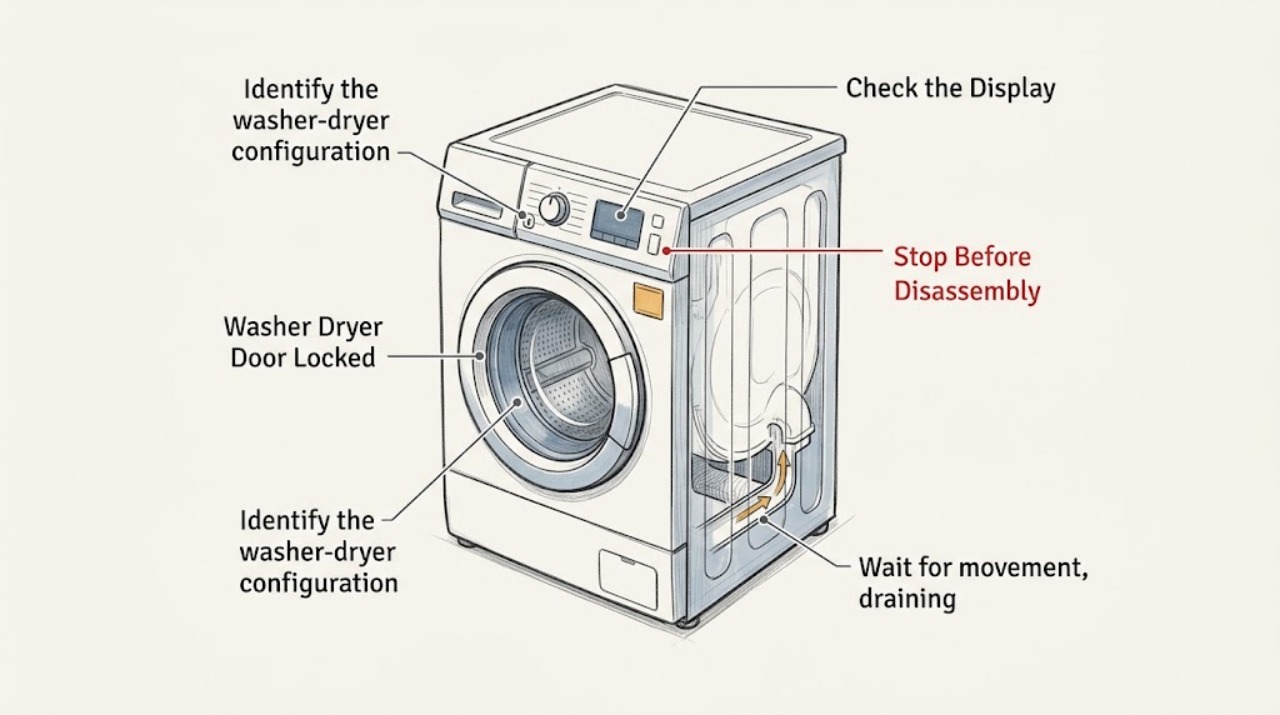
Work through in order
Diagnostic checks
Use only checks that match the exact appliance or system and its official guide.
-
Identify the washer-dryer configuration and lock state
From outside the machine, determine whether this is a separate Whirlpool front-load washer paired with a dryer or a single all-in-one washer-dryer. Note whether the locked part is the wash door, a dryer door, or the shared all-in-one door; record whether the cycle is washing, draining, spinning, cooling, or drying and whether a lock indicator or error is displayed.
Expected result: The wash door is locked during a running cycle, the shared all-in-one door is locked after washing, the dryer side is hot or cooling, or the control is unresponsive with an error or lock symbol.
Next step: Follow the wait, cancel, Control Lock, drain, or reset branch that matches this configuration. Do not pull the door or attempt a manual release while the tub is moving, water is present, or the dryer is hot.
Why this matters
Why: A wash door can remain locked for safety while the tub is moving or water is hot. An all-in-one door can remain locked into Dry Mode or because water remains. A lock symbol or error can be a control state rather than a failed latch.
-
Wait for movement, draining, and heat to become safe
If the washer is tumbling, spinning, pumping, or drying, press the model's Pause or Cancel control once and wait without touching the door. Observe whether the tub stops, the pump finishes, the lock indicator clicks off, and the door or shared unit cools. Keep children away and do not reach through the gasket.
Expected result: The door unlocks after the tub stops and water or heat falls, the pump continues, the unit remains hot, or the lock remains on after the cycle should be complete.
Next step: If the lock releases, open the door normally and end the check. If water remains, the machine is hot, or the lock remains on, continue with the drain and control-state checks; never force the door.
Stop if: Stop for a heavy leak, flooding, water near electrical connections, smoke, burning smell, sparks, or a damaged door or latch.
Why this matters
Why: Whirlpool explains that high water level, hot water, tumbling, spinning, or an active dry state can intentionally delay unlocking. A pump that continues or a door that stays locked after those conditions clear points to drainage, error, or lock diagnosis.
-
Check Control Lock and cancel the cycle normally
Look for a padlock, key, LoC, or LC indicator and use the exact model manual to deactivate Control Lock. If the cycle must end, use the documented Pause/Cancel or Power/Cancel command rather than pulling the plug immediately; on many models the cancel command drains the washer before the door can unlock.
Expected result: The Control Lock indicator clears, the cancel command starts a controlled drain, the controls remain locked, or an error or flashing light returns.
Next step: Allow the documented cancel or drain routine to finish. If controls remain unresponsive or the lock indicator returns, record the exact display and move to the drain or single-reset branch; do not bypass the lock.
Why this matters
Why: Whirlpool says Control Lock prevents normal button operation, while canceling can end a cycle and allow a door to unlock after water is removed. A persistent lock or error after the documented control command suggests a model-specific fault.
-
Check the door, gasket, and lock area from outside
With the cycle stopped and the door cool, inspect the visible gasket and latch opening for a trapped garment, foreign object, or soap buildup. Confirm the door closes evenly without forcing it; do not remove the gasket, insert a tool into the lock, or disassemble the front panel.
Expected result: An object or buildup prevents closure, the gasket is torn or displaced, the door closes and latches normally, or the lock mechanism appears damaged or binds.
Next step: Remove only an obvious external obstruction and wipe accessible buildup with a soft damp cloth as directed by the manual, then test one normal start. If the latch still fails or the gasket or door is damaged, leave the unit off and arrange qualified appliance service.
Stop if: Stop if glass, hinge, gasket, latch, or frame is cracked, sharp, displaced, or under tension.
Why this matters
Why: Whirlpool identifies gasket or lock-area obstructions and buildup as reasons a front-load door may not latch. A damaged or binding lock is a safety-control issue and cannot be safely proven or repaired by forcing the door.
-
Use the drain and all-in-one dry-mode branch
Look through the door only for standing water and note whether the drain pump is running or the unit was in Dry Mode, Tumble Fresh, or another post-wash option. Check the external drain hose for a visible kink without disconnecting it or opening a full tub. On an all-in-one model, use the owner's manual for the model's drain or end-cycle command.
Expected result: Water remains in the tub, the pump runs continuously, the washer is in a dry or freshness phase, the hose is visibly kinked, or the tub is empty but the door stays locked.
Next step: Allow the documented dry or drain routine to finish and correct only an obvious external hose position when safe. If the tub stays full, the pump only runs, or the door remains locked after an empty and cool tub, arrange service; do not drain through an improvised opening.
Stop if: Stop for a leak, water near electricity, a flooded floor, a hot tub, or any need to open the pump or lock path with water present.
Why this matters
Why: Whirlpool says a lock can remain on to prevent flooding when water cannot drain, and an all-in-one door can stay locked because Dry Mode or a freshness option is active. A continuous pump or a full tub changes the problem from a simple latch wait to a drain or control fault.
-
Try one safe model-appropriate power reset
Only when the washer-dryer, floor, cord, and outlet are dry and there is no heat, odor, leak, or electrical damage, follow the owner's manual for one power reset. Whirlpool's guidance commonly uses a short power disconnect, but the exact duration and sequence vary by model; restore power once and wait for the lock indicator to clear. Do not repeat the reset or cycle a breaker that trips.
Expected result: The lock indicator clears and the door opens after the unit is idle, the controls remain unresponsive, an error returns, or the breaker trips.
Next step: If the lock clears, run no more than one supervised empty or model-directed test. If it remains locked, an error returns, or the circuit trips, leave the unit off and arrange qualified appliance or electrical service.
Stop if: Do not reset or reconnect power when the floor or outlet is wet, the cord is hot or damaged, there is smoke or burning odor, or a breaker will not hold.
Why this matters
Why: A control reset can clear a transient state, but it cannot repair a failed lock, blocked drain, hot-water condition, or electrical fault. A repeated error or trip is evidence for service, not a reason to keep resetting.
-
Prepare a service handoff without forced entry
Record the exact Whirlpool model, separate washer or all-in-one identity, cycle and phase, lock or error display, water level, temperature or dry state, drain-pump sound, door and gasket result, and any reset result. Keep the door closed and the unit off if the lock persists or a hazard is present; do not manually unlock it unless the exact owner manual provides a safe procedure for that model.
Expected result: The lock remains after the tub is empty and cool, the same error returns, the door or latch is damaged, water cannot drain, or there is an electrical or flooding warning.
Next step: Arrange qualified Whirlpool appliance service for a persistent locked door, failed latch, error, or drain fault. Use qualified electrical or plumbing service for a circuit or household drain problem; do not open the cabinet or bypass the safety lock.
Why this matters
Why: This record distinguishes a normal safety delay or Control Lock state from a door-lock, drain, control, or wiring fault. It also prevents a technician from having to reproduce a potentially hot, wet, or unsafe condition.
Use your observations
Decision map
Find the observation that best matches what you see, then follow the next safe action.
-
PATH 01Next step
What you see
The wash tub is tumbling, spinning, pumping, or still hot, and no hazard is present.
Do this next
Pause or cancel using the model's control and wait for movement to stop, water level to fall, and temperature to become safe. Do not pull or pry the door.
-
PATH 02Next step
What you see
The all-in-one washer-dryer has finished washing but indicates water remains, a freshness option, or Dry Mode.
Do this next
Allow the documented drain, cooling, or dry routine to finish and use the model manual's end-cycle control. If the door remains locked after an empty, cool tub, arrange service.
-
PATH 03Next step
What you see
A padlock, LoC, or LC indicator appears and the buttons seem unresponsive.
Do this next
Use the model-specific Control Lock command to deactivate it. If the controls remain locked or an error returns, record the display and arrange service rather than bypassing the lock.
-
PATH 04Next step
What you see
The gasket or lock area has a visible clothing obstruction or soap buildup, but the door, glass, and frame are intact.
Do this next
Remove only the obvious external obstruction and clean accessible buildup as directed by the manual, then test one normal start. A persistent latch failure requires service.
-
PATH 05Next step
What you see
Water remains in the tub, the pump runs continuously, or a drain error prevents the door from unlocking.
Do this next
Do not open the lock or pump path with water present. Check only the external drain hose for an obvious kink and follow the model's safe drain instructions; persistent water or humming requires qualified service.
-
PATH 06Next step
What you see
The unit is empty and cool, the door still will not unlock, and the area is dry and undamaged.
Do this next
Try one model-appropriate power reset, then wait for the lock indicator to clear. If the lock remains or the error returns, leave the unit off and arrange qualified appliance service.
-
PATH 07Next step
What you see
There is standing water near electricity, flooding, a hot or damaged cord, smoke, burning odor, sparks, a damaged latch or glass, or a breaker that trips again.
Do this next
Stop using the washer-dryer and keep clear. Disconnect power only from a safe dry location if possible; otherwise leave the area and arrange qualified appliance or electrical service. Never force the door.
Helpful context
Understand the symptom
A lock can be normal during a cycle
Whirlpool locks the front-load wash door while the tub is tumbling or spinning and while water is too high or too hot. An all-in-one washer-dryer may remain locked after washing because water is still present, a freshness option is active, or the unit has entered Dry Mode. A short wait and a model-specific cancel or pause command can be enough; a lock that persists with water, an error, or an unresponsive control needs a different branch.
Keep the lock and water path intact
Keep hands out of the drum, do not pull the door or use a tool to pry it, and never bypass a door-lock switch. A locked door may be preventing a flood or exposure to hot water. Keep the floor and electrical connections dry; if the machine leaks, the pump runs without draining, or there is an electrical or burning warning, stop and arrange qualified appliance service.
Safety boundary
Stop conditions
- Stop for standing water near the plug, outlet, cord, controls, or another electrical connection, flooding, smoke, sparks, a burning smell, a hot or damaged cord, or a breaker that trips again.
- Stop while the tub is moving, water is hot, the dryer is hot, or the pump is running continuously; wait for a safe state and do not force the door.
- Do not pry the door, bypass a lid or door-lock switch, reach into a moving or full tub, or open the cabinet or pump path with water present.
- Stop for cracked glass, a damaged or binding latch, a torn gasket, a sharp frame, or any need to manually unlock the door without exact model instructions.
- Arrange qualified appliance service when the door remains locked after the tub is empty and cool, the same error returns, or safe control, drain, and single-reset checks fail.
Only after diagnosis
Potential parts
- door lock or latch assembly
Consider this only when a qualified diagnosis confirms that correct control, temperature, door closure, and drain conditions are present but the safety lock does not release or engage.
Lock assemblies vary by separate washer and all-in-one model; verify the exact model and use qualified installation. - door gasket
Consider this only if a qualified diagnosis confirms that a torn or persistently displaced gasket prevents the door from closing or sealing after external obstructions are removed.
Gaskets are model-specific and may require partial disassembly; confirm fitment and safe installation before ordering. - drain pump or drain hose
Consider this only after a qualified diagnosis isolates a recurring no-drain condition to the appliance pump or hose rather than a household drain or visible external kink.
Drain components vary by model and can contain water; verify exact fit and use safe qualified service. - control board
Consider this only when qualified testing confirms that the control does not command or recognize the door lock after the lock, drain, temperature, and wiring paths are checked.
Electronic controls are model-specific and involve electrical hazards; do not infer compatibility from the brand alone.
When checks do not resolve it
Need a professional?
Arrange qualified Whirlpool appliance service when a wash or all-in-one washer-dryer door remains locked after movement stops and the tub is empty and cool, when the latch or gasket is damaged, when water cannot drain, when an error returns, or when a single model-appropriate reset does not clear the lock. Use qualified electrical service for a wet or repeatedly tripping circuit and qualified plumbing service for a household drain problem. Provide the exact model, configuration, cycle phase, display state, water or heat condition, and observed safety symptoms.
Common questions
FAQ
Why is my Whirlpool washer door still locked after the cycle?
The tub may still be moving, draining, or too hot, or water may remain inside. Wait for the machine to stop, use the model's Pause/Cancel control, and check the water state. Never force the door; a persistent lock with an empty, cool tub needs service.
Why is my Whirlpool all-in-one washer-dryer door locked after washing?
Whirlpool identifies remaining water, a freshness option, or Dry Mode as possible reasons. Let the documented drain, cool-down, or dry routine finish. If the tub is empty and cool but the door remains locked, arrange qualified service.
What does LoC or LC mean on a Whirlpool washer?
It usually indicates that Control Lock is active, not necessarily a mechanical door failure. Use the exact model's Control Lock command to deactivate it. If the controls remain unresponsive or another error appears, do not bypass the lock.
Can I reset a Whirlpool washer with a locked door?
Only try one model-appropriate power reset when the machine and electrical area are dry, cool, and undamaged. Follow the owner's manual because reset steps vary. Do not repeat resets, cycle a tripping breaker, or reset while water is near electricity.
How do I open a locked Whirlpool washer-dryer door?
Do not pry or bypass the lock. First wait for movement, draining, and heat to end; cancel the cycle and address Control Lock using the manual. If water remains, the latch is damaged, an error returns, or the empty cool door stays locked, use qualified appliance service.
Read the exact guide
Official sources
- Door Will Not Lock or Unlock - Front Load WasherWhirlpool Product Help · Whirlpool front-load washer lock obstruction, Fresh Hold, drain-and-spin, power reset, and service guidance
- How Do You Reset a Washer Machine: A Step-by-Step GuideWhirlpool · Whirlpool washer locked-door cancel, power reset, Control Lock, and model-specific reset guidance
- Front Load Washer Door Will Not OpenWhirlpool Product Help · Whirlpool front-load washer door lock, water level, temperature, drain, pause, and model-error troubleshooting
- LoC or LC - Front Load WasherWhirlpool Product Help · Whirlpool front-load washer Control Lock indicator and control deactivation guidance
- Latching a Front Load Washer DoorWhirlpool Product Help · Whirlpool front-load washer gasket, latch, lock, cancel, drain, and power-cycle guidance
- Door Will Not Unlock - All-In-One Washer DryerWhirlpool Product Help · Whirlpool all-in-one washer-dryer error, temperature, door-lock malfunction, and manual-specific unlock guidance
- Door is Locked at the End of the Wash Cycle - All-In-One Washer DryerWhirlpool Product Help · Whirlpool all-in-one washer-dryer post-wash door-lock, water, freshness-option, and Dry Mode behavior
Community feedback
Share a repair observation
Share a plain-text repair observation. Accepted observations are published automatically; this page may take a moment to update.