
On this page
Start here
Quick answer
First decide whether the washer-dryer is still running or has water in the drum; a locked door can be a protective state, so do not pull or pry it open. If the display says LOC, Electrolux identifies that as the control lock and directs you to select the control-lock option again to unlock it. If it says E42, check that the door closes fully, that clothing or debris is not in the way, and that the latch and striker engage. If it says E11 or the drum is not filling or draining normally, follow the water-supply branch and allow the documented lock period to finish rather than repeatedly resetting the appliance. A door that stays locked after the cycle is safely stopped, or a door-lock code that returns after the visible checks, needs model-specific service diagnosis.
Before you begin
Safety first
- Never force a locked Electrolux washer-dryer door or use a tool to defeat the lock. Do not remove the cabinet or test the interlock, wiring, control board, drain pump, or water-level circuit unless you are qualified and the appliance is isolated according to the model service procedure.
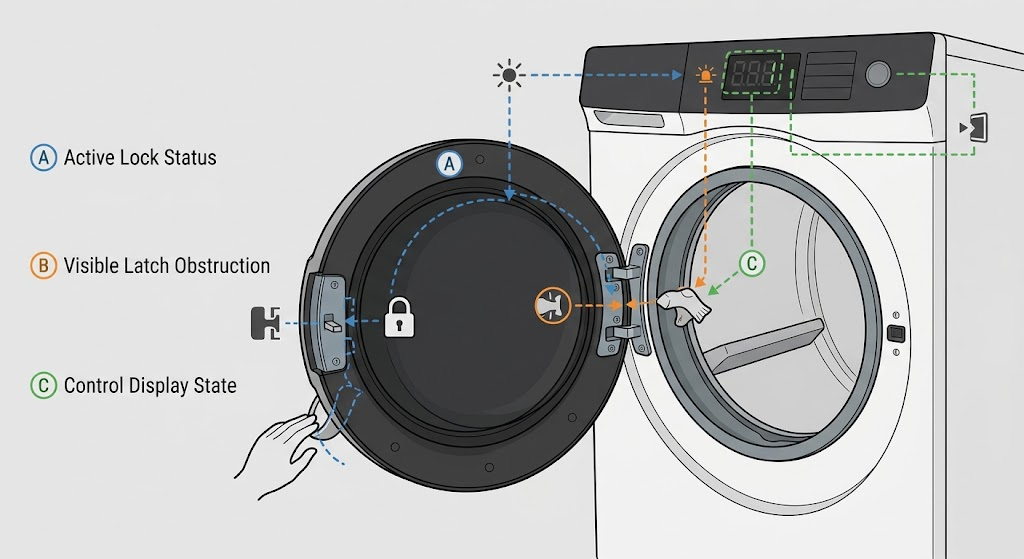
Work through in order
Diagnostic checks
Use only checks that match the exact appliance or system and its official guide.
-
Check 1
Look at the display and safely note whether the drum is moving, whether water is visible through the door, and whether the door is physically closed but merely locked. Record any code exactly, including LOC, E42, or E11.
Expected result: The cycle is active or water is present; the controls show LOC, E42, E11, another code, or no code.
Next step: If the drum is moving or water is present, keep the door closed and use only the documented pause, cancel, or drain control for this model. If a code is shown, continue with its matching branch below.
Why this matters
Why: An active cycle or visible water can explain a protective lock. LOC points to the control-lock feature, E42 to door-lock recognition, and E11 to a long-fill condition; another code must be matched to the exact model manual.
-
Check 2
If the cycle has ended, use the model manual's normal pause or cancel procedure and wait for the appliance to finish its own unlock sequence; do not pull the handle or insert an object into the seal or latch.
Expected result: The door unlocks after the documented end-of-cycle sequence, or it remains locked with no active movement and no visible water.
Next step: If it unlocks, remove the load and test an empty short cycle only if the manual permits it. If it remains locked, stop user troubleshooting and prepare the model information for service.
Why this matters
Why: An unlock after the cycle points to a normal protective state. A persistent lock after a safely completed sequence is not resolved by force and points toward a latch, interlock, sensing, or control diagnosis.
-
Check 3
With the appliance stopped and the door still closed, inspect only the visible door opening: look for a trapped item, lint, or debris at the latch/striker and gasket, and close the door gently while listening for the normal engagement click.
Expected result: The obstruction can be removed without tools and the door now closes squarely with an engagement click, or the door is misaligned, will not latch, or has damaged glass, hinge, latch, or striker.
Next step: Remove only the loose visible obstruction, close the door gently, and retry once. If the latch still will not engage, the door is damaged, or E42 returns, leave the appliance unused and arrange professional diagnosis.
Why this matters
Why: Electrolux lists incomplete closure, clothing or debris, and latch/striker operation as the visible checks for E42. Damage or a latch that does not engage is a hardware or alignment fault, not a reason to bypass the lock.
-
Check 4
If the display shows LOC, select the control-lock option using the model's normal controls; then select that same option again as Electrolux describes for unlocking.
Expected result: The control-lock icon clears and the cycle controls respond, or LOC remains and the controls still will not run a cycle.
Next step: If the icon clears, run the intended cycle only when the door closes and latches normally. If the model uses different buttons, or LOC remains after the manual sequence, stop repeated button experiments and request model-specific service.
Why this matters
Why: LOC is the control lock used between cycles, and Electrolux states that washer cycles will not run while it is active. It is different from a failed door-lock device.
-
Check 5
If E11 is displayed, or the appliance is waiting for water, check from outside that both supply valves are open and that the hot and cold hoses are not reversed or kinked; do not disconnect hoses while pressurized.
Expected result: The valves are closed, a hose is kinked, or the connections were recently changed; alternatively the external supply looks correct and E11/locking persists.
Next step: Correct only an obvious valve or hose-position issue, then allow the appliance's documented waiting period to finish once. Do not keep power-cycling it. If E11 returns, water remains, or the door stays locked, stop and arrange service.
Why this matters
Why: Electrolux defines E11 as a long-fill condition and notes that the unit can remain locked for up to six minutes; unplugging and reconnecting restarts that lock period. A correct external supply with a persistent code needs deeper diagnosis.
-
Check 6
If the lock persists after the safe checks, record the full display, whether water remains, the point in the cycle when it locked, and the appliance model and serial information from the product label or manual.
Expected result: A complete symptom record and model identity are available, or the appliance has smoke, burning odor, sparking, a hot damaged door, an active leak near electrical parts, or repeated electrical trips.
Next step: For a persistent but non-urgent lock, keep the appliance out of use and give the record to an authorized Electrolux service provider. For smoke, burning, sparking, uncontrolled water, severe heat, or electrical trips, switch off power only if it can be done without contact with water, isolate the water supply if safe, leave the area, and seek urgent professional help.
Why this matters
Why: A recurring lock can require testing of the interlock, latch alignment, drain/water-level sensing, wiring, or control system; those tests can expose live or stored energy and are not safe to infer from the symptom alone. Hazard signs make the situation urgent.
Use your observations
Decision map
Find the observation that best matches what you see, then follow the next safe action.
-
PATH 01Next step
What you see
The drum is moving or water is visible.
Do this next
Keep the door closed and use the model's documented pause, cancel, or drain sequence. Do not force the door; escalate if the cycle cannot safely finish or water cannot be removed.
-
PATH 02Next step
What you see
The display shows LOC and the appliance is otherwise intact.
Do this next
Use the control-lock option again as specified for the model. If the icon will not clear or the controls remain disabled, stop and request model-specific service.
-
PATH 03Next step
What you see
The display shows E42, the door will not latch, or the door closes without an engagement click.
Do this next
Check only for a loose visible obstruction and obvious latch/striker alignment. If the check fails or E42 returns, do not bypass the interlock; arrange service.
-
PATH 04Next step
What you see
The display shows E11 or the lock follows a fill problem.
Do this next
Check external valves and hose routing once, allow the documented waiting period, and stop if the code or standing water persists.
-
PATH 05Next step
What you see
The door remains locked after a safely completed cycle, a code returns, or any hazard sign is present.
Do this next
Keep the appliance out of use and seek professional diagnosis; do not open the cabinet, defeat the interlock, or attempt live electrical testing.
Helpful context
Understand the symptom
Why the door may stay locked
The lock is part of the washer-dryer safety sequence. Treat the state differently depending on whether the drum is moving, water is visible, or a code is displayed. Do not force the handle while the appliance may still be running or holding water. The checks below are limited to the controls and visible door area; cabinet, interlock, wiring, and live electrical diagnosis belong to a qualified technician.
Before you start
Keep the door closed, keep children away from the appliance, and note the exact display text before changing settings. If the unit was recently installed or moved, keep that fact for the service conversation. Exact button names vary by model, so use the model manual for any cancel, drain, or control-lock sequence.
Read the result, not just the symptom
A click and a locked door during a normal cycle do not by themselves prove a failed lock. A door that will not latch, a recurring E42, an unresponsive LOC control lock, standing water, or a returning code changes the next step. Stop at the branch that requires opening the cabinet or defeating the interlock.
Only after diagnosis
Potential parts
- door lock or interlock assembly
Consider this category only if the door closes correctly, visible debris is absent, and E42 or a persistent lock is confirmed by model-specific diagnosis.
Confirm the complete appliance model and the manufacturer's fit information before ordering; do not infer fit from the symptom or appearance. - door latch or striker
Consider this category only when the visible latch or striker is damaged or fails to engage after the door and gasket are clear.
Match the exact model and revision using manufacturer information; a similar-looking latch is not proof of compatibility. - drain or water-level sensing component
Consider this category only after standing water or recurring E11 remains despite correct external valves and hose routing, and a technician confirms the relevant test result.
Use the model-specific parts information and service diagnosis; do not replace a sensing or drain component solely because the door is locked. - control interface or control board
Consider this category only if LOC or another control symptom remains after the documented control-lock sequence and the technician rules out the latch and wiring.
Confirm model-specific fit and programming requirements with the manufacturer or technician before ordering.
When checks do not resolve it
Need a professional?
Call a qualified appliance technician when the door remains locked after the normal model-specific unlock sequence, E42 returns after the visible closure check, LOC cannot be cleared with the documented controls, E11 or standing water persists after the external supply check, or the door, hinge, latch, striker, wiring, or cabinet is damaged. Give the technician the exact code, water state, cycle point, and model/serial information.
Common questions
FAQ
Can I pull the Electrolux washer-dryer door open when it is locked?
No. Keep it closed while the drum may be moving or water may be present. Use the model's normal pause, cancel, or drain procedure and escalate rather than prying or bypassing the lock.
What does LOC mean on an Electrolux front-loading laundry appliance?
Electrolux identifies LOC as the control lock used between cycles. Select the control-lock option again using the model's controls to unlock it; cycles will not run while the control lock is active.
What does E42 mean when the door is locked?
Electrolux says E42 means the door lock is not being recognized. Check complete closure, visible clothing or debris, and whether the latch and striker engage. If it persists, arrange service.
Why does E11 matter if the complaint is a locked door?
E11 is Electrolux's long-fill condition. The appliance may remain locked temporarily; check the external hot and cold supply and hose routing, avoid repeated resets, and seek service if the code, water, or lock persists.
Read the exact guide
Official sources
- Where can I find my model and serial number?Electrolux · Electrolux appliances, including laundry appliances, when preparing model and serial information
- Laundry front loading washer displaying Error Code LOC control lock activator.Electrolux · Electrolux front-loading laundry washers displaying LOC or a control-lock state
- Laundry front loading washer displaying Error Code E11 long fill time.Electrolux · Electrolux front-loading laundry washers displaying E11 or a long-fill condition
- Laundry Washers Noises GuideElectrolux · Electrolux laundry washers when distinguishing normal locking or operating sounds from an unresolved condition
- Laundry front loading washer displaying Error Code E42 door lock device failure.Electrolux · Electrolux front-loading laundry washers displaying E42 or a door-locked condition
Community feedback
Share a repair observation
Share a plain-text repair observation. Accepted observations are published automatically; this page may take a moment to update.