
On this page
Start here
Quick answer
First identify which half of the all-in-one is failing: the washer may not enter its final spin, or the dryer may not tumble. On the washer side, a low-spin cycle, an unbalanced or bulky load, standing water from a restricted drain, excess suds, an unsecured door, or a power interruption can prevent or reduce spinning. On the dryer side, check that a dry cycle was selected, the door is closed, Start/Pause was registered, the required water supply is available for this all-in-one drying function, and power is present. Stop immediately for violent shaking, a leak near electrical parts, smoke, burning odor, sparks, gas odor, overheating, or a tripped breaker; do not bypass a door lock or keep testing a hazardous appliance.
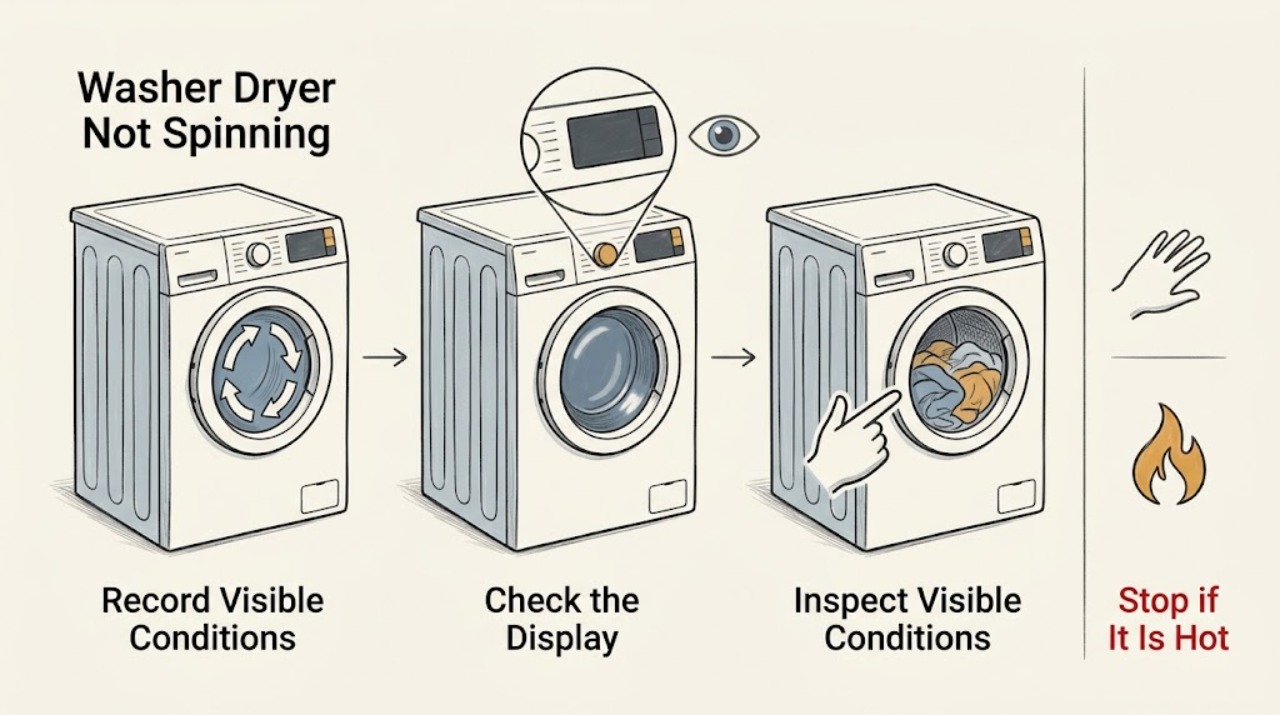
Work through in order
Diagnostic checks
Use only checks that match the exact appliance or system and its official guide.
-
Check 1
Stop the cycle and note whether the failure is on the washer side (the final spin after washing) or the dryer side (the drum does not tumble during drying). Record whether there is standing water, an active warning, or an unusual sound before touching controls.
Expected result: Washer clothes are wet with water remaining, or the dry cycle never tumbles; a warning, leak, violent movement, smoke, burning odor, gas odor, spark, overheating, or breaker trip may also be present.
Next step: If any hazardous symptom is present, stop and arrange professional help. Otherwise continue with the control and cycle check, keeping the drum stopped.
Stop if: Stop immediately for violent shaking, leaking near electrical parts, smoke, burning odor, gas odor, sparks, overheating, or a tripped breaker.
Why this matters
Why: Standing water points the diagnosis toward drain or door conditions, while a dry-only symptom points toward dry-cycle selection, door, water-supply, or power checks. Any hazardous symptom overrides routine troubleshooting.
-
Check 2
Check the selected cycle and settings from the control panel. For washing, confirm that a low- or no-spin option or an intentionally gentle cycle was not selected. For drying, confirm that a dry cycle is actually selected and press Start/Pause once as the model instructions require. Confirm the washer or dryer door is fully closed; never bypass the lock.
Expected result: The display shows a low/no-spin setting, a gentle cycle, no dry cycle, an unregistered Start/Pause command, or a door-open indication.
Next step: Choose a model-appropriate cycle and spin setting, close the door without forcing it, and retry only if there are no stop-condition symptoms. If the correct settings and closed door do not change the symptom, continue to load and drain checks.
Stop if: Do not force, defeat, or electrically bypass a door lock; stop if the door cannot close, the lock is damaged, or the control behaves erratically.
Why this matters
Why: A low-spin or gentle setting can leave more water by design, and an unselected dry cycle or open door can prevent tumbling. This is a control or loading-state issue rather than proof of a failed motor.
-
Check 3
With the appliance stopped, inspect the load through the door and redistribute clothing if it is gathered on one side. Remove or spread a single bulky item, and do not add more items to an already overloaded drum. Look for severe movement and confirm the appliance is not visibly rocking on its feet.
Expected result: The load is a single heavy item, packed tightly, or visibly off-center; the appliance rocks, bangs, or vibrates heavily during attempted spin.
Next step: After the drum has fully stopped, redistribute or reduce the load and check leveling only from the outside. If the correction does not help, or if movement is violent, stop and call for service.
Stop if: Stop for violent shaking, walking, repeated banging, a damaged door, or any water leak that reaches the floor or electrical area.
Why this matters
Why: An unbalanced or bulky load can reduce spin speed or cause the control to stop spinning to limit vibration. A machine that rocks or moves violently may also need leveling or service; it is not safe to keep running it to observe more.
-
Check 4
Check for standing water and inspect the drain hose from the outside for a kink, crushing, loose routing, or a visible obstruction. Confirm the household drain is not backing up. If this model provides an accessible drain-pump filter, clean or reseat it only as the model instructions permit, with the appliance stopped, unplugged, and water contained safely.
Expected result: Water remains in the drum, the hose is kinked or blocked, the household drain backs up, or the accessible pump filter is clogged or not seated.
Next step: Correct only an external hose-routing issue or a user-accessible filter procedure specified for the model, then reassess once. If water cannot be safely contained, the filter is inaccessible, or the drain path remains restricted, arrange service.
Stop if: Do not open a filter or door with a moving drum or uncontrolled hot/dirty water. Stop for a persistent leak, water near electrical parts, or a pump that is unusually hot or making a grinding noise.
Why this matters
Why: A washer may not complete spin while it cannot drain. A restricted hose, drain, or pump filter is a more likely next branch than a drive part when water remains.
-
Check 5
Review detergent use and the wash result. Use only the detergent type and amount specified for the appliance and avoid adding more detergent to compensate for poor results; look for persistent suds in the drum or at the drain.
Expected result: There is a heavy layer of suds, the wrong detergent was used, or excessive detergent was added.
Next step: Follow the model's documented recovery and detergent guidance, then use the correct detergent amount on a later load. If suds or no-spin behavior persists with correct detergent, stop experimenting and request service.
Stop if: Do not mix cleaning chemicals or reach into a drum containing an unknown chemical mixture; stop for a chemical spill, skin/eye exposure, or leaking sudsy water.
Why this matters
Why: Excess suds can interfere with pumping and prevent or delay spinning. Suds are a wash-process condition, not evidence that the drive assembly should be replaced.
-
Check 6
For a dry-side failure on the all-in-one, confirm the door is closed, the dry cycle is selected, the drain-pump filter is correctly installed if the model has one, the water supply is on, and the appliance has power. For a separate dryer symptom reported alongside the washer, do not assume the washer checks prove the dryer circuit is healthy; inspect only the accessible plug, outlet, and breaker without opening the appliance.
Expected result: The door is open, the filter is missing or obstructed, water is unavailable, the dry cycle was not selected, or the display is blank after a power interruption.
Next step: Correct a safe, obvious setting or supply condition once. If the outlet, cord, breaker, or control remains suspect, stop and use a qualified electrician or appliance technician; do not repeatedly reset the breaker.
Stop if: Stop for a warm or discolored plug/outlet, damaged cord, moisture at the receptacle, sparks, a burning smell, or a breaker that trips again.
Why this matters
Why: Whirlpool identifies these conditions as reasons an all-in-one dry cycle may not run. A blank display or a breaker that will not hold can indicate an electrical fault rather than a simple no-spin setting.
Use your observations
Decision map
Find the observation that best matches what you see, then follow the next safe action.
-
PATH 01Next step
What you see
A low/no-spin or gentle wash setting is selected and there is no hazardous symptom.
Do this next
Treat the slower spin as an intentional cycle behavior; use the model-appropriate higher spin option on a future load if the fabric permits.
-
PATH 02Next step
What you see
The load is off-center, bulky, overloaded, or the cabinet rocks.
Do this next
Redistribute or reduce the load only after the drum stops and check leveling from the outside; service is needed if the machine still vibrates or stops.
-
PATH 03Next step
What you see
Water remains in the drum or the drain hose, household drain, or permitted pump filter is restricted.
Do this next
Resolve only the safe external or model-permitted blockage; if drainage remains poor, have the pump and drain system diagnosed by a technician.
-
PATH 04Next step
What you see
The washer or dryer door is not recognized as closed, or Start/Pause and cycle selection were not registered.
Do this next
Close the door normally and select the intended cycle; do not bypass an interlock. Service is appropriate if the correct state is not recognized.
-
PATH 05Next step
What you see
The dry cycle will not tumble while the all-in-one has no leak or electrical warning.
Do this next
Confirm dry-cycle selection, door closure, filter placement, water supply, and power once; escalate if the drum still does not start.
-
PATH 06Next step
What you see
Excess suds are visible or the detergent type/amount was wrong.
Do this next
Stop adding detergent, follow the model's recovery guidance, and use the correct detergent amount; request service if no-spin persists with normal loads.
-
PATH 07Next step
What you see
There is violent shaking, continued filling, a leak, overheating, smoke, burning odor, gas odor, spark, or repeated breaker trip.
Do this next
Stop immediately, keep clear of unsafe water/electrical/gas conditions, and contact the appropriate qualified service or emergency utility channel.
Helpful context
Understand the symptom
What “not spinning” means on a washer-dryer
Watch when the symptom occurs. A washer can tumble during washing but still leave clothes wet if its final spin is slow or skipped. An all-in-one can also wash normally while its dry cycle never starts or its drum does not tumble. Separate those two observations before changing settings or inspecting the drain. A gentle or low-spin option can be intentional, while standing water, a severe imbalance, or an unlocked door can inhibit the spin step.
Use the result of each check to choose the next safe step
Whirlpool's washer guidance connects wet clothes and reduced spin with an unbalanced load, a low-spin option, a bulky item, leveling, or a drain restriction. Its all-in-one dry-cycle guidance also calls out door closure, the drain-pump filter, power protection, water supply, and selecting a dry cycle. These checks are external or model-permitted maintenance only; do not remove panels, defeat an interlock, or work on energized wiring.
When to stop troubleshooting
A no-spin symptom is not a reason to repeatedly reset the appliance. If the machine shakes violently, continues filling, leaks, overheats, smells of burning or gas, produces smoke or sparks, or trips a breaker again, stop the cycle. If it is safe to do so without touching wet electrical parts, disconnect power and close the water supply; arrange qualified appliance service, an electrician, or emergency gas assistance as appropriate.
Safety boundary
Stop conditions
- Stop and seek urgent help for gas odor, smoke, sparks, or a burning smell; do not operate switches or continue the cycle in a suspected gas or fire condition.
- Stop for violent shaking, repeated banging, a machine that walks, or a damaged door; wait for the drum to stop before moving anything.
- Stop for a leak that reaches electrical parts, uncontrolled water, or a door that cannot be safely opened or closed; do not reach into a moving or water-filled drum.
- Stop for overheating, a hot/discolored cord or outlet, or a breaker that trips again. Do not repeatedly reset protection or remove panels.
- Stop if drain or detergent checks require opening sealed panels, handling unknown chemicals, or working on energized wiring; use a qualified technician.
Only after diagnosis
Potential parts
- door lock or door switch
Consider only if the door closes mechanically but the appliance never recognizes it as closed after the cycle and wiring have been professionally checked.
Confirm the full appliance model and manufacturer fit information before any part is ordered. - drain pump or pump filter assembly
Consider only when standing water remains after the external drain path and any model-permitted filter check are clear, and a technician confirms the pump or its circuit is at fault.
Pump design and fit vary by model; confirm model-specific compatibility with the manufacturer or technician. - drive system component
Consider only after cycle selection, balance, door, drain, suds, and power causes are ruled out and a technician confirms a mechanical drive fault.
Do not infer a particular belt, motor, or control part from the symptom alone; verify the model and diagnosis first.
When checks do not resolve it
Need a professional?
Call an appliance technician if the correct cycle, balanced load, clear external drain path, correct detergent, closed door, and safe power checks do not restore the relevant washer spin or dryer tumble. Arrange urgent help for smoke, burning odor, sparks, gas odor, uncontrolled leakage, violent movement, overheating, or repeated breaker trips.
Common questions
FAQ
Why is my Whirlpool washer-dryer washing but not spinning the clothes dry?
Start with the final washer spin: check the selected spin setting, load balance, standing water and drain path, excess suds, and door recognition. A washer that cannot drain may not complete its spin.
Why does the dry cycle run but the drum does not tumble?
Confirm that a dry cycle was selected, the door is closed, Start/Pause registered, the model's drain-pump filter is installed if applicable, water is available for the all-in-one dry function, and power is stable.
Should I keep resetting a Whirlpool washer-dryer that will not spin?
No. Do not repeatedly reset it, especially after a breaker trip. Stop for shaking, leaking, overheating, smoke, burning odor, gas odor, sparks, or a warm or damaged cord, and arrange qualified help.
Read the exact guide
Official sources
- Washer Not Draining or Spinning? Troubleshooting GuideWhirlpool Product Help · Whirlpool washer drain and spin troubleshooting
- Not Spinning - WasherWhirlpool Product Help · Whirlpool washer spin-cycle troubleshooting
- Dry Cycle Will Not Run - All-In-One Washer DryerWhirlpool Product Help · Whirlpool all-in-one washer-dryer dry-cycle troubleshooting
- Not Tumbling or Spinning - DryerWhirlpool Product Help · Whirlpool dryer no-tumble and no-spin troubleshooting
Community feedback
Share a repair observation
Share a plain-text repair observation. Accepted observations are published automatically; this page may take a moment to update.