
On this page
Start here
Quick answer
First determine whether the Whirlpool washer-dryer is a true all-in-one machine and whether the failure affects washing, drying, or both. With the appliance dry and no burning smell, smoke, sparks, damaged cord, standing water, or repeated breaker trip, check the display, Control Lock, door or lid closure, cycle selection, and the required Start hold. For a wash problem, check both water faucets, fill hoses, and the drain path; for a dry problem, check the door, selected dry cycle, lint path, and—on an all-in-one—water supply and drain-pump filter. Do not open panels, probe live wiring, bypass a door or lid lock, or keep resetting a breaker. A leak, wet receptacle or cord, overheating, gas odor, burning smell, arcing, smoke, sparks, or recurring trip is a stop condition requiring qualified service.
Before you begin
Safety first
- Do not bypass locks, open panels, probe live wiring, work on gas components, or keep operating an appliance with a leak, wet electrical area, overheating, burning smell, smoke, sparks, arcing, gas odor, or repeated trip.
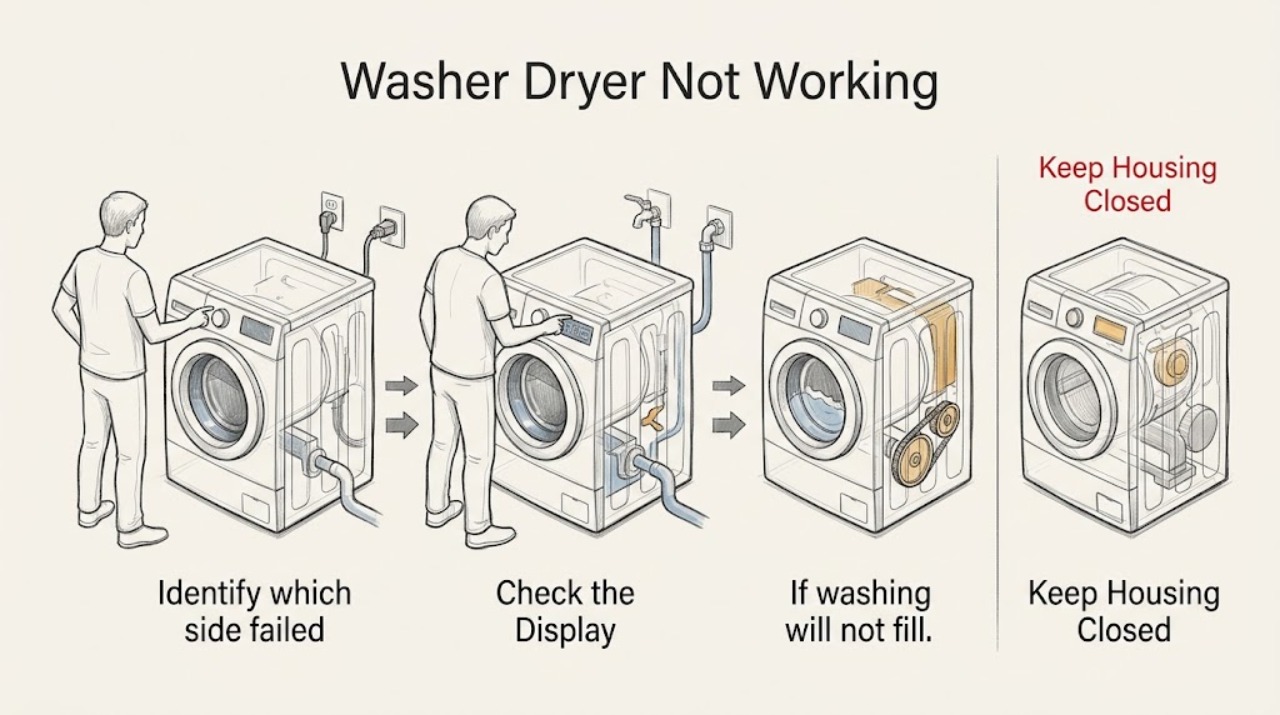
Work through in order
Diagnostic checks
Use only checks that match the exact appliance or system and its official guide.
-
Identify which side failed and screen for stop conditions
From outside the appliance, note whether it is an all-in-one washer-dryer or a paired washer and dryer, then record exactly what fails: no display, no start, no fill, no drain or spin, no dry cycle, or no heat. Look and smell for standing water, a wet cord or receptacle, overheating, smoke, sparks, arcing, an acrid burning smell, or a gas odor from the appliance or nearby gas equipment.
Expected result: Only washing fails, only drying fails, both sides fail, or a safety symptom is present.
Next step: If no stop condition is present, follow the matching wash or dry branch below and do not run unrelated cycles. If any stop condition is present, leave controls off, keep clear of wet or hot areas, and arrange qualified appliance, electrical, or gas service.
Stop if: Stop immediately for a leak that reaches electrical parts, a wet receptacle or cord, overheating, smoke, sparks, arcing, burning smell, gas odor, or a breaker that trips again.
Why this matters
Why: A wash-only symptom points to the washer controls, water, drain, or drive path; a dry-only symptom points to the door, cycle, airflow, water/drain dependency, or heating path. Failure of both sides makes power or controls more likely. A safety symptom is not a normal branch and cannot be diagnosed by repeated operation.
-
Check power, controls, door or lid, and Start
With the appliance dry and cool, check whether the display or indicator responds, whether Control Lock is active, whether the door or lid closes fully, and whether the intended cycle is selected. Press and hold Start for the duration specified by the Whirlpool model instructions rather than tapping it once. Inspect the outlet and breaker or GFCI status visually; do not open the appliance or repeatedly reset a tripping breaker.
Expected result: The display is dead, Control Lock is active, the door or lid is not recognized as closed, Start responds only after a hold, or the machine powers up but still will not begin.
Next step: Clear an unintended Control Lock setting and close the door or lid normally, then make one start attempt with the correct cycle. If the supply is clearly off, restore it once only when the area is dry and safe. If the display remains dead, the lock is not recognized, or the breaker trips again, stop and provide the model and symptom to qualified service.
Stop if: Do not bypass a door or lid lock, remove a panel, touch wet electrical parts, or continue after a repeated breaker trip, smoke, sparks, burning smell, or damaged cord is seen.
Why this matters
Why: No display or a tripped household protection device can explain a whole-machine failure. Control Lock, an unlatched door or lid, an unselected cycle, or a short Start press can prevent operation without proving a failed part. Power with a persistent no-start condition moves the issue toward the lock, controls, or model-specific fault path.
-
If washing will not fill, check the visible water path
If the wash side starts but no water enters, confirm that both household water faucets are open for the model, the hot and cold fill hoses are not kinked, and the hose ends are not visibly crushed. With the water supply turned off before any hose removal, inspect only the accessible inlet-screen area as described by Whirlpool; keep a container available for residual water and never work on a wet electrical connection.
Expected result: One faucet is closed, a hose is kinked, the inlet screen is visibly restricted, water enters normally, or no water enters despite an open and unobstructed supply.
Next step: Correct only an obvious closed faucet or loose external obstruction, then make one supervised fill attempt. If hoses or screens need removal, keep water off and follow the exact model instructions; if the washer still will not fill, leaks, or requires internal valve work, stop and request service.
Stop if: Stop for a leaking hose connection, standing water near the cord or receptacle, a hose that is cracked or bulging, or any need to open the cabinet or work near energized parts.
Why this matters
Why: A closed faucet, kinked hose, or restricted inlet can prevent filling without showing that the washer's control or valve has failed. Normal water flow shifts attention to a cycle, lock, sensing, or service issue. Water at the floor or around the electrical connection is a stop condition, not a fill test.
-
If washing will not drain or spin, separate load from drain clues
If the washer fills but stops before draining or spinning, wait until the drum is still and note the water level. Check for an obviously kinked or obstructed external drain hose, then check that the load is not tightly packed or visibly unbalanced and that a spin-capable cycle was selected. If the model has an owner-accessible pump filter, use only the model instructions and protect the floor from residual water.
Expected result: The tub is full, the drain hose is kinked or restricted, the load is unbalanced or sudsy, the pump filter is blocked, or the hose and load appear normal but the washer still will not drain or spin.
Next step: Stop the cycle, allow movement to end, and correct only an obvious load imbalance, excess suds condition, or external hose kink. If water remains, do not force the door or repeatedly restart the cycle; arrange service if the safe external checks do not restore drainage.
Stop if: Stop for a leak, standing water near electrical parts, an unusual burning smell, a hot motor or cabinet, a repeated trip, or any need to bypass the lock or disassemble the pump.
Why this matters
Why: Whirlpool identifies drain-hose restrictions, load balance, spin selection, excess suds, and pump-filter condition as different causes of a no-drain or no-spin symptom. A full tub with a clear external path and no safe user-accessible correction points toward a pump, control, or other service diagnosis; it does not justify reaching into moving or wet parts.
-
If drying will not start, check the dry-cycle prerequisites
For a dry-only failure, make sure the door closes and latches, Control Lock is not active, a dry cycle is selected, and Start is held as specified for the model. On an all-in-one, confirm the water supply is available and the user-accessible drain-pump filter is not indicated as blocked; on a separate electric dryer, check only the visible lint filter and vent opening without dismantling the duct.
Expected result: The door is not recognized, Control Lock is active, no dry cycle is selected, an all-in-one lacks water or cannot drain, or the cycle begins but stops or remains unheated.
Next step: Correct one obvious door, lock, cycle, water-supply, or visible lint-path issue and make one supervised attempt. If the dry cycle still will not run, stops with water, or needs a lock, pump, control, or duct repair, leave it off and request service.
Stop if: Do not bypass a door lock, reach into a moving drum, remove panels, or continue if the cabinet overheats, smoke or sparks appear, or the breaker trips again.
Why this matters
Why: Whirlpool's all-in-one guidance lists door closure, Start/Pause, drain-pump-filter condition, household protection devices, water supply, and dry-cycle selection as relevant prerequisites. A separate dryer has its own door, control, cycle, and airflow checks. A cycle that begins but produces no heat belongs to the heating branch, not the no-start branch.
-
If the dry cycle runs but does not heat, stop at the supply boundary
Confirm whether the drum turns and whether the cycle completes with cold or damp clothes. Check only the visible lint filter and vent opening, and record whether the model is an all-in-one or a separate electric dryer. Do not probe the receptacle, terminal block, heater, fuses, or wiring while energized; use the owner's manual or a qualified electrician or appliance technician for supply and internal-heating checks.
Expected result: The cycle never starts, the drum turns but remains cold, airflow is visibly restricted, an all-in-one has a water or drain problem, or the appliance stops with a heat or electrical symptom.
Next step: Clear only loose lint from the accessible filter or opening, then make one supervised cycle attempt if the appliance is otherwise safe. If the drum remains cold, the supply is uncertain, or the unit overheats or trips protection, stop and request qualified service rather than testing live voltage or replacing an unverified part.
Stop if: Stop immediately for smoke, sparks, arcing, a burning smell, an unusually hot cabinet or cord, a damaged vent, or a repeated breaker trip.
Why this matters
Why: Whirlpool states that an all-in-one dry function requires its specified household supply and directs owners to qualified electrical help when the supply cannot be confirmed. A restricted visible lint path can reduce drying performance, but a running cold drum can also involve a fuse, heater, sensor, control, or supply fault that is not safely identified from outside.
-
Use one documented reset only, then hand off useful evidence
After the appliance is dry, cool, and free of any unsafe condition, perform at most the single power reset described in the model's Whirlpool instructions. Record the exact side affected, cycle, display or code, water level, drum motion, and what changed after the reset; do not repeat resets or run many unrelated cycles.
Expected result: The same fault returns immediately, one side recovers while the other does not, a code reappears, or the appliance runs once and fails again.
Next step: Stop testing and contact qualified appliance service; provide the full model number, side and cycle affected, any displayed code, whether water remains, whether the drum turns, and whether the breaker or GFCI changed state. If a household supply or protection device is implicated, include a qualified electrician in the handoff.
Stop if: Do not continue after any leak, wet electrical area, overheating, gas odor, smoke, sparks, arcing, burning smell, or repeated trip.
Why this matters
Why: A reset can clear a temporary control state but cannot establish that a pump, lock, motor, heater, sensor, or household supply is healthy. A repeat or side-specific failure is useful service evidence and should be escalated instead of masked with repeated cycling.
Use your observations
Decision map
Find the observation that best matches what you see, then follow the next safe action.
-
PATH 01Next step
What you see
Leak, wet electrical area, overheating, smoke, sparks, arcing, burning smell, gas odor, or repeated breaker trip
Do this next
Leave the appliance off, keep clear of wet or hot parts, and arrange qualified appliance, electrical, or gas service.
-
PATH 02Next step
What you see
Both wash and dry sides are dead or the display never responds
Do this next
Check the visible outlet, GFCI or breaker status, Control Lock, and door or lid closure once; if power remains absent or protection trips again, stop and request service.
-
PATH 03Next step
What you see
Controls respond but the wash side does not fill
Do this next
Check both faucets, external hose routing, and the safe accessible inlet-screen procedure; persistent no-fill or any leak needs service.
-
PATH 04Next step
What you see
The wash side fills but will not drain or spin
Do this next
Check the safe external drain path, load balance, spin selection, suds, and model-specific pump-filter guidance; do not force the door or disassemble the pump.
-
PATH 05Next step
What you see
Wash works but the dry cycle will not begin
Do this next
Check door closure, Control Lock, Start hold, cycle selection, and on an all-in-one the water and drain prerequisites; persistent no-start needs service.
-
PATH 06Next step
What you see
The dry cycle runs but clothes remain cold or damp
Do this next
Clear only the visible lint path and preserve the symptom; do not test live supply or internal heating parts. Have a qualified technician or electrician check the model-specific supply and heating path.
Helpful context
Understand the symptom
A washer-dryer report needs a side and a symptom
A washer-dryer can have separate wash and dry controls, or it can be an all-in-one unit whose dry cycle also depends on water and draining. Record whether the display is dead, whether a wash cycle fills or drains, whether the drum turns, and whether the dry cycle starts or simply produces no heat. If only one side fails, keep the other side out of the diagnosis; a machine that washes but will not dry has a different first path from one that is completely without power.
Keep low-risk observations separate from repair work
Only inspect cool, dry, visible, user-accessible parts. Do not reach into a moving drum, bypass a door or lid lock, remove electrical panels, test energized wiring, or dismantle a gas or heating system. A leak or wet electrical connection, overheating, smoke, sparks, an acrid burning smell, a gas odor, or a breaker that trips again takes priority over troubleshooting: leave the appliance off and arrange qualified service.
When checks do not resolve it
Need a professional?
Call qualified appliance service when the safe external checks do not identify a simple control, supply, hose, load, or visible lint-path issue. Use qualified electrical service for an uncertain household supply or repeated protection trip, and qualified gas service if a gas odor or gas appliance issue is involved.
Safety scope: Do not bypass locks, open panels, probe live wiring, work on gas components, or keep operating an appliance with a leak, wet electrical area, overheating, burning smell, smoke, sparks, arcing, gas odor, or repeated trip.
Have this ready
- Provide the exact model number, whether the unit is an all-in-one, which side and cycle failed, any display code, whether the drum turned, whether water remained, and whether a breaker or GFCI changed state.
Common questions
FAQ
Why does my Whirlpool washer-dryer seem completely dead?
First determine whether both wash and dry controls are dead. Check the visible outlet, GFCI or breaker status, Control Lock, door or lid closure, and the model's Start hold once. If the display stays dead or the protection device trips again, leave it off and arrange service rather than opening the cabinet.
Why does the washer fill but not finish the cycle?
Observe whether water remains, the drain hose is visibly restricted, the load is unbalanced or sudsy, or the selected cycle has a spin step. Correct only an obvious external hose or load issue; do not force the door or reach into wet or moving parts. Persistent no-drain or no-spin needs service.
Why does the dry cycle run but not heat?
A running cold drum can involve airflow, the model-specific household supply, or an internal heater, fuse, sensor, or control. Clean only the visible lint filter or opening. Do not test live voltage or open panels; have a qualified technician or electrician check the supply and heating path, especially if the unit overheats or trips protection.
Read the exact guide
Official sources
- Dryer Not Heating - All-In-One Washer Dryer - Product Help | WhirlpoolWhirlpool Product Help · Whirlpool all-in-one washer-dryer units whose dry cycle does not heat
- Not Starting - Washer - Product Help | WhirlpoolWhirlpool Product Help · Whirlpool washers; use model instructions for exact control behavior
- Washer Not Draining or Spinning? Troubleshooting Guide - Product Help | WhirlpoolWhirlpool Product Help · Whirlpool washers that do not drain or spin
- Not Starting or Not Operating - Dryer - Product Help | WhirlpoolWhirlpool Product Help · Whirlpool separate dryers; use only as the dryer-side comparison when the setup is not an all-in-one
- No Power - Washer - Product Help | WhirlpoolWhirlpool Product Help · Whirlpool washers; visible outlet, breaker, GFCI, and control checks
- Checking the Fill Hoses if the Washer is not Filling - Product Help | WhirlpoolWhirlpool Product Help · Whirlpool washers that do not fill
- Dry Cycle Will Not Run - All-In-One Washer Dryer - Product Help | WhirlpoolWhirlpool Product Help · Whirlpool all-in-one washer-dryer units
Community feedback
Share a repair observation
Share a plain-text repair observation. Accepted observations are published automatically; this page may take a moment to update.