
On this page
Start here
Quick answer
A Whirlpool washer that stops before the cycle ends is easiest to diagnose by the stage shown when it stops: filling, washing, rinsing, draining, or spinning. First note any flashing code, control lock, delay or rinse-hold setting, remaining water, and whether the load is wet. Whirlpool identifies unbalanced loads as a cause of longer cycles, reduced spin, noise, and stopping during spin; excess suds, a restricted drain path, a closed door or lid, and power interruptions can also prevent completion. Pause the machine and wait for the drum to stop before redistributing a safe load or checking visible hose routing. Do not open a hot or water-filled machine or touch electrical parts in water. If there is leaking water near electrical parts, smoke, a burning smell, arcing, severe movement, a hot outlet, or a repeated electrical trip, stop using the washer and arrange qualified service.
Before you begin
Safety first
- This article supports safe observation, normal controls, load redistribution, visible hose and clearance checks, and one model-permitted control reset only. It does not authorize live electrical testing, bypassing locks, opening hot or pressurized drain paths, tilting or moving the appliance, panel removal, or internal parts replacement.
Work through in order
Diagnostic checks
Use only checks that match the exact appliance or system and its official guide.
-
Check 1
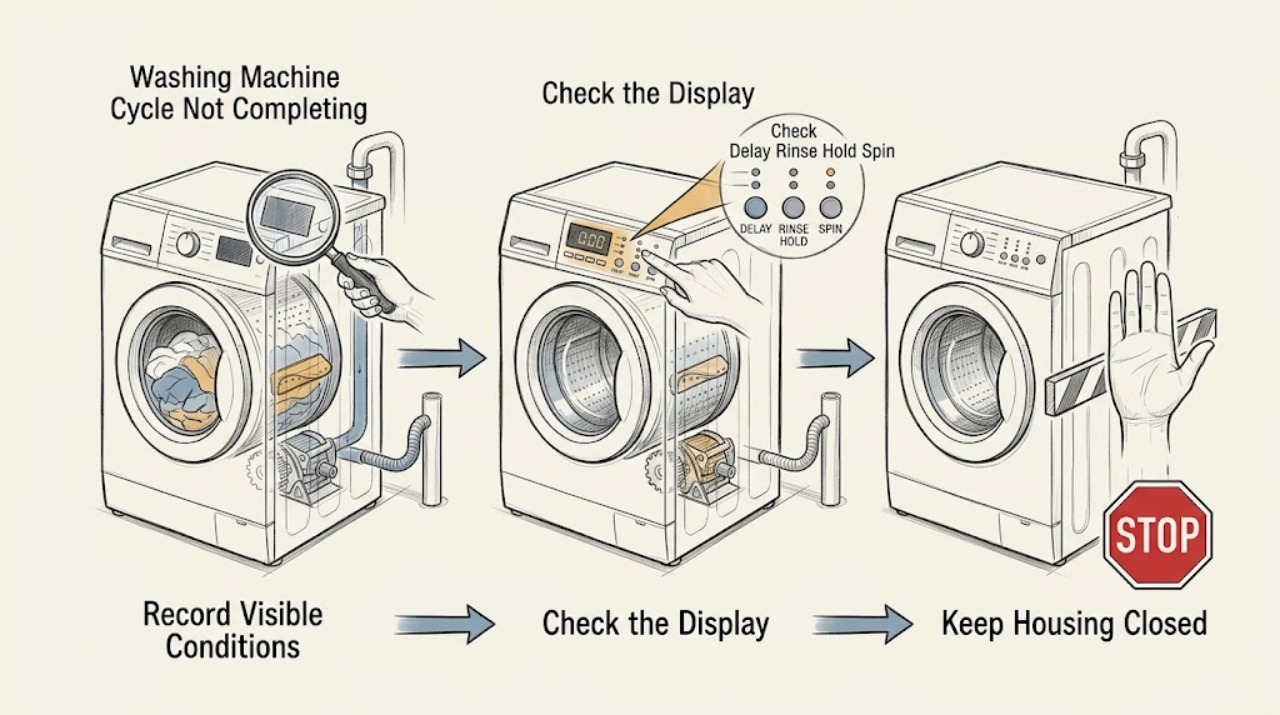
Press Pause or Stop using the normal control and wait until the drum, basket, and pump stop. From a dry, safe position, note the last displayed stage, any flashing lights or code, water level, water temperature if known, and whether there is leaking water, smoke, burning odor, arcing, a hot or damaged cord or outlet, severe movement, or a repeated breaker trip.
Expected result: The washer is stable with no hazard signs, or a water, fire, mechanical, or electrical warning is present.
Next step: For a hazard, follow the matching stop condition and arrange qualified service. Otherwise record the stage and display before changing settings or restarting.
Stop if: Do not touch wet electrical equipment, reach into a moving drum, hold a walking washer in place, or restart after smoke, arcing, burning odor, severe movement, water near electrical parts, or a repeated trip.
Why this matters
Why: A quiet stop can receive staged troubleshooting. A hazard makes the unfinished cycle secondary and requires the washer to remain off.
-
Check 2
Record every displayed code, flashing light, lock indicator, and alternating message. Check whether Control Lock is active and whether a front-load door or top-load lid is fully closed and latched, using only the normal user controls and the exact owner's manual.
Expected result: A code or flashing indicator is present, the controls are locked, the door or lid is not latched, or the display is normal but the cycle remains stopped.
Next step: Follow the exact model's documented control-unlock or door/lid procedure, then continue with the recorded stage. If the code returns or the latch will not engage normally, leave the washer off for service.
Stop if: Do not bypass a door or lid lock, force the door, insert tools into the latch, or borrow a code explanation from another Whirlpool model.
Why this matters
Why: Whirlpool directs owners to the applicable error-code path for flashing lights; a control lock or lid/door interlock can prevent the next stage. A normal display without progress points to the stage-specific checks rather than a guessed code.
-
Check 3
Compare the selected cycle and options with the exact manual: check Delay Start or Delay Wash, Rinse Hold, Low Spin, No Spin, Delicate or Hand Wash, and any pause or Add Garment state. Do this before starting a new cycle.
Expected result: A delay or hold is active, a low/no-spin or gentle cycle is selected, or the selected options do not explain the stop.
Next step: Use the manual's normal control sequence to cancel the delay or complete the hold, or choose a suitable drain/spin option if safe and appropriate for the load. If the washer stops at the same stage with ordinary options, continue to the water-path check.
Stop if: Do not start a spin or drain cycle when the tub, floor, door, or lid is unsafe, water may be hot, or the machine has a leak or electrical symptom.
Why this matters
Why: A delay or rinse hold can intentionally leave the washer waiting or leave water in the tub; low-spin and gentle cycles can leave more water in the load without proving a failure.
-
Check 4
If the washer stops during filling, observe from outside whether water enters, stops at the expected level, or never begins; check only that the visible household water valves are in their normal open position and that accessible inlet hoses are not visibly kinked.
Expected result: There is no incoming water, filling is very slow or intermittent, the washer fills and immediately loses water, or the water level appears normal but the cycle does not advance.
Next step: Use the exact model's fill and drain installation instructions. If the hose, valve, inlet screen, water-level sensing, or internal fill path needs disassembly, leave the washer off and arrange service.
Stop if: Do not disconnect a pressurized hose, open a wet electrical area, probe inlet valves, or continue if water is leaking or approaching electrical parts.
Why this matters
Why: No or slow fill can prevent the control from reaching wash or rinse; immediate loss may indicate drain-hose installation or siphoning; a normal level with no advance points toward a control, lock, sensing, or later-stage condition.
-
Check 5
If the washer stops during wash or rinse, note whether there is unusually heavy foam, an overloaded or tightly packed load, a single bulky absorbent item, or a cycle that is intentionally slow or low-water; do not add more detergent or water to force progress.
Expected result: Foam is excessive, the load is packed or uneven, a bulky item dominates, or the load and cycle appear appropriate.
Next step: Follow the model manual for a safe pause, load redistribution, or appropriate rinse/drain response. Use only the specified detergent type and measured amount on future cycles; arrange service if the washer cannot clear the condition or repeatedly stops.
Stop if: Do not open a locked, hot, or water-filled washer, add chemicals to counteract foam, or keep running a washer that leaks, walks, smokes, or smells burnt.
Why this matters
Why: Whirlpool states that excessive suds can stop pumping and spinning, while overloaded or unbalanced loads can extend the cycle and reduce performance. A suitable load with repeated stopping suggests a different fault.
-
Check 6
If water remains or the cycle stops during drain, inspect from outside for a visibly kinked drain hose, an overflowing or blocked standpipe or utility sink, and a hose that has become displaced; for a front-load model, open or clean a pump filter only when the exact manual permits it and the water is cool, the machine is safely isolated, and the floor can remain dry.
Expected result: The hose is kinked or displaced, the household drain is backing up, a model-authorized filter is obstructed, the pump hums without moving water, or no visible drain problem is found.
Next step: Correct only an obvious external hose-routing issue or follow the exact manual's cool-water filter procedure. If water remains, the pump is noisy, the filter is inaccessible, or a leak appears, leave the washer off and arrange service.
Stop if: Do not open a filter or hose with hot water, trapped pressure, an unsafe floor, or water near electrical parts; do not tilt the washer or remove the pump housing.
Why this matters
Why: A restricted or incorrectly installed drain path, an accessible filter obstruction, or excessive suds can prevent the washer from reaching spin. A pump that hums without drainage or a clear path with retained water needs service diagnosis.
-
Check 7
If the stop occurs during spin or leaves clothes wet, wait for the drum to stop, redistribute clothing, remove an excessive load, and inspect from outside whether the washer rocks or contacts a wall or cabinet; use the exact manual for any safe leveling adjustment.
Expected result: The load is bunched, heavy, single and bulky, or overloaded; the washer rocks or contacts something; or the load and installation are balanced and firm.
Next step: Run only an appropriate short drain/spin observation if the manual and safety conditions allow it, staying nearby. If movement or the incomplete cycle returns with a balanced load, leave the washer off for service.
Stop if: Do not restrain a walking washer by hand, run it with a damaged floor or cabinet, overload it, or repeat spin tests after impact, grinding, leakage, smoke, or severe shaking.
Why this matters
Why: Whirlpool associates imbalance with noise, vibration, reduced spin speed, longer cycles, wet clothes, and a possible spin stop. A firm machine and balanced load that still stops points toward service rather than repeated retries.
-
Check 8
Only if there is no water or electrical hazard, the drum is stopped, and the exact Whirlpool guidance permits it, disconnect the washer from its power source for one documented control reset; do not use repeated breaker cycling as a test.
Expected result: After the single reset, the display and controls return normally, the same stage stops again, a code returns, or the appliance will not power normally.
Next step: Record the before-and-after state. If the cycle still does not complete, leave the washer off and provide the stage, code, water state, load, and reset result to qualified Whirlpool service.
Stop if: Do not reset a wet or damaged appliance, repeatedly cycle power, hold a breaker on, or continue after smoke, odor, arcing, a hot outlet, or a trip.
Why this matters
Why: A reset can clear a transient control state but does not prove that a lock, pump, motor, sensor, or water-path fault is repaired. A recurring stop or code is evidence for service.
-
Check 9
Prepare a service note with the Whirlpool model and serial information, top-load or front-load design, exact code or lights, stopping stage, selected cycle and options, water level and temperature if known, load type, recent move or outage, visible hose or leveling observations, and the result of the one reset.
Expected result: The timeline and identity are complete, or the model, code, stage, or water state remains uncertain.
Next step: Use Whirlpool's model-specific manual and service route or a qualified appliance technician. State unknown details rather than guessing a failed part.
Stop if: Do not order or replace a pump, lock, motor, sensor, control board, suspension part, or valve based only on an incomplete-cycle symptom.
Why this matters
Why: A precise timeline lets service distinguish fill, wash, suds, drain, lock, balance, power, and control paths without asking the owner to reproduce a risky failure.
Use your observations
Decision map
Find the observation that best matches what you see, then follow the next safe action.
-
PATH 01Safety boundary
What you see
There is leaking water near electrical parts, smoke, burning odor, arcing, a hot or damaged cord or outlet, severe walking, damaged glass or lid, or a repeated electrical trip.
Do this next
Keep the washer off. Isolate water or power only when it can be done without entering unsafe water or touching damaged equipment, then arrange qualified appliance or electrical service.
Why this path and its safety boundary
Why it matters: This is a water, fire, mechanical, or electrical safety boundary, not an ordinary cycle-reset problem.
Safety stop: Do not touch wet electrical equipment, hold the machine in place, re-energize after a trip, or restart it to reproduce the failure.
-
PATH 02Safety boundary
What you see
A delay, rinse hold, low/no-spin, gentle, or other intentional cycle option is active and there is no hazard symptom.
Do this next
Follow the exact model's normal control sequence to complete or cancel the option; select a suitable drain/spin function only when the water and machine are safe.
Why this path and its safety boundary
Why it matters: The washer may be waiting for a user action or may have completed its selected behavior while leaving more water in the load.
Safety stop: Stop if the control cannot respond normally, a lock will not release as documented, water is hot or leaking, or the same stop returns with ordinary settings.
-
PATH 03Safety boundary
What you see
The washer stops during fill with no or slow incoming water, immediate loss of water, or a normal water level that does not advance the cycle.
Do this next
Check only visible valves and hose routing, then use the exact manual or arrange qualified service for inlet, sensing, lock, or internal water-path diagnosis.
Why this path and its safety boundary
Why it matters: The fill supply, drain routing, door/lid condition, sensing, or control path may be preventing progression.
Safety stop: Do not disconnect pressurized hoses, probe valves, open panels, or continue with a leak or water near electrical parts.
-
PATH 04Safety boundary
What you see
The stop occurs during wash or rinse and the load is overloaded, tightly packed, dominated by one bulky item, or surrounded by excessive suds.
Do this next
Use the manual's safe pause and load response, reduce future detergent to the specified amount, and arrange service if the washer cannot clear the condition or repeatedly stops.
Why this path and its safety boundary
Why it matters: Whirlpool identifies excess suds and unsuitable load distribution as conditions that can delay or prevent pumping and spinning.
Safety stop: Do not add chemicals or water to force a cycle, open a hot or locked tub, or continue a leaking, smoking, or unstable washer.
-
PATH 05Safety boundary
What you see
The washer stops with water in the tub or during drain, and the visible hose, standpipe, or user-accessible filter has a possible restriction or incorrect routing.
Do this next
Correct only an obvious external hose issue or perform a cool, manual-authorized filter check. If drainage remains poor or the filter is not safely accessible, arrange service.
Why this path and its safety boundary
Why it matters: The machine may be unable to satisfy the drain condition required before spin; a pump fault cannot be confirmed from the symptom alone.
Safety stop: Do not open a hot, pressurized, or unsafe wet drain path, tilt the washer, or remove the pump housing.
-
PATH 06Safety boundary
What you see
The washer stops or extends the cycle during spin with loud noise, excessive shaking, walking, wet clothes, or an uneven load.
Do this next
Pause, redistribute the load, check firm level support and clearance, and use only a short safe observation. Persistent stopping with a balanced load needs qualified service.
Why this path and its safety boundary
Why it matters: An out-of-balance load or leveling issue may have triggered protective behavior; Whirlpool notes that a significant imbalance can stop spinning.
Safety stop: Do not hold the washer in place, run repeated spin cycles, or continue after violent movement, impact, leakage, smoke, or burning odor.
-
PATH 07Safety boundary
What you see
One safe, model-permitted control reset does not restore completion, the same stage stops again, the code returns, or the controls remain abnormal.
Do this next
Leave the washer off and provide the exact stage, code, water state, load, settings, and reset result to qualified Whirlpool service.
Why this path and its safety boundary
Why it matters: The condition is not established as a transient control state and needs model-specific diagnosis.
Safety stop: Do not repeatedly reset, replace a part from the symptom alone, or open the appliance to continue testing.
Helpful context
Understand the symptom
Identify the point where the cycle stops
The timer alone does not identify the fault. Record the last stage or indicator: filling, wash movement, rinse, drain, or spin. A washer can spend extra time correcting an unbalanced load, and a significant imbalance may stop spinning. Water left in the tub points toward a drain or control condition; a full tub with no visible movement needs a different path from a washer that has drained but leaves clothes wet. The exact Whirlpool model, top-load or front-load design, and control layout determine which checks apply.
Check settings before treating normal behavior as a failure
A delay, rinse-hold, low-spin, no-spin, control-lock, or lid/door-lock state can make a cycle appear to stop or finish with water still present. Whirlpool also notes that gentle cycles retain more water and that excess detergent suds can reduce pumping and spinning. Match the selected cycle and options to the load and the exact owner's manual; do not assume one Whirlpool model's controls or error meanings apply to another.
Drain and spin checks have strict safety limits
If the washer stops with water inside, treat the water as potentially hot and do not open a filter, hose, door, or lid until the manual and conditions make that safe. Inspect only visible hose routing and accessible controls unless the model specifically provides a user maintenance procedure. A clogged or incorrectly routed drain, foam, or an unbalanced load can explain a wet or unfinished cycle, but a pump, lock, motor, suspension, or control fault requires model-specific service.
Safety boundary
Stop conditions
- Stop immediately for leaking water near electrical parts, smoke, burning odor, electrical arcing, a hot or damaged cord or outlet, severe walking or impact, damaged glass or lid, or a repeated electrical trip.
- Treat water in the tub as potentially hot; do not force a locked door or lid, reach into a moving drum, or open a drain filter or hose until the exact manual and safe conditions permit it.
- Do not bypass a door or lid lock, test live wiring, tilt or move the washer alone, remove panels, remove the pump housing, or hold a walking machine in place.
- Do not add chemicals or water to counteract suds, repeatedly cycle power, or run repeated spin/drain cycles to reproduce a failure.
- Leave the washer off and arrange qualified service when the same stage stops after one safe model-permitted reset, a code returns, water remains without a safe drain explanation, the load and installation are balanced but the cycle still fails, or an internal fault is suspected.
When checks do not resolve it
Need a professional?
Arrange qualified Whirlpool appliance service when the cycle repeatedly stops at the same stage, a code returns after one model-permitted reset, water remains without a safe external drain explanation, the washer will not advance after a balanced load and correct settings, the door or lid lock behaves abnormally, or an internal pump, motor, sensor, suspension, valve, or control fault is suspected. Use qualified electrical or emergency service for smoke, fire, arcing, exposed electrical damage, or unsafe water contact.
Safety scope: This article supports safe observation, normal controls, load redistribution, visible hose and clearance checks, and one model-permitted control reset only. It does not authorize live electrical testing, bypassing locks, opening hot or pressurized drain paths, tilting or moving the appliance, panel removal, or internal parts replacement.
Common questions
FAQ
Why does my Whirlpool washer stop before the cycle finishes?
The stopping stage matters. Common documented paths include a delay or rinse hold, door or lid lock, slow fill, excess suds, restricted drain, an unbalanced load, low-spin selection, power interruption, or an error state. Record the stage and display before changing anything.
Why does my Whirlpool washer keep adding time?
An unbalanced load can trigger repeated redistribution and longer cycle time, especially during spin. Excess suds, a drain issue, or a selected cycle that uses a slower spin can also leave the load wet or extend the program. Pause safely and check the load, settings, and visible drain routing.
What if my Whirlpool washer stops with water inside?
Treat the water as potentially hot. Check the selected hold or cycle, then inspect only visible drain-hose routing and a model-authorized, cool-water pump-filter procedure. Do not open a hot or pressurized drain path or work near water and electrical parts.
Can I reset a Whirlpool washer that stops mid-cycle?
Only when the machine is dry and safe and the exact Whirlpool guidance permits it. Perform one documented control reset, record the result, and stop if the same stage or code returns. Repeated power cycling does not establish that the fault is fixed.
When should I stop using a Whirlpool washer?
Stop for leaking water near electrical parts, smoke, burning odor, arcing, a hot or damaged cord or outlet, severe walking or impact, damaged glass or lid, or a repeated electrical trip. Keep the washer off and arrange qualified appliance or electrical service.
Read the exact guide
Official sources
- Vibration or Out of Balance loads - Product Help | WhirlpoolWhirlpool · Official Whirlpool Product Help page for top-load washers; model-specific loading and leveling details apply.
- Not Starting - Washer - Product Help | WhirlpoolWhirlpool · Official Whirlpool Product Help page for top-load washers; use the exact owner's manual for other models.
- Washer Not Draining or Spinning? Troubleshooting Guide - Product Help | WhirlpoolWhirlpool · Official Whirlpool Product Help guide; pump-filter access and drain procedures vary by model.
- Stops Mid Cycle- Washer - Product Help | WhirlpoolWhirlpool · Official Whirlpool Product Help page for top-load washers; exact model instructions control front-load and other configurations.
Community feedback
Share a repair observation
Share a plain-text repair observation. Accepted observations are published automatically; this page may take a moment to update.