
On this page
Start here
Quick answer
A Whirlpool washing machine that is not working can be completely without power, refusing to start, waiting for water, stopping with water inside, or reaching wash but not spinning. Record which stage fails before changing anything. Check the grounded power connection and controls, confirm the lid or door can latch, inspect the external water supply and drain hose, and then assess load balance and the selected cycle. A single model-approved five-minute power reset may clear a temporary control state, but do not keep resetting a washer that trips a breaker, leaks, smells burned, sparks, shakes violently, or has water near electrical parts. Match any code to the exact model manual; if a safe external check does not restore the cycle, arrange qualified appliance service.
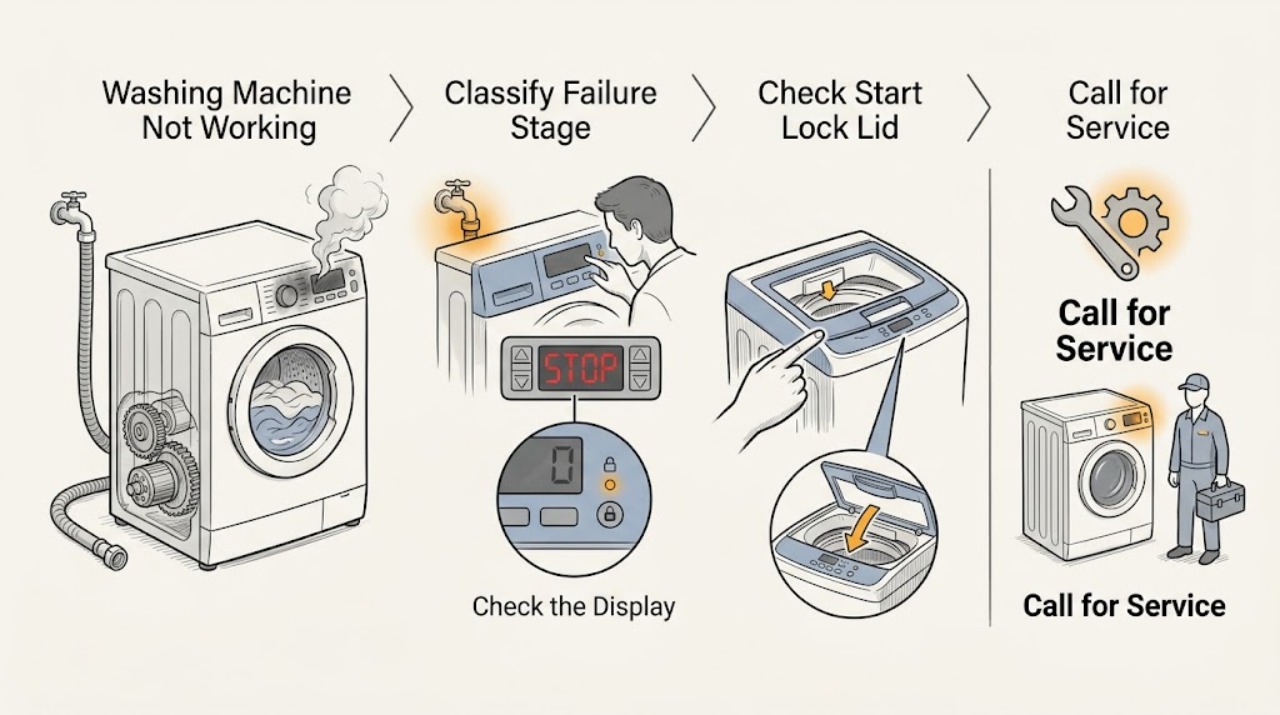
Work through in order
Diagnostic checks
Use only checks that match the exact appliance or system and its official guide.
-
Check 1
With the washer idle and the floor dry, record whether the display is dark, whether it responds to touch, the exact point at which the cycle stops, whether water is present, and any code or indicator shown. Do not start a cycle if there is an active leak, smoke, or an electrical hazard.
Expected result: The panel is either dark, lit but unresponsive, lit and accepting settings but not starting, filling slowly or not at all, washing but not draining, or leaving the load wet after a failed spin; the displayed code and cycle stage are recorded exactly.
Next step: Use the matching branch below and keep the exact model number available for the owner's manual. Do not skip to internal part replacement based only on the broad not-working symptom.
Stop if: Stop if the washer is wet around electrical parts, emits smoke or a burning odor, sparks, has a hot or damaged cord or outlet, or has an active uncontrolled leak.
Why this matters
Why: These outcomes separate a supply or control problem from inlet, drain, lock, load, or drive symptoms. A code is a model-specific clue, not a universal diagnosis.
-
Check 2
For a dark or unresponsive washer, look at the plug and cord without opening anything. Confirm the cord is fully seated in a grounded three-prong outlet and that no extension cord is used; from a dry position, check whether the household breaker, fuse, or GFCI has operated.
Expected result: The outlet and washer connection are secure and the circuit is on, or the breaker/GFCI has tripped, the outlet is loose or warm, or the cord is damaged.
Next step: Correct only an obvious, dry, one-time circuit state from a safe position. If the circuit trips again, the outlet is hot or damaged, or the washer remains dark on a known-good supply, stop and request electrical or appliance service; do not repeatedly reset the breaker.
Stop if: Do not touch a wet outlet, exposed conductor, scorched plug, hot receptacle, or water-affected appliance. Do not perform live voltage tests or remove panels.
Why this matters
Why: A tripped or faulty supply can explain a dark washer, while a sound supply with no display narrows the problem to the washer or its controls. Whirlpool says not to use an extension cord and to involve an electrician if the circuit problem continues.
-
Check 3
If the panel lights but the cycle will not begin, look for a Control Lock indicator, select a normal cycle, close the door or lid without forcing it, and hold Start for the period specified by the model. Inspect only the visible latch contact for clothing or packing material; do not bypass the interlock.
Expected result: The control responds after the lock is released, Start is held, or an obstruction is removed, or the washer clicks and performs its normal lid-lock self-check but still will not start.
Next step: Run the cycle only if the latch closes normally and no safety symptom is present. If the lock will not engage, the door or lid is damaged, or the controls remain unresponsive, use the exact manual and arrange appliance service.
Stop if: Never hold a lock open, tape it, bypass it, force the door or lid, or reach into a moving or locked tub.
Why this matters
Why: Control Lock, an incomplete latch, and a model-specific Start input can make a working washer appear dead. Whirlpool notes that top-load models vary: some fill with the lid open, while others require it closed and latched for operation.
-
Check 4
For a cycle that waits for water or fills slowly, confirm from a dry, stable position that the household hot and cold supply valves are open, both connected hoses are not kinked, and there is no visible hose damage or leak. If the model instructions permit hose removal, turn the water off first and inspect the inlet screens without dislodging them.
Expected result: Both supplies are available and the hoses are open and intact, or a valve is closed, a hose is kinked, screens are visibly restricted, or water appears at a connection.
Next step: Correct only an accessible kink or closed valve, clean a screen only as the exact model instructions permit, and test once while watching the connections. If it still will not fill, the inlet valve, pressure, lock, or control may need service.
Stop if: Shut off water and stop for an active leak, a burst or cracked hose, uncontrolled filling, water approaching electrical equipment, or any need to open the cabinet or replace a valve.
Why this matters
Why: Whirlpool identifies the hot and cold supply, hose kinks, inlet screens, and drain-hose installation as common fill checks; a leak or failed supply connection is a water-safety issue, not a reason to keep cycling.
-
Check 5
If water remains after washing or the washer will not advance to spin, inspect the external drain hose and household standpipe or utility sink from a safe, dry position for a kink, visible blockage, disconnection, or water backing up. Keep any pump-filter check limited to front-load models that expose one and only follow that model's manual after power and water are isolated.
Expected result: The hose is kinked, the standpipe backs up, the hose connection leaks, or the visible drain route is clear and the washer still retains water.
Next step: Correct a safe external hose position or household drain blockage and retry once. If the pump only hums, the route is clear but water remains, or the filter cannot be accessed per the manual, arrange appliance or plumbing service.
Stop if: Stop for sewage-contaminated water, a major leak, water near electrical equipment, a hot motor or pump, or any request to open a sealed pump or cabinet while connected to power.
Why this matters
Why: A restricted or incorrectly arranged drain can prevent both drain and spin; Whirlpool notes that only some front-load models provide an accessible pump filter, so its location and procedure cannot be assumed.
-
Check 6
For a washer that completes washing but leaves clothes wet or stops during spin, wait until it is stationary, then redistribute a small or bulky load, confirm the selected cycle does not specify Low Spin or No Spin, and observe whether the machine is stable and level without trying to move it.
Expected result: The load is clumped, overloaded, a gentle or no-spin option was selected, bedding is in an unsuitable cycle, or the washer shakes, walks, bangs, or remains stable with a clear drain.
Next step: Use a suitable cycle and balanced load once. If the machine still will not spin after draining and balancing, record the sound and stage for service instead of opening the drive system.
Stop if: Stop immediately for violent shaking, walking, metal impact, a loose or damaged cabinet, a leak, smoke, burning odor, sparks, or repeated breaker operation.
Why this matters
Why: Whirlpool says imbalance can reduce speed or stop spin, and that cycle selection, bulky loads, water left in the tub, and excessive suds also affect spin performance. Severe movement is a safety boundary rather than a tuning exercise.
-
Check 7
After the external checks are safe, record the exact code and model, then use the owner's manual to decide whether a single control reset is allowed. Whirlpool's general not-starting guidance describes disconnecting power for five minutes; disconnect only from a dry, safe outlet and reconnect once.
Expected result: The washer returns to normal after the documented one-time reset, or the same code, no-start condition, drain/fill fault, or unsafe behavior returns.
Next step: If the symptom returns, stop testing and give the technician the model, exact code, stage, water state, prior observations, and any photos taken from a safe position. Use the model manual rather than applying another model's reset sequence.
Stop if: Do not reset repeatedly, bypass a code or interlock, reconnect a wet or damaged appliance, or continue after smoke, burning odor, sparking, overheating, or a breaker trip.
Why this matters
Why: A reset can clear a transient control state but does not prove that a pump, lock, motor, valve, wiring, or control is healthy. Whirlpool warns that its listed front-load codes are not complete for every model.
Use your observations
Decision map
Find the observation that best matches what you see, then follow the next safe action.
-
PATH 01Next step
What you see
The washer is dark, the outlet is dead, the breaker or GFCI trips again, or the cord or receptacle is damaged.
Do this next
Leave the washer disconnected and arrange electrician or qualified appliance service; do not keep resetting the circuit.
-
PATH 02Next step
What you see
The panel is lit but Control Lock, Start input, or the door/lid latch prevents the cycle from beginning.
Do this next
Follow the exact model control and latch instructions once. If the lock will not engage or the controls remain unresponsive, request service.
-
PATH 03Next step
What you see
The washer starts but waits for water, fills slowly, or shows a water-supply code.
Do this next
Check both accessible supply valves, hoses, and permitted inlet screens. Stop for a leak or uncontrolled filling; persistent faults need service.
-
PATH 04Next step
What you see
Water remains in the tub or the cycle stops before drain or spin.
Do this next
Check the external drain path and model-specific accessible filter procedure. A clear path with retained water requires service.
-
PATH 05Next step
What you see
The washer washes but leaves a wet load, spins slowly, or stops with vibration.
Do this next
Check cycle selection and redistribute a safe, stationary load once. Violent movement or persistent no-spin requires service.
-
PATH 06Next step
What you see
A code or indicator remains after its exact model instruction and one permitted reset.
Do this next
Stop applying generic sequences and provide the model, code, stage, and observations to qualified appliance service.
Helpful context
Understand the symptom
First identify what not working means
Use the symptom rather than the broad label. A dark panel points to power or control supply; a lit panel that will not begin points to control lock, the Start input, or the door or lid interlock. A washer that hums or waits without filling points toward water supply, inlet flow, or a lid or door condition. Water left in the tub points toward draining, while a wet load after the cycle points toward spin speed, balance, suds, or a drain problem. Whirlpool notes that details differ between top-load and front-load models, so the exact model manual controls any model-specific button sequence or code meaning.
What the check results tell you
The order below keeps low-risk observations separate from service work. A good power connection with an unresponsive panel narrows the issue to controls or an internal fault. A washer that fills only after a supply or hose correction has a water-path issue rather than a general motor failure. A clear drain path with a balanced load but no spin leaves a model-specific lock, drive, pump, or control diagnosis for a technician; do not open the cabinet or probe energized parts to guess at a component.
Protect the room and the appliance
Stop before troubleshooting if water is reaching the outlet, cord, controls, or floor electrical equipment; shut off the water supply when an inlet hose or uncontrolled filling is involved and keep clear of wet electrical areas. Do not use an extension cord, defeat a lid or door lock, run a damaged cord, repeatedly reset a tripped breaker, or continue a cycle with smoke, a burning odor, sparks, or violent movement.
Safety boundary
Stop conditions
- Stop and keep people away if there is smoke, a burning or electrical odor, sparking, an arc, a hot or scorched plug or outlet, or a repeated breaker trip.
- Stop the cycle and isolate water from a safe dry position for an active leak, uncontrolled filling, flooding, sewage-contaminated water, or water near electrical equipment.
- Stop for violent shaking, walking, metal impact, a damaged cabinet, broken glass, or a door or lid that cannot close and latch normally.
- Do not bypass the door or lid interlock, use an extension cord, perform live electrical tests, or remove panels or sealed components.
When checks do not resolve it
Need a professional?
Call qualified appliance service for a persistent no-power or no-start condition, failed lock, recurring fill or drain fault, no-spin after safe load and hose checks, or any recurring model-specific code.
Have this ready
- Provide the Whirlpool model number, exact display code or indicator, top-load or front-load layout, cycle and stage where it stops, whether the tub is empty or full, power and water observations, load symptoms, and safe photos of visible hoses or the display.
Common questions
FAQ
Why is my Whirlpool washer not working but the display is on?
Start with Control Lock, the correct Start hold, and a fully closed door or lid. Then identify whether the washer waits for water, stops with water, or leaves a wet load. A recurring lock, fill, drain, or spin failure needs the exact model manual and qualified service rather than a generic part swap.
What should I check if a Whirlpool washer has no power?
From a dry, safe position, confirm a grounded three-prong connection without an extension cord and check for a one-time breaker, fuse, or GFCI state. If the circuit trips again, the outlet is hot or damaged, or the washer stays dark on a known-good supply, leave it disconnected and arrange electrical or appliance service.
Why does a Whirlpool washer fill but not finish?
Record the stage where it stops. Water remaining in the tub points to the external drain path or a model-specific pump-filter issue; a wet load with an empty tub points to balance, cycle selection, suds, or spin behavior. Check only accessible external conditions and stop for leaks or water near electrical parts.
Can I reset a Whirlpool washer that is not working?
Whirlpool's general not-starting guidance describes disconnecting power for five minutes to reset the control. Treat that as one model-appropriate attempt after safe external checks, not a cure or a reason to repeatedly reset a returning code, breaker trip, leak, or electrical symptom.
When should I stop using a Whirlpool washing machine?
Stop for smoke, burning or electrical odor, sparks, a hot or scorched plug, repeated breaker trips, uncontrolled filling, active or sewage-contaminated water, water near electrical equipment, violent walking or banging, or a lock that cannot close normally. Keep clear and arrange the appropriate qualified help.
Read the exact guide
Official sources
- No Power - WasherWhirlpool Product Help · Official Whirlpool top-load washer no-power guidance for household supply checks.
- Error Codes in Front Load WashersWhirlpool Product Help · Official Whirlpool front-load code reference; it states that listed codes may not include every model's codes.
- Not Starting - WasherWhirlpool Product Help · Official Whirlpool top-load washer guidance; exact model instructions control where behavior differs.
- Lid Not Latching - WasherWhirlpool Product Help · Official Whirlpool top-load washer lid-latch guidance; front-load door behavior differs.
- Washer Not Draining or Spinning? Troubleshooting GuideWhirlpool Product Help · Official Whirlpool washer drain and spin troubleshooting; accessible pump filters apply only to some front-load models.
- Checking the Fill Hoses if the Washer is not FillingWhirlpool Product Help · Official Whirlpool washer fill troubleshooting and installation guidance; hose and screen access is model dependent.
- Not Spinning - WasherWhirlpool Product Help · Official Whirlpool top-load washer spin troubleshooting; cycle names and controls vary by model.
Community feedback
Share a repair observation
Share a plain-text repair observation. Accepted observations are published automatically; this page may take a moment to update.