
On this page
Start here
Quick answer
Remove packages blocking the seal, reseat bins and shelves, inspect the gasket, and verify the cabinet is level. The legacy White-Westinghouse guide puts these under door and drawer opening/closing; persistent sag or rubbing needs model-specific hinge service.
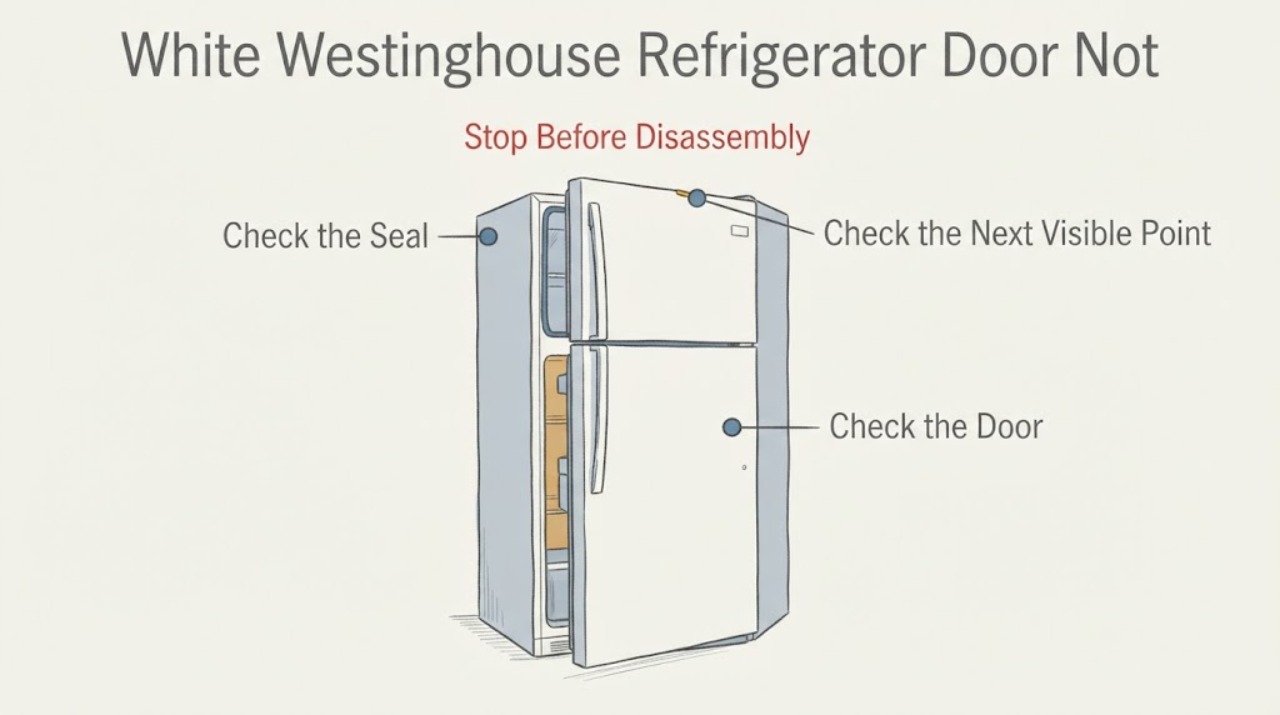
Work through in order
Diagnostic checks
Use only checks that match the exact appliance or system and its official guide.
-
Check 1
Remove packages and reseat shelves, bins, and drawers so nothing projects into the seal path.
Expected result: The door closes or still rubs.
Next step: Correct only the accessible condition and test once; stop repeated attempts and arrange model-specific service if it persists.
Why this matters
Why: A correction supports an obstruction or mis-seated interior part.
-
Check 2
Clean and inspect the gasket for twists, tears, hardened areas, or a persistent gap.
Expected result: The gasket is distorted or the gap remains.
Next step: Correct only the accessible condition and test once; stop repeated attempts and arrange model-specific service if it persists.
Why this matters
Why: A damaged seal can prevent closure; a clear seal shifts to alignment.
-
Check 3
Check that the cabinet is level and the door is not sagging.
Expected result: The cabinet is unlevel or the door sags.
Next step: Correct only the accessible condition and test once; stop repeated attempts and arrange model-specific service if it persists.
Why this matters
Why: Leveling affects door geometry; sag points to hinge/cam wear.
-
Check 4
Close slowly and note the first contact corner after one correction.
Expected result: It latches or rebounds at the same corner.
Next step: Correct only the accessible condition and test once; stop repeated attempts and arrange model-specific service if it persists.
Why this matters
Why: Repeat contact indicates alignment/hinge diagnosis.
Use your observations
Decision map
Find the observation that best matches what you see, then follow the next safe action.
-
PATH 01Next step
What you see
An accessible setting, obstruction, supply, or seating condition was wrong and the product works after one correction.
Do this next
Keep the correction and monitor normal operation.
Why this path and its safety boundary
Why it matters: The external condition was the leading cause.
-
PATH 02Next step
What you see
All documented external checks are correct but the symptom repeats or a code returns.
Do this next
Arrange model-specific service with the recorded evidence.
Why this path and its safety boundary
Why it matters: An internal component or control fault is more likely.
-
PATH 03Next step
What you see
Smoke, burning odor, sparks, liquid near electricity, gas odor, exposed wiring, or repeated breaker trips appears.
Do this next
Isolate power or utilities only when safe and obtain qualified service.
Why this path and its safety boundary
Why it matters: This is a stop condition.
Helpful context
Understand the symptom
Remove packages blocking the seal, reseat bins and shelves, inspect the gasket, and verify the cabinet is level. The legacy White-Westinghouse guide puts these under door and drawer opening/closing; persistent sag or rubbing needs model-specific hinge service. Record the full model and the exact symptom before selecting a part.
Controls and accessible checks vary by refrigerator; internal electrical, sealed-system, gas, and structural work belongs to qualified service.
Only after diagnosis
Potential parts
- model-specific component
Consider only after the model manual or qualified technician confirms the failed component.
The symptom alone does not establish compatibility.
When checks do not resolve it
Need a professional?
Contact the manufacturer or qualified service when refrigerator remains affected after one documented external correction, a code returns, or internal diagnosis is required. Provide model, settings, visible condition, and test result.
Common questions
FAQ
What should I check first for a refrigerator that is door not closing?
Remove packages blocking the seal, reseat bins and shelves, inspect the gasket, and verify the cabinet is level. The legacy White-Westinghouse guide puts these under door and drawer opening/closing; persistent sag or rubbing needs model-specific hinge service.
Should I order a part from the symptom alone?
No. Confirm the exact model and diagnosis before selecting a replacement component.
Read the exact guide
Official sources
- White-Westinghouse Use & Care ManualWhite-Westinghouse · Opened manufacturer or official support guidance; exact model details vary.
Community feedback
Share a repair observation
Share a plain-text repair observation. Accepted observations are published automatically; this page may take a moment to update.