
On this page
Start here
Quick answer
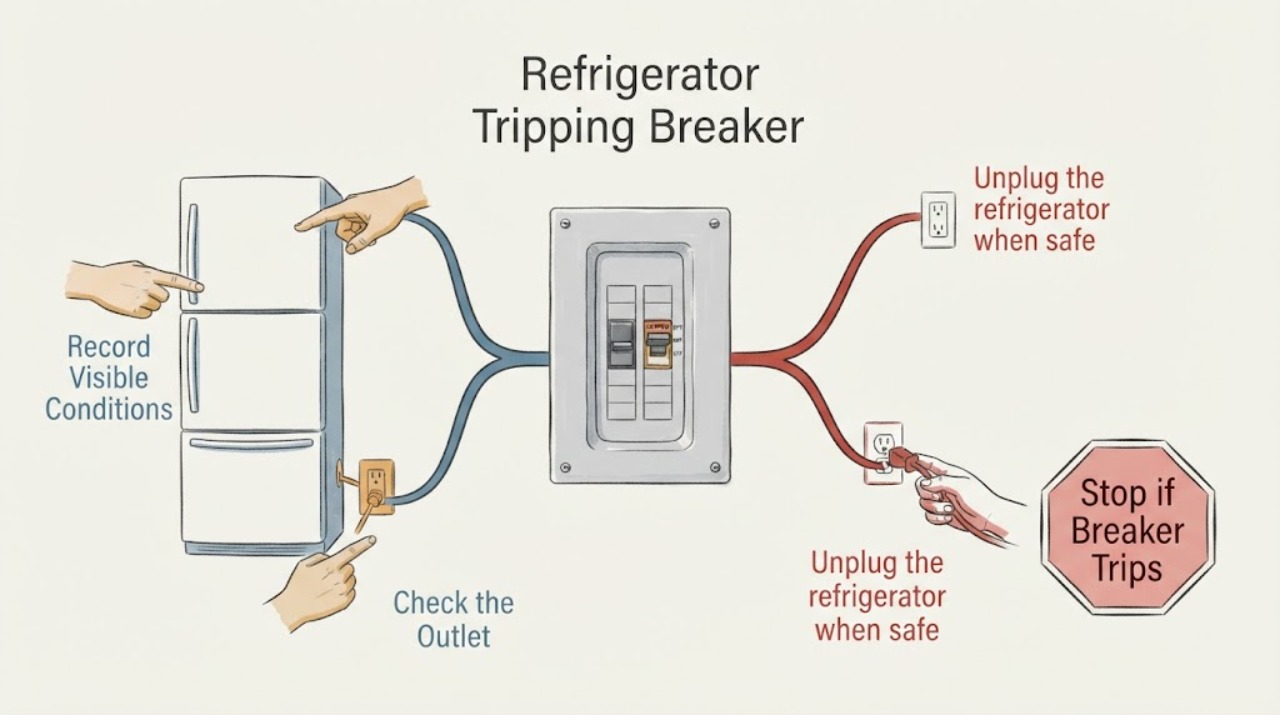
A WINIA refrigerator that trips a breaker should be left off until the cause is separated between the household circuit and the appliance. Note whether the trip happens immediately, when the compressor starts, or after hours. GE’s official appliance guidance recommends unplugging the appliance and using an electrician when the breaker trips immediately; repeated trips, hot connections, smoke, or water near electricity are stop conditions.
Work through in order
Diagnostic checks
Use only checks that match the exact appliance or system and its official guide.
-
Check 1
From a dry, safe position record whether the breaker trips on plug-in, compressor start, defrost, door operation, or after hours; note smoke, odor, heat, water, or arcing.
Expected result: Immediate or hazard-linked trips raise electrical risk; delayed recurrence still means the refrigerator should not be repeatedly tested.
Next step: Leave it off and continue only with safe external observations.
Why this matters
Why: This observation narrows the likely cause but does not identify an internal part by itself.
-
Check 2
Inspect the accessible plug, cord, and outlet for scorch, melting, looseness, moisture, or heat without touching damaged equipment.
Expected result: Connection damage can be the household-side fault; an intact exterior does not clear the refrigerator.
Next step: Do not use an extension, adapter, or a different oversized breaker. Arrange electrical service for damage.
Why this matters
Why: This observation narrows the likely cause but does not identify an internal part by itself.
-
Check 3
Unplug the refrigerator when safe and check whether the breaker holds with the appliance disconnected; do not reset repeatedly.
Expected result: A breaker that still trips with the refrigerator unplugged points toward wiring/protection; one that holds leaves an appliance fault possible.
Next step: Use a qualified electrician for the circuit and qualified appliance service for the refrigerator; do not reconnect to “test.”
Why this matters
Why: This observation narrows the likely cause but does not identify an internal part by itself.
-
Check 4
Check from outside for water leaks, frost melt near wiring, blocked ventilation, or a hot cabinet area. Do not remove the rear cover or use a meter on live parts.
Expected result: Water or overheating can contribute to trips but does not identify compressor, heater, or board failure.
Next step: Keep it disconnected and arrange service for any visible abnormality.
Why this matters
Why: This observation narrows the likely cause but does not identify an internal part by itself.
-
Check 5
Record model/serial, breaker rating, trip timing, outlet condition, recent moves/cleaning, and whether food is warming.
Expected result: This helps separate supply protection from appliance events without replacing a guessed component.
Next step: Provide the record to electrician/appliance technician.
Why this matters
Why: This observation narrows the likely cause but does not identify an internal part by itself.
Use your observations
Decision map
Find the observation that best matches what you see, then follow the next safe action.
-
PATH 01Next step
What you see
Breaker trips with the refrigerator unplugged or when other loads run on the circuit.
Do this next
Leave the appliance disconnected and call a qualified electrician.
Why this path and its safety boundary
Why it matters: Household circuit/protection is more likely.
-
PATH 02Next step
What you see
Breaker trips immediately when WINIA is connected, while the outlet appears sound.
Do this next
Keep it unplugged and arrange qualified appliance service.
Why this path and its safety boundary
Why it matters: An appliance-side short or leakage is possible; the source is not identified.
-
PATH 03Next step
What you see
Trip occurs after hours with cooling/defrost operation, without visible damage.
Do this next
Record timing and arrange service; do not bypass protection.
Why this path and its safety boundary
Why it matters: A delayed appliance event remains possible and repeated resets are unsafe.
-
PATH 04Next step
What you see
There is smoke, burning odor, arcing, water near electricity, or a hot plug/outlet.
Do this next
Move away and isolate only if safe; call qualified electrical help.
Why this path and its safety boundary
Why it matters: Immediate electrical safety boundary.
Helpful context
Understand the symptom
Breaker timing is more useful than guessing at a component: immediate trips implicate supply or an appliance short, while delayed trips can coincide with compressor/defrost operation. No timing proves a specific part.
WINIA model and regional electrical requirements vary. Use the rating plate and exact manual; never substitute a larger breaker or extension cord.
When checks do not resolve it
Need a professional?
Call a qualified electrician for a breaker that trips with the refrigerator unplugged, a damaged outlet, or an incorrectly sized circuit. Call qualified WINIA appliance service for immediate/delayed trips that follow the refrigerator.
Common questions
FAQ
Should I keep resetting the breaker?
No. Record timing, unplug the refrigerator when safe, and arrange electrical/appliance service.
Does an immediate trip prove the compressor failed?
No. It may be household wiring, protection, cord, or an appliance fault. Qualified testing is required.
Can I use an extension cord?
Do not use an extension or adapter to bypass a tripping circuit. Follow the WINIA manual and electrical code.
Read the exact guide
Official sources
- GE Appliance - Circuit Breaker TripsGE Appliances · General refrigerator breaker-trip safety used for a WINIA refrigerator symptom; it does not establish WINIA model-specific electrical design.
Community feedback
Share a repair observation
Share a plain-text repair observation. Accepted observations are published automatically; this page may take a moment to update.