
On this page
Start here
Quick answer
Treat this Wolf gas-oven complaint as two linked but different observations: a burner that does not ignite or ignites late is a gas and ignition safety branch, while an oven that ignites but cooks unevenly is first a preheat, rack, pan, foil, or cooking-mode check. Do not retry if you smell gas, hear a delayed bang, see an abnormal flame, or hear continuous clicking without ignition. If there is no hazard, confirm the exact Wolf model and mode, fully preheat before loading food, use the recommended rack and pan arrangement, and do not cover a rack with foil. If ignition remains unreliable or temperature distribution remains poor after those documented use checks, stop and arrange qualified Wolf service.
Before you begin
Safety first
- Do not manually light the oven, test for a gas leak with a flame, adjust the regulator or gas valve, open the burner path, remove panels, perform live electrical or gas measurements, or bypass a safety device. Stop immediately for gas odor, smoke, a bang, abnormal flame, continuous clicking without ignition, burning odor, damaged wiring, or unexpected heat.
Work through in order
Diagnostic checks
Use only checks that match the exact appliance or system and its official guide.
-
Check 1
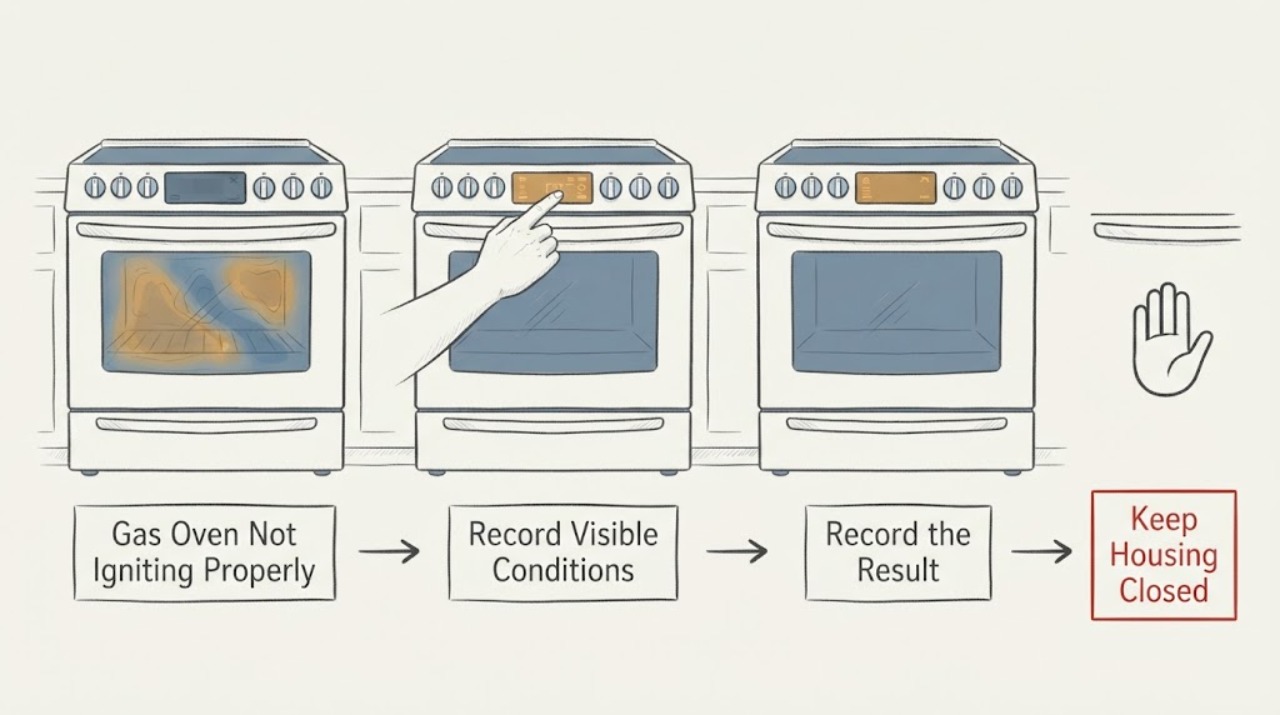
Before another start, identify the exact Wolf model and whether the symptom is no flame or delayed ignition, or whether the oven ignites but food cooks unevenly. Record the selected mode, rack position, pan type, and whether the problem occurs in bake, broil, or both.
Expected result: The oven never ignites or ignition is delayed, or a stable flame is present but food is overdone, underdone, or browned unevenly.
Next step: Use the ignition safety branch for no or delayed flame. If the oven ignites normally, continue with the temperature-distribution checks without changing gas settings or opening the appliance.
Stop if: Do not run a confirmation cycle when gas odor, smoke, a bang, abnormal flame, or continuous clicking is present.
Why this matters
Why: These are different diagnostic branches. Gas release without prompt ignition requires a safety response; uneven cooking after ignition calls first for Wolf's documented preheat and cooking-setup checks.
-
Check 2
If there is no gas odor or other hazard and the oven is meant to ignite, make only one normal start using the exact Wolf control sequence while watching from a safe position. Do not add a flame, hold a control open, or repeat a failed attempt.
Expected result: A prompt flame appears, there is no flame after the normal sequence, ignition is delayed, clicking continues, or a pop, smoke, or abnormal flame appears.
Next step: Turn the oven control off immediately for failed or abnormal ignition and leave the oven unused. Arrange qualified Wolf service; for a gas odor or active smoke/fire situation, leave safely and contact gas or emergency help from outside the hazard area.
Stop if: Never manually light the oven, test for a leak with a flame, adjust the gas regulator, or open the burner or valve path.
Why this matters
Why: A prompt flame supports a normal ignition attempt. No flame, delayed ignition, or continuous clicking means unburned gas or an ignition/supply fault must not be investigated by repeated starts; a pop, smoke, or abnormal flame is an immediate hazard.
-
Check 3
If the oven ignites and the complaint is uneven cooking, let the oven fully preheat before adding food for every mode other than broil. Note whether the preheat indicator completes and whether the result changes when food is added only after preheat.
Expected result: The oven was not fully preheated, or it reaches preheat but still cooks unevenly or does not get hot enough.
Next step: Use a fully preheated cycle only when there is no ignition or safety fault. If the preheated oven still has inaccurate distribution or cannot reach temperature, continue to the pan/rack checks and then service if unresolved.
Stop if: Do not keep heating the oven to force a temperature result if ignition is unreliable, a hazard appears, or the control behaves abnormally.
Why this matters
Why: Wolf says incomplete preheat can produce varied results and identifies full preheat as key to cooking performance. If the oven is fully preheated and the symptom persists, a setup or product-performance issue remains.
-
Check 4
For the uneven-cooking branch, use the Wolf cooking guidance: select the correct rack level and mode, avoid a pan that is too large or too many pans on one rack, and remove aluminum foil that covers a rack or traps heat. If using convection, follow the mode-specific temperature or time adjustment in the Wolf guide.
Expected result: Uneven browning improves after the rack, pan count/size, foil, or mode is corrected, or the same pattern remains with the documented setup.
Next step: Keep the corrected rack, pan, and mode arrangement for ordinary use. If food remains unevenly cooked after following the Wolf guidance, stop user-level diagnosis and arrange Factory Certified Service.
Stop if: Do not cover racks with foil, remove internal panels, reposition gas components, or select a replacement part from uneven browning alone.
Why this matters
Why: An improvement after a cooking-setup correction makes heat circulation or mode selection more likely than an immediately proven component fault. Persistence after the documented setup is a service branch, not proof of a particular heater or fan part.
-
Check 5
After the ignition and documented cooking-setup checks, record whether the oven reaches the selected temperature, whether only bake or broil is affected, whether the door was opened frequently, and whether the same food is unevenly cooked on a correctly positioned rack.
Expected result: The oven reaches temperature and cooks normally after setup changes, or it remains too cool, cycles abnormally, fails in one function, or cooks unevenly despite full preheat and the correct setup.
Next step: Keep the oven out of service if ignition is unreliable or the product remains abnormal. Provide the exact model, fuel type, mode, preheat result, rack/pan setup, and ignition observations to qualified Wolf service.
Stop if: Do not open the oven, perform live gas or electrical tests, bypass a safety device, or continue testing after smoke, odor, abnormal flame, or a protective trip.
Why this matters
Why: Recovery after a documented use correction supports that operating condition as the immediate cause. Persistent poor heating or distribution after those checks needs model-specific diagnosis; the symptom does not identify an igniter, valve, sensor, fan, or control.
Use your observations
Decision map
Find the observation that best matches what you see, then follow the next safe action.
-
PATH 01Next step
What you see
The Wolf gas oven releases gas but does not ignite promptly, clicks continuously, produces a pop, shows an abnormal flame, or creates a persistent gas odor.
Do this next
Turn the control off, do not manually light or test for a leak, leave the hazard area if needed, and contact gas or emergency help safely. Arrange qualified Wolf service after the area is safe.
Why this path and its safety boundary
Why it matters: This is an ignition and gas-safety condition, not an inaccurate-temperature adjustment. Repeated attempts could release more unburned gas.
-
PATH 02Next step
What you see
The oven ignites normally with no hazard, but food is unevenly cooked before the oven has been fully preheated or while an oversized pan, multiple pans, foil-covered rack, or unsuitable mode is being used.
Do this next
Fully preheat, use the correct rack and mode, avoid an oversized or crowded pan arrangement, and remove rack-covering foil. Make one controlled ordinary-use check only when ignition remains normal.
Why this path and its safety boundary
Why it matters: Wolf's guidance makes incomplete preheat or cooking setup more likely than a proven internal heating failure.
-
PATH 03Next step
What you see
The oven fully preheats and follows Wolf's rack, pan, foil, and mode guidance, yet it still does not reach temperature or cooks unevenly; or only one oven function fails.
Do this next
Stop user-level testing and arrange Factory Certified Service with the exact model, affected mode, preheat result, and cooking observations.
Why this path and its safety boundary
Why it matters: The documented use checks did not resolve the temperature-distribution problem. A heating, sensing, airflow, control, or gas-system diagnosis may be needed, but the symptom does not select a part.
-
PATH 04Next step
What you see
The product is not a Wolf gas oven, the exact model or fuel configuration is unknown, or smoke, burning odor, damaged wiring, a hot control, or another electrical or fire hazard appears.
Do this next
Use the exact model manual for a different identity. For a hazard, stop using the appliance, isolate power only if safe, leave active smoke or fire, and arrange qualified appliance or electrical service.
Why this path and its safety boundary
Why it matters: The Wolf gas-oven guidance is not established for that identity, or the symptom has crossed a safety boundary where another ignition or heating test is unsafe.
Helpful context
Understand the symptom
Separate ignition from heat distribution
A Wolf gas oven can have an ignition problem, a cooking-use problem, or both. No flame, delayed ignition, a persistent gas odor, a loud pop, or continuous clicking is not an ordinary temperature-adjustment issue. By contrast, food that browns unevenly after the oven does ignite can result from incomplete preheat, rack or pan placement, foil, or the selected mode. Record which of these actually occurs before choosing the next step.
Wolf does not identify a user-replaceable part from this symptom
Wolf's public guidance gives ordinary-use checks and a service boundary, not a part diagnosis. A gas-oven symptom does not by itself prove an igniter, gas valve, temperature sensor, control, fan, or regulator has failed. Keep the appliance closed and give service the model, fuel configuration, selected mode, ignition behavior, preheat result, and cooking pattern.
When checks do not resolve it
Need a professional?
Arrange qualified Wolf service when ignition is absent, delayed, repeatedly unreliable, or abnormal; when the oven remains too cool or cooks unevenly after full preheat and the documented rack, pan, foil, and mode checks; or when only one oven function responds. Use gas or emergency help first for an active gas or fire hazard.
Safety scope: Do not manually light the oven, test for a gas leak with a flame, adjust the regulator or gas valve, open the burner path, remove panels, perform live electrical or gas measurements, or bypass a safety device. Stop immediately for gas odor, smoke, a bang, abnormal flame, continuous clicking without ignition, burning odor, damaged wiring, or unexpected heat.
Have this ready
- Provide the exact Wolf model and fuel configuration, selected bake or broil mode, whether ignition occurred and how it sounded, whether F03 or another message was displayed if applicable, preheat result, rack and pan arrangement, foil or convection use, and the observed cooking pattern.
Common questions
FAQ
Why can a Wolf gas oven ignite but still cook unevenly?
Wolf says uneven cooking can follow incomplete preheat, an incorrect rack or mode, an oversized pan, too many pans on a rack, or foil that traps heat. Correct those documented use conditions before treating uneven browning as proof of an internal part failure.
What should I do if the Wolf oven clicks but does not ignite?
Turn the control off and do not keep retrying, manually light the oven, or test for a leak with a flame. If there is gas odor, a pop, smoke, or an abnormal flame, leave safely and contact gas or emergency help; otherwise arrange qualified Wolf service for the failed or delayed ignition.
Does uneven temperature distribution identify a fan or igniter to replace?
No. Wolf's public guidance provides preheat and cooking-setup checks and a service boundary, but uneven cooking alone does not identify an igniter, gas valve, sensor, fan, heater, or control part. Confirm the exact model before any professional diagnosis or part selection.
Read the exact guide
Official sources
- Wolf Oven Does Not Get Hot Enough | FAQ | Sub-Zero, Wolf, and CoveSub-Zero, Wolf, and Cove · Official Wolf guidance for an oven that is not hot enough or cooks/browns unevenly. It identifies incomplete preheat, prolonged door opening, foil, and pan size as checks and directs unresolved cases to Factory Certified Service.
- TroubleshootingWolf / Sub-Zero Group · Official Wolf gas-range use-and-care guide. Its troubleshooting section covers erratic, poor, or no ignition, including external burner-cap, burner/igniter cleanliness, moisture-drying, and knob checks, and directs the user to Wolf service with the model and serial information.
- Wolf Oven Temperature Issue | FAQ | Sub-Zero, Wolf, and CoveSub-Zero, Wolf, and Cove · Official Wolf oven temperature support. It identifies incomplete preheat and heating/fan issues as relevant causes, recommends full preheat and an available temperature probe, explains normal temperature cycling, and routes unresolved temperature issues to Factory Certified Service.
- Wolf Oven Temperature Is Too Hot | FAQ | Sub-Zero, Wolf, and CoveSub-Zero, Wolf, and Cove · Official Wolf guidance for food cooking too hot or unevenly. It checks cookware material, setting, pan size, rack level, cooking mode, and convection adjustment before service.
- Uneven Browning in a Wolf Oven | FAQ | Sub-Zero, Wolf, and CoveSub-Zero, Wolf, and Cove · Official Wolf oven guidance for food browning unevenly or being done on one side and raw on the other. It recommends checking proper use, pan size and count, rack level, cooking mode, and foil that traps heat, then directs unresolved cases to Factory Certified Service.
Community feedback
Share a repair observation
Share a plain-text repair observation. Accepted observations are published automatically; this page may take a moment to update.