
On this page
Start here
Quick answer
A Wolf gas oven that is not working needs both electrical power for its controls and igniter and an appropriate gas supply. First decide whether the display is dark, a control or door state prevents a start, the oven calls for heat but does not ignite, or it ignites but does not heat normally. Check only the model-approved knob, mode, door, display, and visible power conditions from a safe, dry position. Do not light the oven with a match, inspect a gas connection, remove a panel, or keep trying after a failed ignition. Wolf says an oven that does not ignite or has gas odor without ignition should be discontinued until repaired; delayed ignition, a bang, abnormal flame, smoke, CO alarm, arcing, or a repeated breaker trip is an immediate stop condition. Arrange qualified appliance service for any internal gas, ignition, burner, thermostat, wiring, or control diagnosis.
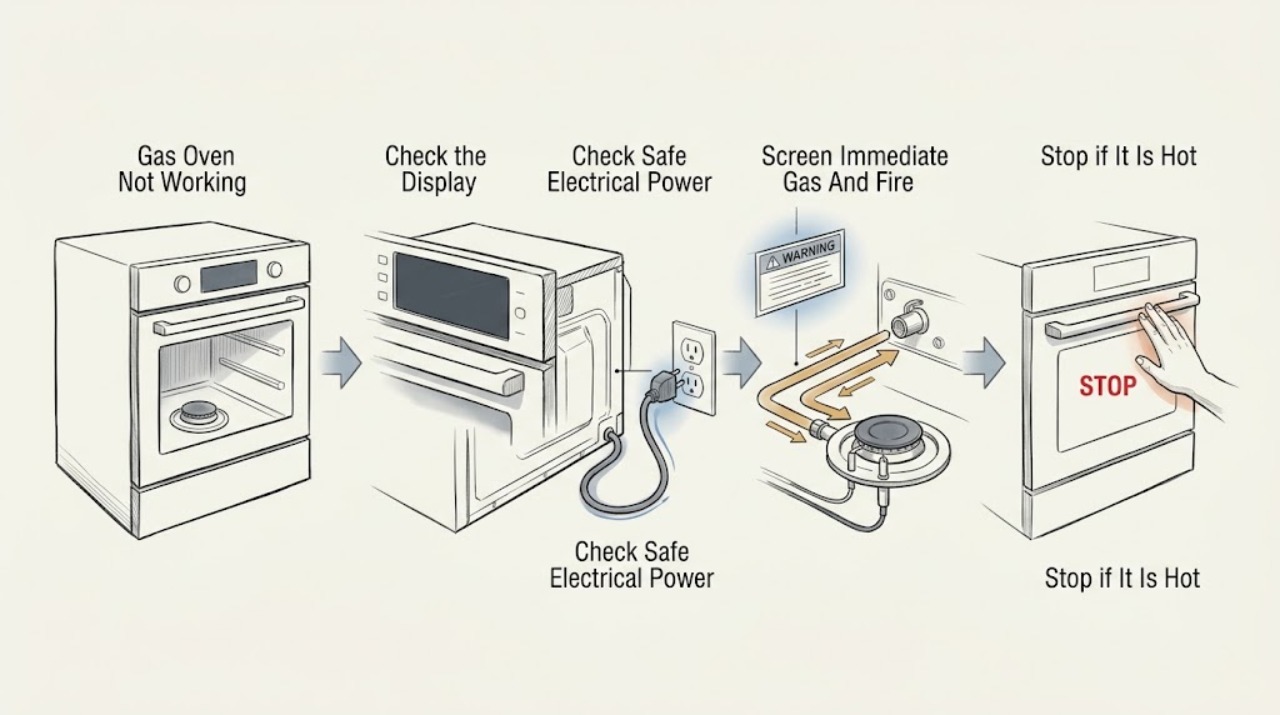
Work through in order
Diagnostic checks
Use only checks that match the exact appliance or system and its official guide.
-
Check 1
Before touching the controls, observe from a safe position for gas odor or hissing, smoke, a flame outside the normal burner area, a burning or electrical odor, visible arcing, a CO or smoke alarm, or a hot or damaged receptacle. Do not use a match, lighter, switch, appliance, or phone near a suspected leak.
Expected result: No warning is present, or gas, hissing, smoke, an alarm, abnormal flame, arcing, or burning odor is present.
Next step: If any warning is present, stop using the oven and leave. From outside or another safe location, contact emergency help, the gas supplier, or a qualified professional as appropriate. If none is present, continue to the identity and power check.
Stop if: Stop immediately for gas odor or hissing, smoke, a CO or smoke alarm, flame outside the normal burner area, visible arcing, or a strong burning or electrical smell.
Why this matters
Why: A no-start symptom can be checked only when there is no immediate hazard. Gas or fire evidence takes priority over all control and ignition checks.
-
Check 2
Read the model and fuel information if safely visible, then check that the correct oven knob or mode is selected, the temperature is set, the door closes normally, and the display does not show a lock, showroom or demonstration state, delay, or fault. Use the exact Wolf guide and do not force the door or bypass an interlock.
Expected result: The display is dark; a lock, showroom, delay, or fault state is shown; the knob or mode is wrong; the door is blocked or will not close; or the controls appear ready but the oven remains inactive.
Next step: Follow the model guide once to cancel a permitted delay or exit a documented mode. If the display stays dark, a fault returns, the door does not close, or the controls remain unresponsive, stop and arrange service.
Stop if: Do not force the door, defeat a lock, cycle an error repeatedly, remove a control, or proceed if heat, gas, smoke, abnormal flame, or electrical damage is present.
Why this matters
Why: A control or door state can prevent an ignition request. Wolf's control modes and messages vary by series, so a generic reset or code interpretation can be wrong. A ready control with no response shifts attention to power, supply, or internal service.
-
Check 3
From a dry, stable position, observe the visible power connection and the oven's dedicated breaker or fuse status without removing panels or touching a wet, hot, loose, or damaged plug or receptacle. Do not use an extension cord or test live wiring.
Expected result: The display and power appear normal; the display is dark; the breaker or fuse is off; the cord or receptacle is warm or damaged; or the breaker trips again.
Next step: If there is no damage or warning, use only the normal model-approved one-time breaker reset. If it trips again, stays off, or the connection is damaged, leave the oven off and use a licensed electrician or qualified appliance service.
Stop if: Do not touch wet, hot, loose, scorched, or damaged electrical parts, open a panel, reset repeatedly, or continue after smoke, sparks, arcing, or a burning odor.
Why this matters
Why: Wolf notes that no power can prevent ignition and control operation. A dark display can be a supply issue, while a warm or damaged connection or recurring trip is an electrical hazard rather than a normal reset condition.
-
Check 4
Without moving the range or touching a gas connection, confirm only from the normal user-accessible position that the intended gas supply is available and that the appliance has not recently been disconnected or converted. Read the rating or serial information if safely visible; never purge a line or test a fitting.
Expected result: Other gas appliances also lack gas; the Wolf oven was recently installed or converted; the supply status is uncertain; or the household gas supply appears normal.
Next step: If supply, fuel type, or recent installation is uncertain, keep the oven off and ask the installer or qualified gas professional to verify it. If gas supply appears normal, continue only to one controlled model-approved observation.
Stop if: Stop for gas odor, hissing, a suspected leak, a damaged connector, any need to move the appliance, or any need to open or adjust a gas assembly.
Why this matters
Why: No gas or an incorrect fuel configuration can prevent ignition, but a supply or conversion question is an installation issue. It cannot be resolved safely by loosening a connector or repeatedly trying to light the oven.
-
Check 5
Only when controls, power, fuel identity, and the surrounding area are normal, make one normal Bake or Broil start exactly as the model guide describes. Observe from a safe position; do not reach through the oven floor, light a burner manually, or restart to reproduce the symptom.
Expected result: The burner ignites normally; the igniter clicks with no flame; ignition is delayed; a bang occurs; the flame is yellow, lifting, or unstable; or the oven does not heat after ignition.
Next step: If ignition is not normal, turn the control off, do not attempt another start, and arrange qualified appliance service. Record the sound, timing, flame behavior, mode, and display state.
Stop if: Stop at once for gas odor, continuous clicking, delayed ignition, a bang, abnormal flame, smoke, CO alarm, arcing, burning odor, or a breaker trip.
Why this matters
Why: Normal ignition points away from an ongoing fault. Clicking without flame can involve ignition, gas, or control components; delayed ignition or a bang can allow unburned gas; a flame or heat problem needs professional diagnosis.
-
Check 6
If the oven ignites but does not cook or heat correctly, note whether the issue occurs in Bake, Broil, or every mode, whether preheat completes, whether the door closes fully, and whether the display reports a fault. Use only external observation and the exact Wolf guide; do not remove a burner, igniter, element, or control.
Expected result: Only one mode fails; all modes fail; preheat never completes; the door is blocked; a fault appears; or the oven heats normally after the safe control and power checks.
Next step: Follow the model guide for one permitted mode or door check. If heat remains absent, a fault returns, or the door or controls fail, keep the oven off and request service.
Stop if: Stop for uncontrolled heat, a gas smell, abnormal flame, smoke, CO alarm, electrical odor, arcing, or a repeated trip; do not continue preheat tests.
Why this matters
Why: A mode-specific symptom can narrow the circuit or burner, while all-mode failure can involve power, control, temperature sensing, or supply. A blocked door or special mode can prevent normal operation. These clues do not identify a replacement part without model-specific testing.
-
Check 7
Prepare service information without internal access: record the full Wolf model and fuel type, mode, temperature, display or preheat indicator, door and control state, power observations, gas-supply or installation history, ignition timing and sound, flame description, and any safe external photos.
Expected result: A technician has a clear symptom sequence without a second ignition attempt, gas-line test, live electrical measurement, or panel removal.
Next step: Keep the oven off until qualified appliance service reviews the information. Use a licensed electrician for a confirmed household circuit issue and a qualified gas professional for fuel supply, conversion, or combustion work.
Stop if: Stop documenting and leave if gas, smoke, fire, an alarm, uncontrolled heat, abnormal flame, or arcing appears.
Why this matters
Why: The sequence separates no power, control or door state, supply, ignition, burner, temperature, and mode-specific faults without guessing at a part or bypassing a safety device.
Use your observations
Decision map
Find the observation that best matches what you see, then follow the next safe action.
-
PATH 01Next step
What you see
The display is dark, a breaker is off, a control or showroom state is active, the door does not close, or the oven will not accept a mode.
Do this next
Use only one model-approved external power or control check when safe. Persistent no-power, lock, door, or control symptoms require qualified service; do not bypass an interlock.
-
PATH 02Next step
What you see
The gas supply is uncertain, fuel type or conversion is unclear, or a recent installation or reconnection preceded the failure.
Do this next
Keep the oven off and have the installer or qualified gas professional verify supply, fuel configuration, and installation. Do not purge gas, move the range, or loosen a connector.
-
PATH 03Next step
What you see
Controls and power appear normal but the igniter clicks without flame or the oven never establishes a normal ignition.
Do this next
Turn the control off and do not attempt another start. Request qualified appliance service to diagnose the ignition, gas, burner, valve, wiring, and control path.
-
PATH 04Next step
What you see
Ignition is delayed, a bang or door movement occurs, the flame is yellow, lifting, unstable, or a gas odor is present without ignition.
Do this next
Discontinue use. For odor or suspected leakage, leave without operating switches and contact gas or emergency help from outside; arrange qualified service after the area is cleared.
-
PATH 05Next step
What you see
The oven lights but one mode, preheat, or temperature behavior is abnormal while another mode may work.
Do this next
Record the exact mode and sequence and keep testing to a minimum. Have service diagnose the model-specific burner, element, thermostat, sensor, fan, and control rather than replacing a guessed part.
-
PATH 06Next step
What you see
Smoke, burning odor, arcing, a hot receptacle, repeated breaker trips, an alarm, uncontrolled flame, or abnormal heat appears.
Do this next
Stop using the oven and move to safety. Leave for gas, fire, or alarm conditions and contact emergency help from outside; use qualified electrical or appliance service once safe.
Helpful context
Understand the symptom
Separate no power, no start, no ignition, and no heat
“Not working” describes several different failures. A dark display or no response points first to household power or a control condition. A powered display that will not accept a mode or Start can involve a lock, showroom or demonstration state, a door condition, or a fault. A preheat request with clicking but no flame points toward the gas and ignition path. A flame that lights but does not heat or cycles abnormally needs professional diagnosis of the burner, safety valve, thermostat, sensor, or control. Record the stage and display before attempting anything else.
Use Wolf's model-specific controls only
Wolf ranges and ovens differ by series and control style. Check the exact Use and Care Guide for the knob position, mode, door, lock, showroom or demonstration state, and any message. Wolf's gas-oven guidance describes the igniter clicking until ignition is sensed and says a gas oven that does not ignite should be discontinued until repaired. Do not infer a gas setting or error meaning from another Wolf series, and do not remove an igniter, burner cover, regulator, or control panel.
Stop for gas, fire, or electrical warning signs
If gas is smelled or heard, do not try another ignition or look for the leak. Leave without operating switches or a phone in the area and contact the gas supplier or emergency help from outside. For smoke, an abnormal flame, CO alarm, visible arcing, a hot receptacle, or a repeated breaker trip, stop using the oven and move to safety. A qualified technician must handle gas pressure, combustion, internal wiring, valves, igniters, and controls.
Safety boundary
Stop conditions
- If gas is smelled or heard leaking, leave immediately without operating lights, switches, phones, or other electrical equipment near the oven and contact gas or emergency help from outside.
- Stop for delayed ignition, a bang, continuous clicking without flame, abnormal flame, smoke, CO or smoke alarm, visible arcing, burning odor, uncontrolled heat, or a repeated breaker trip.
- Do not use a match or lighter, manually light the oven, purge a gas line, move the range, loosen a gas fitting, adjust pressure, or test for a leak.
- Do not remove panels, test live wiring, replace an igniter, valve, thermostat, sensor, burner, or control, bypass a door or safety interlock, or repeatedly reset the breaker.
When checks do not resolve it
Need a professional?
Request qualified appliance service for persistent no-start, no-heat, no-ignition, delayed ignition, abnormal flame, recurring code, failed mode, door or control fault, or any need for internal access. Use an electrician for household power faults and a qualified gas professional for gas supply, conversion, pressure, connector, or combustion work.
Have this ready
- Provide the Wolf model and fuel type, selected mode and temperature, display or preheat indication, door and control state, power and supply observations, installation history, ignition timing and sounds, flame description, code, and safe external photos.
Common questions
FAQ
Why is my Wolf gas oven not working even though the controls have power?
A powered display does not prove that gas reaches the oven or that ignition is working. Check the exact mode, door, control state, fuel configuration, and safe external supply clues. If the oven clicks without flame, fails to heat, or shows a returning fault, keep it off and request qualified service.
What should I do if my Wolf gas oven clicks but does not light?
Turn the control off and do not keep trying. A gas oven that does not ignite should be discontinued until repaired. Record whether clicking continues, whether a flame appears, and whether there is delayed ignition, a bang, abnormal flame, or gas odor; arrange qualified appliance service.
Can a Wolf gas oven fail after installation or a gas conversion?
Yes. A recent installation or conversion makes fuel type, supply, and installation checks relevant. Read the rating information if safely visible, but do not move the range, purge a line, loosen a connector, or adjust gas pressure. Have the installer or qualified gas professional verify the setup.
Is a delayed bang when a Wolf gas oven lights normal?
No. Wolf treats delayed ignition, an ignition bang, or a door that moves during ignition as a condition requiring attention. Turn the control off, do not make another ignition attempt, and arrange qualified service; leave immediately for gas odor or a suspected leak.
When should I stop using a Wolf gas oven immediately?
Stop for gas odor or hissing, continuous clicking without flame, delayed ignition or a bang, an abnormal flame, smoke, a CO alarm, visible arcing, a burning odor, uncontrolled heat, or a repeated breaker trip. Leave for a gas, fire, or alarm emergency and contact help from a safe location.
Read the exact guide
Official sources
- Certain Older Gas Connectors May Be DangerousU.S. Consumer Product Safety Commission · Official CPSC gas-safety guidance applied to a suspected gas odor around a gas oven; do not inspect or move a connector yourself.
- Wolf Electric Oven Does Not HeatSub-Zero, Wolf, and Cove · Official Wolf oven support used for control and power distinctions; only the user's exact gas-oven guide controls model features.
- Gas Oven Delayed IgnitionSub-Zero, Wolf, and Cove · Official Wolf delayed-ignition guidance for gas ovens; timing and controls vary by model.
- Gas Oven Bake Burner Not WorkingSub-Zero, Wolf, and Cove · Official Wolf guidance for gas oven bake-burner symptoms; exact model Use and Care instructions control.
Community feedback
Share a repair observation
Share a plain-text repair observation. Accepted observations are published automatically; this page may take a moment to update.