
On this page
Start here
Quick answer
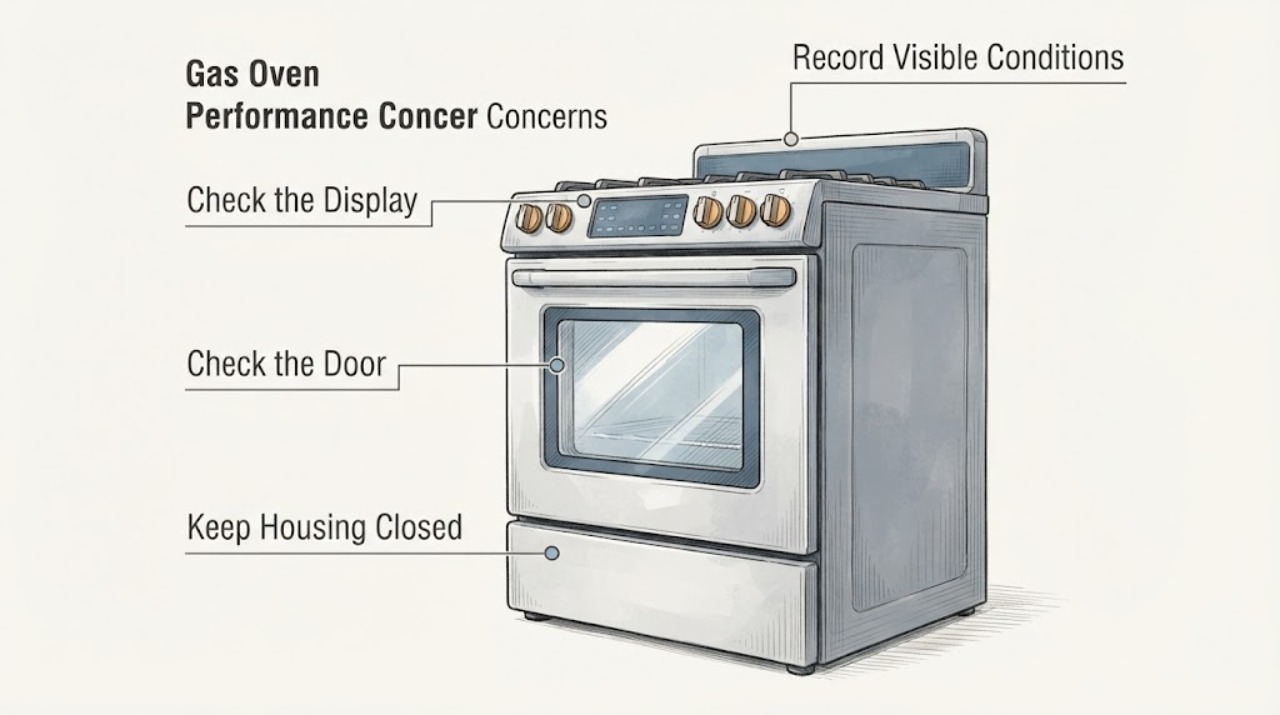
If a Wolf gas oven lights but cooks too slowly, runs too hot or cool, or browns unevenly, first separate a setup problem from a heating failure: use the exact cooking mode and temperature, allow the oven to finish preheating, keep the door closed, and check the rack and pan arrangement. Wolf's gas-range guide says the indicator shows when the set temperature has been reached and then cycles as heat is maintained; it also links low temperature to incomplete preheat, an opened door, or an undersized pan, and uneven browning to an oversized or crowded pan arrangement. If preheat completes but the oven is still not hot, food takes substantially longer than expected, food remains uneven after the manufacturer's instructions are followed, or raising the setting does not improve performance, stop repeated tests and arrange qualified Wolf service. This is a temperature and cooking-performance path, not a substitute for the separate gas-odor or no-ignition safety path: if gas is present without ignition, there is a bang, abnormal flame, smoke, or continuous clicking, turn the control off, avoid retrying, and get gas-safety or appliance help from a safe location.
Work through in order
Diagnostic checks
Use only checks that match the exact appliance or system and its official guide.
-
Check 1
Define the performance symptom before changing a setting. With the oven cool and no gas odor or abnormal sound, record the mode, set temperature, rack position, pan material and size, recipe, expected result, and whether the oven lights and maintains a flame. If the concern is actually no ignition, delayed ignition, or a hazard sign, stop this performance check and use the safety branch below.
Expected result: The oven lights and responds, but the result is too slow, too hot, too cool, or uneven; or the oven does not ignite or shows an abnormal combustion sign.
Next step: For a lit oven, continue with a controlled preheat and cooking-setup check. For no ignition or any hazard sign, turn the control off, do not retry, and arrange gas-safety or qualified appliance help from a safe location.
Stop if: Do not remove a panel, burner, door component, thermostat, regulator, or gas connection to identify the cause.
Why this matters
Why: A lit oven with a repeatable cooking result is a temperature/setup investigation. No ignition, gas odor, a bang, smoke, soot, abnormal flame, or continuous clicking is an ignition-safety problem already outside this page's ordinary user checks.
-
Check 2
Run one controlled bake test using the exact model's normal control sequence. Set the desired temperature directly rather than setting a higher temperature and turning it down, place the rack before heating, and wait until the model's preheat indication shows that the target has been reached before adding the food. Do not open the door repeatedly while waiting.
Expected result: The preheat indication has not completed when food is added, or the food improves when the oven is allowed to reach the target first; alternatively, preheat completes but the cavity still does not feel adequately hot.
Next step: If a complete preheat fixes the result, follow the exact recipe and model guidance. If preheat completes but the oven remains insufficiently hot, stop repeated cooking tests and prepare a service handoff.
Stop if: Do not hold the door open to inspect the flame, add a manual flame, or adjust gas flow to make preheat faster.
Why this matters
Why: Wolf states that preheating is necessary for most cooking, that raising the temperature first does not preheat faster, and that the indicator turns off when the temperature is reached. An incomplete preheat can explain a slow or uneven result; completed preheat with inadequate heat is a service-oriented result.
-
Check 3
Repeat the same recipe once with the recommended pan and rack arrangement. Keep the door closed as much as practical, avoid crowding the rack, and use the cooking mode the recipe calls for; for convection, use a suitable low-sided pan and do not treat a standard-oven recipe as proof of a defect without following its temperature and mode instructions.
Expected result: The result improves with the recommended rack, pan, spacing, and mode, or the same uneven browning or undercooking persists despite following the instructions.
Next step: Use the improved setup for normal cooking. If the same fault repeats with the correct setup, record the recipe, mode, rack, pan, and result and arrange model-specific service rather than guessing at calibration or gas components.
Stop if: Do not line the oven floor or entire rack with foil, block vents, or alter the burner area; those changes can damage the appliance or affect heat and combustion.
Why this matters
Why: Wolf's gas-range guide says a pan that is too small can contribute to a not-hot-enough result, an oversized or crowded pan can produce uneven exterior browning, and different modes distribute heat differently. Persistence after the setup is controlled makes a simple cookware explanation less likely, but does not identify a particular internal part.
-
Check 4
If you have a suitable oven thermometer or the exact model provides a user-accessible temperature probe, use it only as an external observation during one controlled, fully preheated test. Compare the documented reading and cooking result with the set temperature without opening the cabinet or attempting calibration.
Expected result: The independent observation is broadly consistent after preheat, or the oven repeatedly remains far from the expected temperature, takes much longer than the recipe or past experience, or cooks unevenly.
Next step: For a consistent external result, follow the model's cooking guidance and monitor. For a repeatable inadequate-temperature or timing problem, stop further experiments and give the service provider the set temperature, observed result, preheat status, mode, and model/serial information.
Stop if: Do not perform live electrical tests, enter a service/calibration mode, adjust the gas regulator, or remove covers to measure a component.
Why this matters
Why: An external measurement can document a repeatable symptom, but it does not identify whether a thermostat, igniter, valve, burner, sensor, or control is responsible. Wolf's support guidance treats persistent temperature-performance symptoms as a service matter.
-
Check 5
Make a service record after the controlled checks: exact model and market, mode, set temperature, time to the preheat indication, rack and pan setup, door-opening pattern, recipe and expected timing, observed temperature if available, and whether bake or broil behaves differently. Keep the appliance off if the test produced a gas odor, smoke, soot, bang, abnormal flame, or repeated clicking.
Expected result: The symptom is a repeatable temperature or cooking-performance failure after full preheat and correct setup, or the symptom includes ignition or combustion warning signs.
Next step: Arrange Wolf Factory Certified Service or another qualified appliance professional for the persistent performance problem. For gas odor or suspected combustion danger, leave the area as appropriate and contact the gas supplier or emergency help from a safe location; do not operate electrical switches in the odor area.
Stop if: Do not keep cooking to reproduce a failure, manually light the oven, test for a gas leak, or continue operation after a hazard sign.
Why this matters
Why: A repeatable performance failure needs model-specific diagnosis; ignition or combustion signs can indicate unburned gas or unsafe operation and are not normal temperature variation. The observations help a qualified professional choose the correct diagnostic path without the owner opening the gas or electrical system.
Use your observations
Decision map
Find the observation that best matches what you see, then follow the next safe action.
-
PATH 01Next step
What you see
The oven reaches its preheat indication only after the food was added, or the result improves when the oven is fully preheated and the door stays closed.
Do this next
Use the model's completed-preheat procedure and recipe mode/rack instructions. Monitor normal cooking without repeatedly opening the door; seek service if the symptom returns after those controls are consistent.
Why this path and its safety boundary
Why it matters: The documented preheat and heat-loss conditions explain the original performance concern more readily than a proven failed part.
-
PATH 02Next step
What you see
Preheat completes, but the oven is still not hot enough, food takes substantially longer than the recipe or prior experience, or raising the setting does not improve the result.
Do this next
Stop repeated cooking tests, document the exact model and observations, and arrange qualified Wolf service. Do not recalibrate, adjust a gas valve, or replace a part based only on this symptom.
Why this path and its safety boundary
Why it matters: This is not adequately explained by an incomplete preheat or a single cookware choice. The underlying heating or control cause remains model-specific and cannot be safely identified from outside the appliance.
-
PATH 03Next step
What you see
Uneven browning or cooking occurs only with an oversized or crowded pan, an unsuitable pan material, an incorrect rack, or a mode that does not match the recipe; the result improves after the setup is corrected.
Do this next
Keep the corrected rack, pan, spacing, and mode for normal use. If uneven results persist with the manufacturer's instructions and a controlled test, escalate with the complete cooking record.
Why this path and its safety boundary
Why it matters: The cooking setup and heat circulation are more likely contributors than a confirmed appliance defect.
-
PATH 04Next step
What you see
A gas odor occurs without ignition, or there is a delayed bang, smoke, soot, abnormal flame, or continuous clicking with no reliable ignition.
Do this next
Turn the control off, do not use a flame or test for a leak, avoid electrical switches in the odor area, leave if needed, and contact gas-safety or emergency help from a safe location. Keep the oven unused until repaired.
Why this path and its safety boundary
Why it matters: This is an ignition or combustion hazard branch, not ordinary temperature variation. Unburned gas or abnormal combustion can create fire, explosion, burn, or carbon-monoxide risk.
Helpful context
Understand the symptom
What this performance check can and cannot establish
A gas oven may appear inconsistent when food was added before preheat, the door was opened repeatedly, or the pan and rack arrangement changed heat circulation. Those observations do not prove a failed thermostat, igniter, valve, burner, or control. Wolf's gas-range guide documents a separate service path for an oven-temperature issue, so persistent failure after the external setup checks should be handed to qualified service rather than corrected by adjusting gas or internal controls.
Keep ignition hazards out of the performance branch
This page applies when the oven can be operated without a gas odor or abnormal combustion sign. Wolf's gas-oven support guidance says a gas oven normally lights in about 30 to 45 seconds, but gas odor without ignition means use should be discontinued until repaired. Do not use a flame, test for a leak, bypass an interlock, open the gas path, or keep retrying an oven that has delayed ignition, a loud bang, smoke, soot, or an unusual flame.
When checks do not resolve it
Need a professional?
Arrange qualified Wolf service when full preheat completes but the oven remains too cool, cooking is substantially slower than the recipe or past experience, food remains uneven after the manufacturer's setup instructions are followed, or increasing the setting does not improve performance. Escalate immediately to gas-safety or emergency help for gas odor without ignition, a delayed bang, smoke, soot, abnormal flame, suspected carbon monoxide, or continuous clicking without reliable ignition.
Common questions
FAQ
Is a cycling oven indicator or flame automatically a failure?
No. Wolf's gas-range guide says the indicator turns off after the set temperature is reached and cycles as more heat is required to maintain it. A cycling indicator alone does not identify a failed part. Treat persistent under-temperature, long cooking times, or uneven results after full preheat and correct setup as the service threshold.
Should I set the oven higher first so it preheats faster?
No. The Wolf gas-range guide says to turn the control directly to the desired temperature; setting a higher temperature first and then lowering it does not preheat faster. Use the model's preheat indication before adding food.
Can I adjust the gas valve, thermostat, or calibration myself?
Do not. The external checks here document the symptom and rule out common setup conditions; they do not prove which internal gas, ignition, temperature-sensing, or control component is responsible. Use qualified Wolf service for a persistent performance issue.
What if the oven smells like gas while it is not lighting?
Turn the control off and stop. Do not use a flame, test for a leak, keep retrying, or operate electrical switches in the odor area. Leave if necessary and contact gas-safety or emergency help from a safe location; the Wolf support guidance says a gas oven with gas odor without ignition should remain out of use until repaired.
Read the exact guide
Official sources
- Wolf Gas Range Use and Care GuideWolf Appliance · Official Wolf-hosted gas-range guide for the documented gas-range platform; use the exact model guide for model-specific controls, while the preheat, pan, door, and service-boundary observations are directly relevant to gas-oven performance triage.
- Gas Oven Bake Burner Not WorkingSub-Zero, Wolf, and Cove · Official Wolf support FAQ for gas-oven ignition/no-heat symptoms; used here only to separate ignition hazards from ordinary cooking-performance checks and to set the stop/service boundary.
Community feedback
Share a repair observation
Share a plain-text repair observation. Accepted observations are published automatically; this page may take a moment to update.