
On this page
Start here
Quick answer
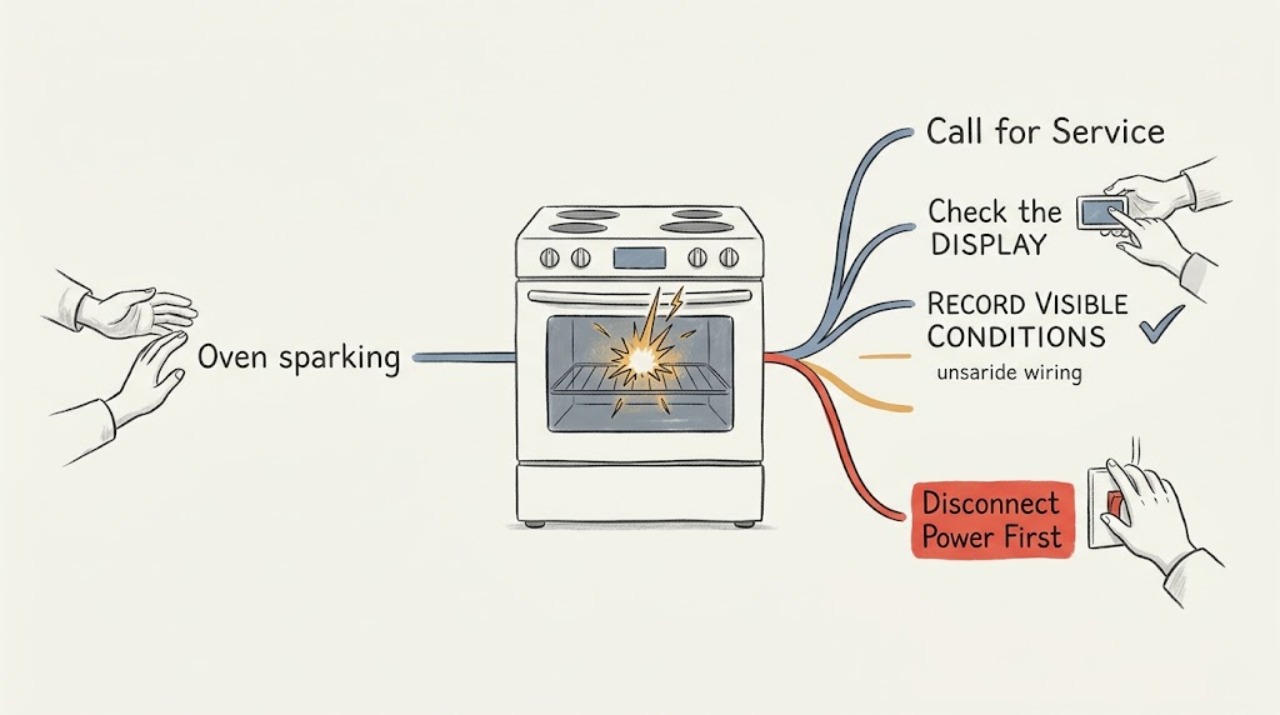
Treat a visible spark or arc from a Wolf oven as abnormal unless you can clearly establish, from a safe position, that it was the normal spark from a separate gas surface burner during its brief ignition. Wolf says sparks visible inside the oven or outside the unit require immediate discontinuation of use and shutdown at the circuit breaker, followed by Factory Certified Service. Do not open the appliance, touch wiring, repeat the test, use a flame, or operate a wet or damaged unit. For smoke, flame, burning odor, gas odor, a hot control, or active arcing, keep clear and use emergency or gas-safety help from a safe location. A Speed Oven or microwave function can also arc around metal or damaged components; turn it off and leave it out of service rather than trying to clean or repair the internal parts.
Work through in order
Diagnostic checks
Use only checks that match the exact appliance or system and its official guide.
-
Check 1
If a spark or arc is visible now, stop the oven and do not touch the appliance, controls, racks, wiring, or plug. From a dry and safe position, shut the labeled circuit breaker off only if it can be reached without crossing smoke, flame, water, or active electrical danger.
Expected result: A spark in the cavity, at the control, behind the unit, or outside the cabinet is abnormal. Smoke, flame, burning odor, gas odor, a hot control, or continuing flashes indicates an immediate hazard.
Next step: Leave the unit off and keep people away. For smoke, flame, active arcing, gas odor, or immediate danger, leave and contact emergency or gas-safety help from a safe location. Otherwise arrange Wolf Factory Certified Service.
Why this matters
Why: Wolf identifies an internal wiring or mechanical short as a possible cause and directs immediate shutdown; continued energization can worsen fire, shock, or equipment risk.
-
Check 2
After the area is safe and the unit is isolated, record exactly where the spark occurred: oven cavity, surface burner, control panel, plug or outlet, rear connection, or Speed Oven interior. Do not restore power or move the range to obtain a closer view.
Expected result: A spark confined to a gas surface burner while that burner is being lit can be normal ignition behavior, but a cavity, control, plug, outlet, or exterior spark is not cleared by that explanation. A Speed Oven spark may be microwave arcing or an internal fault.
Next step: Keep the appliance out of service for any cavity, control, plug, outlet, exterior, or unexplained spark. Provide the location to a qualified appliance professional or electrician; do not repeat the event to confirm it.
Why this matters
Why: Location distinguishes a separate surface-burner event from the assigned oven sparking problem and tells service whether to assess gas ignition, electrical controls, the cavity, or the supply connection.
-
Check 3
When safe, identify the operating function and energy configuration from the model record or rating information: gas bake or broil, electric bake or broil, dual-fuel range, or Speed Oven or microwave mode. Do not remove a panel or reach behind the appliance to find a label.
Expected result: Gas surface ignition, gas oven combustion, electric heating, and microwave arcing have different mechanisms. Wolf says a Speed Oven can arc around metallic material or damaged internal parts, while a gas burner can click during ignition; neither fact makes a spark in an oven cavity safe.
Next step: Give the model, function, and energy type to Wolf service. Leave the appliance isolated when the identity is uncertain or the spark was not clearly limited to normal surface-burner ignition.
Why this matters
Why: Model and function identity prevents applying surface-burner or microwave advice to a conventional oven and helps service select the correct safety procedure.
-
Check 4
From outside the isolated appliance, record whether the event happened during startup, heating, microwave operation, cleaning, door movement, or while the controls were idle; note any metal cookware, foil, spill, food residue, wetness, or recent cleaning without touching the cavity.
Expected result: A Speed Oven arc can be associated with metallic material or internal components, while an idle spark, a spark after a spill, or a spark at a control or outlet points to a fault or moisture risk. Smoke or a burning smell is not a cleanup invitation.
Next step: Keep the unit off and arrange service for any arc, smoke, odor, or unexplained spark. Do not remove stuck material, scrape a cover, dry internal wiring, or restart the appliance to see whether cleaning helped.
Why this matters
Why: Context helps a professional decide between use-related microwave arcing, moisture or residue, an ignitor event, and an electrical or mechanical short without another energized test.
-
Check 5
If the event was clearly a separate gas surface-burner spark, observe only from a safe position whether it stops immediately after that burner is turned off and whether the flame is stable; do not operate the oven, hold a control open, or continue if clicking or sparking persists.
Expected result: Wolf describes surface-burner clicking during ignition and lists wetness, burner placement, a stuck control, wiring, and gas-supply conditions as possible causes. Sparking when the burner is not in use or continued clicking after ignition is abnormal.
Next step: Turn the burner control off, leave the range unused, and arrange qualified service for continued clicking, gas odor, abnormal flame, or any uncertainty about the spark location.
Why this matters
Why: This branch may explain a surface event without explaining a spark in the oven. Persistent or unexplained surface ignition still needs service and must not be used as a reason to test the oven.
-
Check 6
Prepare a service handoff with the model and serial information, function, spark location, timing, sound, smoke or odor, flame or arc appearance, breaker response, moisture or spill history, cookware or foil context, and whether the event occurred once or repeatedly; keep the appliance off.
Expected result: A single cavity or exterior spark, repeated surface clicking, a Speed Oven arc, and a spark at the outlet require different inspections. A breaker trip or visible damage raises the electrical urgency.
Next step: Contact Wolf Factory Certified Service for the appliance and an electrician for a supply-side or outlet concern. Use emergency or gas-safety help first for smoke, flame, gas odor, active arcing, or immediate danger.
Why this matters
Why: The report lets service assess the ignitor, wiring, control, burner, cavity component, outlet, or supply connection without asking the user to expose themselves to a second event.
Use your observations
Decision map
Find the observation that best matches what you see, then follow the next safe action.
-
PATH 01Next step
What you see
A spark is visible in the oven cavity, at the controls, behind the appliance, at the plug or outlet, or outside the unit.
Do this next
Arrange qualified service and follow the exact model guidance.
Why this path and its safety boundary
Why it matters: Stop use immediately, shut the circuit off only from a safe and dry position, and arrange Wolf service or electrical inspection. Do not restore power or perform a second test.
-
PATH 02Next step
What you see
The event is clearly limited to a separate gas surface burner during brief ignition and stops immediately with a stable flame and no odor or abnormal behavior.
Do this next
Arrange qualified service and follow the exact model guidance.
Why this path and its safety boundary
Why it matters: Do not use this as an explanation for oven-cavity sparking. Record the surface-burner symptom and arrange service if clicking persists, returns when unused, or the flame is abnormal.
-
PATH 03Next step
What you see
A Wolf Speed Oven or microwave function arcs, especially around metal, foil, food residue, or a damaged internal cover.
Do this next
Arrange qualified service and follow the exact model guidance.
Why this path and its safety boundary
Why it matters: Turn it off and leave it out of service. Do not remove internal parts or resume operation; arrange Factory Certified Service.
-
PATH 04Next step
What you see
Sparking is accompanied by smoke, burning odor, flame, gas odor, a hot control, visible damage, water, or a breaker trip.
Do this next
Arrange qualified service and follow the exact model guidance.
Why this path and its safety boundary
Why it matters: Stop immediately, keep clear, leave for fire or gas danger, and contact emergency, gas-safety, or electrical help from a safe location. Do not reset or relight the appliance.
-
PATH 05Next step
What you see
The spark cannot be located safely or the model and energy type are uncertain.
Do this next
Arrange qualified service and follow the exact model guidance.
Why this path and its safety boundary
Why it matters: Treat it as abnormal, keep the appliance off, and provide the uncertainty to Wolf service rather than trying another mode or opening a panel.
Helpful context
Understand the symptom
The word oven can describe a gas range oven, an electric wall oven, a dual-fuel range, or a Wolf Speed Oven with microwave power. A brief spark from a gas surface-burner ignitor during normal lighting is not the same event as a spark in the oven cavity, at the control, behind the unit, or outside the appliance. Because the model and energy type are not supplied here, treat the location and timing as evidence, not as permission to test.
Wolf's dedicated sparks guidance gives no repair procedure: visible sparks inside or outside the oven are a stop-use condition. The safest handoff records the function, location, sound, odor, smoke, and power state while keeping the appliance unenergized and untouched.
Safety boundary
Stop conditions
- Stop immediately for any spark or arc in the oven cavity, at the controls, behind the unit, at the plug or outlet, or outside the appliance, and for smoke, flame, burning odor, gas odor, heat, water, visible damage, or a breaker trip.
- Do not restore power to repeat the event, open a panel, touch wiring or internal parts, move the range, use a flame, hold a gas control open, search for a gas leak, remove an internal microwave cover, or test a wet or damaged appliance.
- Leave the area and contact emergency or gas-safety help from a safe location for fire, gas odor, active arcing, or physical symptoms. Otherwise leave the appliance off and arrange qualified service.
Common questions
FAQ
Is it normal for a Wolf oven to spark?
Wolf says visible sparks inside the oven or outside the unit require immediate discontinuation of use and circuit shutdown. A brief spark from a separate gas surface-burner ignitor during normal ignition is a different event, but continued or unexplained clicking still needs service.
What should I do if my Wolf Speed Oven sparks?
Turn it off and leave it out of service. Do not touch internal parts, remove a cover, repeat the test, or continue using it after arcing, smoke, or a burning odor. Arrange Wolf Factory Certified Service.
Can I reset the breaker after my Wolf oven sparks?
Do not restore power to repeat the event. Wolf directs users to shut the unit off at the circuit breaker and obtain service for visible sparks; only operate the breaker from a safe, dry position when there is no smoke, flame, water, or active electrical danger.
Read the exact guide
Official sources
- Sparks in OvenSub-Zero, Wolf, and Cove · Wolf oven sparking, immediate stop-use, circuit shutdown, and service
- Safety Education MaterialsU.S. Consumer Product Safety Commission · Household appliance, electrical arcing, and fire-safety escalation
- Wolf Gas Surface Burner ClickingSub-Zero, Wolf, and Cove · Wolf gas surface-burner ignition sparks, persistent clicking, and service escalation
- Microwave and Speed Oven Noises, Odors, Sparks, Smoke, or ArcingSub-Zero, Wolf, and Cove · Wolf Speed Oven and microwave arcing, smoke, metallic material, and service boundary
Community feedback
Share a repair observation
Share a plain-text repair observation. Accepted observations are published automatically; this page may take a moment to update.