
On this page
Start here
Quick answer
Treat a Zanussi washing-machine error display as a model- and stage-specific clue, not as a code that can be interpreted across every machine. Write down the exact code or light pattern, full model and PNC details, whether the machine is a front or top loader, and the point in the cycle when it stopped. Then make only safe visible checks that match the machine's user manual: power and control state, water supply and inlet hose, drain path, door closure, and excess foam or an unbalanced load. A single manual-authorized reset is reasonable after the machine is safe and any water is controlled; if the code returns, the machine leaks, will not unlock with water inside, shows heating or motor faults, or has smoke, burning odor, repeated trips, or violent movement, stop using it and arrange authorized service.
Before you begin
Safety first
- This article covers ordinary-access observation and only the user procedures authorized by the exact Zanussi manual. It does not authorize internal disassembly, live electrical work, forced unlocking, tilting the appliance, or work on pressurized or hot water.
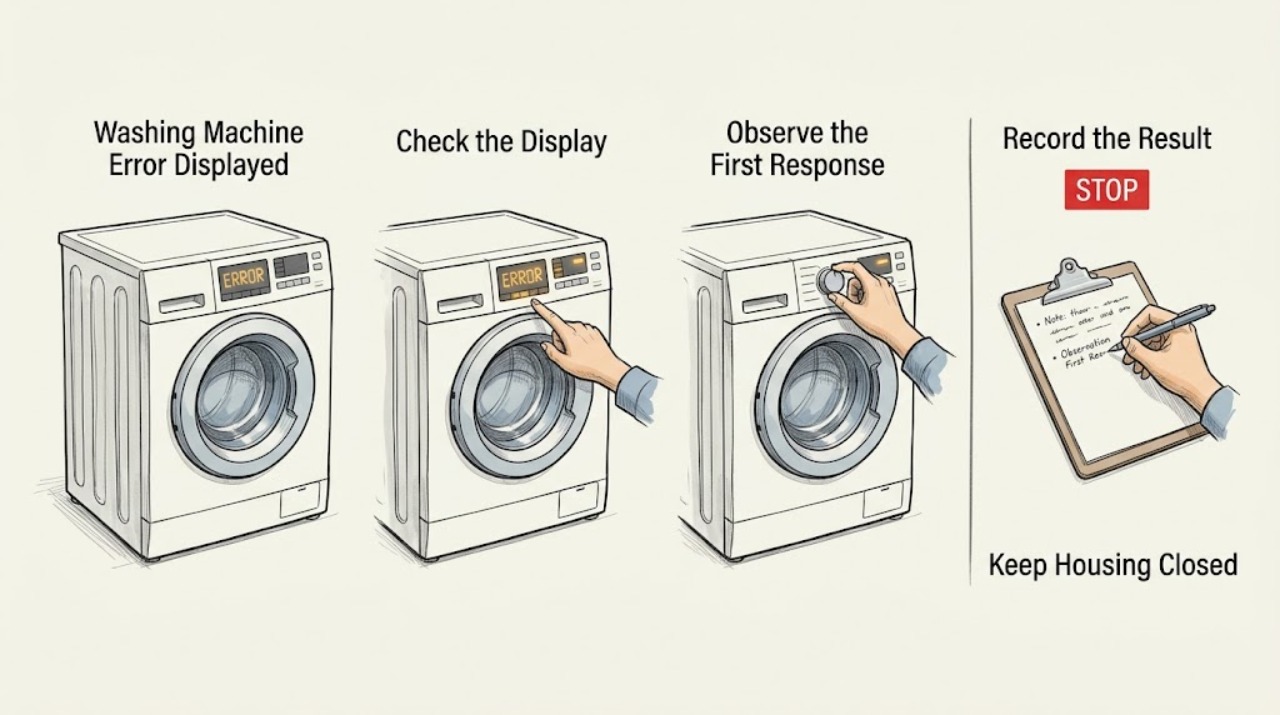
Work through in order
Diagnostic checks
Use only checks that match the exact appliance or system and its official guide.
-
Check 1
Stop the cycle using the normal control if it responds, keep clear of moving parts, and observe the machine from a dry, stable position without opening panels or reaching into the drum.
Expected result: Record whether water is entering, draining, or remaining in the drum; whether the drum is moving; whether the door is locked; and whether there is a leak, smoke, burning odor, hot plug or socket, electrical arcing, repeated breaker trip, or violent movement.
Next step: If any hazard is present, move away and arrange appropriate appliance, electrical, or emergency help; otherwise photograph the display and continue without clearing the code.
Stop if: Do not touch a wet plug, socket, or machine while standing in water, and do not continue a cycle with smoke, a burning smell, arcing, a damaged cord, active flooding, or violent walking.
Why this matters
Why: A visible leak, water near electrical parts, smoke, burning odor, arcing, repeated trip, or violent movement is a stop condition. A stable machine with a dry floor can proceed to model-specific identification and low-risk visible checks.
-
Check 2
Copy the exact error code, alternating characters, beep or flash count, model identifier, PNC or serial details, loader type, and the cycle stage into a note before switching the machine off.
Expected result: Classify the event as a known code in the matching Zanussi manual, a light or beep pattern, or an unknown display; note whether the same code returns immediately or only at a particular stage.
Next step: Search Zanussi support or the supplied user manual using the full model and PNC, and use the listed procedure for that exact machine rather than a generic code chart.
Stop if: Do not guess what an incomplete code means, substitute a code from another appliance, enter a hidden diagnostic mode, or erase the evidence before recording it.
Why this matters
Why: An exact code and machine identity can narrow the support procedure. A code that is only similar to another code, or a code from a different model family, is not enough to claim the same cause; an unknown or recurring display needs model-specific service guidance.
-
Check 3
If the display or lights indicate a power or control problem, inspect the plug, cord, socket, and nearby controls from a dry position and check whether a control or child lock is visibly active; do not use an extension cable.
Expected result: Determine whether the display is stable, another small appliance works at the same socket, the machine is connected directly as intended, and the code is an EH0 or related power message, an E90-series configuration message, or a different code.
Next step: Use only the manual's normal control-unlock steps; for a safe, dry appliance with no hazard, perform at most the manual-authorized 30-second power reset, then stop if the code returns.
Stop if: Do not repeatedly reset a tripping circuit, use an extension lead, remove covers, test live voltage, or touch a hot, damaged, wet, or arcing socket or cord.
Why this matters
Why: A dead socket or EH0-type display points toward the supply or wiring and may require an electrician. An E90-series display concerns configuration or electronic communication and is not proven to be a drain, fill, or door fault. A stable display with a lock indicator may only need the manual's control procedure.
-
Check 4
When the code appears before or during filling, verify from ordinary access that the water tap is open, the inlet hose is not kinked or crushed, and the visible hose connection is not leaking; clean an inlet screen only if the exact manual permits it and the water is isolated.
Expected result: Observe whether water reaches the machine normally, whether the hose connection stays dry, and whether the display resembles the model's E10, E11, or C1 water-flow family; do not infer a code from a symptom alone.
Next step: Restore only a clearly closed tap or visible hose position, then use the exact manual's test program once; request service if the code returns or the machine cannot fill safely.
Stop if: Stop for a leaking connection, burst or damaged hose, uncontrollable water flow, wet electrical parts, or any need to remove a valve or work on internal wiring.
Why this matters
Why: A closed tap, restricted hose, low supply, or permitted dirty inlet screen can explain a fill-related code. No incoming water despite normal supply, a leak, or a recurring code moves the issue toward an inlet valve, sensor, wiring, or another professional diagnosis.
-
Check 5
When water remains after washing or the code appears during draining, inspect the visible drain hose for kinks, check that the household sink or outlet drains, and verify the hose position against the exact installation instructions; access a pump or fluff filter only when the model manual explicitly provides that user procedure and the machine is unplugged, cool, and safely drained.
Expected result: Note whether the hose is kinked, inserted too deeply, set at the wrong height, connected to a blocked outlet, producing a pump hum, or leaving water in the drum; compare the display with the exact model's drain-code guidance rather than assuming E20 or C2.
Next step: Correct only a plainly visible hose-position issue or follow the exact manual's safe filter procedure once; if the drum still holds water or the code returns, keep the machine off and contact service.
Stop if: Do not open a filter against pressure, handle hot or contaminated water, tilt the machine, insert tools into a pump, or work on the drain system while the appliance is powered.
Why this matters
Why: A restricted hose, outlet, filter, foam, or pump can produce a drain-related display and prevent spinning. Water that cannot be controlled, a damaged filter, no pump response, or a recurring drain code indicates a service boundary.
-
Check 6
If the error occurs at start or the door stays locked, wait for the normal end-of-cycle unlock time, check from the outside that clothing is not caught in the seal and that the door or lid is fully closed, and note whether water remains inside.
Expected result: Record whether the lock indicator clears, the machine is empty, the door closes without force, or a door-lock code such as the exact model's E40 or E41 family is displayed.
Next step: Use the manual's normal cancel or drain instruction, if available for that model, and arrange service when the door remains locked, the code returns, or the seal or latch is damaged.
Stop if: Never pry, force, bypass, or defeat the door or lid interlock, and do not reach inside while the drum can move or hot water may be present.
Why this matters
Why: A normal lock during a running cycle or while water remains can be expected. A clear door with no water but a recurring lock code suggests a latch, lock, sensing, or control fault; forcing the door could cause flooding or injury.
-
Check 7
After the machine is safe and the door is available normally, observe the load and detergent result without adding chemicals or running repeated tests; redistribute a visibly bunched load only when the manual allows opening and the drum is stopped.
Expected result: Look for excessive suds, a single bulky item, a very small load, laundry caught in the seal, or repeated stopping during spin; record whether the machine is level and whether it walks, bangs, or makes metal-on-metal noise.
Next step: Allow foam to subside and follow the exact manual's detergent and load guidance once; if movement, leakage, or the warning recurs with a balanced load, request service.
Stop if: Stop immediately for walking, impact, exposed or damaged parts, a leak, smoke, burning odor, or any need to dismantle the drum, motor, suspension, or door seal.
Why this matters
Why: Zanussi identifies over-foaming, an imbalanced load, and laundry caught at the seal as possible contributors to EF0-type warnings and spin or leak symptoms. Severe movement or a mechanical noise is not an invitation to add or remove weight while the drum is moving.
-
Check 8
Only after the safe checks are complete, the machine is dry and stable, and the exact manual or Zanussi support article authorizes it, switch off or unplug the machine for the stated interval and restart one normal program.
Expected result: Observe whether the display clears, whether the machine reaches the previously blocked stage, and whether the identical code, a new code, a leak, abnormal noise, or a safety symptom returns.
Next step: Record the reset result and arrange authorized service for recurrence; give the technician the exact code, model and PNC, cycle stage, visible checks, and whether water remained inside.
Stop if: Do not repeat resets to suppress a code, run an unattended test, or reconnect the appliance after smoke, arcing, burning odor, flooding, repeated tripping, or a known motor, heater, or electronic fault.
Why this matters
Why: A one-time clear after a transient supply or cooled-pump condition does not prove the underlying cause is repaired. A repeated identical code or a new safety symptom confirms that continued use should stop and the machine needs model-specific diagnosis.
Use your observations
Decision map
Find the observation that best matches what you see, then follow the next safe action.
-
PATH 01Safety boundary
What you see
The display or light pattern is incomplete, unknown, or does not match the exact model's manual.
Do this next
Keep the record, find the exact Zanussi manual using the model and PNC, and contact authorized service if the message persists or the machine is unusable.
Why this path and its safety boundary
Why it matters: A code cannot be safely interpreted from a similar Zanussi model or another brand.
Safety stop: Do not enter service mode or replace a component based only on a guessed code.
-
PATH 02Safety boundary
What you see
The error occurs before or during filling and the machine does not receive water normally.
Do this next
Check the tap, visible hose, and exact manual's user-serviceable inlet screen procedure; escalate for a recurring code or an internal valve or sensor issue.
Why this path and its safety boundary
Why it matters: Water supply, hose restriction, permitted inlet-screen blockage, or a water-sensing fault is plausible.
Safety stop: Stop for uncontrolled flow, a burst hose, a leak, or water contacting electrical parts.
-
PATH 03Safety boundary
What you see
The error occurs after washing, water remains in the drum, or the machine will not proceed to spin.
Do this next
Check visible hose routing and the household outlet, then use a filter procedure only if the exact manual permits it; request service when water remains or the code returns.
Why this path and its safety boundary
Why it matters: A drain hose, household outlet, filter, pump, foam, or drain-control problem is possible.
Safety stop: Do not open a pressurized filter, handle hot water, tilt the appliance, or work while it is connected to power.
-
PATH 04Safety boundary
What you see
The machine stops at start or end with a lock indicator or door-related code.
Do this next
Wait for normal unlock, use the manual's normal cancel or drain procedure, and arrange service for recurrence without forcing the door.
Why this path and its safety boundary
Why it matters: The interlock may be operating normally because the cycle or residual water has not cleared, or it may have a latch or sensing fault.
Safety stop: Never pry or bypass the door or lid lock, especially when water or heat may remain inside.
-
PATH 05Safety boundary
What you see
There are excessive suds, a bunched or very small load, or repeated stopping during spin.
Do this next
Allow foam to settle and follow the exact detergent and load guidance once; service the machine if the warning or severe movement returns with a suitable load.
Why this path and its safety boundary
Why it matters: Zanussi identifies over-foaming, imbalanced laundry, and leakage around caught laundry as possible contributors to relevant warning displays.
Safety stop: Stop for walking, impact, metal scraping, a leak, burning odor, smoke, or damaged seals or parts.
-
PATH 06Safety boundary
What you see
The display is EH0 or a related power message, or it is an E90-series configuration or communication message.
Do this next
For a dry, undamaged appliance, use the authorized one-time reset; arrange an electrician for supply or wiring concerns and authorized appliance service for a recurring configuration code.
Why this path and its safety boundary
Why it matters: The support guidance points toward the supply, wiring, or electronic configuration rather than a generic fill or drain correction.
Safety stop: Do not use an extension cable, repeatedly reset a tripping circuit, remove covers, or test live electrical parts.
-
PATH 07Safety boundary
What you see
The same code returns after the exact safe checks or one authorized reset, or the display accompanies a motor, heating, leak, smoke, or electrical symptom.
Do this next
Leave the machine disconnected when the manual or safety condition requires it and request authorized service with the complete event record.
Why this path and its safety boundary
Why it matters: The issue is no longer a reasonable user-level observation; continued operation could worsen a fault or create a safety hazard.
Safety stop: Do not keep running cycles, suppress the display, or replace internal parts without model-specific professional diagnosis.
Helpful context
Understand the symptom
Start with the exact display, model, and cycle stage
A code is useful only when it is read from the correct appliance documentation. Record every letter and digit, the order of flashing lights or beeps, the model identifier and PNC if shown on the rating plate, the front-loader or top-loader format, and whether the machine was filling, washing, draining, spinning, or waiting to unlock. Zanussi's support overview lists broad families such as E10 water-flow, E20 draining, E40 door-lock, E50 motor, E60 heating, EF0 leakage or foam or imbalance, and EH0 power issues, but its page points users to support tailored to their model when the displayed code is not listed.
Separate a water-flow problem from a drain or door-lock problem
The point in the cycle changes the next check. A code appearing before the drum fills makes the tap, inlet hose, inlet screens where the manual permits, and water pressure relevant. A code after washing with water left in the drum makes the drain hose, household outlet, and model-approved pump-filter procedure relevant. A locked door with water remaining is a safety state: do not force the door or bypass its interlock. A code that appears with excess suds, an unstable load, or a visible leak needs a different branch from a stable display with a power-supply code.
Use one safe reset as a test, not as a repair
For power or configuration messages, Zanussi support describes unplugging the machine for about 30 seconds before selecting a program again; some drain guidance describes allowing a blocked pump to cool before trying another cycle. Use a reset only once and only when the exact manual permits it, the machine is dry and stable, and there is no smell, smoke, heat damage, active leak, or abnormal movement. A recurring code is evidence for service, not a reason to keep cycling the machine or to open a live appliance.
Safety boundary
Stop conditions
- Stop immediately for active flooding, water near a plug or socket, smoke, burning odor, electrical arcing, a hot or damaged cord or socket, repeated breaker trips, or a damaged appliance enclosure.
- Do not force, pry, or bypass the door or lid interlock; do not reach into a moving drum or handle potentially hot water.
- Do not remove covers, test live voltage, work on internal wiring, replace a valve, pump, heater, motor, sensor, or control board, or enter an undocumented diagnostic mode.
- Do not repeatedly reset or run unattended cycles to make an error disappear, and do not interpret a code from another model as if it were this machine's code.
- Stop and arrange service when a code recurs, water remains after the permitted drain checks, a leak persists, the machine walks or bangs, or a motor, heating, electronic, or power fault is indicated.
When checks do not resolve it
Need a professional?
Arrange Zanussi-authorized appliance service when the exact code is unknown or recurring, a safe visible supply or drain check does not resolve it, the door remains locked, the machine leaks or retains water, an E50 or E60 family code is shown, an E90-series code returns, or the display is accompanied by abnormal movement, smoke, burning odor, arcing, or repeated electrical trips. Use an electrician for a supply or wiring fault and emergency help for immediate fire, flooding, or electrical danger.
Safety scope: This article covers ordinary-access observation and only the user procedures authorized by the exact Zanussi manual. It does not authorize internal disassembly, live electrical work, forced unlocking, tilting the appliance, or work on pressurized or hot water.
Common questions
FAQ
Can I use a Zanussi error-code list from another washing-machine model?
Use only the code interpretation and procedure for the exact model and PNC. Zanussi's overview groups common families but directs users to model-specific support when a code is not listed; record the complete display and cycle stage instead of guessing from a similar machine.
What should I check when a Zanussi machine shows a water or drain code?
For a fill-stage message, check the tap, visible inlet hose, and any inlet screen procedure allowed by the exact manual. For residual water or a drain-stage message, check visible drain-hose routing and the household outlet, and access a pump filter only when the manual permits it and the machine is unplugged, cool, and safely drained.
When should I stop using the machine after an error appears?
Stop for flooding, water near electrical parts, smoke, burning odor, arcing, repeated electrical trips, violent movement, a recurring code after the exact safe checks, or a lock that will not clear with water inside. Do not force the door or continue repeated reset cycles; provide the exact code, model, stage, and observations to authorized service.
Read the exact guide
Official sources
- Washing machine displays error message EF0, EFo, EF3 or emits 15 beeps / 15 flashesZanussi · Official Zanussi support article for the listed warning families; exact model instructions control user procedures.
- Washing machine does not drain, displays error code E20, E21 or C2, emits 2 beeps / 2 flashesZanussi · Official Zanussi drain guidance; installation instructions and the exact user manual control hose height and filter access.
- Washing machine displays an error code, how to fix it?Zanussi · Official Zanussi support overview; the exact appliance manual and model support page control a particular code.
- Washing machine displays error message EHO / EH0Zanussi · Official Zanussi support for EH0, EH1, EH2, and EH3 messages; wiring faults belong with an electrician.
- Washing Machine Error E10, E11 or C1? How to Fix Water Supply & Drain IssuesZanussi · Official Zanussi support article for E10, E11, and C1 or one-beep or one-flash conditions; exact model instructions control filter access.
- Washing machine displays error message E90, E91, E92, E93 or E94Zanussi · Official Zanussi support for E90 through E94; the exact model's service instructions control the reset and diagnosis.
Community feedback
Share a repair observation
Share a plain-text repair observation. Accepted observations are published automatically; this page may take a moment to update.