
On this page
Start here
Quick answer
If a Zanussi washing machine leaves water in the drum, first note whether it stops during drain or spin and record any exact code. From a dry, safe position, check the visible drain hose and household waste connection, then use the model-specific cool-water drain and pump-filter instructions only after safe power isolation. E20, E21, or C2, a pump that only hums, a leak, standing water near electrics, or an unusual burning or electrical smell means stop and arrange appliance service.
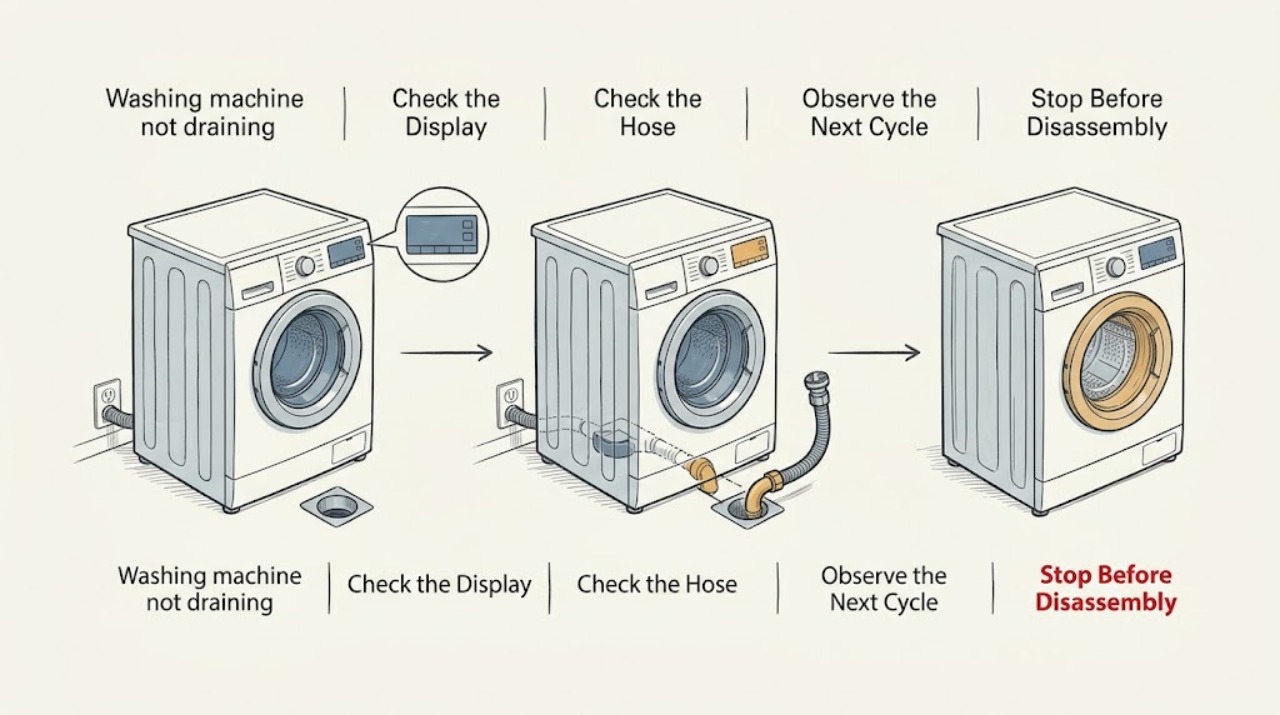
Work through in order
Diagnostic checks
Use only checks that match the exact appliance or system and its official guide.
-
Check 1
Note whether water remains in the drum, whether the machine stopped during drain or spin, whether the drum still turns, and whether the display shows an exact code or flashing pattern.
Expected result: E20, E21, or C2 together with water left inside supports a drain-path branch; wet laundry with no water left may be a spin or programme-option issue; an unusual pump noise is a further blockage warning.
Next step: Use the drain-hose and waste check for a drain symptom, and keep the code and model number for service if the symptom does not clear.
Why this matters
Why: The stage and code separate a drainage problem from an imbalance, door, inlet, motor, or control issue. Zanussi codes are model-dependent, so do not apply a code meaning from another model without checking the manual.
-
Check 2
From a dry, safe position, inspect the visible drain hose behind the washer and the connection at the sink trap or waste outlet without moving or tilting the appliance.
Expected result: A kink, twist, crushed section, loose connection, or waste outlet that does not drain normally can explain the retained water. A spreading leak or water close to a plug or socket is an immediate stop condition.
Next step: Correct only an obvious hose position issue that is reachable without wet contact or appliance movement, then select the appropriate drain programme once. Escalate if the connection leaks or the waste outlet remains blocked.
Why this matters
Why: Zanussi identifies a kinked or blocked hose and a blocked household drain or siphon as common causes; a clear external hose does not prove that the internal pump path is clear.
-
Check 3
If the household waste connection is questionable, compare its normal flow with the washer disconnected from that connection only when the area is dry and the model instructions permit a safe hose placement; do not pour water into an unsafe or overflowing outlet.
Expected result: A waste outlet that backs up or drains slowly points to a household plumbing restriction. If the outlet is normal but the washer still leaves water, the fault is more likely in the washer drain path.
Next step: Use a plumber for a persistent household waste restriction; use appliance service when the outlet is clear but the washer will not pump out.
Why this matters
Why: Separating the appliance hose from the household waste path avoids replacing an appliance part for a sink trap or drain restriction.
-
Check 4
Stop the programme, allow any hot water to cool, and isolate mains power only when the plug and floor are dry and safely reachable; then follow the exact Zanussi manual for draining residual water and accessing the pump filter, if that model has one.
Expected result: Lint, coins, or other visible debris in an accessible filter can restrict pump-out. Water released unexpectedly, a filter that will not move, a damaged seal, or a pump blade that is not free to move means stop the procedure.
Next step: Refit an accessible filter exactly as the manual directs and keep the area dry; do not dismantle the pump or touch wiring. Persistent no-drain, humming, or leakage requires appliance service.
Why this matters
Why: A filter and pump blockage is plausible, but Zanussi uses different layouts and some top-loaders may not expose a filter. Opening the wrong point can spill water or create a leak.
-
Check 5
Check the load and detergent history after the water path is safe: look for heavy suds, a tightly packed load, or a single bulky item, and use only the detergent amount and type specified for the model.
Expected result: Excess foam can interfere with the level system, while an imbalanced load can prevent the final spin and leave laundry wet. If water remains with normal foam and a balanced load, the drain path remains the priority.
Next step: Correct the load or detergent once and choose a suitable drain or spin programme. Repeated incomplete cycles with a normal load need service rather than more detergent or repeated trials.
Why this matters
Why: A spin that is skipped is not always a failed pump, but a true retained-water symptom still needs drain checks. EF0 or similar leakage, over-foaming, or imbalance indications require model-specific interpretation.
-
Check 6
After the relevant safe external check, run one appropriate drain or spin programme and observe whether the pump evacuates water normally; if needed, perform one power reset from a dry safe position.
Expected result: Normal pump-out and a completed spin support a temporary blockage or setup issue. No pump sound, a loud hum, immediate return of E20/E21/C2, or water remaining after the check indicates a persistent fault.
Next step: Stop using the washer and request appliance repair for persistent no-drain, a pump fault, internal blockage, electrical symptoms, or any leak. Do not repeat tests if the washer walks, bangs, smokes, smells burnt, sparks, or trips power.
Why this matters
Why: A reset cannot repair a defective pump, internal blockage, electrical malfunction, damaged seal, or household drain restriction.
Use your observations
Decision map
Find the observation that best matches what you see, then follow the next safe action.
-
PATH 01Next step
What you see
Water remains in the drum and E20, E21, or C2 is shown, or the pump makes an unusual noise.
Do this next
Arrange qualified service and follow the exact model guidance.
Why this path and its safety boundary
Why it matters: Use the cool-water, model-specific drain and filter guidance after safe power isolation; persistent no-drain or humming needs appliance service.
-
PATH 02Next step
What you see
The visible hose or sink-trap connection is kinked, loose, or the household waste outlet backs up.
Do this next
Arrange qualified service and follow the exact model guidance.
Why this path and its safety boundary
Why it matters: Correct a safe obvious hose position issue or arrange plumbing service for the waste outlet; do not move or tilt the washer to reach hidden plumbing.
-
PATH 03Next step
What you see
The washer drains but skips final spin, shows wet laundry, or reports imbalance or excess foam.
Do this next
Arrange qualified service and follow the exact model guidance.
Why this path and its safety boundary
Why it matters: Redistribute the load and correct detergent use once; repeated imbalance, walking, banging, or retained water requires appliance service.
-
PATH 04Next step
What you see
The door remains locked while water or heat may remain inside.
Do this next
Arrange qualified service and follow the exact model guidance.
Why this path and its safety boundary
Why it matters: Wait for cooling and safe drainage, then follow the exact model door guidance. Never force, pry, or bypass the door lock.
-
PATH 05Next step
What you see
A leak spreads, water contacts electrics, the pump or cord is hot or damaged, or there is smoke, burning smell, sparking, repeated tripping, or violent movement.
Do this next
Arrange qualified service and follow the exact model guidance.
Why this path and its safety boundary
Why it matters: Stop immediately, keep clear of wet electrics, and request appropriate appliance or electrical help; do not restart the washer.
Helpful context
Understand the symptom
A drain fault can look like a cycle fault: the washer may stop before spin, leave clothes wet, keep the door locked, or display a code. Do not assume every Zanussi model has the same filter location or emergency-drain arrangement; use the manual for the exact model.
Before touching a hose or filter, stop the programme and let hot water cool. Keep the plug, socket, and floor dry. Do not tilt the washer, force the door, reach into a pump, or work on it while connected to power.
Safety boundary
Stop conditions
- Stop immediately for spreading water, standing water near the plug or socket, a hot or damaged cord, smoke, a burning or electrical smell, sparking, repeated breaker trips, violent movement, or a broken filter seal.
- Do not tilt the washer, force the door, open a filter with hot water or unsafe wet electrics, reach into the pump, dismantle the appliance, or touch wiring.
Common questions
FAQ
Why is my Zanussi washing machine not draining?
A blocked filter, kinked or blocked drain hose, household waste restriction, pump issue, or excess foam can leave water in the drum. The exact code and model determine the safe next check.
Can I open the Zanussi pump filter with water in the drum?
Only follow the exact model instructions after the programme stops, hot water cools, and power is safely isolated from a dry position. Drain gradually as directed and stop if water reaches electrics, the filter will not move, or its seal is damaged.
Why does a draining problem keep the door locked?
The door may remain locked while water or heat is detected inside. Wait for safe cooling and drainage, follow model-specific guidance, and never force or bypass the lock.
Read the exact guide
Official sources
- Washing machine displays an error code, how to fix it?Zanussi Support · Zanussi washing-machine error-code identification
- Washing machine does not drain, displays error code E20, E21 or C2, emits 2 beeps / 2 flashesZanussi Support · Zanussi washing-machine drainage error guidance
- How to Drain a Washing Machine or Washer Dryer (Step-by-Step Guide)Zanussi Support · Zanussi washing machines and washer-dryers
- Zanussi Washing Machine Does Not Spin – Causes and SolutionsZanussi Support · Zanussi washing machines and washer-dryers
Community feedback
Share a repair observation
Share a plain-text repair observation. Accepted observations are published automatically; this page may take a moment to update.