
On this page
Start here
Quick answer
A Zanussi washer can leave clothes wet or fail to spin because Rinse Hold or a low-spin setting was selected, the machine is still waiting to drain, the load is unbalanced or over-sudsed, or the appliance is not stable. First record the cycle stage, any display code, and whether water remains. Then check the selected spin option, the load, visible drain path, latch, and installation only through safe external or model-manual steps. Do not force a locked door, reach into a moving drum, tilt the washer, or open internal panels. Stop for hot or wastewater that cannot be contained, a leak near electrical parts, walking or impact, metal scraping, smoke, burning odor, visible arcing, or a repeated electrical trip.
Before you begin
Safety first
- A technician should diagnose the drain path, interlock, motor, bearing, controls, and suspension before selecting any replacement component.
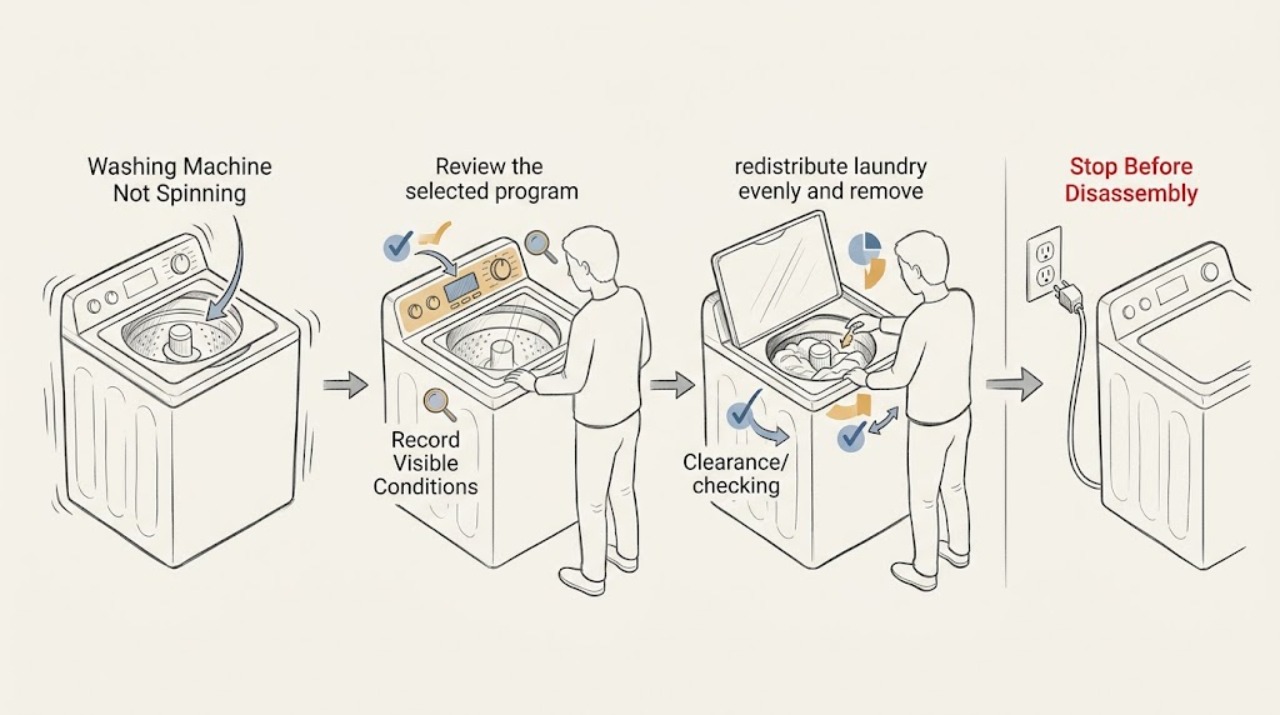
Work through in order
Diagnostic checks
Use only checks that match the exact appliance or system and its official guide.
-
Check 1
Record the exact cycle, spin setting, display message or flashing pattern, and the stage at which the washer stops: filling, washing, draining, attempted spin, or end of cycle. From outside the appliance, note whether water is visible in the drum and whether clothes are wet or soaked.
Expected result: Water remaining in the drum or a stop during draining is different from a low-spin selection, a balance pause, or a drum that never accelerates. EF5, EF0, C9, and F9 should be recorded exactly rather than guessed from a similar-looking display.
Next step: If water remains, use the drain branch. If there is no water, check the cycle option and latch state. Stop before opening the door if it is locked, hot, or under pressure.
Why this matters
Why: The stage and water status choose the first branch; they do not by themselves prove a motor, pump, bearing, or control failure.
-
Check 2
Review the selected program and spin option against the complete model manual. Check for Rinse Hold, no-spin, gentle, or reduced-speed selections. If the drum is empty of standing water and no hazard is present, select the model-authorized drain or spin program once.
Expected result: Zanussi says Rinse Hold can skip final spin and leave water in the drum. A gentle or reduced-spin choice can leave clothes wetter without being a mechanical fault; a suitable spin-capable program that still stops moves the diagnosis onward.
Next step: Keep the successful or failed setting in the service notes. Do not repeatedly restart after an electrical trip or continue testing if the washer leaks, smells hot, or behaves violently.
Why this matters
Why: A deliberate program choice can explain the symptom. A repeat failure on an appropriate setting makes the setting less likely to be the cause.
-
Check 3
When the basket is stationary and the load is safe to handle, redistribute laundry evenly and remove excess items so the load stays within the manual's limit. Avoid testing with only one large heavy item. If there is visible excess foam, do not add more detergent; note the product and amount used.
Expected result: A single bulky item, an overloaded drum, or heavy foam can make the washer attempt to rebalance and then stop or reduce spin. A balanced ordinary load that fails in the same way points away from the load alone.
Next step: Run one suitable test only when there is no leak or unusual sound. Stop if the cabinet walks, bangs, scrapes, or produces smoke, a burning odor, or visible electrical arcing.
Why this matters
Why: The washer may limit spin to control an imbalance or foam condition. A successful spin after redistribution supports a load-related explanation rather than a guessed replacement part.
-
Check 4
With the washer stopped, check the visible drain hose for a sharp kink, crushing, or an obviously obstructed outlet. If water is present, do not handle hot or contaminated water. A pump or fluff filter is model-specific: only after a dry, safe power isolation and only when the exact manual provides a user access procedure, inspect and refit it by hand as directed.
Expected result: Standing water, slow drainage, a drain warning, or a restricted visible hose supports a drain interlock or drain-path branch. A clear hose does not rule out an internal restriction or pump fault.
Next step: If the manual does not provide a safe filter step, or water remains after the allowed external check, keep the washer out of use and arrange service. Do not tilt the washer, remove internal plumbing, or force a filter.
Why this matters
Why: A washer that has not completed draining may not enter final spin; a drain symptom should be resolved or escalated before diagnosing the drive.
-
Check 5
Check the front-load door or top-load lid from the outside for clothing, residue, or an object preventing full closure. Note a padlock or other lock indicator and use only the model manual's control-lock release. Do not hold, bypass, or force the latch.
Expected result: A door or lid that cannot latch, a control lock that remains active, or a lock-related message can prevent a cycle from entering spin even when the load and drain path are normal.
Next step: If the latch will not engage after the visible obstruction check, keep the washer out of use and give the technician the model, indicator, cycle stage, and water status.
Why this matters
Why: The interlock is a safety condition, so an apparent no-spin problem may be a latch or control-state problem rather than a motor fault.
-
Check 6
From outside, check whether the cabinet rocks and whether all visible feet appear firmly supported on a hard, stable floor. If the washer was recently installed, compare the installation with the model manual, including whether transport bolts should have been removed. Do not tilt the appliance or remove panels to investigate suspension parts.
Expected result: A rocking cabinet, unstable floor, severe vibration, or movement during spin supports an installation or leveling issue. Transit hardware is relevant only when the installation history and manual make it applicable.
Next step: Correct only a simple external, manual-authorized leveling issue. If movement persists, the washer is newly installed with uncertain transport hardware, or impact has occurred, stop and arrange service.
Why this matters
Why: Zanussi links stable leveling and removal of transit bolts with the washer's ability to balance safely; a stable installation with the same failure points to another branch.
-
Check 7
If the washer is empty, dry around its controls and connections, free of stop conditions, and the manual permits it, perform one model-authorized empty spin or drain-and-spin test. Record whether the drum accelerates, whether it repeatedly retries, and any code or unusual sound.
Expected result: An empty-drum failure after the correct program, safe drain check, latch check, and stable installation is different from a failure that occurs only with an unbalanced load. Repeated EF5, C9, or F9, unusual noise, or a motor or bearing symptom needs model-specific diagnosis.
Next step: Arrange qualified Zanussi appliance service and provide the model number, exact code, cycle and setting, water status, load result, and sound or movement description. Do not keep testing after a hazard or repeated trip.
Why this matters
Why: A repeat empty-drum failure raises the likelihood of a drain, lock, motor, bearing, control, or suspension fault; it does not identify a part by itself.
Use your observations
Decision map
Find the observation that best matches what you see, then follow the next safe action.
-
PATH 01Next step
What you see
Water remains in the drum, the washer stops during drain, or a drain-related indicator appears.
Do this next
If water remains or the path is not user-accessible, keep the washer out of use and arrange service; do not tilt the appliance or force the door or filter.
Why this path and its safety boundary
Why it matters: Treat drainage as the first branch. Perform only the visible hose check and any exact-model manual filter step that is safe and accessible.
-
PATH 02Next step
What you see
No water remains and Rinse Hold, no-spin, gentle, or reduced-speed selection is active.
Do this next
If the suitable program still will not spin, continue to the latch, load, and installation branches.
Why this path and its safety boundary
Why it matters: Use the model-appropriate spin-capable program once; wetter laundry can be expected from a deliberately reduced or skipped final spin.
-
PATH 03Next step
What you see
The washer pauses or stops after repeated balance attempts, especially with one bulky item, an overloaded drum, or heavy foam.
Do this next
If a balanced ordinary load still fails, or the cabinet walks or impacts nearby objects, stop and request service.
Why this path and its safety boundary
Why it matters: Wait for the drum to stop, correct the load or detergent amount within the manual's limits, and do not add more detergent to a suds condition.
-
PATH 04Next step
What you see
The door or lid does not latch, a lock indicator remains active, or a lock-related code returns.
Do this next
If the latch cannot engage or the indication returns, keep the washer out of use and arrange service.
Why this path and its safety boundary
Why it matters: Use only the model-specific lock or latch guidance after checking the visible closure area; do not defeat the interlock or force the door.
-
PATH 05Next step
What you see
The washer rocks, walks, or vibrates severely, or recent installation leaves transport hardware uncertain.
Do this next
If movement continues or the cabinet has impacted nearby objects, arrange service before another spin test.
Why this path and its safety boundary
Why it matters: Stop the cycle and check only stable external support and model installation information; do not tilt or dismantle the appliance.
-
PATH 06Next step
What you see
The washer fails an empty-drum test after the correct setting, safe drain check, latch check, and stable installation.
Do this next
Provide the model, exact display, cycle stage, water status, load result, and unusual sound or movement to a qualified appliance technician.
Why this path and its safety boundary
Why it matters: Treat this as a model-specific service diagnosis that may involve the drain system, interlock, motor, bearing, control, or suspension rather than a guessed part.
Helpful context
Understand the symptom
Start by locating the point where the cycle changes. Note whether the washer filled and washed, whether it drained, whether the drum ever accelerated, whether the display shows EF5, EF0, C9, F9, or another message, and whether the clothes are merely damp or sitting in water. A slow tumble or a few balance attempts is not the same symptom as a drum that never spins on an appropriate cycle. Do not open the door while it is locked or while hot water may be present.
The checks below stay at the control panel, visible hose and latch area, load, floor, and any filter access explicitly described by the exact model manual. They do not require tilting the washer, defeating a door or lid interlock, opening an electrical panel, or reaching into moving parts.
A successful result should change the next decision: a Rinse Hold setting points to the program, standing water points to draining, repeated balance attempts point to the load or installation, and an empty-drum failure after safe checks points to model-specific service.
Safety boundary
Stop conditions
- Stop if hot or wastewater is present and cannot be contained safely; do not force the door.
- Stop and keep liquid away from the cord, outlet, controls, and other electrical parts if there is a leak or standing water nearby.
- Stop if the cabinet walks, bangs the surrounding structure, or develops severe uncontrolled vibration.
- Stop if you hear metal scraping or see damage that could contact the moving drum.
- Stop immediately for a burning odor, smoke, visible arc, melted material, or a repeated electrical trip; do not run another test.
- Do not bypass a door or lid lock, reach into a moving drum, tilt the washer, open an electrical panel, or remove internal parts as a user check.
Only after diagnosis
Potential parts
- door or lid lock assembly
Consider only if the latch will not engage or a lock fault is confirmed for the exact model.
Confirm the complete Zanussi model and manufacturer fit information before selecting a component. - drain pump or pump filter component
Consider only after a drain fault is confirmed and the exact model service information identifies the component.
Filter access and pump design vary by model; do not infer fit from the symptom alone. - spin drive, bearing, or suspension component
Consider only when a balanced, draining washer still fails to spin or has a confirmed drive, bearing, or suspension symptom.
A qualified technician should identify the cause and verify model fit before any component is ordered.
When checks do not resolve it
Need a professional?
No spin remains after safe checks, a model-specific code or lock fault returns, or a listed stop condition is present.
Safety scope: A technician should diagnose the drain path, interlock, motor, bearing, controls, and suspension before selecting any replacement component.
Have this ready
- Complete Zanussi model number, exact display code or flashes, cycle and spin setting, stopping stage, water status, load result, and any unusual sound, smell, heat, or movement.
Common questions
FAQ
Why is my Zanussi washing machine not spinning but the drum turns slowly?
A slow tumble can occur while the washer balances a load or when a gentle or reduced-spin program is selected. Check the exact cycle and load, then treat repeated failed balance attempts, standing water, unusual noise, or a recurring code as a reason to stop and arrange service.
Can Rinse Hold stop a Zanussi washer from spinning?
Yes. Zanussi says Rinse Hold can skip the final spin and leave water in the drum. Use the model-appropriate drain or spin selection once when the drum is safe and empty of standing water; do not force a locked door.
Can an unbalanced load cause a Zanussi washer to stop spinning?
Yes. A single bulky item, too much laundry, or heavy foam can prevent the washer from balancing. Wait for the drum to stop, redistribute the load within the manual's limit, and stop if the cabinet walks, bangs, leaks, or makes a scraping or burning sound.
Can a blocked filter stop a Zanussi washing machine from spinning?
It can. If the washer cannot drain, it may not enter final spin. Only inspect a pump or fluff filter when the exact manual provides a safe accessible procedure; otherwise keep the appliance out of use and arrange service. Do not tilt the washer.
What should I do if my Zanussi washer still will not spin when empty?
After the correct cycle, safe drain and latch checks, and stable installation are confirmed, an empty-drum failure needs model-specific diagnosis. Provide the complete model number, code, cycle stage, water status, load result, and any noise or movement to a qualified technician.
Read the exact guide
Official sources
- Washing machine stops in the middle of a cycleZanussi · Zanussi washing machines and washer dryers; mid-cycle load, drain, water-supply, and reset troubleshooting
- Zanussi Washing Machine Does Not Spin – Causes and SolutionsZanussi · Zanussi washing machines and washer dryers; spin, load balance, leveling, transit bolts, drain filter, and Rinse Hold guidance
- Washing machine displays error message EF0, EFo, EF3 or emits 15 beeps / 15 flashesZanussi · Zanussi washing machines and washer dryers; EF0, EF3, foam, imbalance, water leakage, hose, filter, and door-seal causes
- Washing machine displays error message C9 or F9Zanussi · Zanussi washing machines; C9/F9 imbalance, one-time model-specific reset, and motor or bearing service guidance
- Washing machine displays an error code, how to fix it?Zanussi · Zanussi washing machines and washer dryers; model-specific error-code families and service escalation
Community feedback
Share a repair observation
Share a plain-text repair observation. Accepted observations are published automatically; this page may take a moment to update.