
On this page
Start here
Quick answer
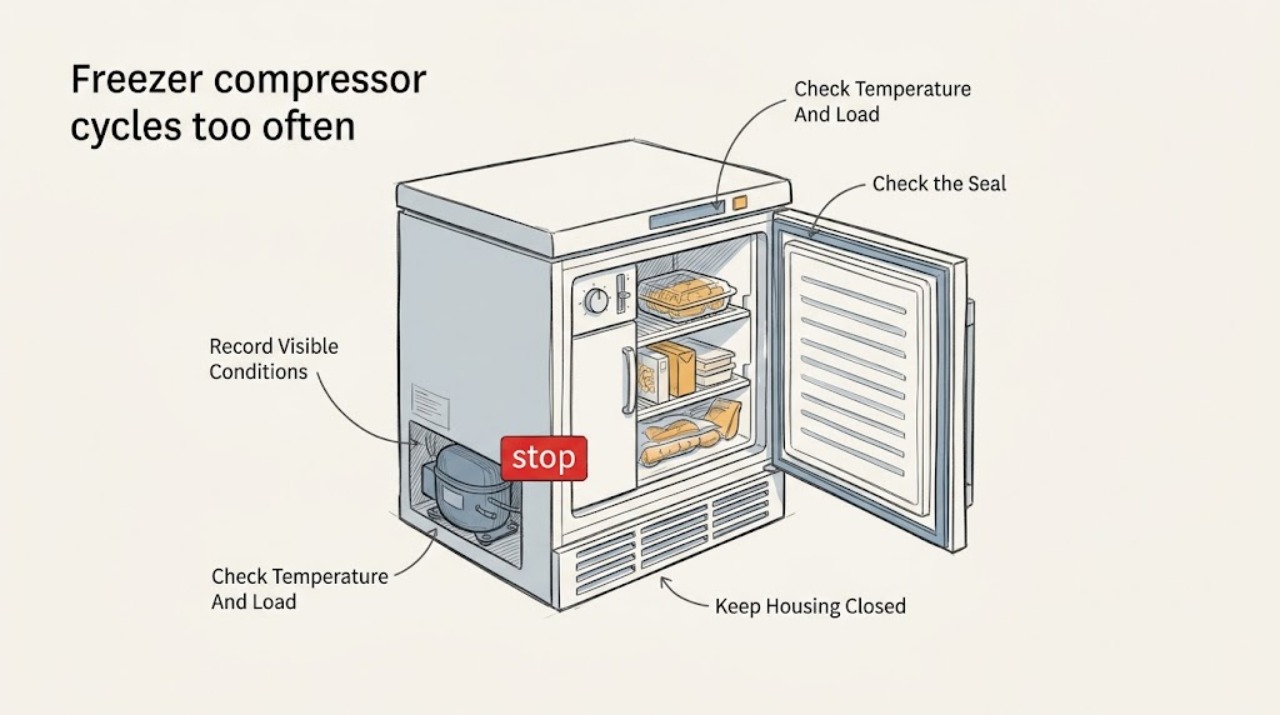
A Midea freezer may run for long periods or cycle frequently while cooling after first connection, after a large amount of food is added, in a hot room, after frequent door openings, or when the temperature control is set too cold. A dirty or leaking door gasket, food blocking closure or airflow, poor leveling, or a temperature or defrost-sensor fault can keep the compressor from reaching its target. Check the setting, load, door closure and gasket, room conditions, and visible clearance without opening the sealed system. If the freezer never reaches a safe frozen condition, a sensor or high-temperature code appears, the compressor is excessively hot or noisy, frost or food damage is worsening, or the cycle remains abnormal after these checks, arrange qualified appliance service.
Before you begin
Safety first
- This article covers ordinary-access observation of settings, load, door gasket, level, room, clearance, and displayed codes only. Do not open the sealed system or electrical covers, probe live parts, bypass sensors, handle refrigerant lines, or continue use through severe heat, electrical, temperature, or food-safety hazards.
Work through in order
Diagnostic checks
Use only checks that match the exact appliance or system and its official guide.
-
Check 1
Record when the compressor runs and stops, the cabinet or food temperature trend using a suitable appliance thermometer if available, the control setting, and whether the pattern began after installation, a power interruption, or a large load.
Expected result: Note whether the compressor runs continuously while the freezer is first cooling, starts and stops every few minutes, reaches the target and cycles normally, or runs for long periods without the contents becoming properly frozen; record any high-temperature or sensor code.
Next step: Continue with the door, load, setting, and room checks when no electrical, refrigerant, or food-safety hazard is present; arrange service if the freezer never reaches a safe condition or a code returns.
Stop if: Stop handling the appliance and arrange service for a burnt electrical smell, damaged cord, repeated breaker trip, leaking fluid, severe compressor heat, active smoke, or food that is thawing unsafely.
Why this matters
Why: Midea says a newly connected unit runs continuously during initial cooling and that a large load, hot room, frequent door opening, recent disconnection, or incorrect setting can extend operation. A persistent warm cabinet or sensor or high-temperature code points beyond ordinary pull-down.
-
Check 2
Verify the temperature control is at the model-recommended freezer setting and inspect the load for recently added warm food, tightly packed packages, blocked vents, or food pressing against the door.
Expected result: Record whether the setting is colder than needed, a large amount of food was just added, packages prevent complete closure or circulation, or the load has had adequate time to freeze after a recent start or power loss.
Next step: Use the exact manual's setting and distribution guidance, leave space for closure and circulation, and allow the freezer time to cool before judging the cycle; do not keep changing the control to an extreme setting.
Stop if: Do not store food against a blocked door, force packages into place, or repeatedly change settings while food is warming or the compressor is abnormally hot or noisy.
Why this matters
Why: Midea lists a low temperature setting, a large newly added load, and recent disconnection among causes of longer compressor operation; overpacked food can also prevent proper closure or circulation.
-
Check 3
Inspect the closed door and gasket around the full perimeter for dirt, tears, gaps, distortion, or packages preventing closure; confirm the freezer is level and not touching a wall where the model manual requires clearance.
Expected result: Record whether the gasket contacts evenly, a paper or dollar-bill check has little resistance at a location, the door rebounds open, the unit is out of level, or the cabinet contacts a wall or another object.
Next step: Clean the gasket with the model-approved mild method, remove items blocking the door, and correct only ordinary leveling or clearance issues described by the manual; request service for a torn, distorted, or persistently leaking gasket or hinge.
Stop if: Do not force the door, heat or reshape a gasket without exact model guidance, remove hinges, tip a loaded freezer, or use the appliance when the door cannot seal.
Why this matters
Why: Midea connects frequent compressor operation with a dirty or poorly sealing gasket and incomplete closure, and its manuals identify leveling and wall contact as installation conditions affecting operation. A leaking seal admits warm air and increases the cooling load.
-
Check 4
Observe the installation area for high ambient heat, direct heat sources, blocked clearances, vibration, and unusual compressor or fan sound; do not remove covers or touch the sealed refrigerant system.
Expected result: Record whether the room is unusually hot, the freezer is near a heat-producing appliance or heating duct, the cabinet vibrates or contacts a wall, or the compressor or fan is excessively loud rather than a normal hum.
Next step: Improve ordinary surrounding clearance and stability according to the model instructions, reduce direct heat exposure, and monitor one normal cooling period; arrange service if sound, heat, or cycling remains abnormal.
Stop if: Do not move a loaded unit alone, block ventilation, remove the rear cover, handle the compressor or refrigerant lines, or keep operating with severe vibration, overheating, or a burning smell.
Why this matters
Why: Midea lists high room temperature as a reason for longer or frequent compressor operation and says excessive noise or continuous fan noise warrants attention; normal refrigerant or compressor sounds do not by themselves prove a fault.
-
Check 5
After the setting, load, door, gasket, level, and room checks, record any displayed code or high-temperature alert and observe one normal cooling period without repeatedly unplugging or resetting the freezer.
Expected result: Classify the result as normal cycling after pull-down, compressor still cycling frequently while temperature is stable, continuous running with a warm cabinet, worsening frost, an E1 to E8 or E9-type alert where applicable, or excessive compressor or fan noise.
Next step: Protect food and arrange qualified Midea appliance service for persistent abnormal cycling, warmth, codes, frost, or noise; provide the model, setting, temperatures, load history, gasket result, and timing.
Stop if: Do not open the sealed system, add refrigerant, bypass a thermostat or sensor, repeatedly reset a code, or keep operating through a severe heat, electrical, or food-safety hazard.
Why this matters
Why: Stable temperature with normal cycling can be expected after the initial load or room condition is corrected. A persistent warm condition, high-temperature alert, sensor or defrost code, worsening frost, or excessive noise makes a sensor, seal, defrost, airflow, compressor, or control diagnosis more likely.
Use your observations
Decision map
Find the observation that best matches what you see, then follow the next safe action.
-
PATH 01Safety boundary
What you see
The freezer was recently plugged in, reconnected after an outage, or loaded with a large amount of food, and the compressor runs longer while contents are becoming colder.
Do this next
Keep the door closed, allow the contents time to freeze, and reassess the temperature and cycle after the model's initial cooling period; do not keep adding warm food.
Why this path and its safety boundary
Why it matters: Midea describes extended initial cooling and a large new load as expected reasons for longer compressor operation.
Safety stop: Stop and arrange service if the cabinet remains warm, food is thawing, the compressor becomes abnormally hot, or an alert appears after the initial pull-down.
-
PATH 02Safety boundary
What you see
The room is hot, the freezer is near a heat source, or the door is opened frequently, while the gasket seals and the contents eventually reach the intended condition.
Do this next
Move or shield the unit from direct heat only as safely and as the model allows, reduce door openings, and monitor a comparable period with the door closed.
Why this path and its safety boundary
Why it matters: The compressor is responding to additional heat entering or surrounding the cabinet rather than necessarily failing.
Safety stop: Do not place the freezer where required clearances are blocked, move a loaded unit alone, or continue if food warms or the compressor overheats.
-
PATH 03Safety boundary
What you see
The gasket is dirty, torn, distorted, or unevenly contacting, or packages or leveling prevent the door from closing completely.
Do this next
Clean the gasket, remove obstruction, and correct ordinary alignment or leveling per the manual; request service for a persistent leak, damaged gasket, hinge, or door.
Why this path and its safety boundary
Why it matters: Warm air can enter continuously, increasing the compressor's cooling load and causing frequent cycling or long operation.
Safety stop: Do not force the door, reshape a gasket without model guidance, remove hinges, or store food in a freezer that cannot seal.
-
PATH 04Safety boundary
What you see
The temperature control is set unusually cold, food blocks closure or circulation, or the freezer is overfilled, and operation improves after setting or distribution is corrected.
Do this next
Use the exact model setting and organize food to keep the door closed and air paths clear; monitor temperature before making further changes.
Why this path and its safety boundary
Why it matters: Control choice or load arrangement may have increased the cooling demand or prevented the cabinet from exchanging cold air normally.
Safety stop: Do not set the control to an extreme to compensate for a leak, block internal vents, or keep changing settings while food is warming.
-
PATH 05Safety boundary
What you see
The freezer remains warm or cycles frequently after the load, setting, gasket, level, room, and clearance checks, or a high-temperature, temperature-sensor, or defrost-sensor alert appears.
Do this next
Protect food and arrange qualified Midea appliance service; provide the model, temperature trend, code, frost pattern, and observations without opening the system.
Why this path and its safety boundary
Why it matters: A sensor, defrost, control, sealed-system, or compressor diagnosis is more likely than a simple room or door condition.
Safety stop: Do not add refrigerant, bypass a sensor or thermostat, remove sealed-system covers, or repeatedly reset a persistent alert.
-
PATH 06Safety boundary
What you see
The compressor or fan is excessively loud, the cabinet or compressor is unusually hot, there is a burning electrical odor, a damaged cord, a repeated breaker trip, leaking fluid, or food is rapidly thawing.
Do this next
If safe, disconnect power using the normal plug or breaker without touching damaged parts, keep the freezer out of service, protect food, and arrange qualified repair; use emergency services for active smoke or fire.
Why this path and its safety boundary
Why it matters: This is an equipment, electrical, refrigerant, or food-safety boundary rather than normal compressor cycling.
Safety stop: Do not restart repeatedly, handle refrigerant lines or a damaged cord, remove covers, or keep food in an appliance with a severe temperature or electrical hazard.
Helpful context
Understand the symptom
First distinguish normal pull-down from a persistent cycle problem
A freezer that has just been plugged in, has just received a large amount of food, or is operating in a hot room may run longer while the cabinet and contents cool. Midea's manuals also list frequent door openings and a temperature control set too cold as contributors. The useful comparison is whether the freezer reaches and holds its intended setting after the initial pull-down, not whether the compressor is audible every minute of the first cooling period.
Check the heat load and door seal before suspecting the compressor
Confirm the control setting, leave room for the door to close, clean the gasket, and check for gaps or food packages preventing closure. Reduce unnecessary door opening and give a large newly loaded freezer time to cool. Keep the unit level and away from heat-producing conditions or blocked clearances as the model instructions require. A poor seal continuously admits warm air, so the compressor may keep running even though it is functioning as commanded.
Use temperature, frost, noise, and codes to set the service boundary
If the freezer remains warm, develops excessive frost, produces an unusually loud compressor or fan sound, or displays a high-temperature, temperature-sensor, or defrost-sensor code, do not adjust the sealed system or repeatedly cycle the power. Midea's support material directs service for sensor faults and abnormal persistent conditions. Protect food according to its safety needs and give the technician the model, temperatures, cycle pattern, door-seal result, and code history.
Safety boundary
Stop conditions
- Stop immediately for smoke, burning electrical odor, sparks, a damaged or hot cord, repeated breaker trips, leaking fluid, active fire, or a compressor that is dangerously hot.
- Protect or relocate food when the freezer is warming, thawing, or showing a high-temperature alert; do not rely on a frequently cycling compressor to preserve food indefinitely.
- Do not open the sealed refrigerant system, add refrigerant, bypass a thermostat or sensor, remove electrical covers, or probe live parts.
- Do not force a door, remove hinges, tip a loaded freezer, block required clearances, or operate when the gasket cannot seal.
- Do not repeatedly reset a code or keep changing the temperature setting when the freezer remains warm, frosted, noisy, or abnormally hot.
Only after diagnosis
Potential parts
- door gasket or hinge-related sealing assembly
Consider this category only when inspection confirms a damaged or persistently leaking gasket, misalignment, or hinge condition after cleaning and ordinary closure checks.
Match the complete Midea model and gasket or hinge design; do not force the door or reshape a seal without model-specific instructions. - temperature or defrost sensor
Consider this category only when a recurring high-temperature, temperature-sensor, or defrost-sensor alert and qualified diagnosis identify the sensor or its circuit.
Confirm the exact model, code interpretation, wiring, and diagnosis before ordering; do not bypass the sensor. - temperature control or electronic control
Consider this category only when a qualified technician confirms that the control is not regulating the compressor after door, load, and room conditions are excluded.
Match the complete model and revision and verify the diagnosed control; do not infer a board failure from frequent cycling alone. - compressor, fan, or sealed-system component
Consider this category only after qualified diagnosis confirms a compressor, fan, refrigerant, or sealed-system fault associated with persistent warmth, abnormal noise, or excessive heat.
Sealed-system and compressor work requires qualified service; confirm the exact model and diagnosis before any part decision.
When checks do not resolve it
Need a professional?
Arrange qualified Midea appliance service when the compressor remains abnormal after the load, setting, gasket, level, room, and clearance checks; the freezer remains warm; a high-temperature, temperature-sensor, or defrost-sensor alert returns; frost worsens; or excessive noise or heat is present. Use qualified electrical service for a damaged or overheating power connection. Stop and follow local emergency procedures for smoke, fire, or a gas-related emergency if applicable.
Safety scope: This article covers ordinary-access observation of settings, load, door gasket, level, room, clearance, and displayed codes only. Do not open the sealed system or electrical covers, probe live parts, bypass sensors, handle refrigerant lines, or continue use through severe heat, electrical, temperature, or food-safety hazards.
Common questions
FAQ
Is it normal for a Midea freezer compressor to run continuously after plugging it in?
Midea says a freezer can run continuously after it is plugged in while it cools. Keep the door closed and allow the contents time to freeze. If it remains warm, an alert appears, or operation stays abnormal after the initial pull-down, arrange service.
Can a large food load make my Midea freezer cycle more often?
Yes. Midea lists a recently added large amount of food as a reason the compressor may run longer or cycle frequently. Leave room for closure and circulation, allow the load time to cool, and reassess before changing settings repeatedly.
Can a dirty Midea freezer gasket cause frequent compressor cycling?
Yes. A dirty, damaged, or poorly sealing gasket lets warm air enter and increases the cooling load. Clean it, remove packages blocking closure, and check that the door seals evenly. A persistent gap or damaged gasket needs qualified service.
Why does my Midea freezer cycle more often in a hot room?
Midea identifies high room temperature as a reason for longer or frequent compressor operation. Keep the freezer away from direct heat and preserve the model-required clearance, but request service if it remains warm, excessively hot, or noisy.
When should a Midea freezer with frequent compressor cycles be serviced?
Arrange service when the freezer remains warm after load, setting, gasket, level, and room checks; a high-temperature or sensor alert returns; frost worsens; the compressor or fan is excessively noisy; or a sealed-system or electrical check is needed. Stop immediately for smoke, sparks, a damaged cord, or rapidly thawing food.
Read the exact guide
Official sources
- Midea Upright Freezer User Manual MU53DSWBR1RCMMidea · Midea upright freezer manual for a specific model family; use the installed unit's manual for exact settings and procedures.
- Midea 7 cu. ft. Convertible Chest Freezer with Removable Storage BasketMidea US · Midea support and FAQ content for the linked freezer product; other models may differ.
- Midea Upright Freezer User ManualMidea · Midea upright freezer manual for the linked model family; use the installed unit's manual for exact controls and service details.
- All FreezersMidea US · Midea US FAQ covering multiple freezer types; the exact model manual controls settings and procedures.
Community feedback
Share a repair observation
Share a plain-text repair observation. Accepted observations are published automatically; this page may take a moment to update.