
On this page
Start here
Quick answer
A Midea freezer defrost drain can stop flowing when ice, frost, food residue, or debris blocks the drain opening or drain path. First identify whether the appliance is a manual-defrost chest freezer or an automatic-defrost upright/refrigerator-freezer, because the safe procedure and drain layout differ. Protect the food, follow the exact model manual, unplug before cleaning or defrosting, let ice melt naturally, and collect the water. Midea instructs owners not to use boiling water, sharp or mechanical tools, or methods that could damage the refrigeration circuit. If water remains after a complete safe defrost, returns quickly, appears under the cabinet, or the drain is behind an interior panel, stop and arrange qualified appliance service rather than forcing the blockage.
Before you begin
Safety first
- Do not puncture refrigerant tubing, remove panels, scrape the liner, probe the drain with hard objects, use boiling water or unapproved mechanical methods, work on wiring, or bypass a defrost or temperature safety. Internal drain, defrost, sealed-system, and electrical diagnosis belongs to a qualified technician.
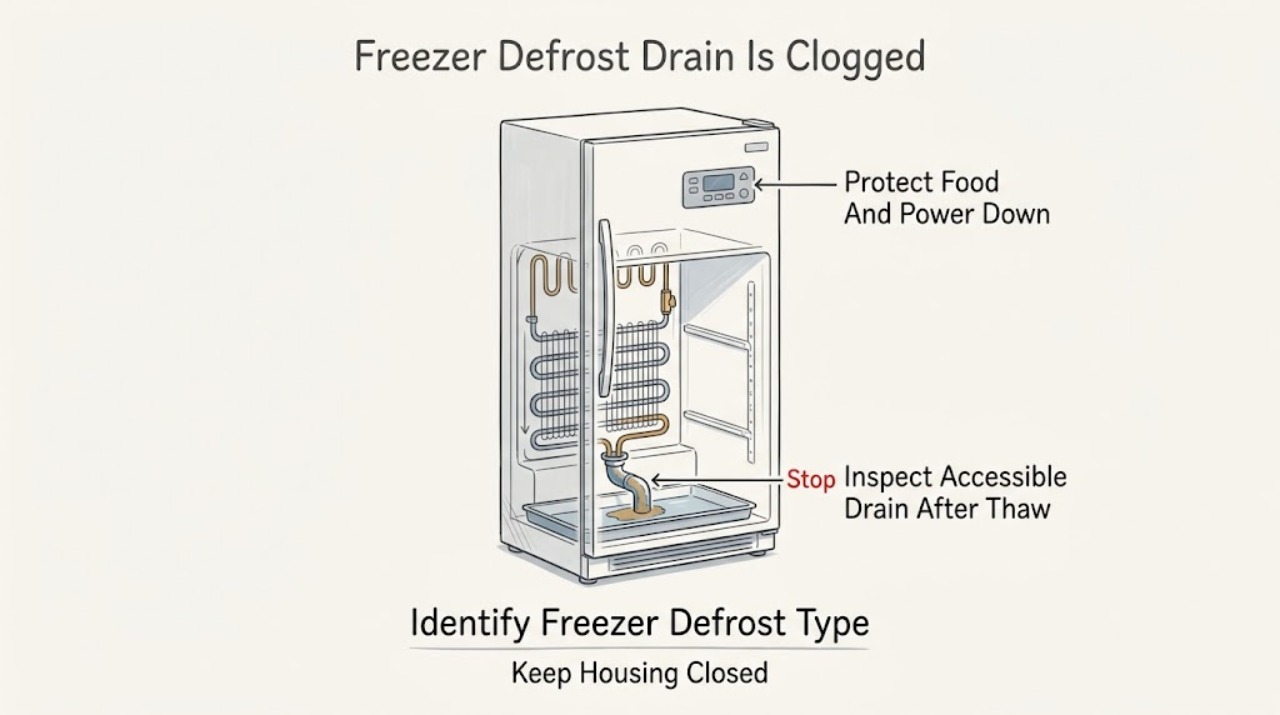
Work through in order
Diagnostic checks
Use only checks that match the exact appliance or system and its official guide.
-
Check 1
Read the Midea model label and manual, and identify whether the appliance is a manual-defrost chest freezer, an automatic-defrost upright freezer, or a refrigerator-freezer with a freezer compartment. From a safe position, note where water or ice is pooling and whether a drain opening or plug is visibly provided.
Expected result: The manual describes a drain hole or plug, the freezer is automatic-defrost with an interior drain, the drain location is not visible, or the model type is uncertain.
Next step: Use only the exact model manual for drain access and defrost instructions. If the drain is concealed or the model is uncertain, limit the work to safe observation and arrange service for an internal blockage.
Stop if: Do not remove an interior panel, puncture ice, or probe an unidentified opening to locate the drain.
Why this matters
Why: A chest freezer may expect the owner to open a drain during manual defrost, while an automatic-defrost appliance may route water through a concealed tube and pan. The wrong procedure can damage the liner or refrigeration system.
-
Check 2
Move food to an appropriate cold place, turn the temperature control to the model-specified off position if applicable, and unplug the freezer before cleaning or manual defrosting. Place a shallow collection tray where the manual says meltwater should exit and protect the floor from overflow.
Expected result: The freezer is unplugged, food is protected, meltwater begins to collect at the intended outlet, or water remains trapped inside despite the model's safe defrost setup.
Next step: Allow the frost to soften and melt naturally, empty the tray before it overflows, and keep the appliance unplugged while cleaning. Do not speed the process with boiling water or unapproved devices.
Stop if: Stop if water approaches an outlet or wiring, the cord or plug is damaged or wet, refrigerant tubing is exposed, or flooding cannot be controlled safely.
Why this matters
Why: Midea's manual-defrost instructions use unplugging, an open door, food removal, and a collection tray; water that cannot reach the intended outlet suggests ice or a drain-path restriction rather than a simple full tray.
-
Check 3
After ice has softened, inspect only the drain opening, plug, and outlet that the model manual identifies. Remove loose surface residue with a soft cloth or the manual-approved method; do not push a wire, knife, screwdriver, or other hard object into the drain and do not pour boiling water into it.
Expected result: The opening is visibly blocked by softened ice or residue, the plug is misplaced or closed when the manual calls for it to be open, water flows to the intended outlet, or water still does not move.
Next step: Clear only the loose, accessible residue permitted by the manual and verify that meltwater reaches the intended tray or outlet. Arrange service if the path remains blocked or requires access behind a liner or panel.
Stop if: Do not scrape the liner, drill ice, force a plug, remove tubing, or use compressed air or chemicals to force the drain open.
Why this matters
Why: A visible, accessible obstruction may explain the pooling. No flow after a complete safe thaw points to a hidden frozen or obstructed tube, a blocked outlet, or a model-specific internal component.
-
Check 4
Once the accessible drain area is dry, inspect the door or lid seal, food placement, frost pattern, cabinet level, and clearance around the appliance without disassembling it. Note whether the drain problem returns after the freezer resumes normal operation.
Expected result: The seal is dirty or not closing, packages hold the door open, frost quickly returns around the drain, the cabinet is unstable, or the drain remains clear and the problem does not return.
Next step: Clean the accessible seal with the model-approved method, rearrange packages so the door closes, and follow the manual for leveling or defrost intervals. Request appliance service if frost or water returns with a clean seal and clear drain.
Stop if: Do not bend the door, alter hinges, remove the liner, or continue operation if water reaches electrical parts or food cannot be kept safely frozen.
Why this matters
Why: Midea links frost buildup with moist air entering through an imperfect seal and identifies door closure, leveling, and excess frost as relevant freezer conditions. A clear drain with recurring ice can indicate a defrost or airflow fault rather than a simple clog.
-
Check 5
Record the Midea model, freezer type, drain location, water location, frost thickness or pattern, seal condition, steps allowed by the manual, and whether meltwater reached the intended outlet. Restore operation only when the appliance is dry and the model manual permits it.
Expected result: Water drains normally after the safe thaw, water still pools, water appears beneath the cabinet, the drain freezes again, cooling is abnormal, or a fault or high-temperature alert appears.
Next step: Monitor one normal defrost interval only if the freezer is dry and cooling normally. Otherwise arrange qualified Midea appliance service and provide the model, photos, water path, and completed safe checks.
Stop if: Do not keep operating through flooding, exposed wiring, refrigerant damage, a rapid temperature rise, burning odor, or repeated electrical interruption.
Why this matters
Why: Normal drainage after a safe thaw supports an ice or accessible-residue blockage. Persistent or recurrent pooling makes a concealed drain, drain pan, defrost control, seal, or cooling-system issue more likely; the noise or water location alone cannot identify a replacement part.
Use your observations
Decision map
Find the observation that best matches what you see, then follow the next safe action.
-
PATH 01Next step
What you see
The freezer is unplugged, the model-approved defrost completes, and water begins flowing through the identified drain opening or outlet.
Do this next
Dry the interior, replace the drain plug if the manual calls for it, restore operation only as directed, and watch for recurring pooling or frost.
Why this path and its safety boundary
Why it matters: Ice or loose surface residue was likely restricting an accessible part of the drain path; this does not prove that the full tube or defrost system is healthy.
-
PATH 02Next step
What you see
No water reaches the intended outlet after the appliance has safely defrosted, or the drain path is behind a liner, evaporator cover, or other panel.
Do this next
Stop probing and arrange qualified appliance service. Provide the model, appliance type, water location, and the fact that the safe defrost did not restore drainage.
Why this path and its safety boundary
Why it matters: A concealed frozen or blocked drain, outlet, drain pan, or defrost component is more likely than a simple surface clog.
-
PATH 03Next step
What you see
The drain clears temporarily but water or ice returns, the door or lid seal leaks air, or frost rapidly rebuilds around the drain.
Do this next
Check only the accessible seal, closure, food clearance, and model-approved maintenance. If the condition returns with a clean seal and normal loading, request service for the defrost and drainage system.
Why this path and its safety boundary
Why it matters: Moist-air entry, a seal or closure issue, an abnormal frost condition, or a defrost-system fault may be driving repeated blockage.
-
PATH 04Next step
What you see
The appliance is automatic-defrost, the drain is not visible, the model manual does not describe owner drain access, or the owner is unsure whether the unit has a drain plug.
Do this next
Use the exact Midea model manual and arrange service for an inaccessible drain. Do not remove panels or inject water into an unidentified passage.
Why this path and its safety boundary
Why it matters: A chest-freezer manual-defrost procedure may not apply; forcing access can damage the liner, wiring, evaporator, or refrigeration circuit.
-
PATH 05Next step
What you see
Water reaches electrical parts, the cord or outlet is wet or damaged, refrigerant tubing is punctured or exposed, the freezer smells burnt, or food temperature is rising rapidly.
Do this next
Keep clear, disconnect power only if it can be done without touching wet electrical equipment, protect the food, and contact qualified appliance service; use local emergency guidance for fire or immediate electrical danger.
Why this path and its safety boundary
Why it matters: This is an electrical, fire, refrigerant, or food-safety escalation, not a routine drain-cleaning step.
Helpful context
Understand the symptom
A clogged defrost drain usually shows up as meltwater that pools inside the freezer, freezes into a sheet, or appears beneath the appliance instead of reaching the intended outlet or pan. The same symptom can also come from a drain that is frozen, a blocked outlet, a damaged door seal, excess frost, or a hidden defrost-system problem. Do not assume a generic drain location applies to every Midea model.
Midea manuals warn against puncturing refrigerant tubing and against using boiling water or unapproved mechanical defrosting methods. Unplug before cleaning or manual defrosting, keep water away from electrical parts, and stop if the drain is inaccessible without removing covers or panels.
Only after diagnosis
Potential parts
- Midea freezer defrost drain tube or drain grommet
Consider this category only if a qualified diagnosis confirms a damaged, detached, or obstructed drain tube or grommet after the accessible drain path and model-approved defrost have been checked.
Drain routing and connections vary by model and defrost type; confirm the exact model and professional fitment before ordering. - Midea freezer defrost drain pan or outlet component
Consider this category only if service inspection confirms that the drain pan or outlet is cracked, displaced, or blocked and is responsible for the water path.
Confirm the freezer type, model, pan or outlet shape, mounting, and fitment before selecting a component. - Midea freezer door gasket or defrost-system component
Consider this category only when recurring frost or pooling continues with a clear drain and professional diagnosis identifies a leaking seal or failed defrost component.
Gaskets, heaters, sensors, and controls are model-specific; do not select one from a drain symptom alone.
When checks do not resolve it
Need a professional?
Arrange qualified Midea appliance service when the drain does not flow after a complete model-approved defrost, the drain is concealed, water returns, frost rapidly rebuilds, water appears beneath the cabinet, cooling changes, or a defrost or temperature fault appears. Stop immediately for water near electrical equipment, a damaged cord, punctured refrigeration tubing, burning odor, smoke, rapid temperature rise, or flooding.
Safety scope: Do not puncture refrigerant tubing, remove panels, scrape the liner, probe the drain with hard objects, use boiling water or unapproved mechanical methods, work on wiring, or bypass a defrost or temperature safety. Internal drain, defrost, sealed-system, and electrical diagnosis belongs to a qualified technician.
Have this ready
- Provide the exact model and serial information, freezer type, drain and water location, photos of frost or pooling, door or lid seal condition, whether the appliance is manual or automatic defrost, and which steps the model manual allowed.
Common questions
FAQ
How do I know whether my Midea freezer has a defrost drain?
Check the exact model manual and identify whether the appliance is a manual-defrost chest freezer or an automatic-defrost freezer or refrigerator-freezer. Midea says some chest freezers have a bottom drain, while product specifications for automatic-defrost models may list a defrost drain. Do not probe an opening to find it.
Can I pour hot or boiling water into a clogged Midea freezer drain?
Do not use boiling water. Midea's chest-freezer manual directs owners to unplug the appliance and let frost melt using the model-approved process, and warns against damaging the refrigeration circuit. Use only the exact manual's permitted method.
Can I push a wire through the Midea defrost drain?
No. A wire or other hard tool can damage the liner or hidden refrigeration parts, and Midea warns not to puncture refrigerant tubing or use unapproved mechanical methods. If the drain remains blocked after a safe thaw, arrange service.
Why does water return after I clear the Midea freezer drain?
Recurring pooling can indicate a hidden drain restriction, drain-pan or outlet problem, excess frost, a door or lid seal that admits moist air, or a defrost-system fault. Check only the accessible seal and food clearance; repeated water needs qualified appliance diagnosis.
When should I call for Midea freezer service?
Arrange service when a complete model-approved defrost does not restore drainage, the drain is concealed, water returns, frost quickly rebuilds, cooling changes, or a fault or high-temperature alert appears. Stop for water near electrical parts, damaged wiring, punctured refrigerant tubing, burning odor, smoke, rapid warming, or flooding.
Read the exact guide
Official sources
- All FreezersMidea · Midea freezer defrost, drain availability, frost, door-seal, model identification, and freezer-care guidance
- Chest FreezerMidea · Midea chest-freezer manual defrost, drainage hole, electrical safety, and refrigerant-tubing safety
- 11.5 Cu. Ft. 24" Top Mount Freezer RefrigeratorMidea · Midea top-mount freezer-refrigerator automatic-defrost and defrost-drain feature identification
Community feedback
Share a repair observation
Share a plain-text repair observation. Accepted observations are published automatically; this page may take a moment to update.