
On this page
Start here
Quick answer
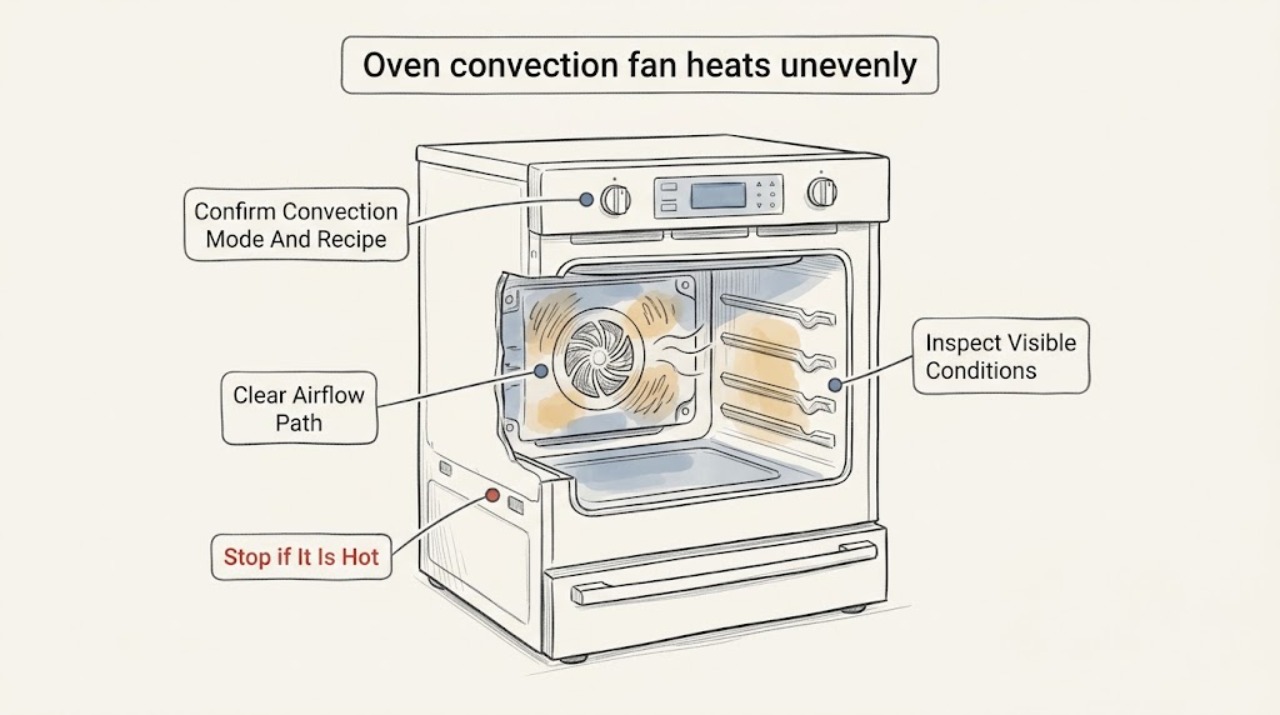
Uneven convection cooking does not automatically mean the fan motor has failed. First confirm that the selected mode actually uses convection, the rack and pan leave space for air to circulate, the food is not blocking the rear fan area, and the door is not being opened repeatedly. A convection fan may cycle on and off normally, and some ovens use a separate cooling fan, so judge it by the exact model manual rather than sound alone. With the oven cool, inspect only the visible fan area for an obstruction or damage; never reach through the guard or spin the blade by hand. Run one controlled test with the recommended rack and cookware, then compare the result with the same recipe and placement. If the fan never runs in a mode that requires it, makes a new grinding or scraping noise, the oven has a fault code, heating elements appear abnormal, or food remains uneven after setup and airflow checks, stop using that mode and arrange appliance service.
Before you begin
Safety first
- This article supports checking the selected mode and manual guidance, using a single-rack airflow setup, observing the visible fan area while cool, and documenting a controlled cooking pattern. It does not authorize fan or guard removal, live electrical testing, element or sensor replacement, calibration changes without the manual, self-clean testing, or operation with unsafe heat.
Work through in order
Diagnostic checks
Use only checks that match the exact appliance or system and its official guide.
-
Check 1
Read the exact model manual and confirm that the selected setting is Convection Bake, Convection Roast, or the model's named convection mode rather than conventional Bake or another mode. Note whether the recipe was written for conventional cooking and whether the oven has an automatic convection temperature conversion.
Expected result: Record the selected mode, fan icon or indicator, rack position, recipe temperature and time, pan material and depth, and whether the result is uneven by side, front-to-back, top-to-bottom, or between racks.
Next step: Repeat the test using the manual's recommended convection mode, rack, cookware, and any stated temperature conversion. If the same pattern remains, continue with the airflow and fan observations.
Stop if: Do not change calibration, temperature conversion, or service settings by trial before recording the original setup, and do not assume a fan icon proves that the fan motor is healthy.
Why this matters
Why: A non-convection mode, an unaccounted temperature conversion, or a recipe and rack mismatch can look like fan-related uneven heating. A repeatable hotspot in the same area across an appropriate convection setup is more concerning for airflow, heating, sensor, or control behavior.
-
Check 2
With the oven cool, use one rack and the cookware recommended by the manual. Center the food, leave the specified space around the pan and food, keep the rear fan area and vents unobstructed, and remove foil or a liner that covers the shelf or blocks circulation. Preheat fully and keep the door closed during the test.
Expected result: Compare the single-rack result with the earlier result. Note whether the unevenness disappears, becomes less severe, or remains in the same location despite clear space and the correct rack.
Next step: Use the improved setup for normal convection cooking. If the pattern persists, inspect only the visible fan area when cool and use the service branch for abnormal fan behavior or repeatable heating faults.
Stop if: Do not cover the entire rack with foil, block the rear fan or vents, place food against the fan guard, or open the door repeatedly to watch progress.
Why this matters
Why: Improvement with a clear, well-spaced rack supports a circulation or cookware setup issue rather than a failed fan. Persistent, location-specific unevenness makes a fan, element, sensor, seal, or control problem more likely, while a general temperature issue may affect all modes.
-
Check 3
After the oven is completely cool and switched off, look through the cavity at the visible convection fan and guard. Check for an obvious piece of foil, cookware contact mark, debris, or physical damage without reaching through the guard. During one permitted convection test, listen from outside the oven for normal intermittent airflow versus a new grinding, scraping, rattling, or no-fan condition.
Expected result: Record whether the fan cycles on and off, never starts in a mode that requires it, runs with a new abnormal noise, appears obstructed, or looks intact while the food remains uneven.
Next step: Remove only an obvious loose item that is outside the fan guard and safe to reach without tools. If the fan remains abnormal or the issue is not visible, stop using convection and arrange service.
Stop if: Do not spin the blade by hand, remove the guard, touch a hot fan, insert tools into the rear opening, or run the oven with a damaged guard or exposed wiring.
Why this matters
Why: Intermittent fan operation can be normal on some models, while no airflow or a new mechanical noise can indicate a fan, motor, control, or obstruction problem. An intact-looking fan does not rule out a heating element, sensor, seal, or control fault.
-
Check 4
Compare the same food and cookware in the model-recommended convection mode with a conventional mode when the manual permits both, without deliberately overheating the oven. Note whether the oven preheats normally, whether the temperature behavior or display is abnormal, and whether the uneven result follows the fan mode or appears in every mode.
Expected result: Classify the result as convection-only unevenness, unevenness in both convection and conventional modes, a slow or incomplete preheat, or an oven that reaches heat but has a repeatable side or rack hotspot.
Next step: Stop repeated cooking tests once the pattern is clear. Record the mode, rack, cookware, and result and arrange service for a repeatable fault, abnormal preheat, or broad temperature problem.
Stop if: Do not use a household thermometer as the sole safety proof, alter wiring or calibration without the exact manual, or continue cooking if smoke, a burning smell, arcing, or uncontrolled heat appears.
Why this matters
Why: Convection-only trouble makes fan airflow, fan motor, rear element, mode control, or circulation more likely. Unevenness in all modes points more toward general temperature calibration, an element, sensor, door seal, power, or control issue. A slow or incomplete preheat needs service if basic setup checks do not explain it.
-
Check 5
Stop using the convection mode and arrange appliance service when the fan never runs when required, has new grinding or scraping noise, is physically damaged, a fault code appears, the oven cannot preheat or regulate, or a correct single-rack setup still produces repeatable uneven heating.
Expected result: Provide the technician the exact model, selected mode, recipe and cookware, rack position, whether automatic conversion was active, fan behavior, temperature pattern, fault codes, and photos of any visible obstruction or damage.
Next step: Use the confirmed model-specific repair and have the technician verify fan operation, heat circulation, temperature regulation, and safe operation before resuming convection cooking.
Stop if: Do not remove panels, test energized circuits, replace the fan motor or element, bypass thermal protection, or keep using an oven with abnormal heat, smoke, arcing, or a damaged fan guard.
Why this matters
Why: The cause may be the convection fan or motor, rear heating element, temperature sensor, control, door seal, airflow path, or a power or heating fault. The cooking pattern alone cannot identify a compatible part or prove the fan is the failed component.
Use your observations
Decision map
Find the observation that best matches what you see, then follow the next safe action.
-
PATH 01Safety boundary
What you see
The selected mode, rack, cookware, spacing, and temperature conversion were not matched to the manual, and the result improves during a single-rack, well-spaced test with the door kept closed.
Do this next
Use the model-recommended rack and cookware, keep the fan area and vents clear, and monitor normally without repeated door opening.
Why this path and its safety boundary
Why it matters: Cooking setup and airflow around the food are more likely than a failed convection fan.
Safety stop: Do not cover the rack with foil or block the rear fan to force a different browning pattern.
-
PATH 02Safety boundary
What you see
Unevenness is confined to convection mode and the fan never runs when required, has a new grinding or scraping sound, has visible damage, or the result is unchanged after correct airflow setup.
Do this next
Stop using convection and arrange appliance service with the mode, sound, fan observation, and repeatable food pattern.
Why this path and its safety boundary
Why it matters: A fan, fan motor, rear heating element, mode control, obstruction, sensor, or related airflow fault is more likely than cookware alone.
Safety stop: Do not remove the guard, touch the fan, test wiring, or replace a fan or element from the symptom alone.
-
PATH 03Safety boundary
What you see
Food is uneven in both convection and conventional modes, preheating is slow or incomplete, or a consistent hotspot remains despite the recommended setup.
Do this next
Stop repeated cooking tests, document the modes and temperature behavior, and arrange appliance service for heating and regulation diagnosis.
Why this path and its safety boundary
Why it matters: A general temperature, heating-element, sensor, door-seal, power, or control problem is more likely than the convection fan alone.
Safety stop: Do not keep changing calibration, use an unverified thermometer as a safety decision, or continue when heat is uncontrolled or unsafe.
-
PATH 04Safety boundary
What you see
The oven shows a fault code, smoke, burning smell, arcing, a damaged fan guard or wiring, uncontrolled heat, or another safety abnormality.
Do this next
Turn the oven off, keep it out of service, and arrange prompt professional appliance service; follow household electrical or fire-safety procedures for smoke or arcing.
Why this path and its safety boundary
Why it matters: The problem exceeds a cooking-setup check and may involve energized, hot, or safety-critical components.
Safety stop: Do not run another test, use self-clean, open panels, reach into the fan area, or continue cooking.
Helpful context
Understand the symptom
Confirm the cooking setup before condemning the fan
Convection modes differ from conventional bake, and some ovens offer more than one convection mode. A crowded pan, foil covering, high-sided cookware, an unsuitable rack position, or frequent door opening can create uneven browning even when the fan is operating. Use the exact model manual and recipe guidance to establish a repeatable test.
A fan that cycles is not necessarily a failed fan
The convection fan can turn on and off as the oven controls temperature, while a separate cooling fan may run to protect the electronics. Listen for a new grinding, scraping, rattling, or stalled sound and observe the fan only through the normal cavity view after the oven is cool. Do not touch the fan, remove its guard, or open the rear panel.
Use the cooking pattern to decide whether service is needed
If a single-rack, well-spaced test is evenly cooked but a crowded or multi-rack test is not, the setup is the more likely variable. If one side, one rack, or every mode remains consistently under- or overcooked, or the fan has abnormal noise or no motion in a required mode, the oven may need inspection of the fan, heating element, sensor, control, seal, or airflow path.
Safety boundary
Stop conditions
- Do not reach through the fan guard, spin the blade by hand, remove panels, test energized wiring, or replace the fan, motor, element, sensor, or control as a guess.
- Do not block the rear fan or vents, cover a whole rack with foil, overcrowd the oven, or repeatedly open the door while testing convection circulation.
- Do not use self-clean or continue cooking when the fan guard is damaged, heat is uncontrolled, a fault code appears, or there is smoke, arcing, or a burning odor.
- Do not treat a fan that cycles on and off as failed without checking the exact model manual; some convection fans cycle normally and some ovens have a separate cooling fan.
- Arrange appliance service for a fan that never runs when required, new grinding or scraping, repeatable unevenness after correct setup, abnormal preheat, or uneven heating in every mode.
Only after diagnosis
Potential parts
- oven convection fan or fan motor
Consider this category only when a technician confirms that the fan does not operate correctly or its motor or bearing is the cause of convection-only uneven heating.
Confirm the complete oven model, fan design, connector, guard, and service instructions before sourcing a part; do not select it from noise or uneven cooking alone. - convection heating element
Consider this only when qualified testing confirms a failed or abnormal element in a model that uses one for convection heating.
Element type, mounting, wiring, and control behavior are model-specific; installation and electrical testing require qualified service. - oven temperature sensor or control component
Consider this category only when the oven is uneven in multiple modes or a technician confirms a sensor or control fault after airflow and fan operation are checked.
Confirm the exact model, connector, calibration requirements, and manufacturer service information before ordering or replacing any control or sensor.
When checks do not resolve it
Need a professional?
Arrange appliance service when the convection fan never runs in a mode that requires it, makes a new grinding, scraping, or rattling sound, has visible damage, or the oven shows a fault code. Also call when a correct single-rack, well-spaced setup still produces repeatable uneven heating, the oven preheats abnormally, or conventional and convection modes are both uneven. Keep the oven off for smoke, arcing, a burning odor, uncontrolled heat, or a damaged fan guard.
Safety scope: This article supports checking the selected mode and manual guidance, using a single-rack airflow setup, observing the visible fan area while cool, and documenting a controlled cooking pattern. It does not authorize fan or guard removal, live electrical testing, element or sensor replacement, calibration changes without the manual, self-clean testing, or operation with unsafe heat.
Common questions
FAQ
Why does my convection oven heat unevenly?
A crowded pan, blocked airflow, wrong rack or cookware, frequent door opening, or a convection temperature conversion can cause uneven results even when the fan works. If the same hotspot remains with the manual's single-rack setup, a fan, heating element, sensor, seal, or control issue becomes more likely.
Should the convection fan run continuously?
Not necessarily. Samsung notes that the convection fan can turn on and off at regular intervals, and some ovens also have a separate cooling fan. Use the exact model manual and treat a new grinding, scraping, rattling, or no-fan condition in a required mode as a service clue.
What rack position should I use for convection cooking?
Use the rack position and cookware specified in the oven's manual for the selected convection mode. Start with one rack, center the food, leave space for air circulation, keep the fan and vents clear, and avoid covering the shelf with foil. Different models and foods can require different positions.
How can I tell whether the fan or the oven temperature is the problem?
Compare a repeatable, well-spaced convection test with a permitted conventional-mode test. Convection-only unevenness with abnormal fan operation points toward fan airflow, the rear element, or mode control; unevenness in both modes points more toward general heating, sensor, seal, power, or control behavior. This comparison does not replace service testing.
When should I call for oven service?
Arrange service when the fan never runs in a required mode, has new abnormal noise, the fan guard is damaged, a fault code appears, preheating is abnormal, or unevenness remains after the manual's rack, cookware, spacing, and door-use checks. Turn the oven off for smoke, arcing, burning odor, or uncontrolled heat.
Read the exact guide
Official sources
- Samsung oven temperature issuesSamsung Support · Samsung oven and range temperature guidance; exact settings, modes, and permitted calibration vary by model.
- How to use your Samsung convection ovenSamsung Support · Samsung convection-oven guidance; exact modes, fan behavior, rack positions, and temperature conversion vary by model.
- Samsung oven fan is making a noise or will not turn offSamsung Support · Samsung oven fan guidance; fan count, normal cycle, sound, and access vary by model.
Community feedback
Share a repair observation
Share a plain-text repair observation. Accepted observations are published automatically; this page may take a moment to update.