
On this page
Start here
Quick answer
A top-load washer may refuse to spin because the lid is not closed or the lid-lock system has not confirmed closure, but a lid-lock symptom does not prove the lock itself is bad. First note whether the washer fills and drains, whether it pauses normally between agitation and spin, and whether a lid-lock light or error appears. Close the lid fully and inspect the visible lid strike, probe or magnet, hinge area, and lock opening for clothing, lint, detergent buildup, or damage without bypassing the safety device. Also rule out an unbalanced load, excess water that has not drained, a cycle pause, or a power interruption. If the lid never locks, repeatedly unlocks, shows a lock error, or the washer still will not spin after safe external checks, leave it off and arrange appliance service. Never tape, hold, or otherwise defeat the lid lock, reach into a moving basket, or open the cabinet for a live electrical test.
Before you begin
Safety first
- This article covers observing the cycle, checking visible lid-closure parts, allowing normal pauses, balancing a safe load, and using the exact model's reset and verification procedure. Do not bypass the lock, open the console or cabinet, handle live wiring, or reach into a moving or wet washer.
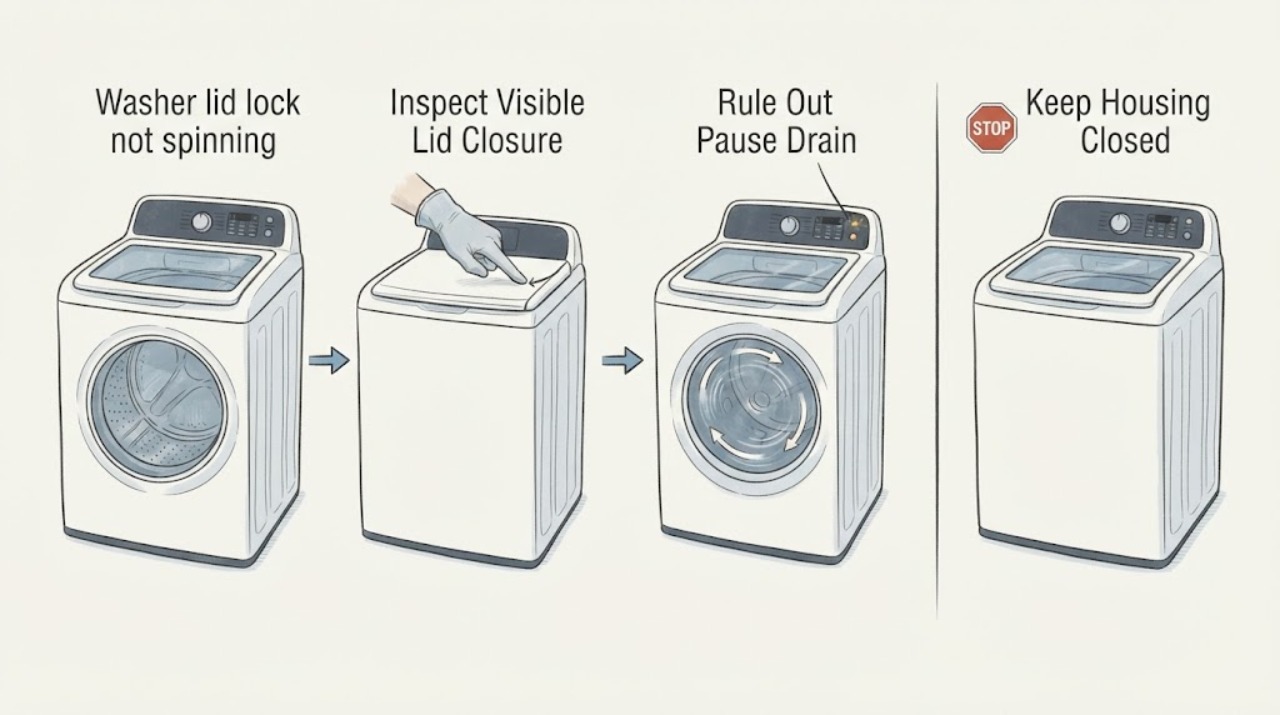
Work through in order
Diagnostic checks
Use only checks that match the exact appliance or system and its official guide.
-
Check 1
Observe one safe cycle attempt from outside the washer and record whether it fills, agitates, drains, pauses, attempts to lock the lid, and then stops before spin; note every lid-lock light, sound, or displayed message.
Expected result: Record lid-lock light off, blinking, or steady; a lock click with no spin; an open-lid or balance indication; water remaining in the basket; or a motor/pump sound without basket movement.
Next step: Use the exact model manual to interpret the indicator and continue with the matching external check; stop and arrange service for smoke, burning smell, flooding, or severe mechanical noise.
Stop if: Do not defeat the lock, open the lid during movement, or keep restarting a cycle that stops with an active fault.
Why this matters
Why: A washer may delay while sensing or pumping out water, while a lock indication or open-lid message points toward the lid-closure path. A locked lid with no basket movement shifts suspicion toward balance, drainage, motor, drive, or another internal fault rather than the lock alone.
-
Check 2
With the washer stopped and the lid unlocked, inspect the visible lid strike, switch probe or magnet, lid opening, hinge, bumpers, and top cover for clothing, lint, detergent residue, displacement, cracks, or bending.
Expected result: Note an obstruction, a missing or damaged probe/magnet/strike, a bumper that is out of place, a lid that does not sit level, or a clean closure path with no visible damage.
Next step: Remove only loose accessible debris with the washer stopped, reseat an accessible bumper only if the model manual directs it, then close the lid and retry once; arrange service for damage, misalignment, or a lock that still will not engage.
Stop if: Do not push the lock mechanism, tape or weight the lid shut, bend the strike, or insert tools into the lock opening.
Why this matters
Why: Debris or a misaligned closing part can prevent the lid lock from confirming closure and therefore prevent spin. A clean, intact closure path makes a lock assembly, wiring, control, or another no-spin cause more likely, but does not identify it by sight alone.
-
Check 3
After the lid is closed normally, allow the model's normal pause and pump-out period to finish, then check for remaining water and redistribute an uneven or bulky load only after the lid unlocks safely.
Expected result: Record a normal delay before spin, water left in the basket, a flashing spin or balance indicator, laundry gathered on one side, or no water/balance issue.
Next step: Use the model's Drain & Spin or load-rebalance procedure if indicated; if water remains, draining is poor, or the same no-spin condition returns with a balanced load, leave the washer off and arrange service.
Stop if: Do not reach into a basket that is moving, open a locked lid, or keep adding/removing laundry while the machine is attempting to spin.
Why this matters
Why: A pause during pump-out, an unbalanced load, or excess water can stop or postpone spin even when the lid lock works. If the tub is empty and balanced yet the washer still refuses to spin, an internal or lock-related issue becomes more likely.
-
Check 4
If there is no active leak or unsafe condition, stop the cycle and perform only the power reset specified in the washer's owner's manual, leaving the appliance disconnected for the manual's stated interval before one restart.
Expected result: Note whether the lid-lock indicator returns to normal, whether the washer completes a no-load or Drain & Spin check, and whether the same lock or spin message returns.
Next step: If the fault returns, stop resetting and arrange appliance service with the exact message and sequence; do not use a reset to bypass a mechanical lid problem.
Stop if: Do not cycle power while water is spraying, wiring is exposed, or the washer has an active uncontrolled fill or drain.
Why this matters
Why: A temporary control-state interruption can clear a one-time pause or fault, but a recurring lid-lock indication after a model-approved reset is not proof that the lock is repairable by repeated resets. Persistent no-spin needs diagnosis.
-
Check 5
With the lid closed and the washer stopped, compare the model's lid-lock indication and start behavior with the owner's manual; observe whether the lock engages once, cycles repeatedly, or never acknowledges closure.
Expected result: Record a normal lock click and steady indicator, repeated clicking or unlocking, no lock response, a lock-related error, or a lid that appears closed but does not meet the switch or sensor.
Next step: Keep the washer off for a repeated or absent lock signal and arrange model-specific service; provide a photo of the lock area and the exact indicator sequence.
Stop if: Do not test the lock with a jumper, bypass its sensor, open the console, or apply live electrical measurements.
Why this matters
Why: No acknowledgement or a recurring lock error makes the lid lock, strike/probe/magnet, wiring, control, or lid alignment more likely. A normal lock acknowledgement with no spin shifts the diagnosis to drainage, balance, motor, drive, or another system.
-
Check 6
If the lid closes and locks normally and there is no hazard, run one model-approved Drain & Spin or light-load verification while observing from outside for pump-out, lock engagement, basket acceleration, balance, leaks, and error return.
Expected result: Record restored spin, a locked lid with a still basket, repeated balance stopping, failure to drain, continuous lock cycling, or a leak/burning smell.
Next step: Stop using the washer for persistent no-spin, repeated lock errors, leaks, or abnormal sounds and arrange appliance service with the model and observations; do not order a lock or motor from the symptom alone.
Stop if: Stop immediately for smoke, burning smell, flooding, exposed wiring, severe walking, or a lid that opens while the basket is moving.
Why this matters
Why: Restored spin after a closure, pause, load, or reset correction supports that the lid lock was not necessarily failed. A locked lid with a still basket, recurring lock fault, or failure to drain requires a technician to distinguish the lock assembly from motor, drive, pump, control, or sensor faults.
Use your observations
Decision map
Find the observation that best matches what you see, then follow the next safe action.
-
PATH 01Safety boundary
What you see
The lid-lock indicator stays off or shows open, and the visible strike/probe/magnet, bumper, hinge, or lock opening has debris, displacement, or damage.
Do this next
Remove loose accessible debris or correct only the model-approved external closure item, then retry once with the lid fully closed; arrange service for damaged or misaligned parts.
Why this path and its safety boundary
Why it matters: The lid is not being mechanically presented to the lock, so the washer may correctly refuse to spin for safety.
Safety stop: Do not bend the strike, force the lid, tape the lock, or insert an object to simulate closure.
-
PATH 02Safety boundary
What you see
The lid locks normally, but the washer is still in a pump-out delay, has water remaining, reports balance trouble, or stops only with a tangled or bulky load.
Do this next
Allow the model's normal pause to finish, use its Drain & Spin or balancing procedure, and service the washer if it cannot drain or repeats the no-spin state with an empty or balanced load.
Why this path and its safety boundary
Why it matters: Drain timing or load balance is more likely than a lid-lock failure; a working lock does not force the basket to spin while another condition blocks it.
Safety stop: Do not open a locked lid, reach into a moving basket, or keep running an appliance with standing water and a leak.
-
PATH 03Safety boundary
What you see
The lid is visibly closed and clean, but the lock never acknowledges closure, repeatedly clicks or unlocks, or a lock-related error returns after the model-approved reset.
Do this next
Keep the washer off and arrange model-specific appliance service for a lock and control diagnosis; provide the model and exact indicator sequence.
Why this path and its safety boundary
Why it matters: A lid-lock assembly, strike/probe/magnet, alignment, wiring, or control issue is more likely; the indicator pattern cannot identify the failed component.
Safety stop: Do not bypass the lock, jumper the sensor, open the console, or apply live electrical measurements.
-
PATH 04Safety boundary
What you see
The lid locks and remains locked, water pumps out, but the basket does not spin or the motor runs without basket movement.
Do this next
Stop further testing and arrange appliance service for internal diagnosis; report that the lid locked and whether the motor and pump were heard.
Why this path and its safety boundary
Why it matters: A motor, drive, belt, transmission, basket, control, or another internal no-spin fault is more likely than the lid lock.
Safety stop: Do not open the cabinet, handle a belt or motor, or keep running high-speed cycles with a stationary or scraping basket.
-
PATH 05Safety boundary
What you see
The lid opens while the basket is moving, the washer floods, water is near electrical parts, smoke or burning smell appears, or a severe mechanical noise accompanies no spin.
Do this next
Stop the cycle, close the water supply if flow is uncontrolled, disconnect power only from a dry safe position, keep clear of moving or wet parts, and arrange urgent service.
Why this path and its safety boundary
Why it matters: The washer presents an immediate mechanical, water, or electrical hazard beyond a routine lid-lock check.
Safety stop: Do not restart the washer, reach into the basket, touch wet electrical parts, or defeat the lock to retrieve laundry.
Helpful context
Understand the symptom
A lid-lock light is a condition, not a diagnosis
The lock is a safety interlock that must confirm a closed lid before a top-load washer spins. A washer can also pause to sense a load, pump out water, rebalance clothing, or recover from a power interruption. Record the sequence—fill, agitate, drain, lock attempt, and spin—before replacing the lock. Model controls and indicator meanings differ, so the owner's manual takes priority over a generic light pattern.
Inspect only the visible closing path
The lid strike, switch probe or magnet, bumpers, hinge, and lock opening must meet cleanly. A sock edge, lint, detergent residue, bent strike, displaced bumper, or warped lid can prevent that confirmation. Clean or reseat only accessible debris as the manual permits. Do not press the lock closed with a tool or tape the lid shut to make the washer spin.
When the no-spin symptom is not the lid lock
If the lid locks but the basket still does not spin, check whether the washer is waiting to drain, reporting an unbalanced load, or stopping because of a motor or drive fault. A machine that pumps water out while the motor runs but leaves the basket still needs service diagnosis. Do not open the cabinet to distinguish these parts yourself.
Safety boundary
Stop conditions
- Stop using the washer and arrange appliance service for a lid that does not lock, repeated lock errors, a lid that opens during movement, persistent no-spin after safe external checks, a leak, smoke, or burning smell.
- Do not tape, hold, jumper, bypass, or otherwise defeat the lid-lock safety device; do not reach into a moving basket or force a locked lid open.
- Do not open the cabinet or console, handle wiring, motor, belt, transmission, or lock electronics, or apply live electrical tests as a homeowner diagnosis.
- Use the exact owner's manual for indicator meanings, pauses, reset instructions, lid hardware, and model-specific parts; do not infer a failed lock or compatible replacement from a generic symptom.
Only after diagnosis
Potential parts
- washer lid-lock assembly
Consider this class only when the lid is correctly aligned and closed, visible obstructions are absent, the model-specific indicator still shows a lock fault, and a qualified diagnosis confirms the lock assembly failed.
Match the exact washer model, lock connector, mounting, lid design, and safety rating; do not bypass the lock or select by appearance. - washer lid strike, probe, magnet, or bumper
Consider this class only when inspection finds a missing, cracked, displaced, or model-specific closing part that prevents the lid from presenting correctly to the lock.
Confirm the exact lid and washer model and the part position; similar-looking strikes, magnets, and bumpers are not universally interchangeable. - washer lid-lock wiring or control assembly
Consider this diagnostic category only after the closure path and lock assembly are checked and a qualified technician identifies a wiring or control fault.
Electrical assemblies are model-specific and require safe diagnosis; do not order or connect a control or harness from a generic lock symptom. - washer drive or motor assembly
Consider this class only when the lid locks normally, the washer drains, and a technician confirms the basket does not spin because of an internal drive or motor fault.
Confirm the exact model, drive design, and failure diagnosis; a no-spin condition with a working lock does not identify a particular drive part.
When checks do not resolve it
Need a professional?
Arrange appliance service when the lid will not lock or repeatedly unlocks, a lock-related error returns, the lid or strike/probe/magnet is damaged, the washer still will not spin after the lid closes and external balance/drain checks, or the motor runs without basket movement. Call urgently for a lid opening during motion, flooding, exposed wiring, smoke, burning smell, severe walking, or water near electrical equipment.
Safety scope: This article covers observing the cycle, checking visible lid-closure parts, allowing normal pauses, balancing a safe load, and using the exact model's reset and verification procedure. Do not bypass the lock, open the console or cabinet, handle live wiring, or reach into a moving or wet washer.
Common questions
FAQ
Why will my washer not spin when the lid is closed?
The lid may look closed without the lock or switch confirming it. Check the visible strike, probe or magnet, bumpers, hinge, and lock opening for debris or damage, then check for a normal pump-out pause, remaining water, or an unbalanced load. If the lid locks normally but the basket remains still, a drain, motor, drive, or control fault is more likely.
Can I bypass the washer lid lock to make it spin?
No. The lid lock or switch is a safety device intended to prevent access while the basket moves. Do not tape the lid, jumper the sensor, press the lock with a tool, or run the washer with the safety device defeated. Arrange service when the lock will not confirm closure.
Why does the lid lock click but the washer still does not spin?
A click may show that the washer attempted to lock, not that the no-spin cause is solved. Check whether water drained, the cycle was still pausing, or the load was unbalanced. If the lid remains locked and the basket does not spin, service is needed to distinguish a motor, drive, basket, control, or other internal fault.
Should I replace the lid-lock assembly?
Only after the exact model and closure path are checked and a model-specific diagnosis confirms the lock assembly. A missing strike or magnet, displaced bumper, wiring, control, balance condition, or drainage problem can look similar. Do not choose a replacement by appearance or bypass the lock while waiting for a part.
Read the exact guide
Official sources
- Top Load Washer - Lid Lock FeatureGE Appliances · GE top-load models with the described lid-lock feature; model behavior differs by design and manual.
- Unitized Spacemaker Washer - Washer Will Not Start / Lid Not LockedGE Appliances · GE Unitized Spacemaker models listed on the page only; not universal guidance for all washers.
- Top Load Washer - Does Not SpinGE Appliances · GE top-load washer no-spin guidance; exact controls and fault messages vary by model.
- Lid Locking on a Top Load High Efficiency WasherWhirlpool Product Help · Whirlpool top-load high-efficiency washer guidance; exact operations vary by model and owner's manual.
- Top Load Washer - Lid SwitchGE Appliances · GE top-load washer lid-switch guidance; probe and magnet arrangements vary by model.
Community feedback
Share a repair observation
Share a plain-text repair observation. Accepted observations are published automatically; this page may take a moment to update.