
On this page
Start here
Quick answer
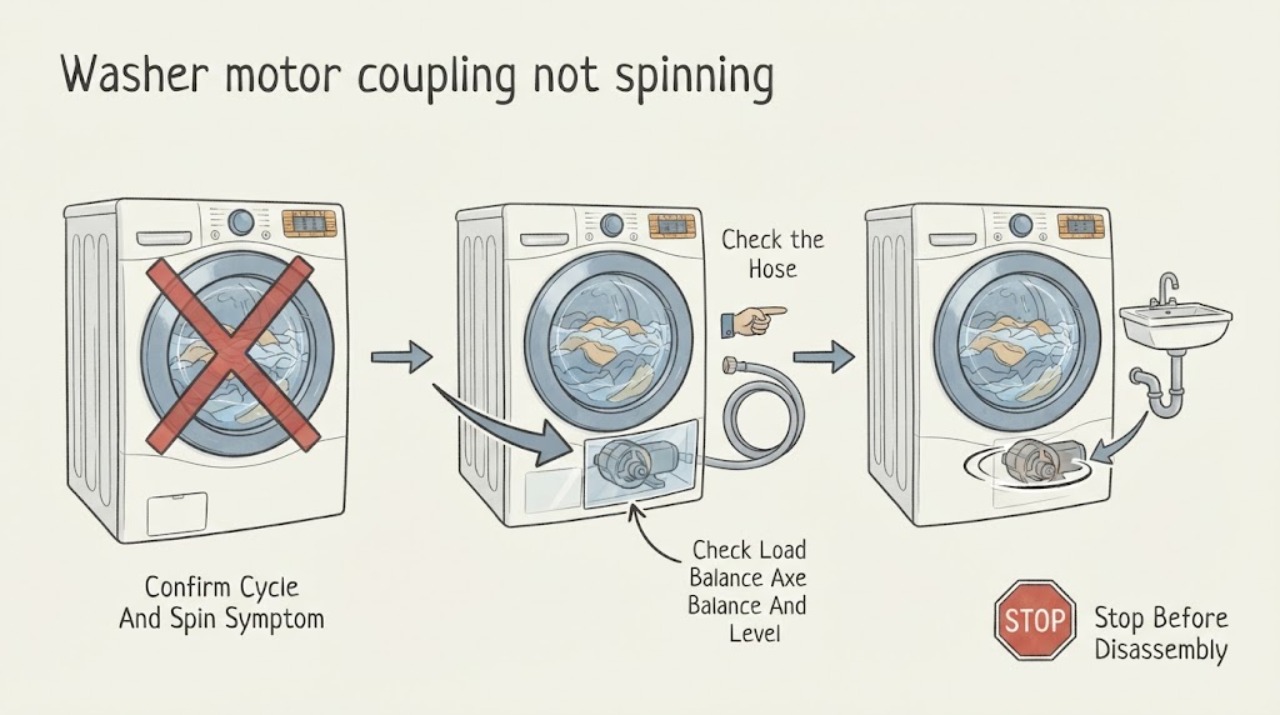
A washer that fills and drains but leaves the agitator or basket still can have a drive-system problem, including a failed motor coupling on models that use one, but a load, spin setting, lid or door interlock, drain problem, or another drive fault can look similar. First confirm that a real spin cycle is selected, the lid or door is closed, the load is not tightly packed or badly unbalanced, and water is draining. Then note whether the washer makes a motor sound, agitates, or only drains. If the motor runs but both agitation and spin are absent, or if it hums, clicks, overheats, leaks, or trips power, stop and arrange service. Do not tip the washer, open the cabinet, bypass the lid lock, reach near the motor or coupling, or run powered tests; coupling replacement requires model-specific access and qualified repair.
Before you begin
Safety first
- This article supports checking cycle settings, a closed lid or door, an accessible drain hose, load balance, visible washer stance, and the external sound and sequence. It does not authorize cabinet or console removal, underside access, lifting or tilting, lid-lock bypass, live electrical testing, motor or pump testing, or coupling replacement.
Work through in order
Diagnostic checks
Use only checks that match the exact appliance or system and its official guide.
-
Check 1
With the washer stopped, check the selected cycle and spin option against the owner's guide. Make sure the lid or door is fully closed and latched, then use the model's normal Drain and Spin or equivalent cycle only if no hazard is present. Do not force the lid or door or reach into a moving basket.
Expected result: Record whether the machine starts, fills, agitates, drains, attempts to ramp up, or ends with the clothes wet; note any displayed error or an open-lid or door indication.
Next step: Correct only an accidentally selected low/no-spin setting or an incompletely closed lid or door. If the correct cycle still produces no motion, stop normal use and continue with the drain and sound observations below.
Stop if: Do not bypass or tape down a lid or door lock, hold the lid open during a spin, or reach into the basket while the washer is energized.
Why this matters
Why: A low- or no-spin selection can leave water in clothes by design, and an unlatched lid or door can prevent agitation or spin. If the correct cycle is selected and the interlock indicates closed but the basket still does not move, continue to distinguish a drain, motor, and drive-system branch.
-
Check 2
Look at the visible drain hose and standpipe or utility sink connection without moving the washer. Check for an obvious kink, crush point, loose placement, or visible blockage, and note whether water remains in the tub after the cycle stops. Correct only a plainly kinked accessible hose according to the installation guide; do not dismantle the pump or pull a heavy washer forward alone.
Expected result: Record an empty tub, standing water, slow draining, water flowing back, a kinked hose, or a drain connection that cannot be safely reached.
Next step: Restore only an obvious accessible hose position, then follow the owner's guide for one normal drain-and-spin attempt. If water remains, the hose is inaccessible, or the pump may be blocked, arrange appliance service before opening the machine.
Stop if: Do not disconnect a water-filled hose, open the pump, reach into a pump, pour chemicals into the washer, or tip or move the appliance to reach its underside.
Why this matters
Why: Whirlpool explains that a kinked, clogged, or incorrectly installed drain hose can leave water standing and interrupt spin. If the washer drains fully but the basket and agitator remain still, a drain restriction is less likely and a drive or control branch becomes more important; full draining does not prove the coupling is failed.
-
Check 3
If the tub is empty or safely accessible after draining, remove an obviously single bulky item or redistribute a small load without overfilling. Look at the washer's stance from the floor and note obvious rocking or severe out-of-level condition; do not crawl under it or loosen feet while it is loaded.
Expected result: Record a single blanket or heavy item, tightly packed load, loud shaking, an error related to balance, a washer that rocks, or the same no-spin symptom with an empty balanced load.
Next step: Run only the cycle recommended by the owner's guide with a balanced load if no other warning is present. If the empty or balanced test still fails, document the result and arrange model-specific service rather than adding more weight or repeatedly retrying.
Stop if: Do not force a shaking machine to spin, operate it with a visibly unstable cabinet, or reach beneath it to adjust leveling or inspect the coupling.
Why this matters
Why: Whirlpool states that an unbalanced or overloaded load and an unlevel washer can reduce or stop spin and leave clothing wet. If an empty or balanced load still has motor sound without basket or agitator motion, load balance is less likely and a drive-system fault, such as a coupling on a design that uses one, becomes more plausible.
-
Check 4
From outside the closed washer, note the sequence during the model's normal cycle: listen for a motor hum or run sound, a pump sound, agitation, basket movement, clicking, grinding, or repeated stopping. Do not remove the cabinet or use a diagnostic mode that requires an open lid, exposed parts, or electrical measurement.
Expected result: Record one of these patterns: no motor response; pump runs but water remains; motor sound with no agitation and no spin; agitation works but spin does not; or loud grinding, slipping, burning odor, or repeated clicking.
Next step: Stop the cycle for loud grinding, burning odor, repeated clicking, smoke, or a motor that hums without movement. Give the technician the exact sequence and sound; request a model-specific drive inspection before ordering a coupling.
Stop if: Do not run the washer with an open cabinet, hold down the lid switch, touch a motor or coupling, use live electrical tests, or keep retrying a stalled or overheated motor.
Why this matters
Why: Motor sound with both agitation and spin absent after the washer drains is consistent with a break in the drive path, including a coupling on some direct-drive designs, but it can also be a motor, control, gearcase, or model-specific drive fault. Agitation that works but spin does not points toward the spin mechanism, clutch, shifter, lid or door sensing, or gearcase rather than proving a coupling. No motor response points earlier toward power, control, interlock, or motor causes.
-
Check 5
From a dry, safe position, note whether the washer's display or controls have power and whether a recent outage, tripped circuit, move, overload, leak, or unusual noise preceded the no-spin condition. Follow the owner's guide for a normal control reset only if it explicitly permits one; do not repeatedly reset a tripping circuit.
Expected result: Record no power, power restored but no motor response, a cycle interrupted after an outage, a repeat breaker trip, or no relevant event.
Next step: Restore only a clearly interrupted control state according to the manual. If power is absent, the circuit trips again, or the same no-spin pattern returns, leave the washer out of service and arrange appliance repair.
Stop if: Do not replace a fuse, open the electrical console, test live voltage, bypass a breaker, or continue operating after smoke, arcing, burning odor, or water reaches electrical parts.
Why this matters
Why: Whirlpool notes that a power failure can interrupt spin, while a repeat trip or persistent no-response condition is not explained by a setting alone. A stable power supply with a repeatable motor-but-no-motion pattern keeps the drive path in consideration; a no-power or interlock pattern should be resolved before any coupling discussion.
Use your observations
Decision map
Find the observation that best matches what you see, then follow the next safe action.
-
PATH 01Safety boundary
What you see
A low/no-spin cycle, tightly packed or unbalanced load, severe washer rocking, or an incompletely closed lid or door is present, and there is no abnormal motor sound or hazard.
Do this next
Use the correct cycle, redistribute or reduce the load, close the lid or door, and follow the owner's guide for a single normal attempt. If the same failure occurs with a balanced load, move to the drain and drive-sound branches.
Why this path and its safety boundary
Why it matters: The control may be intentionally limiting spin or protecting the machine from an imbalance, so a failed coupling is not the leading explanation yet.
Safety stop: Do not defeat the interlock, force the lid or door, or continue with a washer that shakes violently.
-
PATH 02Safety boundary
What you see
Water remains in the tub, drain flow is slow, or the visible hose is kinked, clogged, or incorrectly placed.
Do this next
Correct only an obvious accessible hose issue according to the installation guide and arrange service for a pump, internal blockage, or inaccessible drain problem. Do not access the underside with water or clothing still in the machine.
Why this path and its safety boundary
Why it matters: The washer may refuse or shorten spin because it has not completed draining; this pattern does not identify a motor coupling failure.
Safety stop: Do not disconnect a full tub, open the pump, use chemicals, or tip the washer to reach a drain component.
-
PATH 03Safety boundary
What you see
The washer drains, the lid or door indicates closed, a balanced-load retry fails, and a motor sound is present but neither agitation nor basket spin occurs.
Do this next
Stop repeated cycles, photograph the model and serial label, and arrange appliance service for a model-specific drive diagnosis. Ask the technician to confirm coupling failure and inspect related drive parts before ordering a replacement.
Why this path and its safety boundary
Why it matters: A break in the drive path is more likely. A motor coupling is one possibility on designs that use one, but a motor, control, gearcase, belt, or other model-specific drive fault can produce the same pattern.
Safety stop: Do not tilt the washer, remove the cabinet, reach near the motor or coupling, hold a lid switch closed, or run exposed-part tests.
-
PATH 04Safety boundary
What you see
The washer agitates or tumbles and drains, but the basket does not reach spin, while the load and cycle setting are appropriate.
Do this next
Stop using the washer if the failure repeats and provide the complete cycle sequence to a technician. Request diagnosis against the exact model rather than selecting a coupling from a generic symptom list.
Why this path and its safety boundary
Why it matters: The issue is more localized to the spin mechanism, lid or door sensing, clutch, shifter, belt, gearcase, motor control, or another design-specific component. A coupling is not proven by a spin-only failure.
Safety stop: Do not bypass the lid or door interlock, open the drive assembly, or continue running through grinding, slipping, burning odor, or repeated stops.
-
PATH 05Safety boundary
What you see
There is no motor response, a breaker trips again, the washer hums or clicks without starting, or smoke, arcing, burning odor, water near electrical parts, or a severe mechanical noise is present.
Do this next
Stop using the washer, disconnect power only by a safe accessible plug if the area is dry and there is no arcing, and arrange appliance or electrical service. Leave the area and contact emergency services for smoke or fire.
Why this path and its safety boundary
Why it matters: Power, control, interlock, motor, electrical, leak, or mechanical safety issues take priority over a coupling diagnosis. Continuing to cycle the washer can increase damage or create an electrical hazard.
Safety stop: Do not touch wet electrical parts, reset repeatedly, open the console, test live circuits, or attempt to make the motor run.
Helpful context
Understand the symptom
A coupling symptom is a pattern, not a part number
The motor coupling transfers drive between the motor and the rest of the drive system on some washer designs. A washer that fills, drains, and sounds as though its motor runs while neither agitation nor spin occurs is compatible with a broken or slipping coupling, but the same symptom can come from an interlock, control, motor, pump, gearcase, belt, shifter, or another model-specific part. Confirm the cycle and record the sequence before assuming the coupling is at fault.
Rule out the accessible causes first
Whirlpool advises checking the selected spin setting, load balance, washer level, drain hose, power interruption, and closed lid or door when a washer will not spin. These checks can explain wet clothes or standing water without any drive-part failure. They do not prove that a coupling is good or bad, so a persistent motor-but-no-motion pattern still needs model-specific diagnosis.
The underside is a professional repair boundary
A motor coupling is generally below or behind the tub and drive assembly, where accessing it may require unplugging, draining, moving or tilting the washer, removing covers, and supporting heavy parts. Do not create a powered observation with the cabinet open or defeat a lid lock. Give the technician the model number, cycle sequence, drain result, sounds, and any recent leak, overload, or power event.
Safety boundary
Stop conditions
- Do not open the washer cabinet, console, pump, motor area, or drive assembly; do not tilt or move the appliance to reach the coupling unless a qualified technician is handling the access and support plan.
- Do not bypass a lid or door lock, hold an interlock closed, run the washer with exposed moving or electrical parts, or perform live electrical measurements.
- Stop repeated cycles for grinding, slipping, a stalled or overheated motor, smoke, arcing, burning odor, water near electrical parts, or a breaker that trips again.
- Do not order a motor coupling from a symptom alone. The exact model must use that component, and a technician should confirm failure and inspect related drive parts before replacement.
- Arrange appliance repair when a balanced washer drains but the motor runs without agitation or spin, when spin alone fails repeatedly, when the drain or interlock is inaccessible, or when any electrical, pump, motor, coupling, gearcase, belt, or cabinet work is indicated.
Only after diagnosis
Potential parts
- washer motor coupling
Consider this category only after the exact model's parts documentation shows a coupling and a qualified technician confirms that the coupling has failed.
Coupling design, motor and gearcase interface, model revision, and related isolation pieces vary. The Whirlpool parts list opened for this research covers a specified model family and does not establish fit for another washer. - washer drive-system component such as clutch, belt, shifter, or gearcase
Consider this category only when model-specific diagnosis identifies the relevant spin or drive component rather than assuming the coupling is the cause.
The washer design and exact model number must be confirmed before part selection; do not substitute a generic component based on the no-spin symptom. - washer lid or door interlock component
Consider this category only when diagnosis confirms that the lid or door sensing system prevents a valid spin cycle.
Lock style, wiring, control logic, and model revision vary. Never bypass an interlock as a repair.
When checks do not resolve it
Need a professional?
Arrange appliance repair when a correctly selected cycle with a balanced load still leaves the washer unable to spin, especially if it drains and a motor sound occurs without agitation or basket movement. A coupling may be involved on some designs, but model-specific diagnosis is required. Stop immediately for smoke, arcing, burning odor, water near electrical parts, violent shaking, grinding, an overheated motor, or repeat breaker trips; use emergency services for fire.
Safety scope: This article supports checking cycle settings, a closed lid or door, an accessible drain hose, load balance, visible washer stance, and the external sound and sequence. It does not authorize cabinet or console removal, underside access, lifting or tilting, lid-lock bypass, live electrical testing, motor or pump testing, or coupling replacement.
Common questions
FAQ
How can I tell whether a washer motor coupling is causing no spin?
You cannot confirm a coupling from the symptom alone. A washer that drains and sounds as if its motor runs while neither agitation nor spin occurs is compatible with a drive-path fault, including a coupling on some designs, but a motor, control, gearcase, belt, or other part can look the same. Confirm the cycle, drain, load, and lid or door state, then have the exact model diagnosed.
What should I check before assuming the washer coupling failed?
Check the selected spin setting, closed lid or door, load balance, washer level, visible drain hose, standing water, and any recent power interruption. If a balanced washer drains but still has motor sound without agitation or spin, provide that sequence to an appliance professional rather than ordering a generic coupling.
What if the washer agitates but will not spin?
That pattern does not prove a motor coupling failure. It can involve spin-specific sensing, clutch, shifter, belt, gearcase, motor control, or another model-specific component. Stop repeated attempts if the washer grinds, slips, overheats, or trips power, and arrange diagnosis using the exact model and full cycle sequence.
Can I replace a washer motor coupling myself?
Only a qualified repairer should decide whether the model uses a coupling and replace it. Access may involve moving or tilting the washer, draining it, removing covers, and working near moving and electrical parts. Do not bypass the lid lock, run the washer with exposed parts, or choose a coupling without exact-model confirmation.
Why is there water left in the washer when it will not spin?
A kinked, clogged, or incorrectly installed drain hose, a pump or internal drain restriction, a low/no-spin setting, an unbalanced load, or an interrupted cycle can leave water or wet clothes. Check only the visible hose and selected cycle as the manual permits; if water remains or the pump needs access, arrange service before investigating the drive assembly.
Read the exact guide
Official sources
- Not Spinning - WasherWhirlpool Product Help · Whirlpool top-load washer homeowner guidance; exact cycle behavior, access, and component diagnosis vary by model and installation.
- Repair Part List 881263Whirlpool Corporation · Official parts list for only the listed Whirlpool model family; it confirms a motor coupling is present in that assembly but does not establish compatibility or failure for another model.
- Whirlpool Washer Owner's Manual: TroubleshootingWhirlpool Corporation · Official Whirlpool owner manual for a specified washer family; the manual's controls, dimensions, and service procedures are not universal across all washers.
- 8 Reasons Why Your Washing Machine Is Not SpinningWhirlpool · Whirlpool consumer guidance across washer types; exact controls and service access vary by model.
Community feedback
Share a repair observation
Share a plain-text repair observation. Accepted observations are published automatically; this page may take a moment to update.