
On this page
Start here
Quick answer
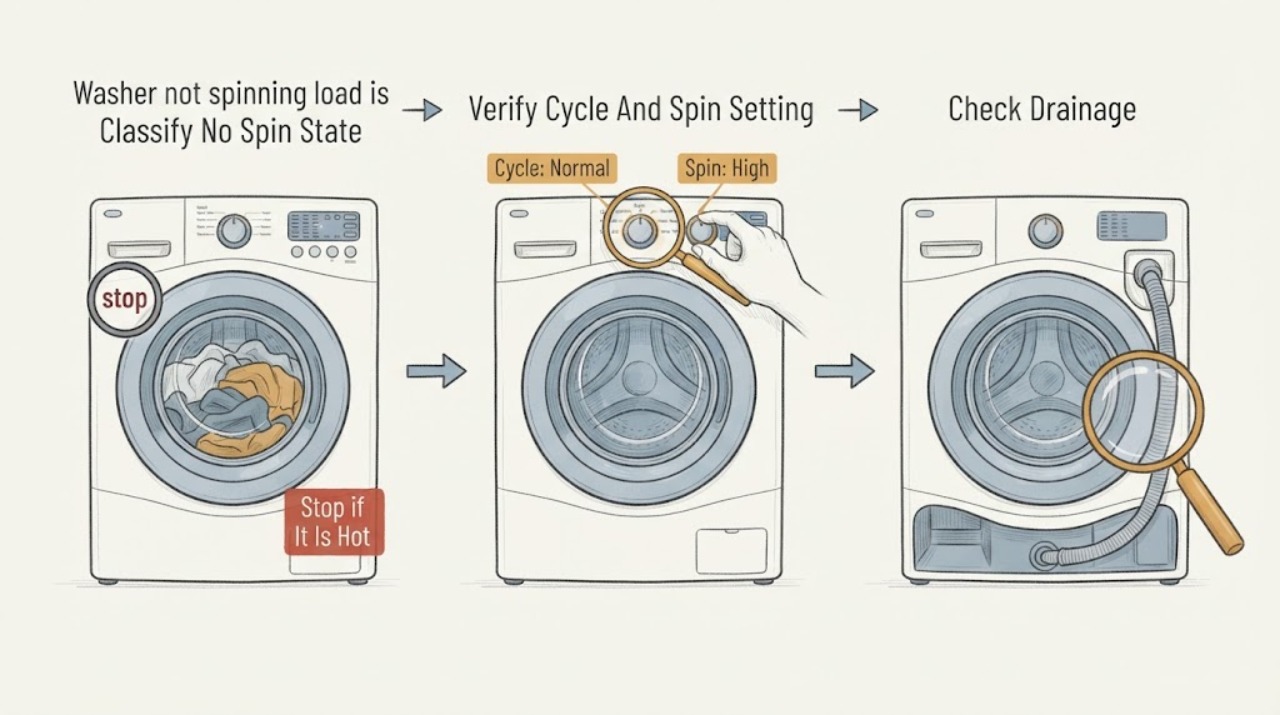
If a washer is not spinning even though the load is balanced, first determine whether it cannot drain, cannot lock, has no selected spin, stops at a normal balancing pause, or never turns the drum at all. Save any display code, confirm the cycle and spin setting, and use the normal pause control before inspecting anything. Check the visible drain hose for a kink or poor routing, confirm the washer is stable and all feet are supported, and verify that the lid or door closes and locks normally without bypassing it. A drain problem can prevent the spin step, while a persistent no-spin condition with a balanced load and clear external checks may require diagnosis of the pump, lock, drive, sensor, wiring, or control. Do not reach into a moving drum, remove panels, open a wet pump filter, or perform live electrical tests. Keep the washer off and arrange qualified appliance service for a recurring no-spin fault, a locked compartment, a leak, violent movement, burning smell, sparks, shock, or any other safety hazard.
Work through in order
Diagnostic checks
Use only checks that match the exact appliance or system and its official guide.
-
Check 1
With the washer stopped or paused by its normal control, record whether the tub contains water, drains but never spins, turns slowly and stops, or never moves; save any display code before changing settings.
Expected result: Distinguish a no-drain state, a drain-then-no-spin state, a brief balancing motion, and a completely unresponsive drum or control panel.
Next step: Choose the matching branch below and do not reach into the washer while the drum is moving or a lid or door is locked.
Stop if: Stop for a leak, uncontrolled water, smoke, burning odor, sparks, shock, exposed wiring, damaged cord, violent movement, or any locked compartment that cannot release normally.
Why this matters
Why: Water remaining makes drain or pump checks the first path. Draining followed by no spin makes lock, drive, selected cycle, sensor, or control causes more likely. Brief slow movements can be normal balancing, while no movement after the safe checks needs service evidence.
-
Check 2
Check the exact model's cycle guide and display to confirm that a spin option is selected and that the washer is not in a cycle or option that intentionally limits spin; do this with the washer stopped and without forcing any control.
Expected result: Note whether the selected cycle calls for spin, whether a low or no-spin option is shown, and whether a power interruption or control-lock indicator is present.
Next step: Select only the model-approved spin or rinse-and-spin function; if the setting is correct but the drum still will not spin, record the result and continue.
Stop if: Do not repeatedly change cycles with water trapped in the tub, force a locked control, or use an undocumented diagnostic mode.
Why this matters
Why: A deliberately limited spin or interrupted control state can explain wet clothes without a failed motor. If the model calls for spin and the controls respond normally, continue to drain, lock, and mechanical checks rather than assuming the balanced load is the cause.
-
Check 3
If water remains or the washer drains slowly, inspect only the visible drain hose and accessible drain opening for a kink, crushing, displacement, or obvious blockage while the washer is stopped; do not disconnect a hose or open a filter with standing water.
Expected result: Record whether the hose is pinched or incorrectly routed, the home drain is visibly blocked, the washer hums but water does not leave, or the external path looks normal.
Next step: Correct only an obvious external routing issue allowed by the model installation guide; if the machine remains full or will not drain, keep it off and arrange service rather than opening wet internal access.
Stop if: Do not tip the washer, remove panels, disconnect hoses, or reach into standing water around energized equipment.
Why this matters
Why: A restricted external drain path can stop the washer before spin. A hum without flow or a normal visible path can point to an internal pump, filter, obstruction, sensing, or control issue, but the sound alone does not identify a part.
-
Check 4
With the washer stopped, close the lid or door in the normal way and observe the lock indicator, latch alignment, and control response; do not press, pry, tape, or bypass the lock.
Expected result: Note whether the lid or door closes cleanly and the lock registers, clicks repeatedly, remains locked after a safe stop, or shows an error or no response.
Next step: Follow only the model's normal cancel or unlock procedure. If the lock will not register or release normally, leave the washer off and arrange qualified service.
Stop if: Never force open or bypass the lid or door, remove the lock, or reach into a locked tub.
Why this matters
Why: A lock that does not register can prevent spinning as a safety measure. A normal lock indication makes a lock fault less likely, but does not rule out a drain, drive, sensor, or control issue.
-
Check 5
From a firm standing position with the washer stopped, gently check whether the cabinet rocks and whether all visible feet appear supported; inspect for a damaged floor, pedestal, cabinet, or nearby contact that could prevent a stable spin.
Expected result: Separate a stable washer with a balanced load from one that rocks, has a foot off the floor, moves on a pedestal, or contacts a wall or shelf.
Next step: Use the exact installation manual for any permitted leveling adjustment; do not pull a full or water-filled washer or work behind it. Continue to service if stability is normal but spin is absent.
Stop if: Do not climb, move the appliance by force, remove service panels, or adjust hidden supports without qualified help.
Why this matters
Why: An unlevel or unstable installation can trigger protective spin behavior even after clothing is evenly distributed. If the cabinet is stable and the load is confirmed balanced, installation is less likely to explain a persistent no-spin condition.
-
Check 6
Only when there is no leak or electrical hazard, the washer is stable and unlocked, and the exact manual provides a test or spin-only procedure, perform one model-approved test and stop if the drum does not spin normally.
Expected result: Record whether the test drains and spins, drains but does not spin, fails to drain, displays a code, makes an abnormal sound, or stops again at the same stage.
Next step: Do not repeat tests or disassemble the machine. Keep it off and arrange qualified service when the test fails, the symptom recurs, or an abnormal sound or safety condition appears.
Stop if: Do not run a test with active leaking, smoke, burning odor, sparks, shock, a damaged cord, violent movement, standing water that the manual does not cover, or a locked compartment.
Why this matters
Why: A successful empty or controlled test makes a load, selected cycle, or prior control state more likely; failure with the balanced load and correct setting makes pump, lock, drive, sensor, wiring, or control diagnosis more likely. The result does not identify the failed part.
Use your observations
Decision map
Find the observation that best matches what you see, then follow the next safe action.
-
PATH 01Next step
What you see
The balanced load remains in water or the washer attempts to drain but never reaches spin; the visible drain hose is kinked, poorly routed, or the washer hums without normal flow.
Do this next
Correct only a clearly visible external routing issue allowed by the model guide. Do not open wet internal access or tip the washer; arrange qualified service for standing water or recurring no-drain behavior.
-
PATH 02Next step
What you see
The washer drains, the load is confirmed balanced, the selected cycle calls for spin, and the machine still does not rotate or stops after brief movement.
Do this next
Check only the normal lock indication and model-approved controls. If the lock is normal but the drum remains stopped, keep the washer off and arrange qualified appliance diagnosis.
-
PATH 03Next step
What you see
The washer turns slowly or pauses while redistributing clothing, the display shows a low/no-spin option or no fault, and it completes after the correct cycle or spin setting is selected.
Do this next
Use the cycle and spin selection specified for that load. If the same balanced, suitable load repeatedly ends without spin, treat it as a fault rather than continuing to change settings.
-
PATH 04Next step
What you see
The washer is stable, unlocked, correctly set to spin, and still will not spin during one model-approved empty or controlled test, or it returns the same no-spin result across suitable loads.
Do this next
Stop test cycles and arrange qualified appliance service with the model, codes, drain result, lock behavior, and exact stage where spin fails. Do not order a part from the symptom alone.
-
PATH 05Next step
What you see
The washer leaks or floods, moves violently, smokes, smells burnt, sparks, shocks, exposes wiring, has a damaged cord, or leaves a lid or door locked without a normal release.
Do this next
Stop using the washer, keep people and pets clear, and arrange qualified service. Use emergency help for active fire, shock, or immediate danger.
Helpful context
Understand the symptom
A balanced load narrows the diagnosis, but does not finish it
The spin step depends on more than weight distribution. Note whether the tub is empty or still contains water, whether the washer drains first, whether the drum turns slowly but never reaches spin, and whether the display shows a code. A normal balancing pause can look like a no-spin fault, but repeated failure after the load is balanced points to a different branch.
Check the selected cycle and the drain path
Some cycles use a reduced or no-spin setting, and a washer may not spin until water has drained. Confirm the spin option in the exact owner's manual and look at visible drain-hose routing for a kink, crushing, or an installation issue. Do not open a pump filter or disconnect a hose with standing water unless the model manual gives a specific safe procedure and the washer has been safely isolated.
Use the lock and control behavior as evidence
A lid or door that does not register as closed can prevent a washer from starting or spinning. Check only the ordinary latch and display behavior; never pry open, defeat, or electrically bypass a lock. If the washer drains but never spins with a balanced load, or if a normal lock state and selected spin do not change the result, service may be needed.
Know when a test stops being a user check
An empty-drum or model-provided test cycle can help separate a load issue from a machine issue, but only when the exact manufacturer's procedure is followed. A drum that still will not turn, a recurring code, an abnormal motor sound, a locked door, a leak, or a no-spin condition that returns after one safe test should be documented and referred to qualified service. Internal drive, pump, sensor, wiring, and control diagnosis is not a general homeowner step.
Safety boundary
Stop conditions
- Stop using the washer for leaks, flooding risk, violent movement, smoke, burning odor, sparks, shock, exposed wiring, a damaged cord, or a broken or falling component.
- Do not reach into a moving drum, pry or bypass a lid or door lock, open a wet pump filter, disconnect hoses, tip the appliance, remove panels, or perform live electrical tests as a general troubleshooting step.
- A safe user check is limited to normal controls, the displayed setting or code, the stopped load, visible hose and clearance issues, and model-approved instructions; persistent no-spin behavior belongs to qualified appliance service.
Only after diagnosis
Potential parts
- washer drain pump or filter assembly
Relevant only when qualified diagnosis finds that the washer cannot drain or cannot pass its drain interlock because the pump or filter path is failed or obstructed.
Confirm the exact washer model and approved service procedure; a no-spin symptom with normal draining does not establish pump failure. - washer lid or door lock assembly
Relevant only when the exact model does not recognize a safely closed lid or door or will not release and qualified diagnosis confirms the lock assembly fault.
Use the exact model's approved lock assembly and never bypass or substitute a safety lock. - washer drive motor or drive assembly
Relevant only when the washer drains, the lock and settings are correct, and qualified testing identifies a motor or drive fault behind the no-spin result.
Match the exact model and manufacturer-approved component; do not infer motor failure from a balanced load alone. - washer control board or speed sensor
Relevant only after drain, lock, load, level, and external checks are normal and qualified diagnosis identifies a sensing, wiring, or control fault.
Confirm exact model fit and diagnostic evidence before replacement; recurring no-spin behavior does not prove a board or sensor is defective.
When checks do not resolve it
Need a professional?
Arrange qualified appliance service when a balanced load drains but the washer still will not spin, the machine fails one model-approved test, a lock will not register or release normally, the same no-spin result recurs, or visible drain and installation checks are normal but spin is absent. Stop immediately for leaking or flooding, violent movement, smoke, burning odor, sparks, shock, exposed wiring, or a damaged cord, and use emergency help for active fire or immediate danger. Provide the model, cycle and spin setting, water and drain result, lock behavior, display code, sounds, and test result.
Common questions
FAQ
Why will my washer not spin when the load is balanced?
A balanced load rules out one common cause but not a drain problem, low or no-spin setting, lid or door lock condition, unlevel installation, foreign object, power interruption, or an internal drive, sensor, wiring, or control fault. First determine whether the washer drains and whether the selected cycle calls for spin.
Can a washer drain but still fail to spin?
Yes. Draining and spinning are separate observations. If a balanced washer drains but the drum never rotates, check the ordinary lock indication and selected cycle; persistent failure can require diagnosis of the drive, motor, speed sensing, wiring, or control.
Could the spin setting be the reason the washer is not spinning?
Yes. Some cycles or options intentionally use a lower or no-spin setting. Check the exact model's cycle guide and select only its normal spin or rinse-and-spin function. If the correct setting is selected and a balanced load still does not spin, continue with drain and lock checks rather than repeatedly changing settings.
Does a drain problem stop a washer from spinning?
Often, a washer must drain before it can spin. A kinked or poorly routed drain hose, a blockage, or a pump or filter problem can leave water and prevent the spin step. Check only visible routing unless the exact manual gives a safe water-removal procedure; do not open wet internal parts casually.
What if the washer makes a brief movement but never reaches full spin?
The washer may be performing a normal balance routine, reacting to a cycle setting, or stopping because it detects a drain or lock condition. If the load is suitable and balanced, the washer is level, and it still repeats the behavior, save the display message and arrange service rather than forcing a test.
Can I bypass the washer lid or door lock to make it spin?
No. The lock is a safety condition during operation. Never pry it open, tape it, remove it, or bypass it electrically. If the lock will not register or release normally, keep the washer off and arrange qualified service.
When should a no-spin washer be serviced?
Arrange service when a balanced load drains but still will not spin, one model-approved test fails, the fault recurs across suitable loads, or the lock, pump, drive, sensor, or control remains suspect after safe checks. Stop immediately for leaking, flooding, violent movement, smoke, burning odor, sparks, shock, exposed wiring, or a damaged cord.
Read the exact guide
Official sources
- LG Washer - Cycle Time Does Not ChangeLG Electronics USA · LG washer cycle delays during drain, spin, and rebalance phases
- LG Washer - Troubleshooting Washer Does Not Drain or Spin (Clothes Too Wet)LG Electronics USA · LG washer drain-before-spin and no-spin decision path
- LG washer - How to Level an LG Front Load Washing MachineLG Electronics USA · LG washer level, feet, and vibration guidance
- Samsung washing machine does not spin at allSamsung Electronics America · Samsung washer no-spin drain and motor troubleshooting
- Not Spinning - WasherWhirlpool Corporation · Whirlpool washer no-spin causes, spin setting, drain, load, and level checks
- Latching a Front Load Washer DoorWhirlpool Corporation · Whirlpool front-load washer door-lock operation and no-drain lock boundary
- LG Washer – Troubleshooting Washing Machine Drum Not SpinningLG Electronics USA · LG washer no-spin, load, level, foreign-object, and model test guidance
Community feedback
Share a repair observation
Share a plain-text repair observation. Accepted observations are published automatically; this page may take a moment to update.