
On this page
Start here
Quick answer
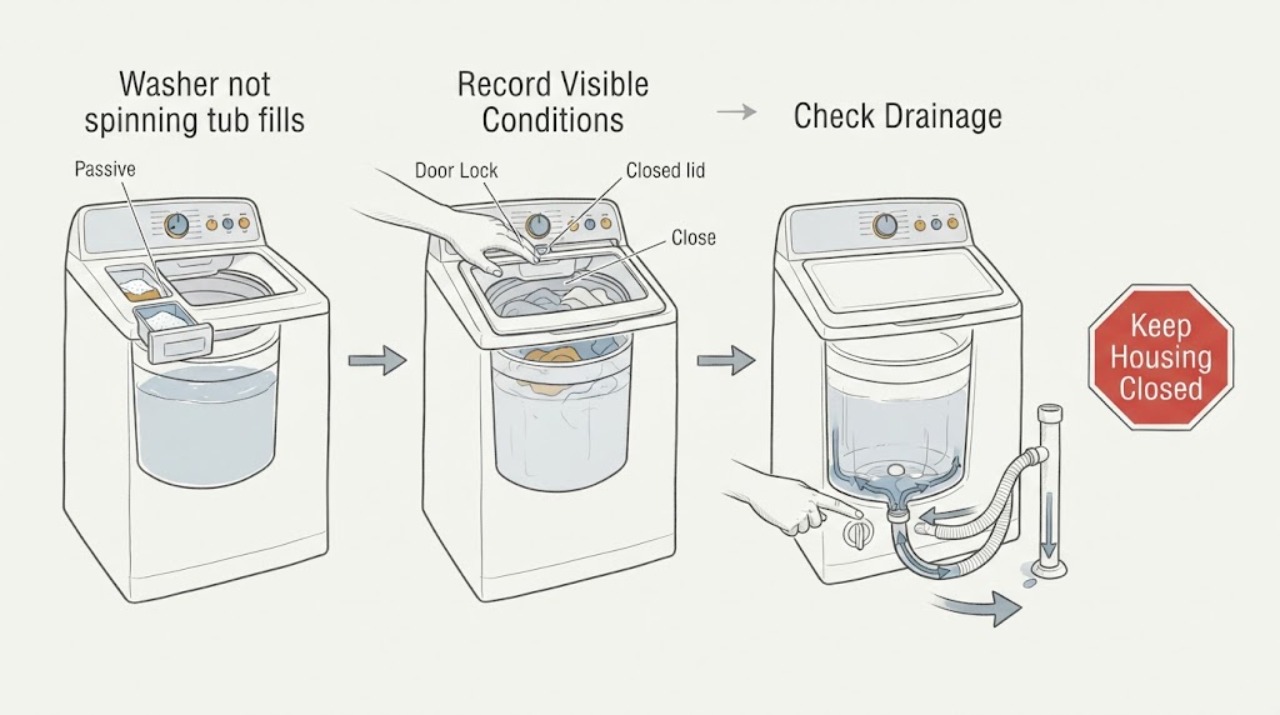
When a washer fills and drains but the tub does not spin, first confirm that the selected cycle is supposed to include a spin and that the lid or door is fully closed and latched. The washer may also refuse to spin when the load is unbalanced, the drain hose or filter restricts discharge, excess suds extend the cycle, or a pause or control condition remains active. Observe whether the tub drains completely, whether the drain pump runs, whether the basket attempts to rebalance, and whether the washer spins on a model-approved Spin or Rinse and Spin cycle. Check the visible drain hose for kinks, crushing, incorrect placement, or a household drain backup, and use only the detergent and amount specified for the model. If it drains but never spins after these safe checks, the same fault repeats, the door or lid will not lock, water remains, or there is a leak, burning smell, unusual noise, or severe vibration, stop using the washer and arrange qualified appliance service.
Work through in order
Diagnostic checks
Use only checks that match the exact appliance or system and its official guide.
-
Check 1
Note the selected course and options, whether Pause is active, the displayed code or indicator, and whether the tub is empty, partly full, or visibly draining before deciding that the spin step has failed.
Expected result: Record whether the course is wash-only or soak, whether the display says complete or remains at one stage, whether water remains, and whether the basket moves at all.
Next step: Select a model-approved Spin or Rinse and Spin course only after the washer is safely stopped and the manual says the course is appropriate; otherwise follow the matching drain or lock check.
Stop if: Do not open a moving or locked lid or door, reach into the tub, or continue when there is leaking, smoke, burning odor, or severe vibration.
Why this matters
Why: A course that does not include spin or a paused control can explain the symptom without a failed part. Water remaining or a stalled display points toward a drain, lock, suds, balance, or control condition that must be separated next.
-
Check 2
With the basket stopped, confirm that the lid or door is fully closed and that no visible clothing, lint, or debris prevents the latch from engaging; verify that Pause or Add Item is not active.
Expected result: Note whether the lock indicator engages, the washer resumes after normal closure or Start/Pause input, a latch warning remains, or the lid or door appears damaged or misaligned.
Next step: Clear only visible ordinary-access debris as the model guide permits. If the lock does not engage or the cycle still will not advance, leave the washer stopped and arrange service.
Stop if: Do not bypass, tape, hold, or force a lid or door lock, and do not reach into a moving basket.
Why this matters
Why: The washer may block spin until its safety gate is satisfied. A persistent latch condition or a washer that remains paused after normal controls respond indicates a lock or control problem rather than a load problem.
-
Check 3
From a dry, safe position, inspect the visible drain hose from the washer to the standpipe or sink for crushing, kinks, blockage, incorrect placement, or a loose end, and check for water backing up; inspect a pump filter only if the exact model manual provides a safe user procedure and the residual water can be contained.
Expected result: Record whether water drains slowly or not at all, the hose is pinched or submerged, the standpipe backs up, a filter area contains debris, or the hose and household drain appear clear while the tub still holds water.
Next step: Correct only an obvious accessible hose placement issue as the manual allows; use the model's water-containment procedure for a user-serviceable filter, and call a plumber for household drain backup or appliance service for an internal fault.
Stop if: Do not open a filter or pump cap with hot or uncontrolled water, remove panels, tip the washer, or repeatedly run drain cycles into an overflow.
Why this matters
Why: A restricted or incorrectly installed drain path can prevent the washer from reaching spin. A clogged filter can retain water. A clear drain path with persistent water or no spin shifts suspicion toward a pump, sensor, lock, motor, or control fault.
-
Check 4
When the washer is stopped and the lid or door can be opened normally, look at the load distribution and identify a single heavy item, bulky item, very small load, or basket movement that repeatedly attempts to rebalance.
Expected result: Record whether the clothes are bunched on one side, the basket shakes or pauses during spin, the washer lowers its spin speed, or a normally distributed load still drains but does not rotate.
Next step: Redistribute or adjust the load only as the model guide permits and try one appropriate cycle. If severe vibration occurs or a balanced load still fails to spin, stop and arrange service.
Stop if: Do not reach into a moving basket, hold the lid or door open during spin, move the appliance alone, or continue with violent shaking.
Why this matters
Why: An uneven, bulky, or very small load can delay, reduce, or stop spin to limit vibration. A balanced load with normal draining that still never rotates makes a mechanical, sensor, lock, or control problem more likely.
-
Check 5
Review whether the load used the detergent type, concentration, and amount specified for the washer, and look for unusually heavy suds or a suds-related indicator after the machine is safely stopped.
Expected result: Record persistent foam, excess detergent, a non-HE product, residue on the clothes, or a cycle that adds time and water but never completes spin.
Next step: Use only the specified detergent and amount and follow the model's cleaning or empty-cycle guidance. Request service if the washer still will not spin after the suds condition is gone.
Stop if: Do not add more detergent, mix cleaners, or keep running full loads to force a suds-affected washer to spin.
Why this matters
Why: Excess suds can interfere with rinsing and draining, leaving the washer unable to complete spin even though it filled and pumped out water. Correct detergent use can prevent recurrence but does not prove the timer or motor is sound.
-
Check 6
After the drain, lock, cycle, load, and detergent checks are normal, run one model-approved empty or lightly loaded Spin or Rinse and Spin test from a safe position and record whether the tub drains and accelerates normally.
Expected result: Record drains but does not spin, does not drain, hums without rotation, spins only after redistribution, shows an error, or completes the test normally but fails again with laundry.
Next step: Stop testing and arrange qualified appliance repair for a repeated no-spin result, a persistent error, or any internal sound or smell. Give the technician the stage, water state, and test result.
Stop if: Do not open panels, test live wiring, bypass a lid or door lock, or continue a cycle with leaking, smoke, burning odor, or severe vibration.
Why this matters
Why: Drains but never spins after safe external checks points toward a lock, motor, actuator, sensor, or control issue. A normal empty test with a repeated loaded failure favors load distribution, cycle selection, or floor and leveling conditions.
Use your observations
Decision map
Find the observation that best matches what you see, then follow the next safe action.
-
PATH 01Safety boundary
What you see
The selected course is wash-only or soak, Pause or Add Item is active, or the washer spins normally when an appropriate Spin or Rinse and Spin course is selected.
Do this next
Use the cycle intended for the load and follow the model's Start/Pause instructions. Recheck the machine only if the no-spin symptom returns on a course that includes spin.
Why this path and its safety boundary
Why it matters: The original course or control state explains why the tub filled and drained without a spin step; a failed motor or timer is less likely.
Safety stop: Do not force an unavailable spin option or open a locked lid or door.
-
PATH 02Safety boundary
What you see
Water remains in the tub, drainage is slow, the drain hose is kinked or incorrectly placed, the filter is blocked, or the household drain backs up.
Do this next
Correct an accessible hose issue or use the exact model filter procedure with water contained; call a plumber for a household drain problem and appliance service if the drain path remains restricted.
Why this path and its safety boundary
Why it matters: A drain restriction or hose installation problem is more likely than a primary spin failure because the washer generally must drain before it can spin.
Safety stop: Do not remove a filter with uncontrolled or hot water, open panels, or keep operating into a drain overflow.
-
PATH 03Safety boundary
What you see
The washer drains, then repeatedly tumbles or pauses while the load is bunched, bulky, very small, or accompanied by strong vibration; a redistributed load spins normally.
Do this next
Use the model's load-size and redistribution guidance and avoid repeating the same problematic load. Arrange service if the machine shakes severely or a balanced load still will not spin.
Why this path and its safety boundary
Why it matters: Load balance is more likely than a failed spin component. The control may reduce or delay spin to limit unnecessary vibration.
Safety stop: Do not reach into a moving basket, hold the lid or door open, or continue severe shaking.
-
PATH 04Safety boundary
What you see
The washer has persistent foam, detergent residue, a suds-related indicator, or adds time and water while clothes remain wet and spin does not complete.
Do this next
Use the specified low-sudsing detergent and amount and follow the model cleaning guidance. If the washer still fails with a correctly dosed load, arrange service.
Why this path and its safety boundary
Why it matters: Excess or incorrect detergent can interfere with rinsing and draining, making a no-spin result a suds-management condition rather than a defective timer.
Safety stop: Do not add detergent to compensate, mix cleaners, or run repeated full loads while the suds condition persists.
-
PATH 05Safety boundary
What you see
The washer drains normally, the course includes spin, the lid or door locks, the load is balanced, detergent is correct, and the tub still never spins or repeatedly shows a fault.
Do this next
Leave the washer out of service and arrange qualified appliance diagnosis with the model, selected course, display code, water state, and the results of the safe checks.
Why this path and its safety boundary
Why it matters: A lock sensor, motor, actuator, pump, belt, or control problem becomes more likely, but the failed component cannot be identified from the symptom alone.
Safety stop: Do not replace a motor, belt, pump, lock, or control speculatively, open panels, or test energized wiring.
Helpful context
Understand the symptom
Filling and draining does not guarantee that spin conditions were met
A washer can fill and pump out water yet stop before spin because the selected course ends at wash or soak, the lid or door gate is not satisfied, or the control is waiting for a safe balance. If the drain completes but the basket never accelerates, separate a load or cycle condition from a mechanical or control fault by observing a model-approved spin-only or rinse-and-spin course.
Check the drain path before blaming the motor
The drain hose should run smoothly to the standpipe or laundry sink, without crushing, blockage, an incorrect loop, or an airtight connection that causes siphoning. A clogged filter can retain water and stop the machine from reaching spin. Filter access differs by model and can release substantial or hot water, so use the exact manual procedure only when the washer is safely stopped and the water can be contained.
Load balance and detergent can change the spin decision
Large, bulky, or single-item loads can repeatedly redistribute and reduce or delay spin to limit vibration. Too much or incorrect detergent can create suds that interfere with rinsing and draining. Correct those conditions once according to the model instructions; if a balanced load with the specified detergent still drains but never spins, professional diagnosis is more useful than repeated cycles.
Safety boundary
Stop conditions
- Do not reach into a moving basket, bypass a lid or door lock, or force open a locked washer.
- Do not place hands in standing or hot water, open a filter or pump cap without a model-approved containment procedure, or tip or move the washer alone.
- Stop for leaking, smoke, burning odor, unusual electrical noise, severe vibration, or a damaged cord or outlet; leave the washer out of service and seek qualified help.
- Do not remove panels, disconnect wiring, test energized components, or replace a motor, pump, belt, lock, or control based only on a no-spin symptom.
- Do not keep repeating cycles when the washer cannot drain, the household drain backs up, an error returns, or the balanced correctly dosed load still will not spin.
Only after diagnosis
Potential parts
- lid or door lock assembly
Consider this only when the exact model shows a persistent lock fault after normal closure and visible obstruction checks and a technician confirms the lock path.
Confirm the exact washer model and manufacturer's fit information before ordering; never bypass the safety lock. - drain pump or drain filter
Consider this only when a blocked or failed pump path is confirmed after the household drain and visible hose are cleared and the model-specific filter procedure is followed.
Confirm the exact model and whether the filter or pump is user-serviceable before ordering or attempting repair. - drive belt or spin actuator
Consider this only when the washer drains, the load is balanced, the lock is satisfied, and qualified diagnosis confirms a drive or actuator fault.
Confirm the exact model, revision, and diagnostic result before ordering; do not open the cabinet as an ordinary-user check. - motor or electronic control
Consider this only after safe external checks pass and a technician confirms the motor, sensor, or control is responsible for the repeated no-spin result.
Confirm the exact model and technician diagnosis before ordering; do not assume a control or motor is interchangeable.
When checks do not resolve it
Need a professional?
Arrange qualified appliance repair when the washer drains but never spins on a model-approved spin course after the lid or door, drain, load, detergent, and cycle checks; when a lock will not engage or release normally; or when the same no-spin fault repeats. Stop immediately for leaking, smoke, burning odor, severe vibration, unusual electrical symptoms, standing or hot water that cannot be safely contained, or any condition requiring panel access or a lock bypass. Use plumbing service when the household drain backs up independently of the washer.
Common questions
FAQ
Why does my washer fill and drain but not spin?
Confirm the selected course includes spin and that Pause is not active. Then check whether water drains completely, the lid or door locks, the load is balanced, and excess suds are present. A repeated no-spin result after these checks needs qualified diagnosis.
Can a drain problem prevent a washer from spinning?
Yes. Washers generally drain before spin. A kinked or blocked hose, incorrect hose placement, clogged filter, or household drain backup can leave water in the tub or keep the washer from reaching spin.
Can a soak or wash-only cycle leave the tub without spinning?
Yes. Some courses intentionally stop after washing or soaking, and Pause or Add Item can also hold the tub. Check the model guide and select an appropriate Spin or Rinse and Spin course when needed.
Why does my washer spin an empty tub but not a load?
A bulky, single, very small, or bunched load can become unbalanced and cause reduced or incomplete spin. Redistribute the load as the model guide allows; severe vibration or repeat failure with a balanced load needs service.
When should a no-spin washer be serviced?
Arrange service when it drains but never spins on an appropriate course after safe checks, when the lock will not engage, water remains, the same error repeats, or the fault requires cabinet or wiring access. Stop immediately for leaks, smoke, burning odor, severe vibration, or electrical symptoms.
Read the exact guide
Official sources
- Samsung washing machine does not spin at allSamsung Support · Manufacturer guidance for pump-filter checks on front-load models, drain hose routing and blockage, and requesting service when a calibration attempt still does not spin; exact model steps vary.
- LG Washer - Why Isn't My Washer DrainingLG USA Support · Manufacturer guidance for drain-filter obstruction, residual water, hot-water and spill cautions, and model-specific filter reassembly.
- [LG washing machine washing] The tub does not spin after water is supplied.LG USA Support · Manufacturer guidance for Pause or Add Item, Soak or wash-only course selection, and escalation when the tub still does not spin.
- LG Washer - Troubleshooting Washer Does Not Drain or Spin (Clothes Too Wet)LG USA Support · Manufacturer guidance for drain-before-spin behavior, drain hose installation, detergent and suds, load balance, drain filtering, and spin-test outcomes; exact steps vary by model.
Community feedback
Share a repair observation
Share a plain-text repair observation. Accepted observations are published automatically; this page may take a moment to update.