
On this page
Start here
Quick answer
Start with the non-invasive causes: an unbalanced or bulky load, a low/no-spin selection, a door or lid that is not fully latched, or water that has not drained. Pause safely, redistribute a small load only when the controls permit it, and check the visible drain hose for a kink. If the tub remains full, the washer makes a new grinding or burning sound, the lid/door will not lock, or the problem returns with a normal load, unplug the appliance before any access and request professional repair. Do not remove panels or reach into a moving tub.
Before you begin
Safety first
- Request diagnosis and repair by a qualified appliance professional. This self-check does not include lock bypass, panel removal, belt/coupling/motor work, pump disassembly, or live electrical testing.
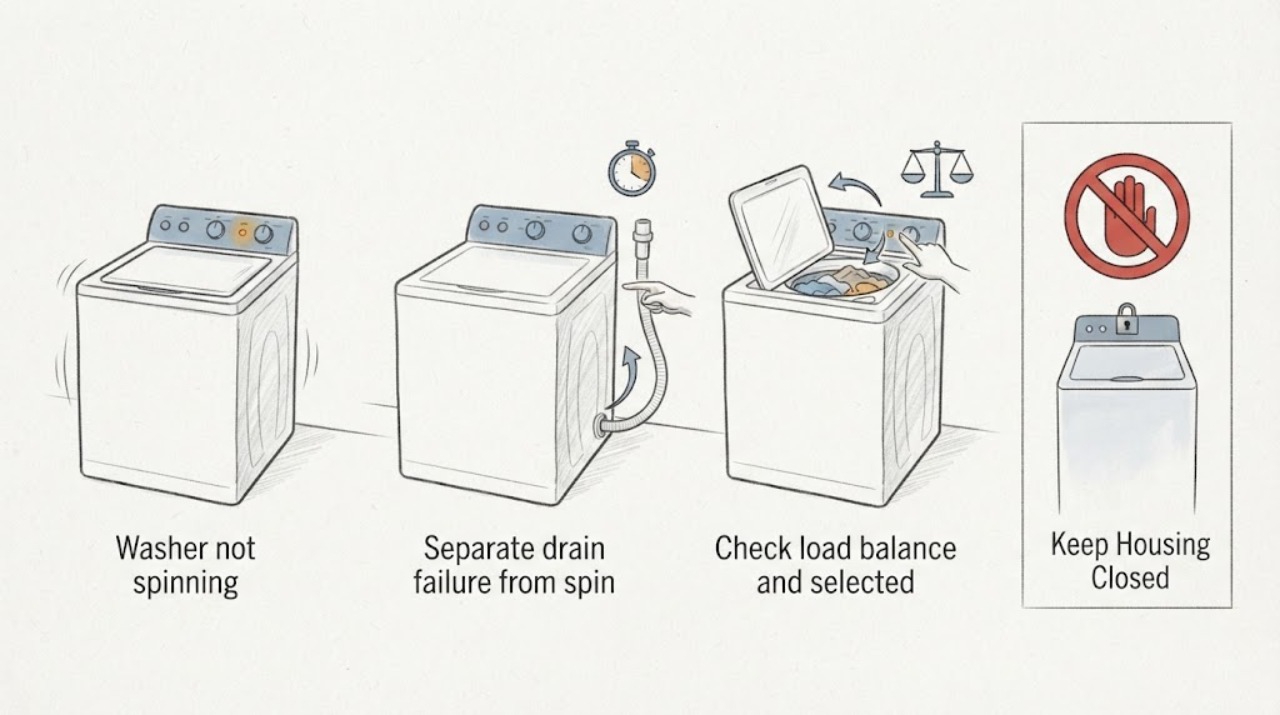
Work through in order
Diagnostic checks
Use only checks that match the exact appliance or system and its official guide.
-
Separate drain failure from spin failure
With the washer stopped, note whether water is standing in the tub, whether clothes are merely damp or soaking, and whether the cycle displayed a code. Do not open a lid or door against its lock and do not reach into the tub.
Expected result: Water remains, the tub is empty but clothes are wet, or the washer stopped before either drain or spin.
Next step: Record the result and continue to the control/load checks. If water remains and the visible hose is kinked, correct only that external condition; request service if the tub will not drain.
Stop if: Stop if water is leaking, the door/lid is locked with water inside, or any check requires opening a panel or bypassing the lock.
Why this matters
Why: Standing water makes drain hose, pump, or drain-control checks more relevant; an empty tub shifts attention to cycle selection, balance, lock, or drive. A code is model-specific evidence, not permission to bypass a safety lock.
-
Check load balance and selected spin
When the controls allow a safe pause, look at the load and selected cycle. Note a single blanket or bulky item, a very small uneven load, overloading, or a Low/No Spin or delicate setting. Redistribute a manageable load only with the tub stopped and the door/lid safely open.
Expected result: The load is uneven/bulky, the selected cycle limits spin, or the load and cycle are ordinary for the machine.
Next step: Use the model-appropriate cycle and a balanced load for one controlled retest. If it still will not spin, stop testing and arrange service rather than forcing the tub.
Stop if: Stop if the tub is moving, the door/lid will not unlock normally, the machine shakes violently, or redistributing the load would require reaching into water or around a moving part.
Why this matters
Why: An imbalance can cause shaking, reduced speed, or a protective stop; low/no-spin settings can leave clothes wet by design. If a normal load and appropriate spin still fail, a mechanical, lock, drain, or control fault becomes more likely.
-
Inspect the visible drain path
With the washer off, inspect only the exposed drain hose and its visible connection for a sharp kink, collapse, or obvious displacement. Do not pull the appliance out over a wet floor or remove the pump/filter cover unless the model instructions clearly identify it as user-accessible and safe.
Expected result: The hose is kinked/displaced, the visible path looks clear but water remains, or the drain path cannot be safely reached.
Next step: Correct only an obvious external kink without disturbing connections, then use the model’s prescribed drain/spin test. If water remains or the path is inaccessible, unplug and call an appliance professional.
Stop if: Stop if there is a leak, standing water near the power connection, a stuck cover, an internal blockage, or a need to tip or dismantle the washer.
Why this matters
Why: A kink or installation problem can prevent draining and therefore prevent a spin. A clear visible hose with standing water points to an internal blockage, pump, control, or installation issue that needs service.
-
Record lock, level, and power clues
Check that the door or lid closes and latches normally, the washer sits steadily without rocking, and the display has power. Note whether the issue followed a power interruption or whether the lock light/code behaves differently from normal. Do not bypass the lock or open electrical covers.
Expected result: The lock is not engaging, the washer rocks, power is absent/intermittent, or these external conditions appear normal.
Next step: Use only the owner’s instructions for leveling or a normal control reset if the appliance is dry and safe. If the lock, power, or mechanical stability remains abnormal, request service.
Stop if: Stop if the cord/outlet is hot or damaged, the lock can be bypassed only with tools, the washer rocks severely, or a reset is followed by burning, grinding, or leakage.
Why this matters
Why: A safety lock, unstable cabinet, or interrupted cycle can prevent or reduce spin. Normal external clues do not rule out a belt, coupling, motor, bearing, pump, or control fault.
-
Prepare the repair handoff
Give the technician the washer type and model from its rating label, cycle selected, load type, whether it filled/agitated/drained, standing water, codes, lock behavior, hose condition, noise, vibration, and what changed after redistributing the load.
Expected result: The record distinguishes a repeatable failure from a one-off unbalanced load and identifies whether water remains.
Next step: Request appliance repair when a normal load still will not spin, the fault returns, or any internal access is required. Leave the washer unplugged if there is a safety or electrical symptom.
Stop if: Stop self-diagnosis if the machine leaks, smells burnt, grinds, trips power, or requires panel removal or live electrical testing.
Why this matters
Why: Those observations help target the drain system, lock, drive belt/coupling, motor, suspension, or control without guessing at a replacement part.
Use your observations
Decision map
Find the observation that best matches what you see, then follow the next safe action.
-
PATH 01Safety boundary
What you see
Water remains in the tub or the washer cannot complete drain.
Do this next
Check only an obvious external drain-hose kink; if water remains, unplug when safe and request appliance service.
Why this path and its safety boundary
Safety stop: Do not force the locked door/lid, tip the washer, or open a pump/filter area without model-specific safe instructions.
-
PATH 02Safety boundary
What you see
The load is bulky/uneven or Low/No Spin/delicate was selected.
Do this next
Redistribute a safe, stopped load and use the model-appropriate cycle for one controlled retest; call if a normal load still fails.
Why this path and its safety boundary
Safety stop: Do not reach into a moving tub or repeatedly run a violently shaking washer.
-
PATH 03Safety boundary
What you see
The door/lid does not latch, power is missing/intermittent, or a lock/power code appears.
Do this next
Use the owner’s instructions for a normal control check; request service if the lock or power fault persists.
Why this path and its safety boundary
Safety stop: Do not bypass a lid/door lock or open electrical covers.
-
PATH 04Safety boundary
What you see
A normal load, appropriate cycle, clear visible hose, and normal latch still produce no spin.
Do this next
Unplug the washer before access and request professional diagnosis of the belt, coupling, motor, suspension, pump, and controls.
Why this path and its safety boundary
Safety stop: Do not remove panels, handle wiring, or order a part from symptoms alone.
-
PATH 05Safety boundary
What you see
Grinding, burning odor, leakage, severe vibration, or a hot cord/outlet accompanies the failure.
Do this next
Stop using the washer, disconnect power only if safe, and request prompt appliance service.
Why this path and its safety boundary
Safety stop: Do not run another test cycle.
Helpful context
Understand the symptom
Check whether it failed to drain or to spin
Wet clothes at the end of a cycle do not prove that the drive system failed. Water left in the tub points first toward a drain path or drain-control issue; an empty tub with no rotation points toward the selected cycle, door/lid lock, load balance, motor, belt, coupling, or controls. Never reach into the washer while it is moving.
Use only controls and user-accessible checks described for the model. If a panel, pump, belt, wiring, lock, or motor must be reached, unplug the washer and stop at that point for a qualified appliance technician. Keep water away from electrical parts and do not repeatedly run a washer that is making a new severe noise.
Use the cycle result as evidence
Record whether the washer filled, agitated/tumbled, drained, and reached spin, plus any displayed code and whether the load was a single bulky item. A normal small mixed load that still will not spin is more useful evidence for service than repeated tests with an overloaded or uneven load.
Safety boundary
Stop conditions
- Do not reach into a moving tub, bypass a lid/door lock, or force a locked door with water inside.
- Stop for burning odor, grinding, smoke, leakage, severe vibration, a hot/damaged cord or outlet, or repeated power trips; unplug only when safe and request service.
- Do not remove panels, handle belts/motors/couplings/wiring, tip the appliance, or perform live electrical testing without qualified repair support.
- Do not keep running a washer that fails with a normal load or makes a new severe noise.
Only after diagnosis
Potential parts
- washer lid lock
Relevant only if a technician confirms a lid-lock fault and identifies the exact washer configuration.
Match the rating-label model and connector; never bypass the safety lock. - washer drive belt
A belt is conditional on professional inspection of the drive system and model-specific belt routing/tension.
Match the full model identification and do not open the cabinet for a visual guess. - washer motor coupling
A coupling applies only to washer designs that use one and after a technician confirms drive symptoms.
Confirm the appliance design and exact model before sourcing; replacement requires unplugged internal access.
When checks do not resolve it
Need a professional?
Request appliance repair when a normal load and appropriate cycle still will not spin, water remains after an external hose check, the door/lid lock or power is abnormal, or the fault returns. Use prompt service for burning, grinding, leaks, severe vibration, or electrical symptoms.
Safety scope: Request diagnosis and repair by a qualified appliance professional. This self-check does not include lock bypass, panel removal, belt/coupling/motor work, pump disassembly, or live electrical testing.
Common questions
FAQ
Why are my clothes wet if the washer completed the cycle?
An unbalanced load, Low/No Spin selection, bulky item, or drain problem can leave clothes wet. Check the cycle result and visible hose safely; if a normal load still fails, request service.
Can I open the washer lid while it is not spinning?
Only use the normal control and latch behavior for the model. Never force or bypass a lock, and never reach into a moving tub or one containing standing water.
Should I replace the belt or lid lock myself?
Do not order or replace a part from symptoms alone. A belt, lock, coupling, motor, pump, or control can produce similar results; unplugged internal diagnosis should be handled by a qualified technician.
Could one blanket stop the spin cycle?
Yes, bulky or uneven loads can trigger reduced speed or a protective stop. Redistribute only when the tub is stopped and the lid/door opens normally; call if a normal balanced load still will not spin.
Read the exact guide
Official sources
- Not Spinning - WasherWhirlpool · Supports checking imbalance, wet clothes, spin selection, bulky loads, standing water, leveling, power interruption, and escalating persistent faults to service.
- What to do when Samsung washing machine does not spinSamsung · Supports model-aware checks for balance, drainage, and operating conditions before professional escalation; exact behavior varies by model.
Community feedback
Share a repair observation
Share a plain-text repair observation. Accepted observations are published automatically; this page may take a moment to update.