
On this page
Start here
Quick answer
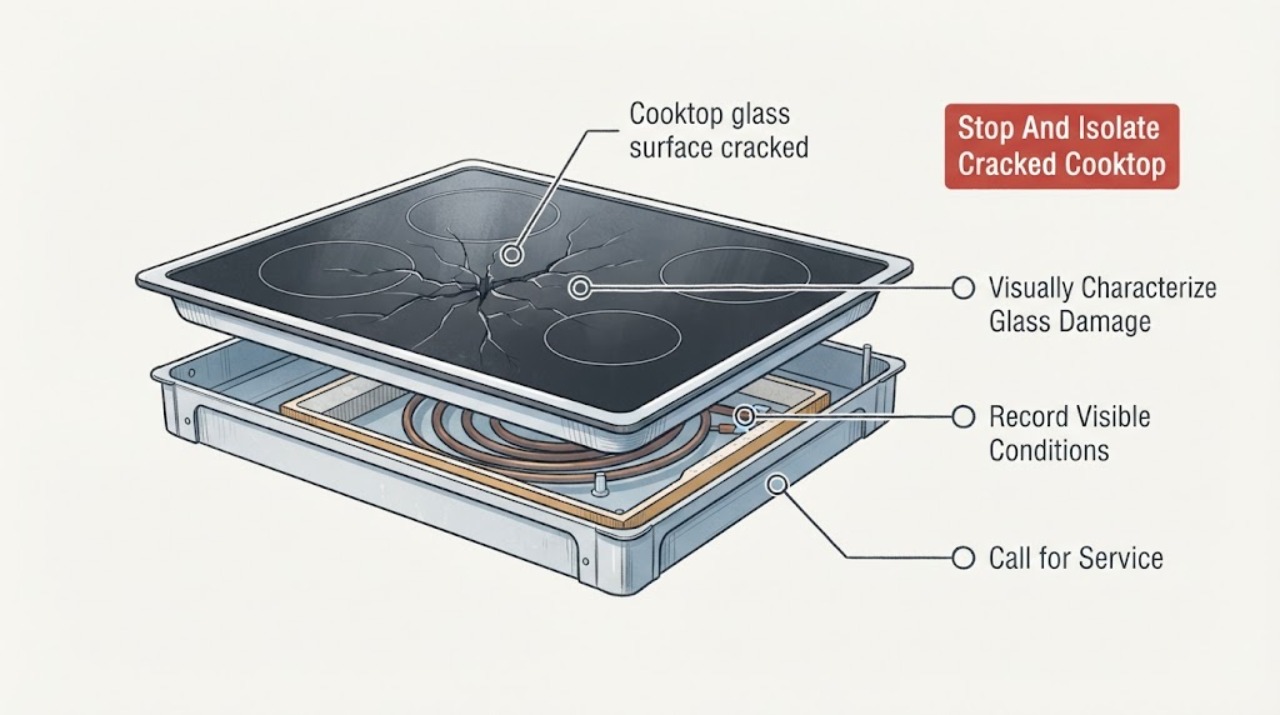
Treat a visible crack or break in a Whirlpool ceramic-glass cooktop as a stop-use condition, even if the burners still work. Turn every control off and keep people away from the surface; do not touch, clean, tape, seal, or test the crack while the glass or cookware may be hot. Whirlpool safety guidance says not to cook on a broken ceramic cooktop because cleaning solutions and spills can penetrate the break and create an electrical-shock risk, and it directs the owner to a qualified technician. From a safe position, document the crack, model and serial information, cooktop type, and any impact or spill, then use the exact manual or arrange qualified appliance service. Do not remove the glass, probe beneath it, or order a replacement surface until the exact model is confirmed.
Before you begin
Safety first
- Owner checks end at safe visual observation, model identification from accessible information, documentation, and service scheduling. A qualified professional must handle glass or frame removal, electrical or gas isolation, live or de-energized testing, elements, sensors, controls, seals, ignition, and replacement of the glass or top assembly.
Work through in order
Diagnostic checks
Use only checks that match the exact appliance or system and its official guide.
-
Check 1
From a safe position, turn all cooktop controls off if they respond normally and keep children, pets, cookware, and flammables away. Do not touch the glass or move a hot pan across it. If the appliance is still heating, smoking, sparking, or will not turn off, leave the area as needed and seek urgent professional or emergency help; do not try to force a control or lift the surface.
Expected result: The cooktop is off and cooling with no smoke, sparks, odor, uncontrolled heat, or exposed conductors; or an active hazard is present.
Next step: For an active hazard, keep clear and contact emergency help from a safe location when appropriate; otherwise leave the cooktop unused and continue only with safe visual documentation after it is cool. Do not restore power or heat to test it.
Stop if: Stop immediately for smoke, fire, sparks, crackling, burning odor, abnormal heat, an element that will not stop, exposed wiring, or any need to touch a hot surface or pan.
Why this matters
Why: A quiet, cooling appliance can be documented from a distance. Smoke, arcing, a burning smell, uncontrolled heating, or exposed wiring is an immediate fire, burn, or shock concern, and the crack is not an owner troubleshooting problem.
-
Check 2
When the cooktop is fully cool and from a safe standing position, photograph the surface without pressing on it. Note whether the line is a scratch or a through-crack, whether it branches, reaches an edge or control area, has chips or loose pieces, or appears to have separated layers. Do not run a finger, paper towel, scraper, or utensil over the line to feel its depth.
Expected result: The mark is clearly superficial with intact glass; a crack crosses or branches through the cooking area; the edge is chipped or loose; or the damage cannot be classified safely.
Next step: Treat any through-crack, chip, loose fragment, or uncertain mark as a stop-use condition and arrange qualified inspection. If a technician confirms it is only a scratch, follow that exact model's cool-surface care instructions; never resume cooking merely because a mark looks small.
Stop if: Stop if the glass moves, flakes, has a sharp edge, is hot, or would need pressure, cleaning, scraping, disassembly, or a test pan to investigate.
Why this matters
Why: A superficial mark may be a care issue, but a through-crack, branching line, chip, loose fragment, or uncertain damage should be treated as a broken surface. Visual appearance alone cannot prove that the underlying element, seal, control, or frame is undamaged.
-
Check 3
Record the complete Whirlpool model and serial information from paperwork, a safely visible label, or the appliance documentation. Also note whether this is an electric radiant, induction, or gas cooktop, a range with an integrated top, and which zone or control area is near the damage. Do not move, lift, tilt, or open the appliance to find the label.
Expected result: The model and type are clear; only a partial model is available; or the construction and cooking technology are uncertain.
Next step: Use Whirlpool's model lookup and the exact owner's manual, or give the technician the photos and partial identification for assistance. Keep the appliance out of service while identity or glass compatibility is uncertain.
Stop if: Stop if identification requires removing trim, pulling a built-in appliance, reaching under the glass, or entering an electrical or gas compartment.
Why this matters
Why: Whirlpool manuals and replacement assemblies are model-specific. The same-looking glass may be part of a standalone cooktop, range, induction assembly, or gas appliance, so an approximate model or generic part cannot establish fit or safe repair steps.
-
Check 4
Write down what happened before the crack was noticed: a dropped or dragged object, a heavy pan, a hot lid, a spill or cleaning event, a rapid temperature change, installation or countertop movement, or no known event. Photograph nearby impact marks and any residue only from a safe distance; do not clean over the crack or pour liquid to reveal it.
Expected result: There is a visible impact or object history; the crack appeared after heating or a temperature change; there was a spill or cleaning event; or no cause is known.
Next step: Include the timeline and photos in the service request and ask the technician to inspect the top, frame, seals, elements, controls, and surrounding installation. Do not make a warranty or part decision from the suspected cause alone.
Stop if: Stop if the surface is warm, fragments are loose, liquid has entered the break, the appliance is energized with exposed parts, or documentation would require handling damaged material.
Why this matters
Why: Whirlpool identifies heavy or hard objects and certain hot-lid or temperature conditions as possible causes of ceramic-glass damage, but context does not prove the cause or determine warranty coverage. Unknown origin still requires the same stop-use boundary.
-
Check 5
Compare the exact model's owner's manual with the observed damage only after the surface is safe and the appliance remains unused. Look for the model's cracked-glass safety direction, cooktop type, service instructions, and model/serial location. Do not follow a generic glass-repair video, adhesive repair, glass-polishing method, or instructions for a different Whirlpool model.
Expected result: The manual explicitly addresses a broken surface; it does not address the exact damage; or the available manual is for a different model or market.
Next step: Follow only the exact model's safety and service boundary, and arrange qualified Whirlpool appliance service for any confirmed crack. If the manual is unavailable or mismatched, use Whirlpool support with the model information rather than improvising.
Stop if: Stop any owner repair attempt if it involves glass removal, electrical or gas disconnection, panel access, sharp fragments, structural support, or an instruction not written for the exact model.
Why this matters
Why: Whirlpool's manuals and Product Help pages are model and product-category resources. A different manual cannot establish that a crack is safe, that a top can be replaced by an owner, or that a specific glass assembly fits.
-
Check 6
Prepare a service handoff containing the model and serial information, photos taken while cool, exact crack location and pattern, cooktop type, affected zones, event timeline, whether any spill or impact occurred, and whether controls and heat were turned off. Tell the technician that the appliance has not been operated after the crack was found; do not reconnect or test it for their benefit.
Expected result: The damage is confirmed or still uncertain; the appliance is safely off; or a hazard remains or the cooktop cannot be left safely isolated.
Next step: Keep the cooktop unused and arrange qualified Whirlpool appliance service. If the appliance cannot be safely left off, there is smoke, fire, arcing, a gas odor, or uncontrolled heat, leave the area as appropriate and contact emergency or qualified electrical/gas help from a safe location.
Stop if: End owner troubleshooting when any glass, frame, element, control, wiring, gas, or installation inspection is required; the repair is not a clean-and-reset task.
Why this matters
Why: A complete visual and event record helps the technician choose the correct top assembly and inspect related parts without asking the owner to reproduce a hazardous condition. A remaining hazard changes this from routine repair scheduling to urgent safety response.
Use your observations
Decision map
Find the observation that best matches what you see, then follow the next safe action.
-
PATH 01Next step
What you see
A visible line crosses the ceramic glass, branches, reaches an edge or control area, has chips or loose fragments, or cannot be distinguished from a through-crack without touching it.
Do this next
Leave the cooktop unused, keep people away, document it while cool, and arrange qualified Whirlpool appliance service. Do not tape, seal, polish, clean, or test the surface.
Why this path and its safety boundary
Why it matters: The surface should be treated as broken. Continued cooking could expose the break to heat and spills, and the visible damage does not show whether the supporting assembly or electrical parts are affected.
-
PATH 02Next step
What you see
The mark looks like a hairline scratch or chip, but its depth or continuity cannot be verified safely, especially near a burner, control, edge, or seal.
Do this next
Do not rub or scrape it to decide. Photograph it when cool and have the exact model assessed by qualified service before returning the cooktop to use.
Why this path and its safety boundary
Why it matters: Uncertainty is a safety-relevant result, not evidence that cooking is acceptable. A scratch may be cosmetic, while a crack can spread or allow liquid through the surface.
-
PATH 03Next step
What you see
The crack follows a dropped or heavy object, a hot lid or pan, a spill, cleaning, installation movement, or a sudden temperature change; or no cause is known.
Do this next
Give the timeline and photos to service and leave the appliance off. Do not retry the burner to determine whether the event caused hidden damage or make a coverage decision from the suspected cause.
Why this path and its safety boundary
Why it matters: Whirlpool documents heavy or hard objects and some hot-lid/temperature conditions as possible ceramic-glass damage mechanisms, but the event history cannot establish fault, warranty, or which internal parts are safe.
-
PATH 04Next step
What you see
The top is an induction or electric radiant surface, a gas glass cooktop, or a range-integrated cooktop, and the crack is near a zone, control, edge, vent, burner opening, or seal.
Do this next
Use the exact model and serial information to request model-specific service. Do not remove the top or attempt to isolate only one zone; keep the complete appliance out of service.
Why this path and its safety boundary
Why it matters: Cooktop type and location can change which electrical, heating, ignition, gas, control, seal, or structural parts must be inspected. A generic glass panel or a part for a similar Whirlpool appliance may not fit or be safe.
-
PATH 05Next step
What you see
The cracked cooktop has smoke, sparks, crackling, a burning or gas odor, abnormal or uncontrolled heat, exposed wiring, liquid near electrical parts, or a control that will not shut off.
Do this next
Keep clear and leave for fire, active arcing, or a gas emergency; contact emergency help from a safe location. Otherwise keep the appliance off and obtain urgent qualified appliance, electrical, or gas service without restarting it.
Why this path and its safety boundary
Why it matters: The immediate concern is fire, shock, gas, or burn injury; identifying the crack or ordering a part is secondary.
Helpful context
Understand the symptom
A crack is different from a cosmetic mark
Do not assume a line is only a scratch because the cooktop still heats. A true crack can spread with heat or allow liquid into the appliance. Without rubbing or scraping, look from several safe angles for a line that continues through the glass, a chip, a raised edge, branching, or a loose fragment. If you cannot tell whether the surface is cracked, treat it as damaged until a qualified technician assesses it.
Stop first; diagnosis is secondary
Turn the controls off and keep the cooktop out of service. Whirlpool's safety instructions warn that a broken ceramic cooktop can let cleaning solutions or spill-overs reach areas where they create shock risk. Do not wipe across the break, pour water on it, use a cooktop scraper, cover it with adhesive, or operate another burner to see whether the damage matters.
The repair is model-specific
Whirlpool sells different electric, induction, and gas cooktop designs, and a range top may have a different assembly from a standalone cooktop. Record the complete model and serial information from a safely visible label or paperwork and use Whirlpool's manual lookup. A technician must determine whether the glass is a replaceable top assembly, whether elements, sensors, controls, seals, or the frame were also affected, and whether the appliance can be safely returned to service.
Safety boundary
Stop conditions
- Do not use a Whirlpool cooktop when the ceramic-glass surface is cracked, broken, chipped with loose material, or uncertain; Whirlpool warns that spills and cleaning solutions may penetrate a broken surface and create electrical-shock risk.
- Do not touch, press, scrape, polish, tape, seal, clean, or test the crack, and do not move cookware across it. Wait for safe cooling without assuming the surface is safe to touch.
- Do not open the cooktop, lift the glass, probe beneath it, disconnect hardwired wiring, alter gas connections, bypass controls, or replace a top assembly from a generic or similar-looking model.
- Stop and leave the area for smoke, fire, active sparking, crackling, a strong burning or gas odor, uncontrolled heating, exposed conductors, or a control that will not turn off; seek emergency help from a safe location as appropriate.
- Call qualified Whirlpool appliance service for any confirmed or uncertain crack, especially near a burner, control, edge, seal, or frame, or whenever diagnosis requires glass, electrical, heating, ignition, gas, or structural access.
Only after diagnosis
Potential parts
- Whirlpool ceramic-glass cooktop surface or top assembly
Consider this only after qualified service confirms a through-crack and identifies the complete model-specific surface or top assembly as the approved repair path.
Verify the exact model, appliance type, glass layout, mounting, trim, electrical or gas configuration, and manufacturer fit information; do not order by appearance or dimensions alone. - Whirlpool cooktop surface seal, gasket, or mounting trim
Consider this only when a technician finds that the crack repair requires a model-specific seal or trim and confirms that the surrounding installation was affected.
Confirm the exact model, seal location, material, heat rating, and installation instructions; do not use household caulk, adhesive, or an unverified substitute around the cooktop. - Whirlpool cooktop element, sensor, control, or ignition component
Consider a related component only if qualified inspection finds secondary damage or a pre-existing fault beyond the cracked glass; a crack alone does not identify an internal part.
Verify the exact model, position, electrical or gas configuration, connector, rating, and manufacturer service information; do not replace or bypass a component based only on the visible crack.
When checks do not resolve it
Need a professional?
Arrange qualified Whirlpool appliance service for every confirmed or uncertain crack in the glass surface. The appliance should remain unused while the technician identifies the exact model-specific top assembly and checks related elements, sensors, controls, seals, frame, wiring, ignition, or gas components. Treat smoke, sparks, burning or gas odor, abnormal heat, exposed wiring, liquid near electrical parts, or an element/control that will not turn off as urgent hazards; leave and contact emergency help from a safe location when appropriate.
Safety scope: Owner checks end at safe visual observation, model identification from accessible information, documentation, and service scheduling. A qualified professional must handle glass or frame removal, electrical or gas isolation, live or de-energized testing, elements, sensors, controls, seals, ignition, and replacement of the glass or top assembly.
Common questions
FAQ
Can I still use a Whirlpool cooktop with a small crack?
No. Treat any confirmed or uncertain crack as a stop-use condition. Whirlpool's safety guidance says not to cook on a broken ceramic cooktop because spills and cleaning solutions may penetrate the break and create an electrical-shock risk. Arrange qualified service.
What should I do first when the Whirlpool glass cooktop cracks?
Turn all controls off if they respond normally, keep clear of the surface and cookware, and let it cool without touching or moving items across the crack. Photograph it from a safe position, record the model, and arrange qualified inspection.
Can I cover a cracked glass cooktop with tape or a mat?
Do not tape, seal, cover, or polish a crack. A cover does not restore the glass or prevent heat and liquid from reaching the break, and it can hide damage from the technician. Keep the cooktop unused until inspected.
Is a hairline mark on a Whirlpool cooktop a scratch or a crack?
You cannot safely prove that by rubbing or scraping it. Look only from a safe distance when the surface is cool; if the depth is uncertain, or the line branches, reaches an edge, or has a chip, treat it as a crack and obtain model-specific service.
What can cause a Whirlpool ceramic-glass cooktop to crack?
Whirlpool identifies heavy or hard objects as one possible cause and warns about certain hot-lid and temperature conditions. Record what happened, but do not assume the cause, warranty result, or damaged part without an inspection.
Can I clean a Whirlpool cooktop after the glass cracks?
Do not clean across or pour liquid on a crack. Whirlpool's broken-surface warning explains that cleaning solutions and spills may penetrate the break. Leave it off and let a qualified technician advise on safe handling.
Does a cracked Whirlpool induction top need a different repair?
The safe stop-use boundary is the same, but the repair scope can differ because induction, radiant electric, gas, and range-integrated designs use different components. Give the technician the exact model and cooktop type; do not order a generic glass panel.
Can the oven in a Whirlpool range be used if only the cooktop glass is cracked?
Do not assume another function is safe. A range-integrated top may share wiring, controls, heat paths, or the damaged frame. Keep the appliance unused and ask qualified service whether any function can be operated after model-specific inspection.
Can I replace the Whirlpool glass top myself?
Do not attempt it from a generic guide. Glass or top replacement can involve sharp fragments, electrical or gas isolation, heating elements, controls, seals, and structural support. Whirlpool's owner guidance directs other servicing to a qualified technician.
When is a cracked Whirlpool cooktop an emergency?
Treat smoke, fire, sparks, crackling, a burning or gas odor, abnormal or uncontrolled heat, exposed wiring, liquid near electrical parts, or a control that will not turn off as urgent. Keep clear, leave for fire or active arcing or gas danger, and contact emergency help from a safe location when appropriate.
Read the exact guide
Official sources
- Cleaning Ceramic Glass Cooktop - Electric RangeWhirlpool Product Help · Official Whirlpool Product Help for an electric range ceramic-glass cooktop; do not apply cleaning steps to a cracked surface.
- Whirlpool® Manuals & LiteratureWhirlpool · Official Whirlpool documentation lookup; the exact model and market determine applicable instructions.
- Owner's ManualWhirlpool · Official Whirlpool owner manual for a ceramic cooktop model family; use the exact current model manual for model-specific instructions.
- Cooktop Product AssistanceWhirlpool Product Help · Official Whirlpool Product Help category page covering multiple cooktop types; use the exact model resource.
- Ceramic GlassWhirlpool · Official Whirlpool product guide for ceramic-glass cooktops; care details vary by model and surface technology.
- Whirlpool® Electric Cooktop User InstructionsWhirlpool · Official Whirlpool electric cooktop instructions; this is not a universal manual for every gas, induction, or range-integrated model.
Community feedback
Share a repair observation
Share a plain-text repair observation. Accepted observations are published automatically; this page may take a moment to update.