
On this page
Start here
Quick answer
A worn concrete patio may have a cosmetic finish change, surface scaling or spalling, localized pits, recurring moisture exposure, or cracks that need more than a coating. First map the type and spread of the wear, look for ponding and water paths, compare the condition at joints and edges, and record whether it is progressing. A stable, shallow-looking finish concern can be reviewed for cleaning, sealing, or resurfacing; loose flakes, exposed aggregate, widening cracks, slab movement, drainage problems, or trip hazards should be assessed by a concrete professional before any surface treatment.
Work through in order
Diagnostic checks
Use only checks that match the exact appliance or system and its official guide.
-
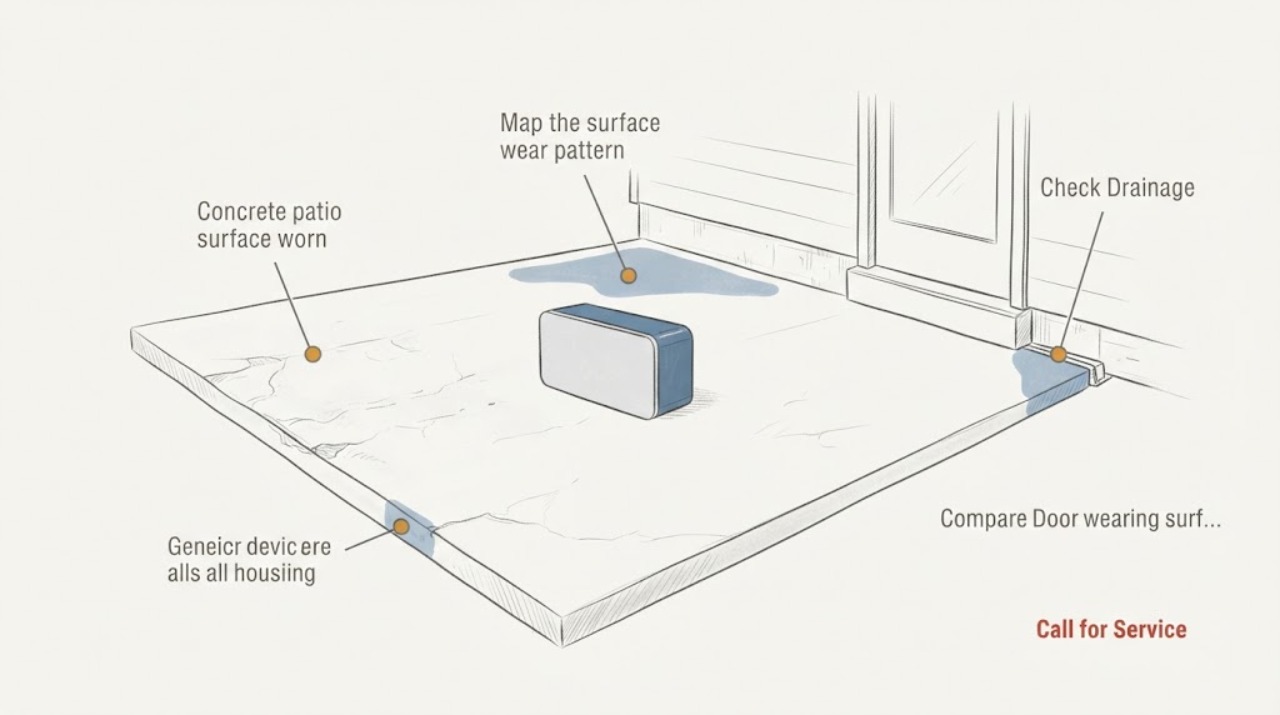
Map the surface wear pattern
Walk only on stable areas and photograph the patio from above and from its edges. Without scraping or breaking the surface, note whether it is mainly faded, powdery, flaking in thin sheets, pitted, or missing larger pieces. Mark isolated spots versus areas spread across the slab.
Expected result: Record the wear depth only in descriptive terms, such as surface texture change, shallow loss, or deeper-looking voids. Note exposed aggregate, loose pieces, sharp edges, and whether the same pattern appears on steps, borders, or adjoining concrete.
Next step: Keep the photos and mark the affected percentage or zones in a simple sketch. Continue to check water and joint patterns before considering a cleaner, sealer, patch, or resurfacing quote.
Stop if: Stop walking the area if pieces move underfoot, edges are sharp, the slab is slick, or a depression could cause a fall. Restrict access and request professional service.
Why this matters
Why: A uniform appearance change may be a finish or maintenance concern, while widespread flaking, pitting, or exposed aggregate is more consistent with surface deterioration that needs a concrete-service assessment. The visible pattern alone does not establish the cause or the remaining slab strength.
-
Look for drainage and moisture clues
After the patio is dry, inspect low spots, edges near the house, downspout discharge areas, nearby planters, and the direction of runoff. Look for staining, algae, damp soil at the edge, salt or deicer residue, and places where water appears to remain after rain.
Expected result: Record whether wear is concentrated where water ponds, where a downspout discharges, along a foundation edge, or beside a joint. Note whether the patio dries evenly or one area stays darker or damp longer than the rest.
Next step: Photograph the runoff path during or after ordinary rain if it can be done from a safe location. Include downspout and grade observations in a concrete-service request; do not redirect water or regrade the property based on a visual guess.
Stop if: Stop and obtain professional help if water is undermining an edge, flowing toward the building, entering a basement or crawl space, or leaving the walking surface persistently slippery.
Why this matters
Why: ACI identifies saturation, freeze-thaw exposure, and inadequate drainage as contributors to joint deterioration, while QUIKRETE describes water entering cracks and freezing as a path to surface flaking and spalling. A water-linked pattern should be addressed as a moisture and drainage question, not covered over immediately.
-
Compare joints, cracks, and slab alignment
From stable ground, trace visible control or isolation joints and compare them with nearby cracks. Look for cracks that stay within a joint, cracks that cross the slab, widening gaps, raised or lowered edges, and changes where the patio meets a wall, step, or other hard surface. Do not widen, probe, or chip any crack.
Expected result: Note whether the surface wear is independent of cracks, follows a joint, radiates from an edge, or occurs with an offset or a change in level. Record whether a joint is filled, open, eroded, or holding water.
Next step: Add close and wide photos with a familiar object for scale, and tell the contractor whether the condition is changing seasonally or after heavy rain. Keep traffic away from any uneven transition.
Stop if: Stop using the patio if a crack creates a raised edge, the slab rocks, a void is visible beneath an edge, or the opening is expanding rapidly.
Why this matters
Why: A joint-only or stable hairline pattern may be a maintenance detail, but an offset, widening, or recurring crack can indicate movement or water exposure that a surface coating will not resolve. A concrete professional should interpret the pattern rather than assuming the slab needs only a cosmetic patch.
-
Track progression and use-related risk
Take a dated photo from the same position after normal weather and use. Record when the wear was first noticed, whether flakes or pits are increasing, whether winter or deicer exposure preceded the change, and whether furniture or foot traffic encounters a rough, slippery, or unstable area.
Expected result: A stable finish change with no loose material differs from deterioration that continues to shed, spreads beyond its original zone, or repeatedly returns after cleaning. Note any new trip edge, dusting, ponding, or water staining.
Next step: Provide the dated log, patio age if known, climate or freeze history, deicer use, drainage observations, and photos when requesting a quote. Do not start a coating project before the contractor confirms the surface is suitable.
Stop if: Stop normal use and arrange service if loose material, dust, slippery growth, deep pits, or uneven edges are worsening or creating a fall hazard.
Why this matters
Why: Progression raises the priority of a professional assessment and makes a simple appearance-only treatment less likely to be sufficient. A stable, dry, sound-looking surface can be evaluated for a compatible cleaner or sealer; a deteriorating surface may need preparation and resurfacing designed for its condition.
Use your observations
Decision map
Find the observation that best matches what you see, then follow the next safe action.
-
PATH 01Safety boundary
What you see
The patio is dry and stable, wear is mainly uniform discoloration or a shallow finish change, and there are no active cracks, loose flakes, or drainage problems.
Do this next
Ask a concrete professional to confirm whether low-risk cleaning and a compatible concrete sealer are suitable, and whether the surface is sound enough for that treatment.
Why this path and its safety boundary
Safety stop: If cleaning reveals loose or weak material, stop surface treatment and request an assessment for repair or resurfacing.
-
PATH 02Safety boundary
What you see
Wearing, flaking, or pitting covers a broad area but the slab remains level and there is no active water path.
Do this next
Request a concrete resurfacing evaluation. Provide the wear map and ask the contractor to confirm surface soundness, preparation needs, compatible overlay, traction, drainage, and curing plan before work begins.
Why this path and its safety boundary
Safety stop: Do not cover broad deterioration with a patch or coating until loose material and the underlying condition have been evaluated.
-
PATH 03Safety boundary
What you see
Wear follows ponding, a downspout, a foundation edge, an open joint, freeze-thaw exposure, or repeated deicer contact.
Do this next
Address the water-management or exposure issue with a qualified concrete or drainage professional, then select any repair or sealer for the confirmed condition. ACI notes that preventing saturation and providing effective drainage are part of reducing joint deterioration.
Why this path and its safety boundary
Safety stop: Do not seal over an active water path or redirect runoff toward a building, neighboring property, or walkway without a considered drainage plan.
-
PATH 04Safety boundary
What you see
There is slab movement, a widening or offset crack, undermined edge, deep void, or a trip hazard.
Do this next
Restrict access and request prompt concrete-service evaluation. Include wide and close photos, drainage history, and the location relative to the house, steps, and property edge.
Why this path and its safety boundary
Safety stop: Do not chip, cut, grind, demolish, or attempt to level the slab as a homeowner project when movement, undermining, or a significant elevation change is visible.
Helpful context
Understand the symptom
Worn is not one diagnosis
A patio that has lost color is different from one that is powdering, flaking, pitted, or exposing larger aggregate. Cracks and joints can also let water reach the concrete and make freeze-thaw damage more likely in cold conditions. Photos and a simple condition map help a contractor decide whether the project is surface maintenance, localized repair, resurfacing, or a larger assessment.
Keep the inspection safe
Inspect from stable ground in daylight or with a flashlight. Do not chip, cut, grind, demolish, or apply an unverified chemical to the slab. Avoid walking on loose flakes, sharp edges, slick algae, or areas that are wet or undermined.
Only after diagnosis
Potential parts
- concrete-cleaner
Only consider a cleaner when the surface is stable, the concern is removable dirt or staining, and the product is confirmed suitable for the patio finish and nearby landscaping.
Follow the product label, protect adjacent materials and plants, and do not use cleaning as a substitute for addressing loose, scaling, or structurally uncertain concrete. - concrete-sealer
Consider a sealer only after the slab is dry and sound, the moisture and drainage pattern is understood, and a concrete professional confirms that sealing matches the surface condition.
Match the sealer to the concrete finish, exposure, traction needs, and any existing coating; sealing cannot correct movement, deep deterioration, or active water entry. - concrete-patch
Only consider a patch for a localized, stable defect after the source of water or movement has been assessed and the repair depth and material are confirmed.
Match the material to exterior exposure, existing concrete, joint location, and intended traffic; do not use a small patch to conceal broad spalling or a moving slab.
When checks do not resolve it
Need a professional?
Call a qualified concrete-service professional when surface wear is widespread or progressing, flakes or pits are loose, cracks widen or offset, water ponds or undermines an edge, or the patio becomes slippery or unsafe. Request a drainage or broader building assessment when runoff affects the house or adjacent property.
Have this ready
- Provide a wear map, dated photos, patio age if known, freeze-thaw and deicer history, drainage and ponding observations, crack and joint locations, and any trip or slip hazard.
Common questions
FAQ
Is a worn-looking concrete patio always ready for sealer?
No. A sealer is conditional on the surface being dry and sound and on the moisture, drainage, and wear pattern being understood. Loose flakes, deep pits, active cracks, or ponding should be assessed before sealing.
What is the difference between surface wear and spalling?
Surface wear may be a finish change or gradual roughening, while spalling or scaling involves pieces or layers of the concrete surface breaking away. Photos can document the pattern, but a concrete professional should confirm the extent and suitable repair.
Can I patch a few damaged spots before resurfacing the patio?
Only after the defects are confirmed to be localized and stable and the cause of water or movement is addressed. Patching broad or active deterioration can hide the pattern and may not bond or remain level with the surrounding slab.
Read the exact guide
Official sources
- Winterize and Protect Your ConcreteQUIKRETE · Supports treating widening cracks, surface flaking, and freeze-thaw exposure as reasons to evaluate the condition before choosing a finish product.
- Joint Deterioration Mechanism and PreventionAmerican Concrete Institute · Supports observing joints, moisture, and drainage before selecting a repair; it is general technical guidance and not a structural evaluation of this patio.
- Winterize Your ConcreteQUIKRETE · Supports the relationship between water, freeze-thaw exposure, surface flaking, and the need to distinguish protection from resurfacing; product directions are not a diagnosis of this patio.
Community feedback
Share a repair observation
Share a plain-text repair observation. Accepted observations are published automatically; this page may take a moment to update.