
On this page
Start here
Quick answer
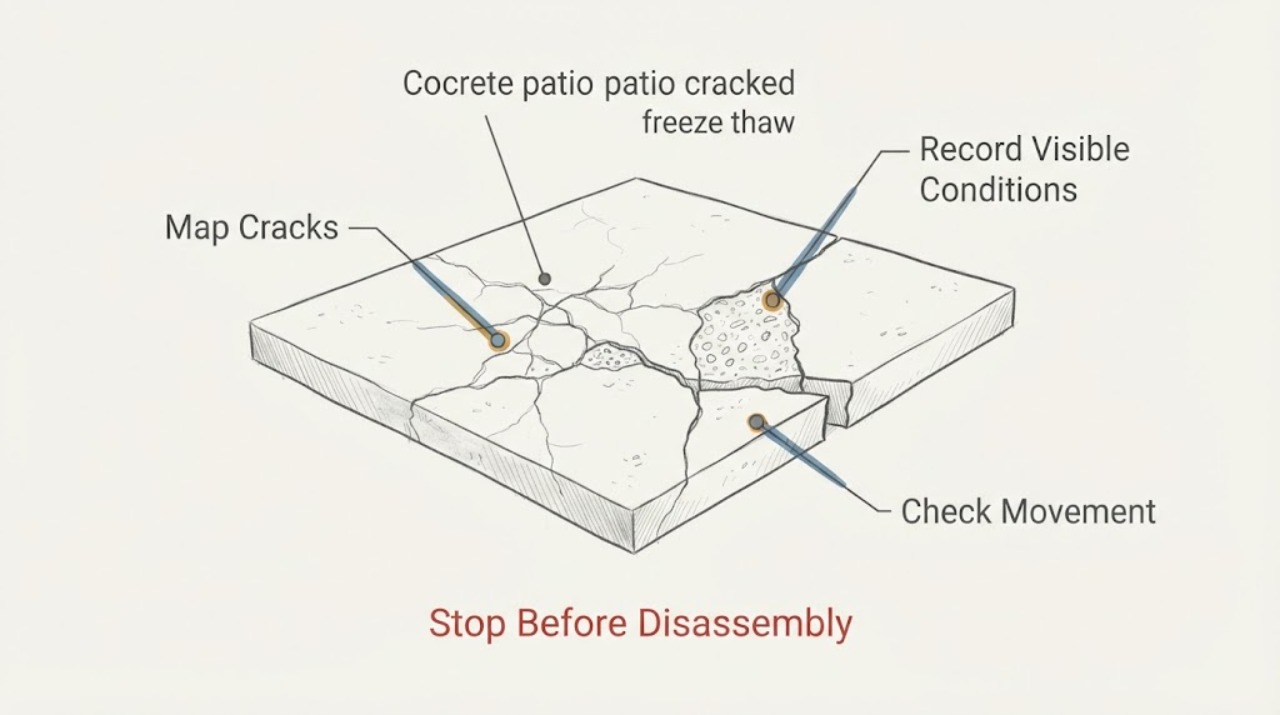
Freeze-thaw cracking is more likely when concrete stays saturated, but crack pattern, depth, movement, and other causes must be assessed before repair. From stable ground, map cracks, joints, ponding, edges, and trip hazards without chiseling, cutting, or grinding. Arrange concrete service for widening or moving cracks, spalling, exposed voids, unsafe edges, or recurring water exposure.
Before you begin
Safety first
- Observation-only guidance; professionals determine depth, drainage interaction, repair, and replacement scope.
Work through in order
Diagnostic checks
Use only checks that match the exact appliance or system and its official guide.
-
Check 1
From stable footing, photograph and map each crack relative to joints, edges, steps, walls, and drains; do not probe or widen it.
Expected result: Cracks are hairline, widening, parallel to joints, map-like, isolated, or accompanied by spalling.
Next step: Share dated photos and a simple patio map with a concrete professional.
Stop if: Stop for loose flakes, sharp fragments, unstable slabs, or trip hazards.
Why this matters
Why: Patterns near joints and edges can be consistent with moisture-related freeze-thaw distress, but visual form cannot establish depth or cause.
-
Check 2
Observe the patio after rain, thaw, or snow melt from a safe edge and note ponding, saturated joints, runoff, and whether the crack stays wet; do not enter standing water.
Expected result: Water drains, ponds at cracks or edges, crosses the slab, or the drainage path is hidden.
Next step: Photograph the water path and provide the seasonal history for assessment.
Stop if: Stop for flooding, unstable soil, or exposed utilities.
Why this matters
Why: Repeated moisture at cracks or edges supports a freeze-thaw or drainage review, while dry conditions do not rule out seasonal saturation.
-
Check 3
From the patio edge, look for vertical offset, rocking slab sections, lifted edges, or a gap opening and closing over seasons; do not load-test or pry the concrete.
Expected result: The slab appears stable; a trip edge or offset is visible; movement is suspected; or the condition is not safely observable.
Next step: Keep traffic away from the hazard and arrange professional evaluation.
Stop if: Do not pry, lift, cut, or demolish the slab.
Why this matters
Why: Movement and offset increase urgency and can indicate settlement or deeper distress beyond a surface crack.
-
Check 4
Compare dated photos after freeze-thaw cycles and note new spalling, widening, staining, or exposed aggregate without touching the surface.
Expected result: The pattern is unchanged; cracks or spalling are progressing; or no reliable history exists.
Next step: Provide the timeline, exposure history, and photos to the concrete professional.
Stop if: Stop walking the area if slippery, unstable, or shedding material.
Why this matters
Why: Progression supports prompt assessment; lack of progression does not prove the slab is sound.
Use your observations
Decision map
Find the observation that best matches what you see, then follow the next safe action.
-
PATH 01Safety boundary
What you see
Is there movement, vertical offset, spalling, or a trip hazard?
Do this next
Keep people away and arrange prompt concrete service.
Why this path and its safety boundary
Safety stop: No striking, prying, cutting, or demolition is included.
-
PATH 02Safety boundary
What you see
Does water pond or remain at cracks, joints, or edges?
Do this next
Request concrete and drainage review together.
Why this path and its safety boundary
Safety stop: Do not dig or work in standing water.
-
PATH 03Safety boundary
What you see
Do cracks or spalling follow joints and moisture-exposed edges?
Do this next
Provide the pattern for freeze-thaw and material assessment.
Why this path and its safety boundary
Safety stop: Do not infer cause from appearance alone.
-
PATH 04Safety boundary
What you see
Has damage widened or progressed after thaw cycles?
Do this next
Arrange professional review before any patch or coating decision.
Why this path and its safety boundary
Safety stop: Stop for loose fragments or unsafe footing.
Helpful context
Understand the symptom
Moisture and freeze-thaw cycles can drive deterioration
FHWA describes freeze-thaw distress as scaling, map cracking, spalling, and deterioration that often starts at joints and free edges where moisture is available. A patio may show similar symptoms from settlement, drainage, or loads, so visual mapping should precede any repair choice.
Keep the patio observation-only
Do not strike the slab, widen cracks, cut joints, or apply a filler as a test. Record water paths, seasonal progression, and whether the patio moves or creates a trip hazard. A concrete professional can determine whether the issue is surface-limited or deeper.
Only after diagnosis
Potential parts
- concrete crack filler
Consider this only after a professional confirms crack type, movement, moisture, and product suitability; filler cannot stabilize a moving slab or correct drainage.
Match the product to the substrate and exposure using label instructions; this guide does not direct cutting or application. - concrete sealer
Consider this only after assessment confirms the surface is suitable and moisture conditions are controlled; sealing cannot repair deeper freeze-thaw distress.
Confirm compatibility and weather requirements with the manufacturer and professional.
When checks do not resolve it
Need a professional?
Arrange concrete assessment for widening or moving cracks, spalling, exposed aggregate or voids, trip edges, repeated ponding, or progression after freeze-thaw cycles.
Safety scope: Observation-only guidance; professionals determine depth, drainage interaction, repair, and replacement scope.
Have this ready
- Dated crack map and photos
- Rain, thaw, ponding, and drainage observations
- Joint, edge, offset, movement, and spalling details
- Progression across seasonal cycles
- Prior patch, sealer, or construction history
Common questions
FAQ
Can freeze-thaw cycles crack a concrete patio?
Yes, moisture-saturated concrete exposed to repeated freezing and thawing can develop cracking, scaling, or spalling. Other causes can look similar and require assessment.
Should I widen the crack to fill it?
No. Do not cut, chisel, widen, or strike the slab as a test. Map and photograph it and have a professional determine the repair approach.
Why document ponding?
Moisture at joints and edges can influence freeze-thaw distress. Record where water remains and whether it recurs after rain or thaw for the concrete assessment.
When is a patio crack urgent?
Arrange service for movement, offsets, spalling, exposed voids, trip hazards, repeated ponding, or damage that progresses after thaw cycles.
Read the exact guide
Official sources
- Guidelines for Detection, Analysis, and Treatment of Materials-Related Distress in Concrete PavementsFederal Highway Administration · Supports linking moisture, joints, edges, freeze-thaw cycles, cracking, scaling, and spalling while keeping diagnosis conditional.
- Concrete Pavement RepairFederal Highway Administration · Supports documenting distress and obtaining an assessment before selecting a repair.
Community feedback
Share a repair observation
Share a plain-text repair observation. Accepted observations are published automatically; this page may take a moment to update.