
On this page
Start here
Quick answer
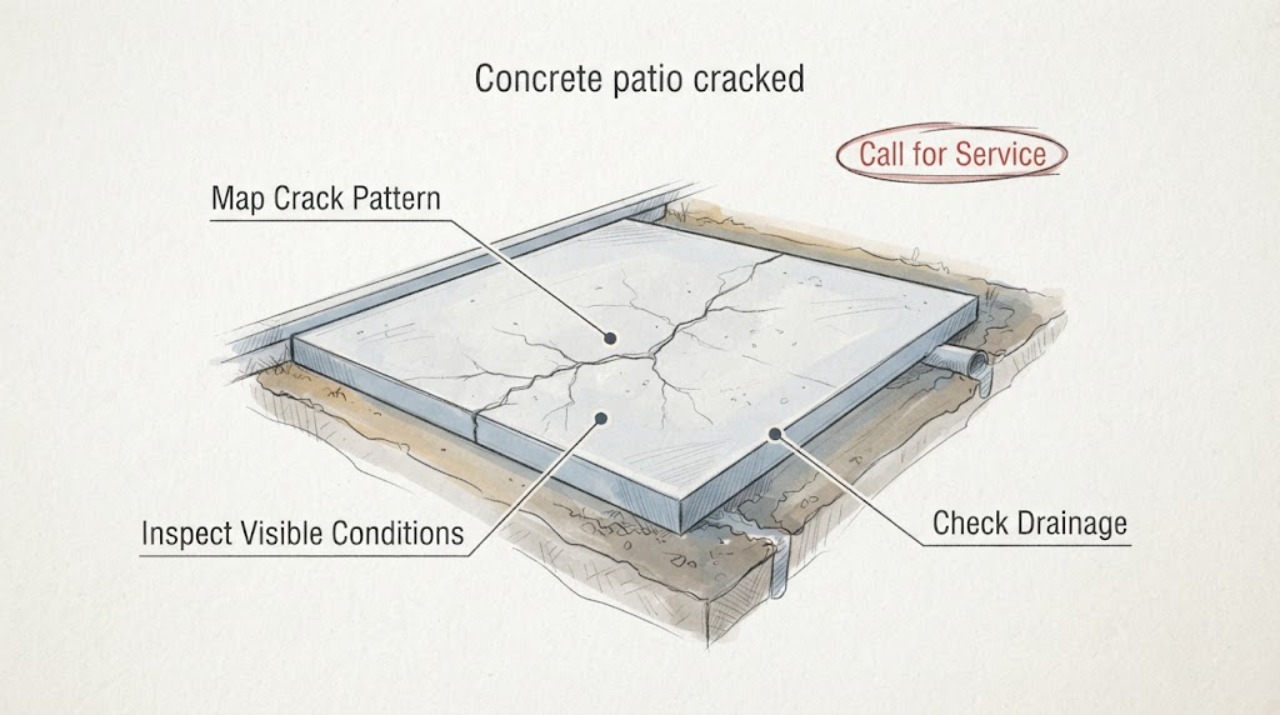
Do not start by filling or sealing a cracked patio. First photograph the whole slab and the crack close up, note whether the line follows a joint or crosses the slab, and observe whether either side is displaced, rocking, or creating a trip edge. Check the surrounding soil, downspouts, drains, and low spots for water or erosion from a safe standing position, and compare the crack over time without loading it. A stable hairline or joint-related line may be a surface or movement-management issue, but a widening or offset crack, slab settlement, undermining, repeated water exposure, exposed reinforcement, or a crack that reaches a foundation or step needs a qualified concrete or site professional to assess the cause. Material, slab construction, climate, and drainage determine whether a filler or sealer is appropriate; a generic product is not a diagnosis.
Work through in order
Diagnostic checks
Use only checks that match the exact appliance or system and its official guide.
-
Check 1
Photograph the full patio and each crack close up, then trace the visible path without scraping, widening, grinding, or inserting anything into the crack.
Expected result: Record whether the line follows a visible joint, runs from an inside corner or edge, crosses an open slab area, branches into several lines, reaches a step or foundation, or appears as surface crazing. Note whether the sides remain flush and whether there is a visible gap or sharp edge.
Next step: Save wide and close photographs, keep furniture and vehicle loads away from the damaged area, and continue with displacement and drainage observations. If a sharp edge, open gap, or unstable area is present, stop and arrange service.
Stop if: Stop if observing requires prying, chiseling, drilling, grinding, cutting, lifting the slab, or placing a hand or foot into an opening.
Why this matters
Why: A joint-related or fine surface pattern has a different decision path from a crack that crosses the slab, branches, reaches an adjacent structure, or has offset edges. Pattern alone cannot establish a structural cause, but it identifies what a professional should evaluate.
-
Check 2
From a stable standing position, view the crack along its length and compare the two surfaces using sight lines or a photograph; do not press, lever, or load either side.
Expected result: Classify the surfaces as flush and stable, visibly offset, rocking or loose-looking, sunken on one side, heaved on one side, or uncertain. Note any trip edge, ponding depression, exposed aggregate, exposed reinforcement, or damage near a step or railing.
Next step: Keep people away from a trip edge and request a concrete or site assessment for any displacement, rocking, exposed reinforcement, or adjacent-structure concern. Do not attempt to level, lift, brace, or support the slab.
Stop if: Stop if the patio moves under ordinary foot traffic, an edge is sharp or unstable, reinforcement is exposed, or the inspection would require stepping across an unsafe gap or moving heavy items.
Why this matters
Why: Offset, rocking, settlement, heave, or exposed reinforcement indicates that a cosmetic fill may not address the condition and could hide a hazard. A flush surface does not prove the crack is harmless, but it supports a narrower material and water assessment.
-
Check 3
From ground level, observe the patio perimeter, adjacent soil, downspout discharge, drains, and low points before and after ordinary rain when it is safe; do not dig, hose-test underground drains, or enter standing water.
Expected result: Record dry and stable soil, water collecting beside or under the patio edge, a downspout directed toward the slab, washed-out soil, standing water, mud, frost or heave signs, or an unknown drainage path. Note whether water appears to travel through the crack or only across the surface.
Next step: Photograph the water path and keep the crack area free of temporary loads. Arrange concrete, drainage, or site evaluation when water collects, soil is washing away, or the patio edge appears undermined.
Stop if: Stop for deep or unstable ground, fast-moving water, electrical hazards, buried-utility uncertainty, undermined edges, or any need to excavate, cut, drill, or redirect buried drainage.
Why this matters
Why: Water and erosion can change the support conditions around a patio, while surface runoff can also stain or weather a crack. These observations suggest a drainage or site review but do not identify the cause without an appropriate assessment.
-
Check 4
Compare dated photographs from the same viewpoints and note visible change without measuring by forcing a gap or applying weight to the slab.
Expected result: Classify the crack as unchanged, longer, wider-looking, more displaced, newly branching, or unknown. Note recent heavy rain, freeze-thaw conditions, landscaping, drainage changes, construction, or impact only when you know the event occurred.
Next step: Give the timeline, photographs, drainage observations, and patio use to a qualified concrete or site professional. Keep heavy loads, impact, and water concentration away from the area while waiting.
Stop if: Stop if the crack changes during observation, the patio becomes unsafe to walk on, adjacent structures move, or comparing the condition would require moving loads or disturbing the slab.
Why this matters
Why: Documented progression or new displacement raises the need for prompt assessment and source correction. A crack that appears unchanged still needs a material-appropriate decision; photographic stability is not proof that a sealant will work.
-
Check 5
Decide whether the crack is clearly stable and non-displaced, the surrounding ground is stable and dry, the material and slab context are understood, and no structural or excavation work would be needed.
Expected result: Answer yes only when the crack is visible and stable, surfaces are flush, no trip or reinforcement hazard is present, drainage is not undermining the edge, and a material-appropriate non-structural treatment has been confirmed. Answer no for any offset, settlement, heave, progression, water or erosion, adjacent-structure crack, unknown material, or unsafe access.
Next step: For yes, provide photographs and patio material and exposure information for confirmation before purchasing a repair product. For no, keep the area safe and request concrete or drainage service with the complete observation record.
Stop if: Do not apply filler or sealer, grind, cut, demolish, excavate, or alter drainage when any required fact is unknown or the answer is no.
Why this matters
Why: Yes supports a focused conversation with the product manufacturer or concrete professional about a cosmetic treatment; it does not guarantee a lasting or invisible repair. No means assess movement, drainage, and site conditions before any filler or sealer.
Use your observations
Decision map
Find the observation that best matches what you see, then follow the next safe action.
-
PATH 01Safety boundary
What you see
The crack follows a visible joint or appears surface-level, both sides are flush and stable, and there is no active water, trip hazard, or progression.
Do this next
Ask a concrete professional or the material manufacturer whether a compatible non-structural filler or sealer suits the exact patio surface and exposure. Keep the area clean and avoid loading the line until confirmed.
Why this path and its safety boundary
Safety stop: Stop if the crack opens, branches, changes level, or the proposed product requires grinding, cutting, or an unconfirmed material compatibility claim.
-
PATH 02Safety boundary
What you see
The patio is offset, rocking, settling, heaving, widening, or showing progression, an exposed edge, or exposed reinforcement.
Do this next
Request an in-person concrete or site assessment to identify movement and repair scope. Provide full-run photographs, crack history, patio use, and any drainage observations.
Why this path and its safety boundary
Safety stop: Do not level, lift, brace, grind, cut, demolish, drill, or cover the movement with patch material.
-
PATH 03Safety boundary
What you see
Water collects beside or over the patio, soil is washing away, a downspout directs water toward the slab, or the edge appears undermined.
Do this next
Arrange a drainage or site review along with concrete assessment, and keep people away from unstable edges. Address any active plumbing or storm-water hazard through the appropriate professional.
Why this path and its safety boundary
Safety stop: Do not excavate, redirect buried drainage, cut the slab, or use a filler to conceal active water or erosion.
-
PATH 04Safety boundary
What you see
The crack reaches a foundation, step, wall, railing, or other structure, or the material, history, or support condition cannot be established safely.
Do this next
Leave the patio undisturbed and request a qualified concrete or site professional to assess the interface and surrounding ground. Provide photographs and the reason the condition is unknown.
Why this path and its safety boundary
Safety stop: Stop if inspection would require removing finishes, dismantling a railing or step, exposing reinforcement, excavating, or making a structural diagnosis from a surface patch.
Helpful context
Understand the symptom
Map the crack before choosing a product
Concrete cracking can be expected in some slabs, but the significance depends on the crack's pattern, movement, surrounding conditions, and the purpose of the slab. Photograph the full patio, then the crack from several angles, and record whether the line is in a designed joint, near an edge or step, or crossing an uninterrupted area.
Look for water and movement without disturbing the slab
Water that collects beside the patio or washes soil away can change the conditions around a slab. Observe downspouts, drainage paths, low spots, soil loss, and any visible gap or trip edge from the ground. Do not excavate, pry the crack open, grind the surface, or test the slab with a vehicle or heavy load.
Repair products are conditional
A commercial patch or sealer may be marketed for patios, but product suitability depends on the crack's type, movement, material condition, and water exposure. Use the observations to ask a concrete professional or the material manufacturer whether a non-structural treatment fits; do not use a cosmetic product to conceal displacement or active settlement.
Only after diagnosis
Potential parts
- concrete crack filler
Consider this category only after the crack is confirmed as stable and non-displaced, drainage is not contributing, and a material-appropriate cosmetic treatment is confirmed.
Confirm the product's intended surface, crack type, movement tolerance, weather exposure, preparation limits, and finish with the manufacturer or concrete professional; do not use it for settlement, heave, structural concern, or active water. - concrete sealer
Consider this category only after the concrete condition is stable, the surface is identified, and a professional or manufacturer confirms that sealing is appropriate after any crack decision.
Confirm substrate condition, moisture exposure, existing coatings, appearance, slip considerations, and application limits; a sealer does not correct movement or drainage.
When checks do not resolve it
Need a professional?
Call a qualified concrete or site professional for any offset, rocking, settling, heaving, widening or branching crack; trip edge; exposed reinforcement; water or soil erosion; ponding; a crack reaching a step, foundation, wall, or railing; or an unknown material or support condition. Arrange drainage or plumbing assessment when water is active or concentrated at the patio.
Have this ready
- Provide full-patio and close photographs, crack path and location, whether the surfaces are flush, progression timeline, patio age and material if known, use and loads, drainage and erosion observations, recent weather or landscaping changes, and a statement that no cutting, grinding, excavation, demolition, or structural alteration was attempted.
Common questions
FAQ
Are cracks in a concrete patio always a serious problem?
No, but their meaning depends on the pattern, movement, water exposure, adjacent structures, and slab context. A stable joint-related line may be a narrower repair question, while offset, progressing, undermined, or adjacent-structure cracking needs professional assessment before any cosmetic treatment.
Can I fill a patio crack with a concrete repair product?
Only after confirming that the crack is stable and non-displaced, drainage is not contributing, and the product is compatible with the specific surface. A filler or sealer cannot correct settlement, heave, erosion, structural concerns, or active water.
What should I look for around a cracked patio?
From a safe standing position, look for offset edges, rocking or settlement, trip hazards, ponding, washed soil, downspouts aimed at the slab, exposed reinforcement, and cracks reaching steps or foundations. Do not excavate or test the slab with weight.
When should I call a concrete contractor?
Call for a widening or displaced crack, settlement or heave, a trip edge, exposed reinforcement, water or erosion, ponding, a crack at an adjacent structure, or an unknown support condition. Share photographs, the timeline, patio use, and drainage observations.
Read the exact guide
Official sources
- Concrete Patching CompoundQUIKRETE · Applies only to the named QUIKRETE product and its instructions; it is included as a conditional example, not a universal product recommendation or structural repair method.
- Do we always need to repair cracked concrete?American Concrete Institute · ACI technical FAQ; it is general concrete guidance and does not diagnose this patio or authorize homeowner structural work.
- Acceptable concrete crackingAmerican Concrete Institute · ACI discussion of reinforced concrete walls and slabs; patio construction, reinforcement, exposure, and acceptable conditions vary and need site-specific assessment.
Community feedback
Share a repair observation
Share a plain-text repair observation. Accepted observations are published automatically; this page may take a moment to update.