
On this page
Start here
Quick answer
When a cracked concrete patio is letting water in, start by observing the water path after normal rain or an existing watering event, not by creating a hose test. From a safe ground-level position, record whether water runs toward the foundation or door threshold, pools because of the patio slope, follows a crack, or leaves a damp mark inside or below. A dry, stable surface crack may fit a surface-repair assessment; pooling or settlement points to drainage or slab work; water at the wall, threshold, or interior side needs waterproofing or structural evaluation. Do not cut, grind, pressure-wash, excavate, inject, or seal over an active leak before the cause is assessed.
Before you begin
Safety first
- Observe from stable ground or a dry interior viewpoint only. Do not create a hose test, cut, grind, pressure-wash, excavate, inject, lift, level, jack, or disturb the slab, foundation, threshold, wet electrical equipment, or concealed finishes.
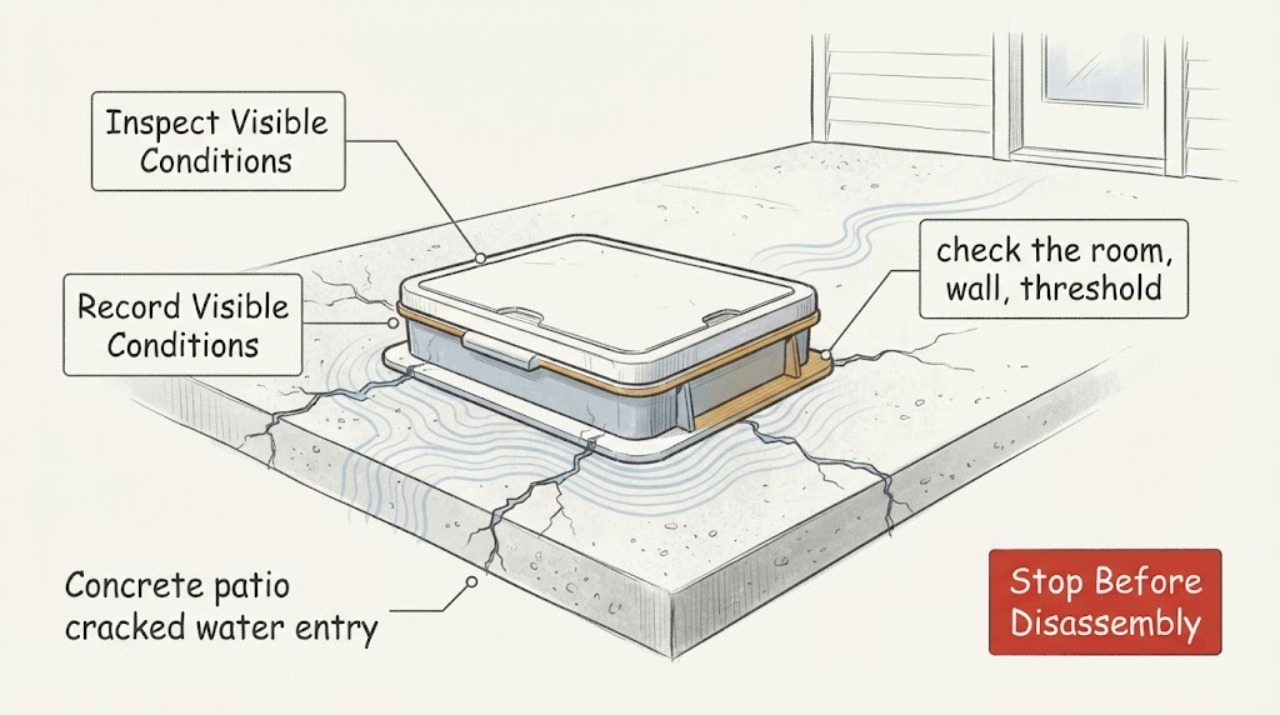
Work through in order
Diagnostic checks
Use only checks that match the exact appliance or system and its official guide.
-
Check 1
After normal rain or an existing watering event, observe the patio from a stable ground-level position and record where water travels, pools, or disappears. Note whether the flow moves toward the foundation, a door threshold, a wall joint, or a drain; do not create a hose test.
Expected result: Water runs away from the house, runs toward the foundation or threshold, pools on the slab, follows the crack, or cannot be followed safely.
Next step: Photograph the patio, crack, foundation edge, threshold, and visible water path while the condition is safe to observe. Do not stand in pooled water or approach a slippery edge.
Stop if: Stop for slipping conditions, active water near electricity, unstable slab edges, or any need to climb, excavate, or disturb the patio.
Why this matters
Why: The water path is the first decision for this patio condition: flow toward the house or threshold can explain entry, while a crack without a connected wet path may need a different assessment.
-
Check 2
From the patio and adjacent ground, visually compare the crack with the wall or foundation line, door threshold, control or construction joint, and nearby drain or edge. Record whether the crack terminates at, parallels, or crosses one of those features without widening, probing, or removing sealant.
Expected result: The crack is isolated in the slab, meets the foundation or threshold, follows a joint, crosses a drain or edge, or the relationship is hidden.
Next step: Mark the location on a photo or sketch and tell the professional what feature the crack meets or crosses. Leave any existing joint or sealant undisturbed.
Stop if: Do not pry joints, remove caulk, lift a threshold, drill the slab, or expose the foundation to trace the crack.
Why this matters
Why: A crack aligned with a foundation, sill, or threshold is more relevant to water-entry and waterproofing scope than an isolated surface mark; the visible relationship does not prove the path or structural cause.
-
Check 3
From a dry interior or other safe viewpoint, check the room, wall, threshold, crawlspace opening, or area below the patio for dampness, staining, peeling finish, efflorescence-like deposits, or a drip that appears after the same weather event. Do not open finishes or enter a wet crawlspace.
Expected result: There is no interior effect, an old dry mark, fresh dampness or dripping, moisture at a door threshold or foundation wall, or an area that cannot be checked safely.
Next step: Record the room or area, timing, approximate location, and whether the mark is new or recurring. Keep furnishings and people away from active water and include the observations in the service request.
Stop if: Stop for active water near electrical equipment, a sagging or unstable finish, contamination, or any need to open a wall, floor, or ceiling.
Why this matters
Why: An indoor or below-slab wet mark makes this more than a cosmetic patio crack and may require a wall, threshold, drainage, or waterproofing assessment; no visible mark does not rule out concealed moisture.
-
Check 4
From stable ground, compare the slab edges and adjacent sections for visible offset, rocking, separated joints, a trip edge, settlement, heaving, or a crack that appears to change after wet weather. Do not lift, level, jack, or move the slab.
Expected result: The slab appears aligned and stable, shows a localized surface crack, has visible offset or settlement, has heaving or separated sections, or movement cannot be judged safely.
Next step: Photograph the offset or joint and record the weather and recurrence pattern. Ask the professional to assess drainage and support before any surface repair is selected.
Stop if: Stop if the slab shifts, an edge is unstable, a trip hazard is active, or inspection would require lifting, excavation, or heavy equipment.
Why this matters
Why: Displacement, recurring movement, or a changed crack points toward drainage, subgrade, settlement, or structural assessment rather than a filler-only repair; a flat-looking surface does not prove the base is stable.
-
Check 5
Assemble a repair-scope handoff with the crack location, water path, foundation or threshold relationship, interior or below-slab wet marks, drainage observations, movement history, photos, and prior patch or sealer work. Ask for separate conclusions on surface crack repair, drainage or settlement, and structural or waterproofing work.
Expected result: The professional may classify the issue as a stable surface crack, drainage or grading problem, settlement or support issue, or structural or waterproofing concern.
Next step: Keep the affected entrance or area dry and protected as safely possible and arrange qualified concrete or waterproofing assessment. Do not buy a generic filler before the water path and slab condition are understood.
Stop if: Stop all DIY repair when the scope requires cutting, grinding, pressure washing, excavation, injection, structural work, or concealed waterproofing.
Why this matters
Why: A crack filler or sealer is appropriate only for a qualified, stable surface-repair scenario; water entry, settlement, or wall and threshold involvement can require a different scope.
Use your observations
Decision map
Find the observation that best matches what you see, then follow the next safe action.
-
PATH 01Safety boundary
What you see
The crack is isolated and dry, the slab appears stable, and no water reaches the foundation, threshold, interior, or area below.
Do this next
Request a planned assessment for a compatible surface crack filler or sealer; follow the professional's preparation and product guidance rather than assuming a filler is suitable.
Why this path and its safety boundary
Safety stop: Do not seal until the surface is stable and the water-entry path has been ruled out.
-
PATH 02Safety boundary
What you see
Rain or existing watering sends water toward the foundation, door threshold, wall edge, or a visible drain, or the patio pools near the house.
Do this next
Request drainage and grading assessment before crack repair; provide photos showing the direction and location of pooling.
Why this path and its safety boundary
Safety stop: Do not regrade, break concrete, excavate, or redirect water beside the foundation yourself.
-
PATH 03Safety boundary
What you see
The crack meets the foundation or threshold and a damp mark, drip, peeling finish, or other wet evidence appears inside or below.
Do this next
Arrange coordinated concrete and waterproofing or building-envelope assessment to trace the entry path and determine whether the wall, joint, threshold, or slab is involved.
Why this path and its safety boundary
Safety stop: Do not cover the interior mark, remove threshold materials, or inject or seal the crack blindly.
-
PATH 04Safety boundary
What you see
The slab has visible offset, settlement, heaving, separated joints, recurring movement, or a crack that changes after wet weather.
Do this next
Request drainage and settlement or structural assessment before any surface patch; include the movement and weather history.
Why this path and its safety boundary
Safety stop: Do not lift, level, jack, cut, or grind the slab.
-
PATH 05Safety boundary
What you see
Water is active near electrical equipment, the slab or edge is unstable, the area is contaminated, or an entrance or walkway is an immediate hazard.
Do this next
Keep people away using a safe route and obtain the appropriate urgent concrete, waterproofing, electrical, structural, or water-damage professional.
Why this path and its safety boundary
Safety stop: Stop immediately and do not enter pooled water, operate wet electrical equipment, or disturb unstable material.
-
PATH 06Safety boundary
What you see
The crack or water path cannot be viewed safely, or the cause remains uncertain after ground-level observation.
Do this next
Leave the patio undisturbed and request qualified inspection with the photos, weather timing, and access limitation.
Why this path and its safety boundary
Safety stop: Do not create a leak, enter a confined space, remove finishes, or use tools to obtain a closer view.
Helpful context
Understand the symptom
Trace water before choosing a repair
For a cracked concrete patio with water entry, the useful first distinction is the water path, not the crack's appearance alone. Observe after normal rain or an existing watering event and record whether water runs toward the foundation or threshold, pools because of the patio slope, follows the crack, or leaves a wet mark inside or below.
Separate the possible scopes
Compare the crack with the foundation line, door threshold, wall edge, joints, and drainage path from stable ground. A dry, stable surface crack may fit a surface filler or sealer assessment. Pooling, settlement, offset, or recurring movement points toward drainage or slab-support work; interior or below-slab dampness can require waterproofing or structural evaluation.
Safe boundary and handoff
Do not create a hose test, cut or grind the slab, excavate, pressure-wash, inject, or seal over active water before the cause is assessed. Keep people away from slippery or unstable areas and arrange qualified concrete, drainage, waterproofing, or structural service when the observations cross those boundaries.
Only after diagnosis
Potential parts
- concrete-crack-filler
Consider only after qualified assessment confirms an isolated, stable surface crack with the water path addressed and no foundation, threshold, settlement, or structural involvement.
Use only a product compatible with the crack type, concrete condition, exposure, and confirmed surface-repair scope; it does not correct drainage, settlement, structural movement, or active water entry. - concrete-sealer
Consider only after the patio is dry and stable and a professional confirms that sealing is appropriate for the observed water-entry risk.
Match the concrete surface, exposure, moisture condition, and manufacturer application guidance; sealer cannot replace waterproofing or drainage work.
When checks do not resolve it
Need a professional?
Call qualified concrete or waterproofing service when water reaches the foundation, threshold, interior, or area below; the patio pools or settles; the crack moves or recurs; the slab is offset or unstable; or the cause cannot be assessed safely.
Safety scope: Observe from stable ground or a dry interior viewpoint only. Do not create a hose test, cut, grind, pressure-wash, excavate, inject, lift, level, jack, or disturb the slab, foundation, threshold, wet electrical equipment, or concealed finishes.
Have this ready
- Provide safe photos, crack and water-path location, foundation or threshold relationship, interior or below-slab wet marks, drainage and pooling observations, movement or settlement history, weather timing, and prior patch or sealer work.
Common questions
FAQ
What should I check first when a cracked patio lets water in?
Observe after normal rain or an existing watering event from a safe position. Record whether water runs toward the foundation or threshold, pools, follows the crack, or leaves a damp mark inside or below. Do not create a hose test.
How do I tell a surface crack from a drainage or structural problem?
A dry, stable, isolated surface crack may fit a filler or sealer assessment. Water at the foundation or threshold, pooling, settlement, movement, or interior dampness needs drainage, waterproofing, or structural evaluation first.
What information should I give the concrete professional?
Record the crack's relationship to the foundation, wall, threshold, joint, or drain; the water direction; interior or below-slab wet marks; movement or settlement; weather timing; photos; and prior patching.
Can I fill or seal the crack before tracing the water?
No. Do not cut, grind, pressure-wash, excavate, inject, or seal over active water before the path and slab condition are assessed. Keep the area safe and request qualified service.
When should I stop checking the patio?
Stop for active water near electricity, unstable slab edges, a trip hazard, recurring movement, a sagging or wet interior finish, contamination, or any need to disturb the slab or foundation.
Read the exact guide
Official sources
- Mold and Your HomeU.S. Environmental Protection Agency · Supports treating recurring moisture and interior dampness as water-management evidence that needs assessment rather than cosmetic concealment.
- Do we always need to repair cracked concrete?American Concrete Institute · Supports distinguishing appearance-only cracking from cracking that may indicate broader distress, and supports qualified evaluation before selecting a repair method.
- Concrete in Foundation Walls is Damp-Proofed and WaterproofedU.S. Department of Energy Building Science Education · Supports observing drainage direction and recognizing that water management at concrete and foundation interfaces affects seepage risk; it does not authorize patio demolition or waterproofing work.
Community feedback
Share a repair observation
Share a plain-text repair observation. Accepted observations are published automatically; this page may take a moment to update.