
On this page
Start here
Quick answer
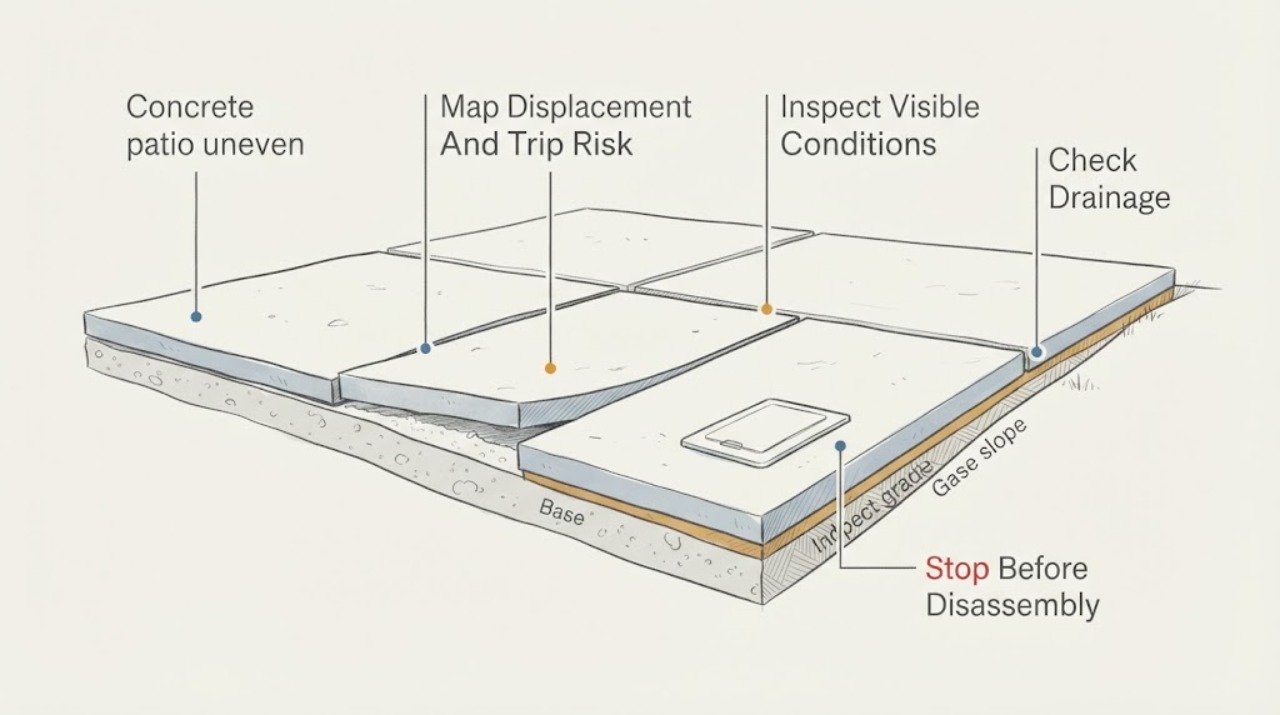
Treat an uneven concrete patio as a trip-and-drainage assessment, not a DIY lifting project. From a safe ground-level position, document where the slab changes elevation, whether the change creates a walking edge, how water moves after rain, and whether cracks or displacement are progressing. A localized, stable low area may be suitable for a professional leveling evaluation; wide movement, active drainage toward the building, spreading cracks, exposed voids, or a sharp trip edge calls for prompt concrete service. Do not lift, cut, grind, excavate, demolish, or make structural conclusions from surface appearance alone.
Work through in order
Diagnostic checks
Use only checks that match the exact appliance or system and its official guide.
-
Check 1
From a stable ground-level position, map where the patio surface changes elevation relative to adjacent slabs, steps, doors, and walking paths. Use room-side or yard-side photos and notes; do not walk repeatedly over a sharp edge, stand on an unstable slab, or assess it from active traffic.
Expected result: The surface is broadly even, has a localized low or raised area, has a displaced joint or edge, or creates a sharp walking transition.
Next step: Keep the area clear, photograph the transitions, and give the location and extent of the unevenness to a concrete professional when requesting an assessment.
Stop if: Stop if the surface shifts, crumbles, has an undermined edge, borders a drop, or can only be assessed from a roadway or other unsafe position.
Why this matters
Why: A localized change may support a focused professional leveling evaluation. A displaced edge or sharp transition is an immediate trip concern, while broad unevenness can indicate a larger base, grade, or drainage issue that should not be judged from one spot.
-
Check 2
From the surface edge or another stable position, observe the pattern of joints, cracks, spalling, and displaced corners. Note whether a crack follows an existing joint, crosses the slab, branches, has an open edge, or appears to be growing; do not widen, fill, drill, grind, or remove concrete to investigate.
Expected result: There are no visible cracks, tight surface cracks, cracks with separated or spalled edges, or multiple intersecting cracks with displacement.
Next step: Photograph the full slab and close views with a scale reference that does not require contact with an unsafe edge, then request a concrete-service evaluation.
Stop if: Stop if concrete is loose, edges are sharp, reinforcement or a void is exposed, dust or fragments are falling, or inspecting the crack would require breaking the slab.
Why this matters
Why: A tight crack and a displaced or intersecting crack represent different levels of uncertainty. Multiple cracks with movement can accompany loss of support, frost or soil movement, or slab distress, but the cause requires professional assessment rather than a surface diagnosis.
-
Check 3
After ordinary rain or by reviewing existing photos, observe where water collects and where it travels around the patio, door threshold, foundation, steps, joints, and downspouts. Do not create a flood test, dig beside the slab, redirect a downspout by cutting, or enter a saturated or unstable area.
Expected result: Water drains away, pools on the patio, runs toward the building, disappears into a joint or edge, or the path cannot be observed safely.
Next step: Record weather, locations of pooling, and any nearby downspout or grade condition for the concrete professional; request prompt service when water reaches doors or the foundation.
Stop if: Stop if water is moving rapidly, the edge is undermined, the area is saturated, utilities are exposed, or inspecting the route would require excavation or entry into unsafe ground.
Why this matters
Why: Pooling or flow toward the building makes drainage part of the service scope. Water disappearing at a displaced edge can indicate a void or erosion concern, while a safe, clear path makes a purely local surface issue more plausible but does not prove the base is sound.
-
Check 4
Compare dated photos or safe observations from different weather and seasons. Note whether the height difference, crack opening, rocking edge, pooling, or door and step relationship changes after freeze, thaw, heavy rain, or dry periods; do not load-test, jack, or pry the slab.
Expected result: The condition appears stable, changes seasonally, or is steadily worsening.
Next step: Share the timeline and photos with the service provider and ask that drainage, support, and the chosen repair scope be assessed together.
Stop if: Stop if movement occurs while observing, the slab rocks or sinks, a void opens, or the area is unsafe to approach.
Why this matters
Why: Seasonal movement can point to moisture, frost, soil, or drainage influences. Steady worsening, a new crack, or a growing trip edge increases the urgency of professional assessment; apparent stability does not confirm a sound base.
-
Check 5
Confirm whether the patio can be described safely with its location, walking impact, displacement pattern, crack pattern, drainage behavior, progression, and nearby doors, steps, utilities, or property edges, without performing lifting, cutting, grinding, excavation, demolition, or traffic-side measuring.
Expected result: The condition is documented from safe ground-level positions, or important areas remain inaccessible or unsafe.
Next step: Request a concrete patio evaluation and provide the photos, timeline, water observations, and trip-risk locations; keep people off the affected path until then.
Stop if: Stop and request professional service immediately for active displacement, a severe trip edge, undermining, rapid progression, or any suspected structural or utility concern.
Why this matters
Why: A clear record helps a concrete professional distinguish leveling or replacement questions from drainage or broader site concerns. An unsafe or incomplete record is a reason to request an on-site assessment, not to improvise a test.
Use your observations
Decision map
Find the observation that best matches what you see, then follow the next safe action.
-
PATH 01Next step
What you see
The patio has a sharp height change, rocking slab, crumbling edge, or a route people must cross.
Do this next
Block the walking route without approaching the unstable edge and request prompt concrete service. Do not try to lift, wedge, grind, or cut the slab.
-
PATH 02Next step
What you see
Water pools against the building, reaches a door or foundation, or disappears into a displaced edge.
Do this next
Request concrete and drainage assessment promptly and provide the water-path observations. Do not excavate, alter the grade, or make a structural diagnosis from the surface.
-
PATH 03Next step
What you see
Cracks intersect with displaced corners, spalling, widening, or an apparent void.
Do this next
Treat the condition as a professional-scope question involving support and slab distress. Keep clear and request an on-site evaluation rather than attempting a surface patch or demolition.
-
PATH 04Next step
What you see
The patio changes with freeze, thaw, rainfall, or dry weather, or the condition is steadily worsening.
Do this next
Give the timeline and photos to the service provider and ask that moisture, drainage, soil movement, and slab condition be considered together.
-
PATH 05Next step
What you see
The unevenness is localized and stable, with no active drainage, undermining, or unsafe access issue.
Do this next
Request a planned concrete-service evaluation to determine whether professional leveling, localized repair, replacement, or no immediate work is appropriate.
-
PATH 06Next step
What you see
The patio borders traffic, a drop, an unstable edge, exposed utilities, or an area that cannot be observed safely.
Do this next
Stop the inspection, keep people away, and ask a qualified professional to assess it on site.
Helpful context
Understand the symptom
Separate a trip hazard from a cosmetic surface issue
An uneven patio can result from settlement, soil or drainage changes, frost movement, slab warping, a damaged joint, or a localized surface condition. The useful first decision is whether people can safely cross it and whether water is being directed toward the building. Keep the assessment observational; the visible surface does not reveal the full condition beneath the slab.
Why cracks and movement change the service path
A tight joint or hairline crack is not the same observation as a displaced edge, an opening that is widening, or a corner that moves under ordinary use. Record the pattern and progression without prying, drilling, or removing concrete. A professional can then decide whether the scope is leveling, drainage correction, localized repair, replacement, or a broader site assessment.
Keep measurements safe and useful
Use photographs from a stable walking area, a straight visual reference placed only where it can be handled safely, and notes about weather and water flow. Do not measure from a roadway, step into an unstable edge, lift a slab, or create a test trench. Mark the patio as a trip area and keep children, guests, and wheeled equipment away until it is assessed.
When checks do not resolve it
Need a professional?
Call a qualified concrete professional promptly for an uneven patio that creates a trip hazard, shows active displacement, has widening or intersecting cracks, exposes a void or undermined edge, sends water toward the building, or changes rapidly. Include drainage or structural specialists when the site conditions require them.
Have this ready
- Provide the patio location, safe ground-level photos, walking-path impact, displacement map, crack and joint pattern, pooling and drainage observations, weather or seasonal timeline, nearby doors and steps, and any exposed utility or property-edge concern.
Common questions
FAQ
Is an uneven concrete patio always a foundation problem?
No. It can involve settlement, drainage, soil or frost movement, slab distress, joint conditions, or a localized surface issue. A safe observation record helps a professional determine the scope; the surface alone is not enough for a structural conclusion.
Can I level a sunken patio slab myself?
This article does not recommend lifting, jacking, drilling, cutting, or injecting beneath the slab as a homeowner task. Request a professional assessment that considers cracks, support, drainage, utilities, and the adjacent grade.
What should I photograph before requesting a quote?
From safe ground-level positions, photograph the whole patio, each height transition, crack and joint patterns, nearby doors and steps, pooling or flow paths, and any change shown by older dated photos. Keep people off unstable or sharp edges while documenting it.
When is an uneven patio urgent?
Request prompt service when the surface creates a trip hazard, rocks or sinks, has a widening or displaced crack, exposes a void, sends water toward the building, changes quickly, or cannot be inspected safely.
Read the exact guide
Official sources
- Full-Depth Repairs: Selection of Candidate ProjectsFederal Highway Administration · Used only for general observation language about crack patterns, lack of support, movement, and distress severity; a residential patio requires a site-specific professional assessment.
- Slips/Trips/Falls: Hospital-Wide HazardsOccupational Safety and Health Administration · Supports the article's safety framing for keeping walking areas clear and addressing uneven surfaces; it is not a concrete repair specification for a residential patio.
Community feedback
Share a repair observation
Share a plain-text repair observation. Accepted observations are published automatically; this page may take a moment to update.