
On this page
Start here
Quick answer
A GFCI outlet keeps tripping when it detects current leaving the intended circuit path. Moisture, a damaged cord or appliance, a downstream outlet or load, a defective GFCI, or wiring trouble can all be involved. First stop using the affected load and look from a dry, safe position for water, discoloration, looseness, warmth, burning odor, smoke, or sparks. If the outlet and area look normal, unplug loads without touching wet equipment, then make one reset attempt according to the outlet instructions. If it trips again, will not reset, the breaker also trips, or the cause is not obvious, leave the circuit off and call a licensed electrician. Do not open the outlet or panel, touch wiring, measure live parts, bypass the GFCI, or repeatedly reset it.
Before you begin
Safety first
- This article permits only dry, non-contact observation, safe unplugging of an accessible dry load, and one normal TEST/RESET check when no warning sign is present. It does not authorize opening an outlet or panel, touching conductors, live measurement, rewiring, repeated resets, bypassing protection, or testing a suspect load elsewhere.
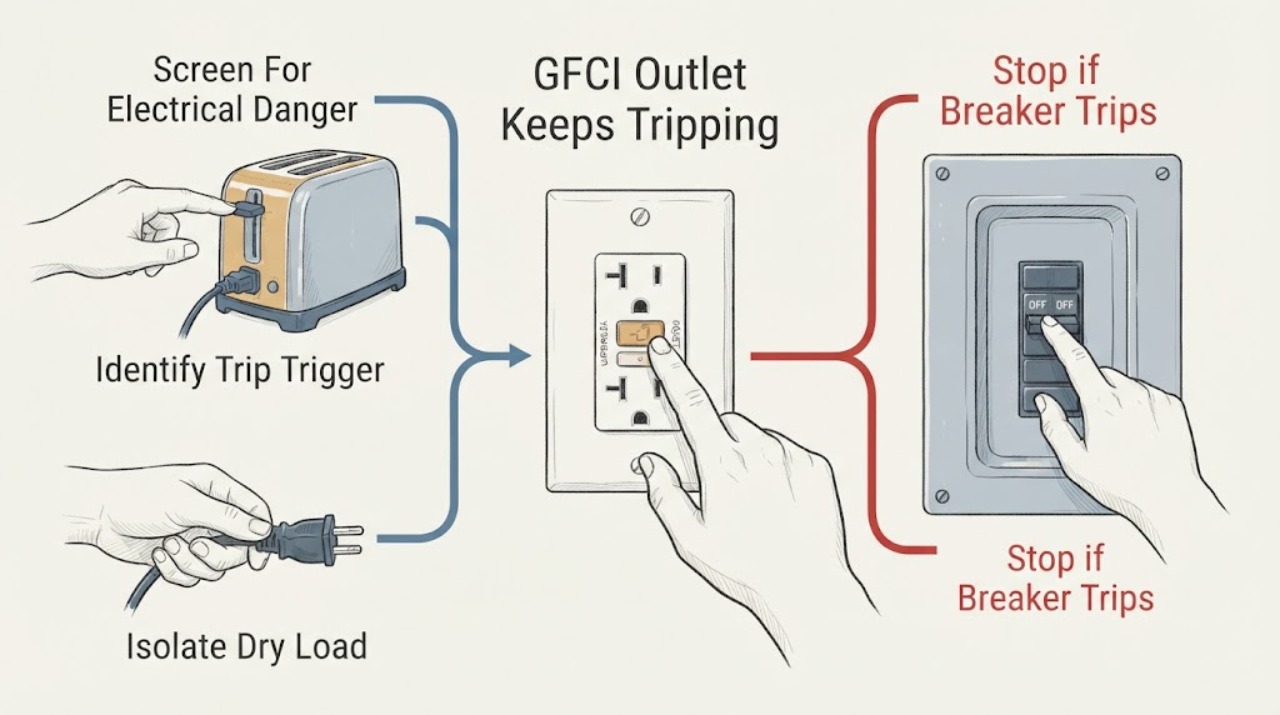
Work through in order
Diagnostic checks
Use only checks that match the exact appliance or system and its official guide.
-
Check 1
Stop using the affected outlet and observe it, nearby plugs, and the surrounding wall from a dry, safe position without touching them. Look for water, a wet floor, discoloration, melted plastic, looseness, warmth, burning odor, smoke, sparks, crackling, or exposed damage.
Expected result: The area is dry and shows no visible warning sign, or there is moisture, heat, odor, smoke, arcing, fire, shock, or visible damage.
Next step: For smoke, fire, arcing, shock, or immediate danger, move away, keep others away, and call emergency responders. For water or visible damage, keep clear and arrange urgent electrical service after the area is safe.
Stop if: Do not touch wet equipment or an energized outlet, spray it, use water on an electrical fire, or approach a hot, smoking, sparking, or damaged device.
Why this matters
Why: A clean visual check permits only the next low-risk isolation step; any warning sign can represent shock or fire risk and is not a reset experiment.
-
Check 2
From a safe position, record what was plugged into the GFCI or any downstream outlet when it tripped, whether the trip happened at plug-in, startup, or during operation, and whether only one outlet or several lost power. Do not recreate the event by plugging loads back in.
Expected result: One appliance, cord, extension lead, or outdoor/wet load was present at the trip, or the GFCI trips with no identifiable load or affects several downstream outlets.
Next step: Leave the suspected load unplugged and label it unsafe to use until inspected. If the symptom is no-load, multi-outlet, or unclear, leave the circuit off and arrange a licensed electrician.
Stop if: Do not use an extension lead to bypass protection, substitute a wet or damaged device, or keep trying different loads to make the GFCI stay on.
Why this matters
Why: A repeatable single-load association makes that device, cord, or moisture exposure the leading suspect; a no-load or multi-outlet symptom points more toward the GFCI, downstream wiring, moisture, or circuit-level fault.
-
Check 3
Only if the outlet, plug, floor, and hands are dry and there is no visible damage, unplug the load that was associated with the trip by holding its insulated plug body. Leave all suspect devices and cords disconnected; do not pull on a cord or reach behind equipment where water or damaged conductors may be present.
Expected result: The GFCI remains reset with the suspect load disconnected, or it trips or will not reset even with the load disconnected.
Next step: Keep the suspect load out of service for manufacturer or electrician inspection. If the GFCI still trips or cannot reset, stop using that circuit and call a licensed electrician.
Stop if: Do not unplug anything from standing water, touch a damaged plug, remove a cover, or handle conductors or a wet appliance.
Why this matters
Why: Staying on implicates the disconnected load, cord, or its moisture exposure; tripping without it means the fault may be in the GFCI, a downstream load, wiring, or circuit protection.
-
Check 4
If the outlet and area are dry, no damage is visible, and connected loads are disconnected, press RESET once using the outlet's normal button. If it resets, use the outlet's built-in TEST button only as the manufacturer's instructions describe, then press RESET once to confirm the intended test response.
Expected result: RESET engages and the TEST action removes power as expected, or RESET will not engage, the TEST result is abnormal, or the GFCI trips again.
Next step: If the response is abnormal or the outlet trips again, leave it unused and contact a licensed electrician. If it remains on with no load, keep suspect equipment disconnected and have it assessed before reuse.
Stop if: Do not hold RESET, repeatedly cycle TEST/RESET, reset a tripped breaker over and over, or continue testing a device that becomes warm, smells burnt, sparks, or trips.
Why this matters
Why: A correct single test response shows only that the device responded during that check; it does not clear a load or wiring fault. Failure to reset, an abnormal test, or another trip means protection must not be bypassed.
-
Check 5
Without removing any plate or cover, note whether nearby ordinary outlets, exterior receptacles, lights, or equipment also lost power and whether the breaker handle appears tripped or partly displaced. Do not touch wiring or force a breaker handle.
Expected result: Only the GFCI is affected, several downstream outlets are dead, or the circuit breaker is tripped or will not stay on.
Next step: Record the locations and leave the affected circuit unused. If the breaker will not stay on or trips again, do not reset it again; call a licensed electrician.
Stop if: Do not remove the panel cover, expose the breaker interior, operate a hot or damaged breaker, or make any wiring change.
Why this matters
Why: A GFCI can protect downstream outlets, while a breaker symptom adds a circuit-level overload or fault possibility; the pattern helps the electrician locate the protected section but does not identify a repair for the user.
-
Check 6
Prepare the electrician handoff: record the GFCI location, the outlet and breaker labels if visible, trip timing, connected loads, weather or water exposure, prior replacement, and any indicator-light behavior. Do not infer line/load wiring from the front or attempt to verify it yourself.
Expected result: The GFCI was recently installed/replaced, the trip began after work or moisture exposure, or no clear trigger is known.
Next step: Give the observations to a licensed electrician and keep the affected circuit off until inspected. Ask the electrician to verify GFCI protection, outlet/wiring condition, downstream loads, and breaker behavior.
Stop if: Do not open the outlet or panel, swap line and load conductors, measure live voltage/current, or bypass the GFCI or breaker.
Why this matters
Why: Recent work raises the possibility of an installation or line/load issue; moisture, unknown triggers, or repeat trips raise the need for circuit and device testing by a professional.
Use your observations
Decision map
Find the observation that best matches what you see, then follow the next safe action.
-
PATH 01Safety boundary
What you see
There is water, a wet device, burning odor, warmth, discoloration, smoke, sparks, arcing, shock, exposed damage, or fire.
Do this next
Move away and keep others away. Call emergency responders for fire, smoke, arcing, shock, or immediate danger; arrange urgent service for water or damaged electrical equipment once safe.
Why this path and its safety boundary
Why it matters: The GFCI symptom is accompanied by a potential shock or electrical-fire hazard.
Safety stop: Do not touch the outlet, wiring, breaker, or wet equipment; do not use water on energized electrical equipment.
-
PATH 02Safety boundary
What you see
The GFCI stays on only after one appliance, cord, extension lead, or wet/outdoor load is disconnected.
Do this next
Leave the load unplugged and have it inspected or replaced through its manufacturer or a qualified professional; do not test it on another unprotected outlet.
Why this path and its safety boundary
Why it matters: That load or its cord/moisture exposure is the leading suspect, although the circuit still needs protection.
Safety stop: Do not reuse a load with a damaged cord, cracked casing, water exposure, heat, or odor.
-
PATH 03Safety boundary
What you see
The GFCI trips or will not reset with connected loads disconnected, or multiple downstream outlets are affected.
Do this next
Leave the circuit off and have a licensed electrician inspect and test the GFCI, circuit breaker, outlet, downstream wiring, and loads.
Why this path and its safety boundary
Why it matters: A GFCI/device fault, hidden moisture, downstream wiring/load, or circuit-protection problem remains possible.
Safety stop: Do not keep resetting the GFCI or breaker and do not open any outlet or panel.
-
PATH 04Safety boundary
What you see
The repeated trips began after the GFCI outlet was installed or replaced, or the device will not reset from its first use.
Do this next
Stop using the outlet and call a licensed electrician to verify the installation and protection.
Why this path and its safety boundary
Why it matters: Incorrect line/load connections, no supply power, or a device problem may be involved; the front buttons cannot safely confirm the wiring.
Safety stop: Do not remove the receptacle or swap conductors yourself.
-
PATH 05Safety boundary
What you see
The GFCI trips again later under similar conditions, or repeated trips have no clear trigger.
Do this next
Keep the affected circuit unused and arrange licensed electrical diagnosis.
Why this path and its safety boundary
Why it matters: The recurring condition may be a device, moisture, wiring, or load fault rather than a nuisance to override.
Safety stop: Do not defeat GFCI protection with an adapter, extension lead, replacement receptacle, or repeated resets.
Helpful context
Understand the symptom
Why a repeated trip matters
A GFCI compares current leaving and returning on a circuit and disconnects power when it detects an imbalance. That imbalance can be caused by water, a damaged appliance or cord, or a fault in the outlet or downstream wiring. A normal-looking outlet does not prove the circuit is safe; repeated tripping is a reason to isolate the load and escalate rather than hold the RESET button. GFCI protection can extend to ordinary outlets downstream on the same circuit.
Keep the check non-contact
The safe user checks are visual and observational: identify what was operating when the trip occurred, inspect the dry exterior for obvious damage, and unplug a suspect load only when the plug and surrounding area are dry and safe to reach. Do not remove the wall plate, pull the receptacle from the box, inspect terminals, open the service panel, or test voltage. A recent outlet replacement is important history because line/load reversal or another installation fault may prevent a safe reset and requires a qualified electrician.
When the answer is professional service
A GFCI that trips again with no connected load, refuses to reset, or trips with more than one load can indicate a defective device, hidden moisture, downstream wiring damage, or another circuit fault. The circuit breaker, outlet, and wiring are connected parts of the diagnosis, but their covers and conductors are not user-serviceable in this guide. A licensed electrician can identify the protected circuit, test it safely, correct wiring, and replace a failed device using the exact local requirements.
Safety boundary
Stop conditions
- Stop immediately and move away for smoke, fire, arcing, sparks, shock, burning odor, hot or discolored equipment, exposed conductors, or immediate danger; call emergency responders as appropriate.
- For water, wet equipment, or a wet floor near the outlet, do not touch the device or enter an unsafe area; isolate power only from a safe location and arrange urgent electrical service.
- Do not open the outlet, wall box, breaker panel, or service equipment; touch wiring; measure live voltage/current; swap line/load conductors; bypass the GFCI; or use a replacement or extension lead to defeat protection.
- Do not repeatedly reset the GFCI or breaker, keep reconnecting suspect loads, or operate a device with a damaged cord, cracked casing, water exposure, heat, odor, or abnormal sound. Persistent or unexplained trips require a licensed electrician.
When checks do not resolve it
Need a professional?
Safety scope: This article permits only dry, non-contact observation, safe unplugging of an accessible dry load, and one normal TEST/RESET check when no warning sign is present. It does not authorize opening an outlet or panel, touching conductors, live measurement, rewiring, repeated resets, bypassing protection, or testing a suspect load elsewhere.
Common questions
FAQ
Why does a GFCI outlet keep tripping with nothing plugged into it?
A hidden downstream load, moisture, a defective GFCI, wiring trouble, or a circuit-level problem may remain. Leave the circuit off and have a licensed electrician inspect it rather than repeatedly resetting the outlet.
Can I keep resetting a GFCI if it eventually stays on?
No. One normal reset and the manufacturer-directed TEST/RESET check are enough for a dry, undamaged outlet with loads disconnected. Repeated trips indicate a fault that should be isolated and professionally evaluated.
Does a tripped GFCI mean the circuit breaker is bad?
Not necessarily. A GFCI responds to leakage current, while a breaker responds to circuit protection conditions; either may be involved along with an appliance, downstream outlet, moisture, or wiring. Do not open the panel—record which devices and outlets are affected for an electrician.
When is a GFCI trip an emergency?
Treat smoke, fire, arcing, sparks, shock, burning odor, hot or discolored equipment, exposed damage, or water around electrical equipment as an immediate stop condition. Move away and call emergency responders for immediate danger; do not touch or wet the equipment.
Read the exact guide
Official sources
- GFCI Buyers GuideLeviton · Manufacturer guide used for general GFCI behavior and safety checks; product-specific instructions and licensed installation apply.
- What To Do When Your GFCI Outlet TripsLeviton · General Leviton consumer guidance for GFCI receptacle behavior; exact device instructions and local electrical requirements control.
- Ground Fault Circuit Interrupters (GFCI)Electrical Safety Foundation International · Electrical-safety education used for non-contact explanation and stop boundaries; local code and a qualified electrician control work.
Community feedback
Share a repair observation
Share a plain-text repair observation. Accepted observations are published automatically; this page may take a moment to update.