
On this page
Start here
Quick answer
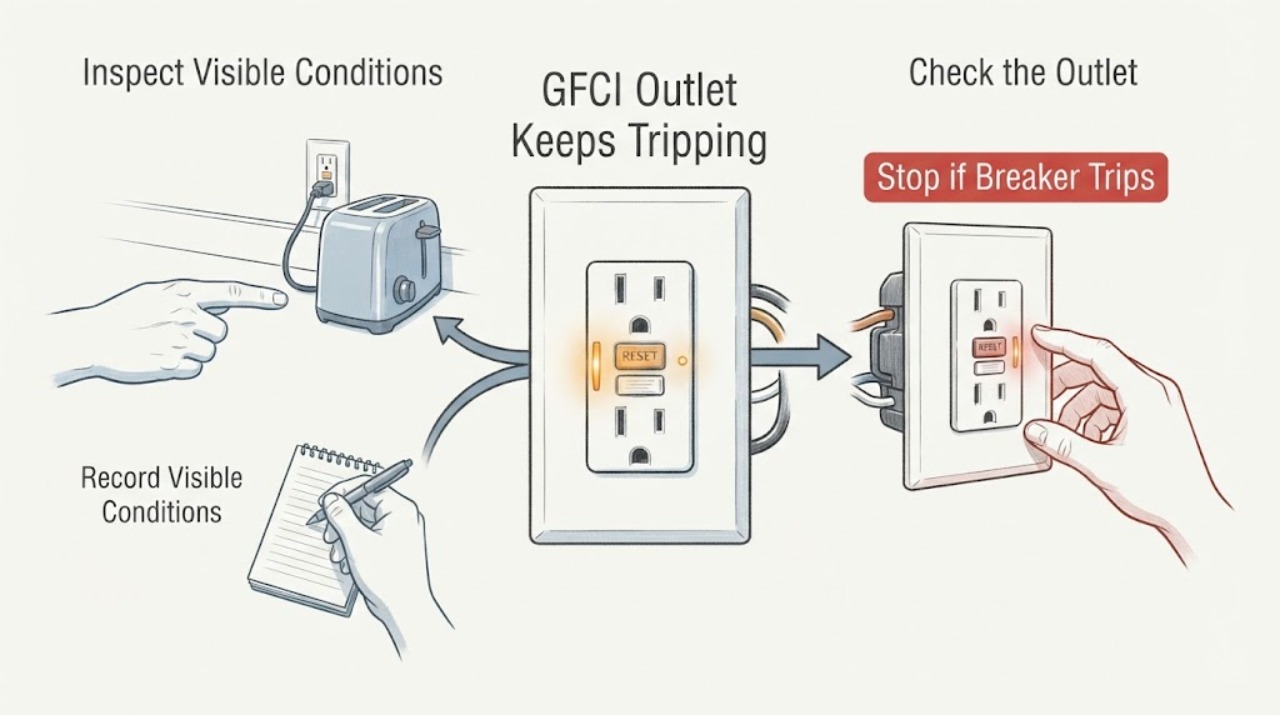
A GFCI that keeps tripping is detecting a possible ground fault, moisture path, damaged load, wiring problem, overload interaction, or a failed device. Do not repeatedly press RESET, open the outlet or panel, touch wiring, unplug equipment, or measure voltage. From a dry, safe position, note when the trip occurs, whether water or a damaged cord is nearby, whether the outlet is warm or discolored, and whether downstream outlets also lost power. Only if there is no moisture, odor, heat, discoloration, smoke, arcing, damage, or other hazard and the manufacturer's instructions permit it, a dry-handed user may try one normal RESET; if it trips again or will not hold, leave it alone and call a qualified electrician.
Work through in order
Diagnostic checks
Use only checks that match the exact appliance or system and its official guide.
-
Check 1
Stop using the GFCI circuit and keep people, children, and pets away without touching the outlet, plug, cord, switch, breaker panel, or wiring. From a safe distance, look for smoke, flame, arcing, moisture, discoloration, warping, or a hot-looking area.
Expected result: No visible hazard is present, or smoke, flame, arcing, water, discoloration, heat, or a burning odor is present.
Next step: If a hazard is present, leave the area and contact emergency services or qualified electrical help from a safe location. If not, continue with non-contact timing and load observations while leaving the circuit unused.
Stop if: Stop immediately for smoke, flame, arcing, crackling, rapidly increasing odor, water near electrical equipment, or a hot or distorted outlet; do not approach to shut it off.
Why this matters
Why: A clean-looking outlet may still have a ground fault; any visible hazard makes this an urgent electrical or fire-safety event rather than a reset problem.
-
Check 2
Without operating any controls or touching equipment, record when the GFCI trips: immediately, after a particular appliance starts, after water or rain, when a downstream outlet is used, or with no obvious event.
Expected result: The trip follows one identifiable event, follows moisture, affects downstream outlets, or occurs randomly or with every attempted restoration.
Next step: Keep the circuit and suspected equipment unused and give the timing record to the electrician. Do not recreate the event, unplug a load, or move a wet or damaged device.
Stop if: Stop recording if the smell strengthens, a device becomes hot, water spreads, or any sound changes to buzzing, sizzling, popping, or arcing.
Why this matters
Why: A repeatable event can identify a suspected load or moisture condition for an electrician; a random or every-time trip can involve wiring, a safety fault, or a failing GFCI and should not be repeatedly tested.
-
Check 3
From a safe position, survey the GFCI location and any visibly connected or downstream loads for damaged cords, wet housings, loose-looking plug fit, heat damage, or abnormal status indicators. Do not pull plugs, test a device, open a cover, or inspect inside the outlet.
Expected result: A connected or downstream item appears damaged or wet, the outlet or plug fit appears warm or loose, or no visible damage is found.
Next step: Keep everything unused and tell the electrician exactly what was visible and where it was connected. Do not isolate the load by unplugging it yourself after a repeated trip.
Stop if: Stop for water, melted plastic, smoke, a damaged cord, heat, visible conductor, sparks, or any need to touch the load or outlet.
Why this matters
Why: A damaged or wet load can create leakage current; a loose, warm, or discolored receptacle can indicate a connection or device problem; no visible defect does not clear hidden wiring.
-
Check 4
Only if the GFCI and surrounding area are completely dry, cool, intact, free of odor or noise, and the manufacturer's instructions allow a reset, make one normal RESET attempt with dry hands and without adding or removing any load. Do not press TEST as a troubleshooting shortcut.
Expected result: The GFCI holds, trips immediately again, will not reset, or shows a fault indicator.
Next step: If it trips, will not reset, or shows a fault, stop and arrange qualified electrician service. If it holds, do not reconnect loads or assume the fault is gone; monitor without operating the circuit and arrange service if the trip recurs.
Stop if: Do not attempt this check at all if there is moisture, warmth, discoloration, odor, smoke, damage, arcing, a recent shock, or uncertainty about the device instructions.
Why this matters
Why: A held reset does not prove the circuit is safe; a repeat trip, failed reset, or fault indicator confirms that the protection device or circuit needs diagnosis.
-
Check 5
Without accessing the panel or wiring, check whether nearby outlets, lights, or fixtures also lost power and whether the affected area is wet or outdoors. Record whether the GFCI protects a bathroom, kitchen, laundry, garage, basement, or outdoor location.
Expected result: Only the GFCI outlet is affected, several downstream outlets are affected, or the wider area or circuit is also without power.
Next step: Leave the affected circuit unused and provide the scope to an electrician. Do not operate a breaker, open a panel, or use an extension cord to bypass the tripped circuit.
Stop if: Stop if any affected area is wet, there is smoke or heat, a person feels tingling, or identifying the circuit requires touching electrical equipment.
Why this matters
Why: A GFCI can protect downstream outlets, so a broader loss may be one protected branch; a wider outage can involve another protective device or supply issue that cannot be identified safely from the receptacle.
-
Check 6
Prepare the electrician handoff with the outlet location, GFCI markings or indicator seen from a safe distance, trip timing, weather or water exposure, connected and downstream loads, one-reset result if safely permitted, affected scope, and all odor, heat, sound, or damage observations.
Expected result: The GFCI continues to trip, refuses to reset, holds only temporarily, or the cause remains unknown.
Next step: Keep the circuit unused and arrange qualified electrician service. If smoke or fire appears while waiting, evacuate and contact emergency services from a safe location.
Stop if: Stop all troubleshooting for smoke, flame, arcing, water near electrical equipment, shock or tingling, or unsafe access.
Why this matters
Why: Persistent or unexplained tripping requires inspection of the GFCI, wiring, connected loads, and downstream branch; a temporary hold is not proof of a safe repair.
Use your observations
Decision map
Find the observation that best matches what you see, then follow the next safe action.
-
PATH 01Next step
What you see
Smoke, flame, arcing, a burning odor, a hot or discolored outlet, water near electrical equipment, or a shock or tingling sensation is present.
Do this next
Stop immediately, leave the area, keep others away, and obtain emergency fire or qualified electrical help from a safe location. Do not reset, unplug, or approach the circuit.
-
PATH 02Next step
What you see
The GFCI trips immediately or again after one permitted reset, or will not reset.
Do this next
Leave the circuit unused and arrange a qualified electrician to inspect the GFCI, wiring, downstream outlets, and connected loads. Do not repeatedly reset it or open the panel.
-
PATH 03Next step
What you see
The trip occurs when one identifiable appliance or downstream load is used, but there is no visible heat, water, odor, or damage.
Do this next
Do not recreate the trip or unplug the load after the event. Record the load and timing and have an electrician assess the device and protected circuit.
-
PATH 04Next step
What you see
The GFCI is in a damp or wet location, or the trip followed rain, splashing, condensation, or a wet appliance.
Do this next
Keep away and leave the circuit unused. Do not wipe, dry, reset, or move wet equipment; have qualified electrical service assess moisture and ground-fault risk.
-
PATH 05Next step
What you see
The GFCI holds after one safe, model-permitted reset and there are no warning signs.
Do this next
Do not treat the hold as a repair or reconnect loads. Monitor without reproducing the fault and arrange service if the trip recurs or the cause remains unknown.
Helpful context
Understand the symptom
Repeated GFCI trips are a safety signal, not a nuisance to defeat. The device can protect against ground-fault current from water or damaged equipment, and a receptacle GFCI can protect outlets farther downstream on the same branch. The trip may therefore be caused by something connected elsewhere, not only the buttoned device on the wall.
Start with a non-contact record. Note whether the trip happens immediately, when a particular appliance starts, after water or rain, or without an obvious event. From a safe distance, look for moisture, discoloration, warmth, a loose-looking plug, damaged cords, buzzing, crackling, sparks, or smoke. Do not touch or reproduce any of those conditions.
A single reset is only a limited, model-approved check when the area and connected equipment are visibly dry, cool, undamaged, and free of odor or electrical noise. If the GFCI trips again, will not reset, or the cause is not obvious, leave the circuit unused and have a qualified electrician inspect the receptacle, wiring, downstream outlets, and loads.
Safety boundary
Stop conditions
- Stop immediately and leave the area for smoke, flame, visible arcing, popping, rapidly worsening odor, or an unsafe evacuation route.
- Stop for moisture, a wet or damaged device, warm or discolored receptacle, tingling or shock, buzzing or sizzling, exposed wiring, or repeated tripping.
- Do not press RESET more than once, press TEST to force a result, pull plugs, operate a breaker, open the outlet or panel, touch wiring, measure voltage, or bypass the protection.
When checks do not resolve it
Need a professional?
Arrange qualified electrician service for repeated or unexplained GFCI trips, a failed reset, a fault indicator, a loose plug fit, warm or discolored outlet, buzzing, sparks, or suspected wiring or load damage., Seek emergency fire assistance for smoke, flame, visible arcing, rapidly increasing burning odor, or an unsafe area; evacuate and stay out., Do not repeatedly reset the GFCI, unplug or move a wet or damaged load, open the outlet or panel, touch wiring, measure voltage, bypass the GFCI, or use an extension cord to defeat the protection.
Common questions
FAQ
Why does a GFCI keep tripping?
It may be detecting leakage current from water, a damaged appliance or cord, a downstream load, wiring, or the GFCI itself. Record when the trip occurs, but do not repeatedly reset or reproduce it.
Can I reset a GFCI that keeps tripping?
Only one normal reset is reasonable when the area and equipment are dry, cool, intact, and free of odor, damage, and electrical noise, and the manufacturer's instructions permit it. If it trips again or will not reset, leave it unused and call a qualified electrician.
Could something downstream cause the GFCI to trip?
Yes. A receptacle GFCI can protect outlets farther downstream on the same branch. Do not unplug or test downstream devices after repeated trips; record which outlets lost power and give that information to the electrician.
When is a GFCI trip an emergency?
Smoke, flame, visible arcing, popping, rapidly increasing burning odor, a hot or distorted outlet, water near electrical equipment, or a shock or tingling sensation requires immediate withdrawal and appropriate emergency or qualified electrical help. Do not approach or reset the circuit.
Read the exact guide
Official sources
- Ground Fault Circuit Interrupters (GFCI)Electrical Safety Foundation International · GFCI ground-fault, moisture, shock-protection, and qualified installation guidance
- GFCI Fact SheetU.S. Consumer Product Safety Commission · CPSC GFCI ground-fault protection, water proximity, downstream protection, testing, and qualified service guidance
- GFCI TripsLeviton · Leviton GFCI trip causes, visual inspection, connected loads, and electrician escalation guidance
- Electrical Safety: ChecklistNational Fire Protection Association · NFPA warning signs for qualified electrician service, including warm or discolored outlets and burning smell
- Home Fire Escape PlansU.S. Fire Administration · U.S. Fire Administration evacuation and fire-emergency guidance
- Don’t Overload Your HomeElectrical Safety Foundation International · ESFI receptacle overload and wiring warning signs
Community feedback
Share a repair observation
Share a plain-text repair observation. Accepted observations are published automatically; this page may take a moment to update.