
On this page
Start here
Quick answer
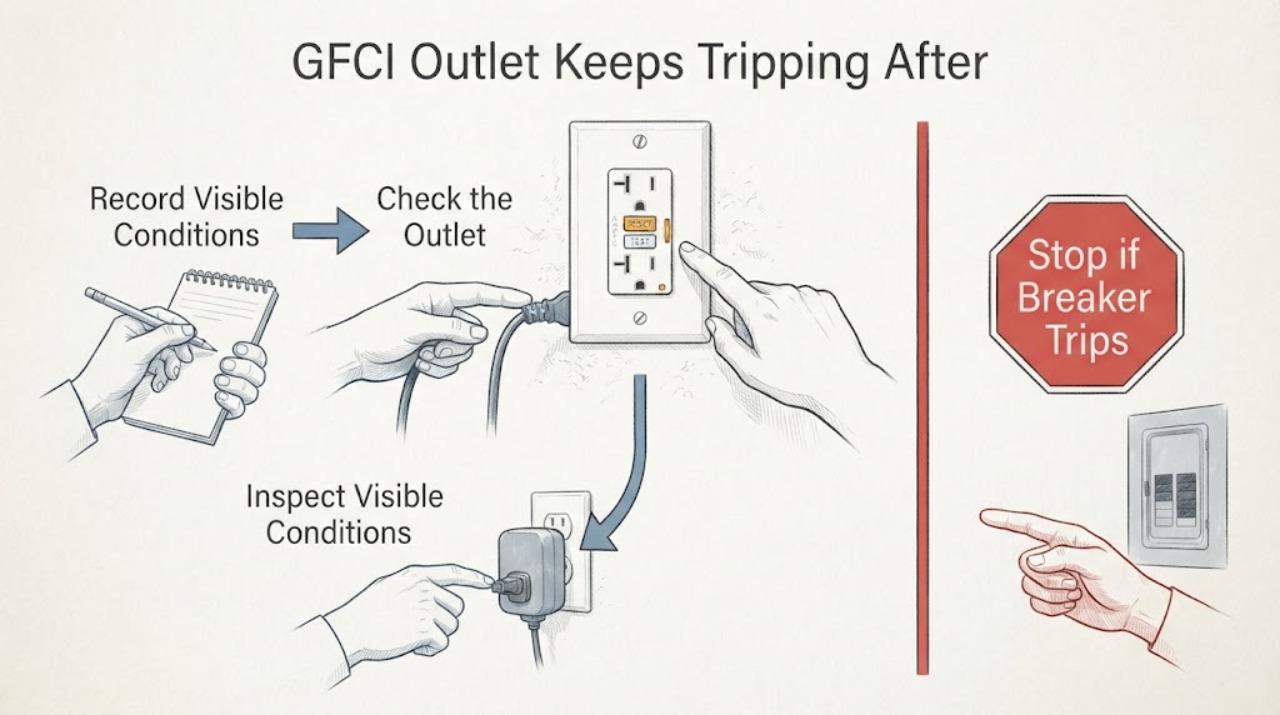
A GFCI circuit that trips only after several hours is still detecting a fault or overload condition; the delay does not make it safe to keep resetting. First record whether the GFCI outlet, the panel breaker, or both have opened, what was running, and whether the event follows moisture, heat, or a particular appliance cycle. From a dry position, inspect the outlet, plug, cord, downstream outlets, and nearby wet areas for visible damage. If there is no hazard and the manufacturer's instructions allow it, make one reset; if it trips again, will not reset, or any device, cord, outlet, wall, or floor is warm, discolored, wet, sparking, or damaged, leave the circuit off and call a qualified electrician. Do not remove the cover, loosen wires, test live voltage, bypass GFCI protection, or repeatedly reset the breaker.
Work through in order
Diagnostic checks
Use only checks that match the exact appliance or system and its official guide.
-
Check 1
At the next safe opportunity, record the time from reset to trip, whether the GFCI RESET button popped, whether a panel breaker moved, the appliance or load in use, and the operating stage when the event occurred. Do not reset anything while smoke, heat, water, damage, or an electrical odor is present.
Expected result: A trip during a delayed appliance cycle, after heating begins, or when a pump or motor starts points toward a time- or load-dependent fault. A trip with no load change or at a similar elapsed time each time may involve moisture, a device fault, wiring, or the protective device itself.
Next step: Keep the suspect load disconnected when that can be done without entering a wet area or handling damaged equipment, and give the sequence to an electrician. Do not recreate the delay as a test.
Why this matters
Why: The several-hour condition narrows the sequence but does not identify a part; timing and load history are more useful than repeated resets.
-
Check 2
From the front of the device and without removing its plate, identify whether the kitchen or other GFCI receptacle shows RESET and TEST buttons, whether its indicator is normal or warning, and whether other nearby outlets also lost power. Check the panel only for the external position of a clearly labeled breaker; do not open the panel.
Expected result: A popped GFCI button with downstream outlets off suggests ground-fault protection opened at that device. A panel breaker in the trip position may indicate an overload, short, ground fault, or dual-function protection. Several affected outlets can share one branch circuit even when only one receptacle has TEST and RESET.
Next step: If there is no hazard and the manufacturer's instructions permit a reset, make one normal reset of the appropriate external control. If the device will not reset or opens again, leave it off and call an electrician.
Why this matters
Why: Locating the protective device distinguishes a receptacle event from a branch-circuit event without touching live parts.
-
Check 3
With power left off after a trip, visually inspect the GFCI face, plug, cord, and appliance exterior, plus any downstream plug and cord that was in use. Look for discoloration, melting, scorch marks, fraying, a loose plug fit, moisture, or an appliance that is unusually warm; do not touch a hot or wet item.
Expected result: A warm or discolored outlet, loose plug, damaged cord, wet appliance, or scorching is an immediate stop condition. If the visible equipment looks normal but the circuit still trips, the fault may be inside the appliance, receptacle, downstream wiring, or circuit.
Next step: Keep damaged or suspect equipment disconnected without handling it in water and arrange qualified electrical or appliance service. Do not substitute a different outlet, extension cord, or adapter to continue the test.
Why this matters
Why: A visual defect can identify the load that must remain out of service, but a clean exterior does not clear the circuit.
-
Check 4
Inspect the surrounding sink, counter, cabinet, wall, floor, and any outdoor or damp-side outlet from a dry position. Look for a drip, condensation, splash path, standing water, wet wall, or water entering a plug or appliance; do not reach into water or wipe a live device.
Expected result: A moisture pattern that appears only after hours can explain a delayed ground-fault trip. Water near electrical equipment, a wet cabinet, or a hidden leak is unsafe even if the outlet face appears normal. No visible moisture does not rule out an internal fault.
Next step: Keep the circuit off and obtain electrical help; address a plumbing leak separately without restoring power in a wet area. Do not dry, open, or relocate energized equipment as a test.
Why this matters
Why: Water and electrical equipment can create the unintended current path that GFCI protection is intended to interrupt.
-
Check 5
If the outlet, cords, appliances, and surrounding area are dry and undamaged, note whether the trip follows one known load, multiple loads together, or no identifiable load. Keep the suspect appliance unplugged when the plug and receptacle are safe to handle; do not reconnect it to see whether the delayed trip returns.
Expected result: One load associated with the event points toward that appliance, its cord, or moisture in its operating path. Multiple loads together can reveal a branch-circuit load condition. No clear load association points toward wiring, a protective-device fault, or a fault that appears only under heat or moisture.
Next step: Arrange appliance repair for a device-specific pattern and electrician service for an unexplained, repeated, circuit-wide, or no-load trip. Do not use an extension cord or bypass protection to continue operation.
Why this matters
Why: Removing the trigger from service is safer than using the GFCI as a repeated experiment.
-
Check 6
Prepare a service handoff with the GFCI location and label, whether the receptacle or panel breaker opened, elapsed time, load and cycle stage, other outlets affected, visible cord or outlet condition, moisture or heat observations, recent work, and whether one safe reset was attempted.
Expected result: A complete sequence helps the electrician separate a device fault, downstream ground fault, overload or short, moisture path, defective GFCI, or branch-circuit wiring problem without asking the household to reproduce the event.
Next step: Leave the circuit off if the trip repeats or the cause is unclear and call a qualified electrician. Keep covers, wires, and the GFCI mechanism untouched.
Why this matters
Why: The delay and protective-device behavior are key evidence, while the absence of a visible defect is not proof that the circuit is safe.
Use your observations
Decision map
Find the observation that best matches what you see, then follow the next safe action.
-
PATH 01Next step
What you see
The trip occurs after a particular appliance begins a delayed cycle or reaches a heating, pump, or motor stage.
Do this next
Arrange qualified service and follow the exact model guidance.
Why this path and its safety boundary
Why it matters: Keep that appliance disconnected when safe and arrange appliance and electrical diagnosis. Do not reconnect it to recreate the several-hour event.
-
PATH 02Next step
What you see
The GFCI receptacle button opens but the panel breaker stays in its normal position.
Do this next
Arrange qualified service and follow the exact model guidance.
Why this path and its safety boundary
Why it matters: Treat it as a ground-fault protection event at the receptacle or its downstream loads. Perform only a visual check and one manufacturer-allowed reset when dry and undamaged; repeat trips need an electrician.
-
PATH 03Next step
What you see
The panel breaker opens, or both the breaker and GFCI receptacle change state.
Do this next
Arrange qualified service and follow the exact model guidance.
Why this path and its safety boundary
Why it matters: Leave the circuit off after a repeat event. The branch may have an overload, short, ground fault, or dual-function protective-device condition requiring qualified diagnosis.
-
PATH 04Next step
What you see
The outlet, plug, cord, wall, floor, or appliance is warm, discolored, melted, wet, scorched, or damaged.
Do this next
Arrange qualified service and follow the exact model guidance.
Why this path and its safety boundary
Why it matters: Stop immediately and keep people away from the area. Do not touch or move the damaged equipment; obtain qualified electrical help and address any water source separately.
-
PATH 05Next step
What you see
Several outlets lose power or the event occurs with more than one load on the circuit.
Do this next
Arrange qualified service and follow the exact model guidance.
Why this path and its safety boundary
Why it matters: Treat the issue as branch-circuit related until an electrician proves otherwise. Do not redistribute loads with extension cords or bypass GFCI protection.
-
PATH 06Next step
What you see
The trip repeats with no identifiable load or after one safe external reset.
Do this next
Arrange qualified service and follow the exact model guidance.
Why this path and its safety boundary
Why it matters: Leave the protective device off and arrange a qualified electrician to inspect the GFCI, downstream circuit, wiring, moisture path, and connected loads.
-
PATH 07Next step
What you see
There is smoke, flame, active sparking, an electrical odor, a hot panel, exposed wiring, or someone may be in contact with energized water or equipment.
Do this next
Arrange qualified service and follow the exact model guidance.
Why this path and its safety boundary
Why it matters: Leave the area and obtain emergency assistance from a safe location. Do not operate switches, touch equipment, or attempt another reset.
Helpful context
Understand the symptom
A trip after several hours is a timing clue, not a harmless nuisance. Heat, moisture, a device that begins a delayed cycle, insulation breakdown, or a changing load can expose a fault later in operation. The first distinction is whether the GFCI receptacle, a panel GFCI breaker, or a standard breaker opened, because one protective device may also supply downstream outlets.
Keep all checks visual and de-energized when possible. The outlet face, plug, cord, appliance exterior, downstream outlets, cabinet, wall, and floor can provide useful clues. The electrical box, receptacle wiring, panel interior, and GFCI mechanism are not homeowner test points.
A GFCI is designed to interrupt power when current takes an unintended path, including through water or damaged equipment. Treat a repeat trip as the protective device doing its job until an electrician identifies the cause; do not defeat that protection to keep an appliance running.
Safety boundary
Stop conditions
- Stop immediately for smoke, flame, sparking, an electrical odor, a hot or discolored outlet, melting, exposed wiring, water near electrical equipment, or a person at risk of shock.
- Do not repeatedly reset the GFCI or breaker, remove an outlet or panel cover, loosen wires, test live voltage, bypass protection, use an extension cord to defeat the trip, or reconnect a damaged appliance.
- Leave the circuit off after one allowed reset fails, the device trips again, the cause is unclear, or the trip occurs without a connected load; call a qualified electrician.
Only after diagnosis
Potential parts
- GFCI receptacle
Consider this only when a qualified electrician identifies the receptacle as defective or unable to reset after the circuit and downstream loads are checked.
The electrician must confirm device rating, location, protection arrangement, wiring, and applicable local requirements; do not select or install it from a trip symptom alone. - appliance power cord
Consider this only when the appliance manufacturer or a qualified repair professional identifies a damaged cord as the cause.
Match the appliance model and electrical rating, and do not replace a cord as a substitute for checking the appliance and branch circuit.
Common questions
FAQ
Why does a GFCI trip only after several hours?
A delayed appliance stage, heat, moisture, a changing load, or a fault that appears only during operation can trigger the protective device later. Record the elapsed time and load, but do not recreate the delay as a test.
Should I keep resetting a GFCI that keeps tripping?
No. If there is no hazard and the instructions allow it, one normal reset can be attempted. A repeat trip, failed reset, or unexplained event means leave the circuit off and call a qualified electrician.
How can I tell whether the outlet or breaker tripped?
Without removing covers, look for a popped GFCI RESET button and the external position of a clearly labeled panel breaker. Several downstream outlets may lose power from one protective device; an electrician can identify the circuit safely.
Can moisture cause a delayed GFCI trip?
Yes, moisture near a plug, appliance, outlet, wall, cabinet, or floor can create an unintended current path. Keep power off in a wet area, do not touch the equipment, and arrange qualified electrical and plumbing help as needed.
Read the exact guide
Official sources
- GFCI Trips: What to do when your GFCI tripsLeviton Manufacturing Co., Inc. · GFCI trip visual inspection, connected and downstream loads, moisture-related ground faults, and electrician escalation
- Appliance Safety TipsElectrical Safety Foundation International · Repeated breaker trips, damaged appliances, electrical equipment near water, and stop-use safety boundaries
- GFCI Fact SheetU.S. Consumer Product Safety Commission · GFCI ground-fault protection, water-adjacent electrical safety, external TEST/RESET behavior, and qualified electrician boundaries
Community feedback
Share a repair observation
Share a plain-text repair observation. Accepted observations are published automatically; this page may take a moment to update.