
On this page
Start here
Quick answer
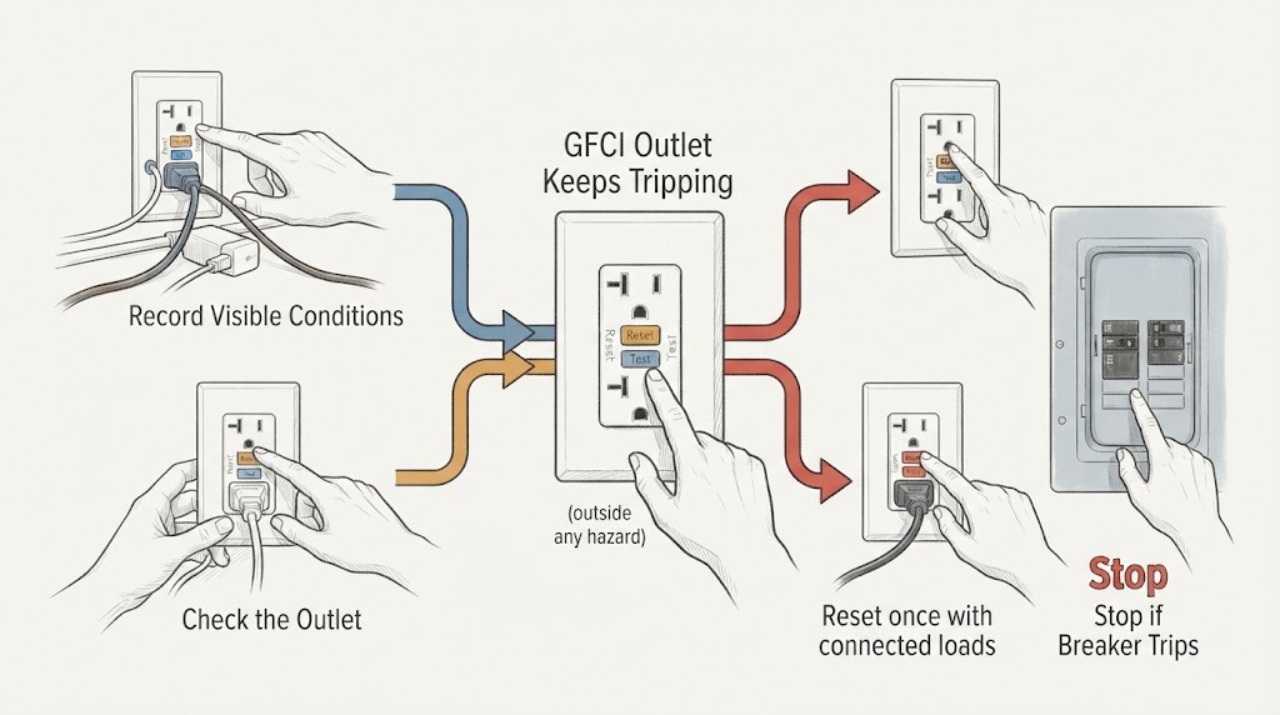
A GFCI outlet keeps tripping because it is detecting a ground fault or another condition it cannot safely clear; common clues include moisture, a damaged appliance or cord, a downstream device, incorrect wiring, or a worn outlet. Note what was plugged in and inspect the outlet, plugs, cords, and nearby area without touching exposed conductors. Unplug the suspect load, press RESET once, and observe whether the GFCI stays reset; if it trips with everything unplugged, will not reset, shows heat or discoloration, or trips again without a clear cause, leave it off and call a licensed electrician. Do not remove the cover, swap LINE and LOAD wires, bypass the GFCI, or keep resetting it to restore power.
Work through in order
Diagnostic checks
Use only checks that match the exact appliance or system and its official guide.
-
Record when and how the GFCI trips
From a dry position, note whether the trip happens immediately at RESET, when a particular appliance is plugged in or switched on, after another downstream outlet is used, during wet weather, or after a delay. Do not deliberately recreate the trip with a suspected device and do not touch the outlet face if it is hot or wet.
Expected result: The GFCI trips with one device, trips when several devices are connected, trips with no load, trips only in damp conditions, or the timing is unknown.
Next step: Write down the device, location, timing, recent installation or water event, and RESET behavior. Unplug loads without handling damaged cords, then continue with a visual inspection.
Stop if: Stop for heat, smoke, buzzing, burning odor, arcing, standing water, exposed copper, a cracked face, or a plug that is hot, loose, or discolored.
Why this matters
Why: A repeatable device-related trip makes that appliance, cord, or downstream load the first suspect. A no-load, weather-related, or unexplained trip points more toward moisture, wiring, the receptacle, or another hidden downstream fault. The pattern narrows the next safe check but does not prove a component is safe.
-
Inspect the outlet, cords, and downstream area without opening anything
With loads unplugged only by their intact plugs, visually inspect the GFCI face, nearby outlets, plugs, cords, power strips, and accessible downstream equipment. Look for water, condensation, discoloration, cracks, loose plug fit, frayed insulation, crushed cords, or signs of overheating; do not remove the wall plate or outlet cover.
Expected result: The GFCI or plug is warm, loose, cracked, discolored, or wet; a cord or appliance is damaged; a downstream outlet or device shows a problem; or no visible defect is present.
Next step: Leave any suspect device unplugged and keep the GFCI off if damage or moisture is present. If everything looks dry and intact, continue by resetting once without reconnecting suspect loads.
Stop if: Do not touch wet equipment, repair a cord, tighten terminals, remove covers, use an outlet with heat or burn marks, or move a damaged appliance to another outlet.
Why this matters
Why: Moisture, damaged insulation, a loose receptacle, or a defective load can create the ground fault that causes the trip. No visible defect does not clear the circuit because faults can be inside the box, wall, appliance, or downstream wiring.
-
Reset once with connected loads removed
After a dry visual check with no visible damage, unplug devices from the GFCI and outlets it may protect. Press RESET once using the button as designed and observe whether it latches and restores power; do not hold it in place, bypass it, or keep pressing after another trip.
Expected result: RESET latches and stays on with no loads, RESET trips immediately, RESET will not latch, or the indicator remains abnormal according to the device instructions.
Next step: If it stays on, leave suspect devices disconnected and reconnect only one known-dry, undamaged load at a time while watching for a trip. If it trips empty or will not latch, leave it off and call a licensed electrician.
Stop if: Do not repeatedly reset, hold RESET mechanically, defeat the protective device, or continue if the outlet is warm, wet, damaged, or making noise.
Why this matters
Why: A stable reset with no loads suggests a connected appliance, cord, or downstream device may be causing the fault. An immediate trip or failed reset with no loads points toward persistent moisture, wiring, no incoming power, a defective receptacle, or another circuit fault.
-
Use the TEST button only after a stable, dry reset
Only if the GFCI is dry, cool, undamaged, and has stayed reset with loads disconnected, follow the device instructions to press TEST once and observe whether power cuts off, then press RESET once. Do not perform this test on a cracked, wet, warm, loose, or repeatedly tripping device.
Expected result: TEST trips the device and RESET restores it, TEST does not trip it, RESET does not restore it, or the indicator shows a fault or abnormal state.
Next step: Record the result and leave suspect loads disconnected. Arrange electrician service for any failed test, failed reset, abnormal indicator, or return of the trip.
Stop if: Do not open the device, swap wires, bridge the outlet, continue using a GFCI that fails its test, or repeat the test to force a different result.
Why this matters
Why: A normal TEST/RESET response shows the mechanism responded during that check, but it does not identify why the earlier trip occurred. Failure to trip, failure to reset, or a fault indication means the GFCI may not be operating correctly or may not have a safe supply and needs professional evaluation.
-
Separate a load fault from a circuit or wiring fault
Document whether the GFCI protects other outlets, whether the trip returns with no load, and whether the installation was recently changed. Inspect only accessible labels and conditions; do not remove the cover, test line or load voltage, or alter any conductor.
Expected result: The GFCI trips empty, the same downstream circuit is involved, the outlet was recently installed or replaced, a neutral or ground concern is suspected, or the source remains unclear.
Next step: Leave the GFCI off when the fault persists and give the electrician the trip timing, connected loads, weather or moisture history, TEST/RESET result, and visible condition.
Stop if: Do not open the electrical box or panel, disconnect neutral or ground conductors, reverse LINE and LOAD, bypass the GFCI, or keep using the circuit after persistent trips.
Why this matters
Why: An empty-load trip or recent wiring change can indicate a circuit, wiring, or GFCI installation problem rather than one appliance. An unclear source is itself a reason to stop because the protective device may be responding to a hidden hazard.
Use your observations
Decision map
Find the observation that best matches what you see, then follow the next safe action.
-
PATH 01Safety boundary
What you see
The GFCI stays reset with loads removed but trips when one particular appliance, cord, or downstream device is connected or switched on.
Do this next
Unplug that device, label it as suspect, and stop using it until it and the circuit are inspected or repaired by a qualified professional.
Why this path and its safety boundary
Safety stop: Do not move a damaged device to another outlet, continue cycling it, or test it in a wet area.
-
PATH 02Safety boundary
What you see
The GFCI trips immediately or will not reset with all connected loads unplugged.
Do this next
Leave the GFCI off and call a licensed electrician to check incoming power, downstream wiring, moisture, and the receptacle itself.
Why this path and its safety boundary
Safety stop: Do not repeatedly reset, remove the cover, alter conductors, or bypass the protective device.
-
PATH 03Safety boundary
What you see
The outlet or nearby equipment is wet, warm, discolored, cracked, loose, corroded, or affected by water or weather.
Do this next
Stop using the circuit, keep clear of standing water, isolate power only from a safe accessible control if necessary, and request prompt electrical inspection.
Why this path and its safety boundary
Safety stop: Do not touch wet equipment, dry an energized outlet, replace the receptacle, or restore power to damaged wiring.
-
PATH 04Safety boundary
What you see
TEST does not trip, RESET will not restore power, an abnormal self-test indication remains, or the GFCI was recently installed or rewired.
Do this next
Leave the device out of service and have a licensed electrician verify the GFCI, power supply, and LINE/LOAD wiring.
Why this path and its safety boundary
Safety stop: Do not swap wires, open the box, bridge the device, or assume a reset means shock protection is working.
-
PATH 05Safety boundary
What you see
The GFCI resets with no loads, no visible damage is present, and the original cause is uncertain.
Do this next
Reconnect only one known-dry, undamaged load at a time and stop at the first repeat trip; if the cause cannot be isolated, call an electrician.
Why this path and its safety boundary
Safety stop: Do not keep resetting or reconnecting loads simply to keep the outlet energized.
Helpful context
Understand the symptom
What repeated GFCI trips mean
A GFCI is a protective device, not an ordinary on/off switch. It compares current paths and cuts power when it senses an imbalance that could involve water, damaged insulation, an appliance, or a person. The protected outlet may also feed outlets farther along the circuit, so the cause may be in a downstream device rather than in the button you are pressing.
Use the trip pattern as the decision point
If the GFCI trips when one appliance or cord is connected, isolate that load and do not keep using it. If it trips with every load unplugged, or the face is warm, discolored, cracked, wet, or loose, the circuit or receptacle itself may be unsafe. A recent installation or replacement can also leave LINE and LOAD wiring incorrect; that is electrical work for a licensed electrician, not a reason to open the box casually.
Keep moisture and electrical work separate
Bathrooms, kitchens, garages, outdoors, and other damp locations deserve extra caution. A dry visual check can identify water, corrosion, or damaged cords, but it cannot prove that the circuit is safe. Stop using the outlet, keep away from standing water, and have an electrician inspect persistent or unexplained trips, failed testing, wiring, or a damaged receptacle.
Only after diagnosis
Potential parts
- GFCI receptacle
Consider this category only when a licensed electrician confirms that the receptacle is damaged, failed its test, or is otherwise defective after the circuit and wiring are assessed.
Confirm the existing device type, location, downstream protection, grounding, and local electrical requirements; no homeowner replacement or fit is assumed. - damaged appliance cord or connected device
Consider this category only when the trip follows one identified device and a qualified assessment confirms that its cord or device is the fault source.
Confirm the exact appliance requirements and approved repair path; do not substitute a cord or continue using a device with heat, moisture, or insulation damage.
When checks do not resolve it
Need a professional?
Call a licensed electrician when the GFCI trips with no loads, will not reset, fails TEST, shows an abnormal indicator, trips repeatedly without a clear cause, or has visible heat, discoloration, looseness, cracking, moisture, or wiring concerns. Seek prompt electrical help for smoke, arcing, burning odor, standing water, or a hot outlet or cord.
Common questions
FAQ
Why does my GFCI outlet keep tripping?
It is detecting a ground fault or another unsafe condition, often involving moisture, a damaged appliance or cord, a downstream device, wiring, or the receptacle itself. Note what triggers it, unplug suspect loads, and stop if it trips with everything removed.
What should I do if the GFCI trips with nothing plugged in?
Leave it off and call a licensed electrician. An empty-load trip can point to persistent moisture, a circuit or wiring fault, no incoming power, or a defective GFCI; repeatedly pressing RESET does not make the circuit safe.
Can I replace a GFCI outlet that keeps tripping?
Do not replace or rewire it as a first diagnostic step. The trip may be protecting against a downstream fault or wiring problem, and a new device can hide an unsafe condition if installed incorrectly. Have a licensed electrician test the circuit and select the correct repair.
How do I know whether an appliance is causing the GFCI trip?
If the GFCI stays reset with all loads unplugged but trips when one particular device is connected or switched on, that device or cord is a strong suspect. Leave it unplugged and do not move it to another outlet; have it assessed or repaired.
Read the exact guide
Official sources
- What To Do When Your GFCI Outlet TripsLeviton · Supports identifying moisture, damaged cords or appliances, visible outlet damage, the device that triggers a trip, and electrician service for persistent or unexplained trips.
- What Does Auto-Monitoring or Self-Test Mean?Leviton · Supports explaining that modern GFCI devices may self-test their protection circuitry and can trip or indicate a potential loss of protection.
- How to Reset a GFCI Outlet After Lockout: A Step-by-Step GuideLeviton · Supports the distinction between no incoming power, a continuing ground fault, incorrect wiring, damaged outlet, no-load reset behavior, and professional handling of wiring or replacement.
- What To Do When Your GFCI Trips: A Homeowner's GuideLeviton · Supports the explanation of ground faults, moisture and damaged-device causes, outlet and cord inspection, isolating a triggering load, and electrician escalation.
Community feedback
Share a repair observation
Share a plain-text repair observation. Accepted observations are published automatically; this page may take a moment to update.