
On this page
Start here
Quick answer
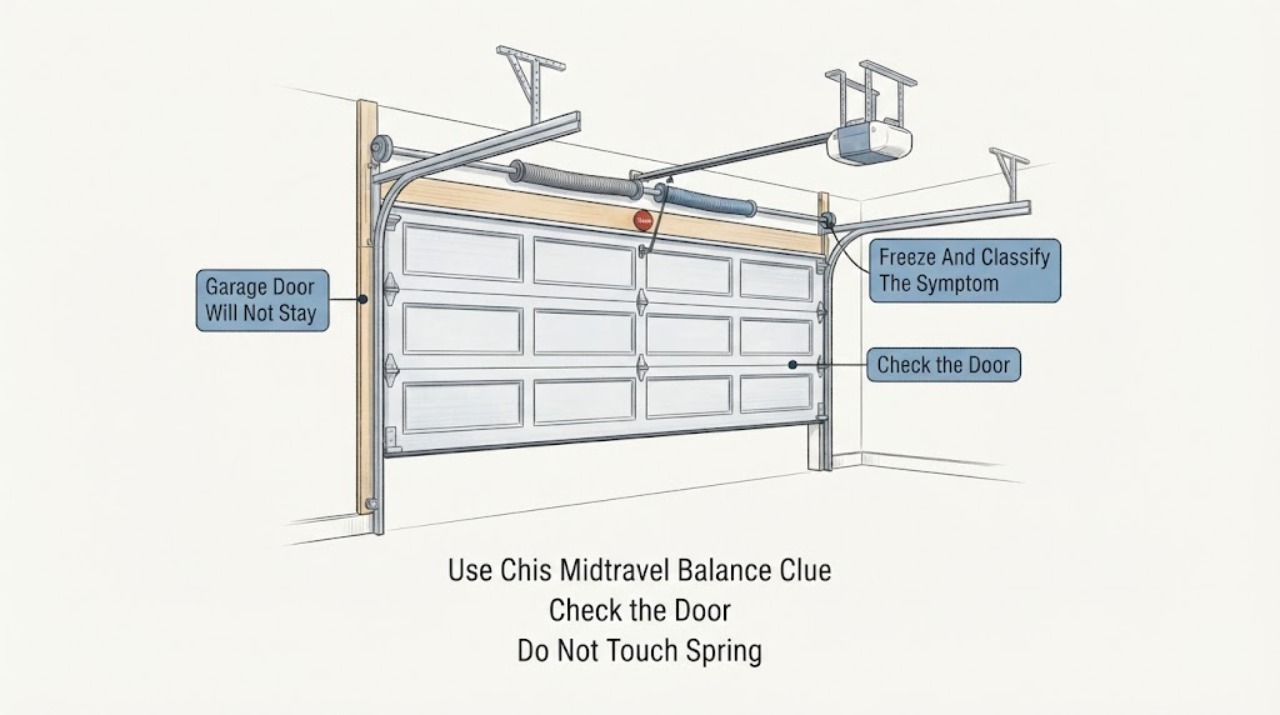
Treat a C.H.I. garage door that drops, sags, or closes after opening as a safety problem until its balance and hardware are checked. C.H.I.'s own safety checklist says a balanced door should lift with little resistance and remain in place when left midway after the opener is disengaged. Only make that observation with the door fully closed, visibly intact, and everyone clear; do not catch, prop, or repeatedly cycle a failing door. A broken or visibly damaged spring, cable, track, roller, bracket, panel, or door that feels heavy ends the homeowner check. If the door is stable by hand but fails only with the opener, record the opener and sensor behavior and contact a C.H.I. dealer rather than changing spring tension or opener force. C.H.I. directs owners to its local dealer network for door and opener service.
Work through in order
Diagnostic checks
Use only checks that match the exact appliance or system and its official guide.
-
Check 1
Stop normal use long enough to classify the failure from a position beside the opening, not beneath the door. Note whether the door drops from open, sags while partly open, rises on its own, binds or scrapes, or stays up by hand but not when the opener is commanded. Photograph the final position and any visible change from a safe distance instead of repeating the cycle.
Expected result: The door moves without a command, feels heavy or uneven, makes a new scraping or popping sound, shows visible damage, or is stable by hand but not under the opener.
Next step: Use the matching branch after the safe visual checks. If the door is falling, binding, off track, or damaged, leave it closed if possible and go directly to C.H.I. dealer service.
Stop if: Do not stand under the door, catch it, hold it up with an improvised prop, pull a cable, or continue activating the opener after abnormal movement.
Why this matters
Why: Self-movement, heavy travel, noise, or visible damage makes a door-balance or hardware issue more likely. A stable door that fails only with the opener shifts the investigation toward the operator or safety system, but does not make continued cycling safe.
-
Check 2
Only if the door is fully closed, the tracks and supporting hardware look intact, the opener manual permits release, and the opening is clear, disengage the motor according to that opener manual. From the door's intended gripping points, lift it cautiously toward mid-travel and release it while remaining clear of pinch points.
Expected result: The door lifts with little resistance and stays near mid-travel, or it drops, rises, feels heavy, binds, or moves unevenly after release.
Next step: If it fails the balance clue, return the door to a safe closed position only if it can be done without force and arrange trained C.H.I. dealer service. If it remains stable, do not change settings; document that result and use the opener-only branch.
Stop if: Do not release the operator with the door partly open, attempt the observation with a broken spring or cable, or continue if the door is jerky, unusually heavy, or cannot be kept clear of people and vehicles.
Why this matters
Why: C.H.I.'s balance clue is a door that can be lifted without unusual strain and does not sag when left midway. Failure of that clue points to balance, spring, cable, track, roller, hinge, or panel service rather than an opener-force adjustment.
-
Check 3
With the door stationary, inspect only what can be seen without touching stored-energy hardware: both track runs, rollers, hinges, brackets, panels, the spring and lift-cable area, and the photo-eye path near the floor. Look for warping, loose-looking hardware, a roller outside the track, a frayed or displaced cable, a broken or heavily corroded spring, panel damage, or an object blocking a sensor lens.
Expected result: There is a clear physical defect, a sensor obstruction, a damaged or sagging section, or no visible defect from the safe viewing position.
Next step: Remove only an obvious loose object from the photo-eye path without entering the door's travel path. For any spring, cable, track, roller, bracket, panel, or sensor fault—or if the issue remains unexplained—keep the door out of service and contact a C.H.I. dealer.
Stop if: Do not touch springs or cables, tighten brackets, bend tracks, reseat rollers, open the opener housing, bypass sensors, or change opener force or travel settings as a trial.
Why this matters
Why: C.H.I. says warped tracks can let a door break or fall from the track, damaged panels and metal parts can create sharp or structural hazards, and the photo-eye/reverse system is a safety feature. A clean view does not prove spring tension, alignment, or opener settings are safe.
-
Check 4
Prepare a C.H.I. service handoff instead of trying to tune the door. Record the door code or model if available, door style, whether the mid-travel balance clue passed, where the door stopped or fell, whether the symptom appeared by hand or only under power, any visible hardware or sensor finding, and any new noise.
Expected result: The door fails the balance clue, has visible supporting-hardware damage, remains unstable after a clear sensor path, or is stable manually but the opener still will not hold it open.
Next step: Keep people, vehicles, and stored items clear and contact a local C.H.I. dealer. Tell the dealer whether the door is unstable without the opener or fails only under power so the correct service path is prepared.
Stop if: Do not resume automatic operation merely because the door stayed open once, and do not order or install a spring, cable, roller, track, bracket, or opener part from appearance alone.
Why this matters
Why: These observations separate a C.H.I. door-system assessment from an opener/safety-system assessment without asking the homeowner to work on spring-connected parts. C.H.I. directs owners to a local dealer for a malfunctioning door and for service on openers purchased from C.H.I.
Use your observations
Decision map
Find the observation that best matches what you see, then follow the next safe action.
-
PATH 01Next step
What you see
The C.H.I. door drops, sags, rises, binds, feels heavy, or will not remain near mid-travel after the operator is released from a fully closed door.
Do this next
Keep the opening clear, leave the door closed if possible, and contact a trained C.H.I. dealer for balance and hardware assessment.
Why this path and its safety boundary
Why it matters: The door-side counterbalance or guide hardware is the leading service path; the opener is not a safe first adjustment target.
-
PATH 02Next step
What you see
The door is stable during the safe manual observation, but it closes, stops short, reverses, or fails to hold open only after an opener command.
Do this next
Remove only an obvious obstruction without bypassing the safety system, then stop testing and contact the C.H.I. dealer or the exact opener service provider if the symptom remains.
Why this path and its safety boundary
Why it matters: The symptom is more consistent with the opener or its safety system than with a failed C.H.I. door balance, but a visual inspection cannot verify settings or internal condition.
-
PATH 03Next step
What you see
A spring, cable, track, roller, bracket, panel, or other supporting part appears broken, displaced, badly corroded, bent, or unsafe to approach.
Do this next
Stop operation, keep the garage opening clear, and contact a trained C.H.I. dealer. Do not attempt a temporary repair or manual repositioning.
Why this path and its safety boundary
Why it matters: C.H.I. identifies damaged springs and warped or damaged door hardware as injury hazards; continued operation can let the door fall or expose people and vehicles to stored energy.
Helpful context
Understand the symptom
Read the door's movement before blaming the opener
For a C.H.I. door, the useful first distinction is whether the door cannot support itself or whether the opener is the only thing causing the loss of the open position. A drop, sag, heavy lift, uneven travel, or sudden hardware change points to the door system. A door that is stable without the opener but fails only after an opener command points to the operator, travel behavior, or its safety sensors. Do not use the opener to keep testing a door that is falling, binding, or damaged.
What is specifically C.H.I. about the service path
C.H.I. sells and supports residential doors through its dealer network rather than asking owners to source or tune spring-connected parts themselves. Its FAQ says a C.H.I. door that is not functioning properly should go to a local C.H.I. dealer, and it gives the same route for openers purchased from C.H.I. Keep the door code or model information and the result of the safe balance observation for that handoff.
The homeowner boundary is visual and conditional
C.H.I.'s safety material calls for visual inspection of the track, panels, springs, and other hardware and warns that a broken spring can strike a person or vehicle. It also identifies the photo-eye path and automatic reverse as safety features. The safe contribution is to note what is visible from a clear position; spring adjustment, cable work, track correction, operator housing work, and force-setting changes belong with trained service.
When checks do not resolve it
Need a professional?
Contact a trained C.H.I. dealer when the door fails the mid-travel balance clue, feels heavy or binds, has a broken or degraded spring, displaced cable, warped track, damaged roller/bracket/panel, or remains unsafe after an obvious sensor obstruction is removed. Use the dealer path for a C.H.I.-purchased opener that still closes, reverses, stops short, or will not hold the open position.
Common questions
FAQ
What does C.H.I. say a balanced garage door should do?
C.H.I.'s safety checklist says that after the motor is disengaged, a balanced door should lift without unusual strain and remain in place rather than sag when left midway. Use this only as a cautious observation with the door fully closed first, the hardware visibly intact, and the opening clear; a failed observation is a service boundary, not a reason to adjust springs.
Why does my C.H.I. door stay open by hand but not with the opener?
That pattern makes a major door-balance failure less likely and shifts attention toward the opener, its travel behavior, or its safety sensors. Check only for an obvious obstruction from a safe position, do not bypass the photo eyes or change force settings by trial, and contact the appropriate C.H.I. dealer or opener service path if it continues.
Can I tighten the spring or put the cable back on my C.H.I. door?
No. C.H.I. warns that springs and other moving metal parts can be dangerous and that a broken spring can strike a person or vehicle. Do not touch spring-connected hardware, reseat a cable, bend a track, or make a temporary repair; keep the opening clear and contact a trained C.H.I. dealer.
Who services a C.H.I. garage door that is not functioning properly?
C.H.I.'s FAQ directs owners to a local C.H.I. dealer for a door that is not functioning properly and for service on an opener purchased from C.H.I. Give the dealer the door code or model, the manual balance result, the failure position, and safe-distance photos of any visible damage.
Read the exact guide
Official sources
- Residential garage doorsC.H.I. Overhead Doors · CHI (C.H.I.) residential garage doors and local dealer aftercare.
- Garage Door Safety ChecklistC.H.I. Overhead Doors · CHI (C.H.I.) residential garage doors and openers; exact door and opener model remains controlling.
- Frequently asked questionsC.H.I. Overhead Doors · CHI (C.H.I.) residential and commercial garage doors and C.H.I.-purchased openers.
Community feedback
Share a repair observation
Share a plain-text repair observation. Accepted observations are published automatically; this page may take a moment to update.