
On this page
Start here
Quick answer
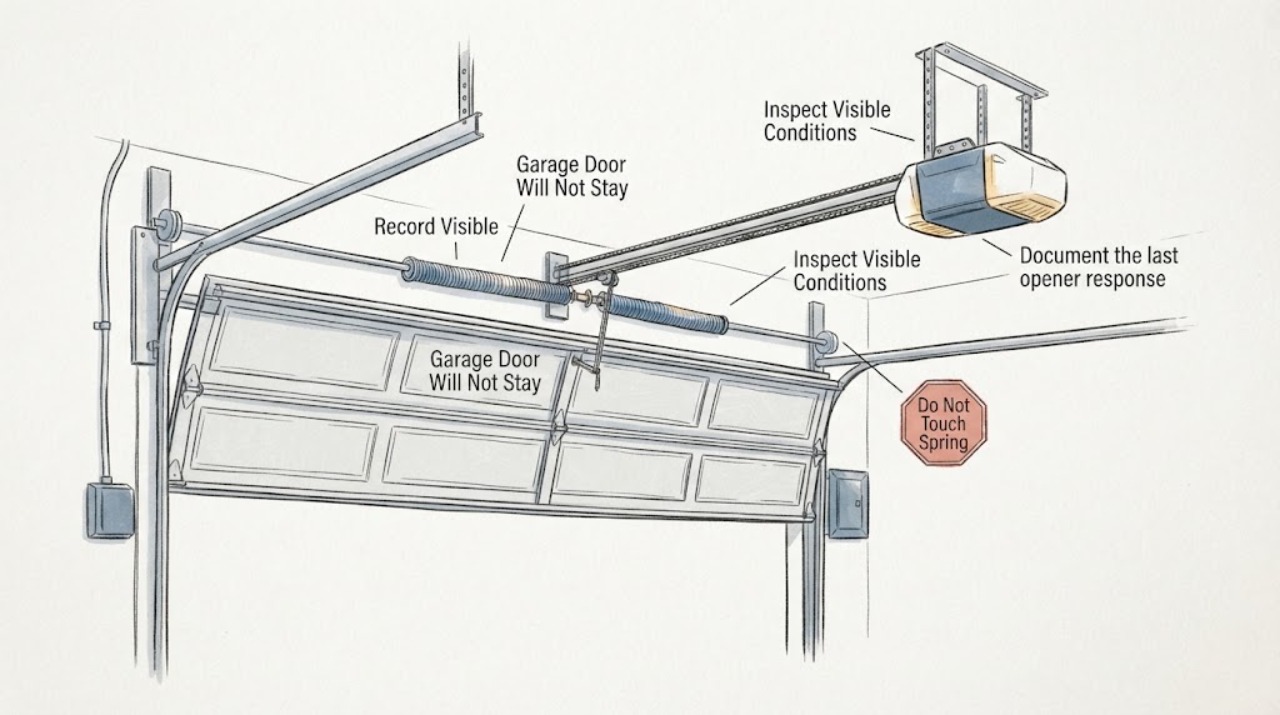
A garage door that falls, drifts, or will not remain open is a safety and counterbalance warning, not a good DIY adjustment. Keep people, pets, and vehicles away from the door and do not stand under it. From a safe distance, record its position, visible damage, opener lights or sounds, and what happened during the last operation. Do not lift or balance-test the door, pull the emergency release, adjust springs, cables, brackets, tracks, force, or travel, or block the door open. Arrange a trained garage-door technician, urgently if the door is leaning, damaged, moving unexpectedly, or has a loose cable or spring.
Work through in order
Diagnostic checks
Use only checks that match the exact appliance or system and its official guide.
-
Record the door's static position from a safe distance
Without entering the door's travel path, observe whether the door is fully closed, partly open, fully open, leaning, bowed, or visibly settling. Stand to the side and outside the path of a possible fall; do not approach under the door or try to hold it in place.
Expected result: Record the position at which it stopped or fell, whether the gap is even across the bottom, and whether the door appears tilted or one side is lower. Note whether the door is resting on the floor or suspended without a stable stop.
Next step: Keep the opening clear, prevent anyone from operating the controls, and give the technician the position and any tilt description. Do not test whether it will stay at another height.
Stop if: Stop all observation and move farther away if the door shifts, drops, swings, or appears unsupported. Do not stand under it or attempt to catch it.
Why this matters
Why: An uneven, tilted, or unstable door suggests a door-system or counterbalance problem and is not a safe opener-setting issue for the homeowner. A door that is already settled closed is still a service clue if it previously fell or would not stay open.
-
Look for visible damage without touching hardware
From outside the travel path and without a ladder, visually scan the door panels, hinges, rollers, tracks, springs, cables, bottom corners, and opener-to-door connection for an obvious break, separation, slack cable, displaced roller, bent track, or hanging hardware. Do not remove covers, reach toward the parts, or probe a suspected failure.
Expected result: Record only what is plainly visible: intact or damaged panels, a cable that appears off its drum or pulley, a spring that appears separated, a roller outside its track, a bent track, or a connection that appears detached. If nothing is visible, record that too; hidden damage remains possible.
Next step: Leave the door and opener unused and send the technician a description or a photo taken only from a safe, stable position. Do not loosen, adjust, reconnect, lubricate, or replace anything.
Stop if: Stop and keep everyone away if a cable, spring, bracket, panel, track, or opener connection is loose, broken, hanging, or visibly displaced.
Why this matters
Why: DASMA warns that springs are under high tension and that damage to door hardware warrants a trained technician. A visible loose cable, separated spring, bent track, or detached connection raises urgency and should not be confirmed by touching it.
-
Document the last opener response
Do not operate the door again. Instead, recall or record what happened during the last normal attempt: whether the opener motor ran, whether the door moved, where it stopped, whether it fell after stopping, and whether the wall control or opener light displayed a code or unusual blink pattern.
Expected result: Classify the last event as door moved then fell, opener ran while the door did not move, door stopped partway, door reversed, or no response. Note beeps, flashing lights, grinding, snapping, or a sudden change from normal operation.
Next step: Give the exact sequence and any indicator pattern to the technician. Leave the opener off or unused as appropriate for the model and situation; do not make repeated cycles or force a close/open command.
Stop if: Stop use immediately after a fall, snapping sound, grinding, uncontrolled travel, or any event involving a loose or damaged part.
Why this matters
Why: An opener that runs without moving the door can be disconnected from the door, while a door that moves and will not remain open points toward the door or counterbalance system. Genie identifies a disconnected carriage as one possible cause but directs model-specific re-engagement to the manual; do not pull the release or attempt it here.
-
Check the surrounding safety zone
From a safe location, check whether people, pets, vehicles, stored items, or a second door are inside the travel area or could be struck. Observe whether the photo-eye lenses appear obstructed or visibly damaged without touching or realigning them, and keep the wall control and remotes out of use.
Expected result: Record a clear or obstructed travel path, a visible sensor obstruction or damage, and whether the door was exposed to impact. Do not place a board, tool, vehicle, or other object under the door and do not test reversal or sensors while the door is unstable.
Next step: Remove people and movable items only from a safe position and only when the door is stationary and there is no need to approach it. Tell the technician about sensor damage, impact, or any obstruction; do not adjust the sensor mounts.
Stop if: Stop if the door is moving, suspended, leaning, or within reach of a person or vehicle. Do not enter the travel path to clear an obstruction.
Why this matters
Why: A clear sensor path may help explain normal opener behavior but cannot make an unstable door safe. A blocked or damaged safety sensor can affect closing behavior, while an inability to stay open remains a door-system service concern.
-
Capture model and history for the service call
Read the opener or door model label only if it is visible from a normal standing position and does not require a ladder, reaching over the door, or opening a cover. Record the approximate age, recent impact or storm, recent noise change, and whether the symptom is new or recurring.
Expected result: Record the label text if legible, door style if known, last known safe position, recent service, and whether a spring or cable was previously replaced. If a label is inaccessible, leave it blank rather than climbing or reaching.
Next step: Include the notes in the service request and wait for professional inspection. Do not order or install a spring, cable, bracket, roller, or opener part based only on the symptom.
Stop if: Stop gathering information if it would require a ladder, opening the opener, approaching tensioned hardware, or entering the door's path.
Why this matters
Why: Model and history help a technician bring the right documentation, but they cannot establish spring or cable compatibility from a distance. A recent impact, repeated drift, or new noise increases the need for prompt inspection.
Use your observations
Decision map
Find the observation that best matches what you see, then follow the next safe action.
-
PATH 01Safety boundary
What you see
The door is leaning, partly open, falling, visibly damaged, or has a loose cable, spring, bracket, track, or detached connection.
Do this next
Keep the entire travel area clear and arrange a trained garage-door technician urgently. Share the static position and visible defect from a safe distance.
Why this path and its safety boundary
Safety stop: Do not operate, lift, catch, block, release, adjust, reconnect, or walk beneath the door.
-
PATH 02Safety boundary
What you see
The opener ran but the door did not move, or the last event suggests the opener and door may be disconnected.
Do this next
Request service and provide the exact opener response. The technician can verify the model-specific carriage and door connection safely.
Why this path and its safety boundary
Safety stop: Do not pull the emergency-release cord or attempt to re-engage a carriage near a potentially unstable door.
-
PATH 03Safety boundary
What you see
The door is closed and appears intact, but it previously would not stay open or fell from an open position.
Do this next
Do not treat the closed position as a reset. Keep the system out of use and book a trained door-systems inspection for counterbalance, track, panel, and opener connection.
Why this path and its safety boundary
Safety stop: Do not perform a balance test, open the door manually, or run repeated cycles.
-
PATH 04Safety boundary
What you see
There is impact damage, a loud snap or grind, uncontrolled travel, or a person/vehicle could be trapped or struck.
Do this next
Move people away from the area without entering the door path and seek urgent professional or emergency assistance as appropriate.
Why this path and its safety boundary
Safety stop: Do not approach the door, touch tensioned hardware, or attempt a temporary restraint.
Helpful context
Understand the symptom
Why this symptom deserves service
The counterbalance system is meant to offset the door's weight so the opener is not doing the lifting. A door that will not stay open can indicate a spring, cable, track, panel, or connection problem, but the visible symptom does not identify which one. Because the door and its tensioned hardware can move with dangerous force, the useful homeowner task is documenting the condition and keeping the area safe.
Safe boundary
Do not repeat cycles to reproduce the failure. Do not walk beneath a raised or partly raised door, catch it, hold it up, place an object beneath it, pull the emergency-release cord, lift it manually, or touch springs, cables, bottom brackets, rollers, tracks, or opener force and travel settings. If the door is already open and unstable, stay clear and call a trained door-systems technician from a safe location.
When checks do not resolve it
Need a professional?
Call a trained garage-door technician whenever the door falls, will not stay open, becomes uneven, stops partway, or shows a cable, spring, bracket, track, panel, or opener-connection concern. Treat uncontrolled movement, visible damage, or a loud snap as urgent.
Have this ready
- Provide the door and opener brand/model if safely visible, static position, whether it is level or tilted, last opener response, indicator lights or codes, sound changes, recent impact or service, and any visible damage photographed from a safe distance.
Common questions
FAQ
Why will my garage door not stay open?
The counterbalance, door hardware, opener connection, or another system component may be out of condition. The symptom cannot identify the failed part safely; keep the door out of use and have a trained technician inspect it.
Should I pull the emergency release to test the door?
Not for this symptom. A door that will not stay open may be unstable, and pulling the release can change how it moves. Do not release, lift, balance-test, or block the door; tell the technician what happened during the last operation.
Can I adjust the garage-door springs or cables myself?
No. Springs, cables, brackets, and related supports can be under high tension. Do not loosen, wind, replace, reconnect, or adjust them; use a trained door-systems technician.
Read the exact guide
Official sources
- DASMA Releases Updated Checklist for InspectionsDoor + Access Systems Manufacturers Association · Supports visual inspection boundaries and the recommendation that repairs and adjustments be performed by trained door-systems technicians.
- Garage doors should live a balanced lifeDoor + Access Systems Manufacturers Association · Supports explaining why a door that will not stay open can reflect improper balance and why continued operator use can be unsafe.
- Automatic Garage Door Opener Safety & Maintenance GuideDoor + Access Systems Manufacturers Association · Supports keeping people away from moving doors, treating springs and supports as high-tension components, and calling trained technicians for damage or improper operation.
- Why does the Genie opener run without moving the door?The Genie Company · Supports recording an opener-running-without-door-motion symptom and leaving model-specific carriage re-engagement to the owner manual or service professional.
Community feedback
Share a repair observation
Share a plain-text repair observation. Accepted observations are published automatically; this page may take a moment to update.