
On this page
Start here
Quick answer
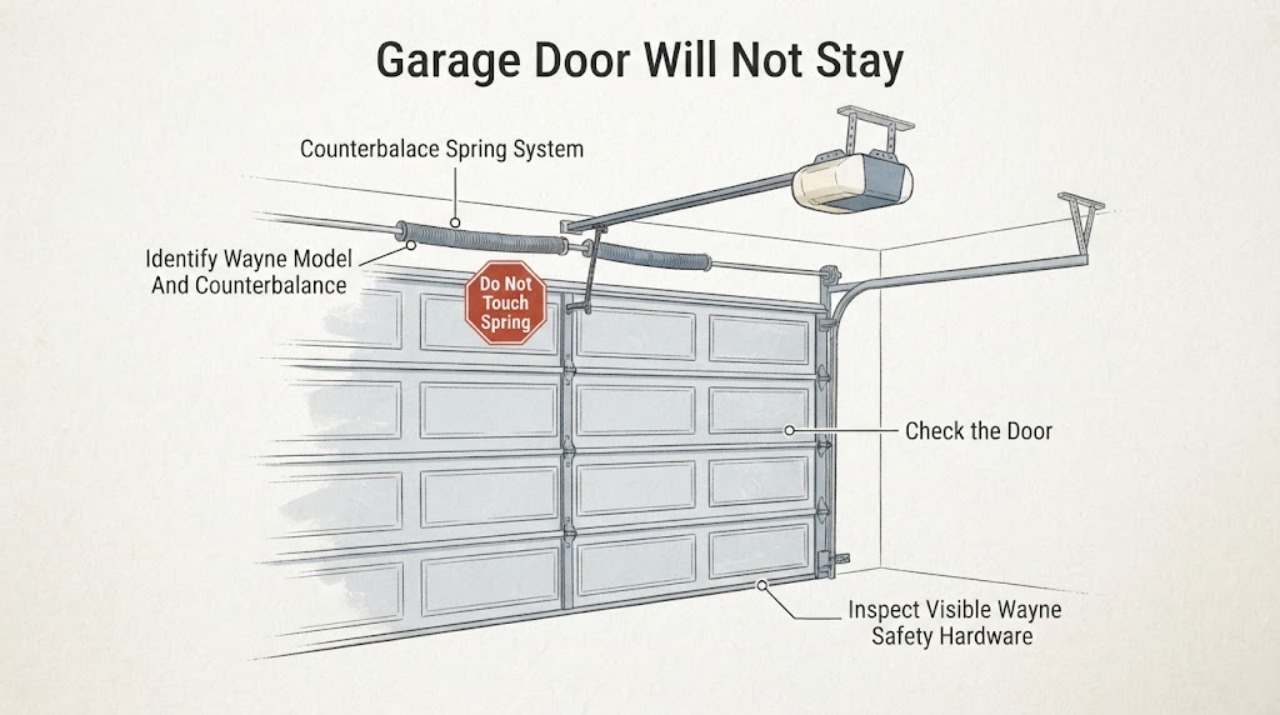
Do not assume a Wayne Dalton door uses the same spring or balance arrangement as another garage door. Start by recording the door model or code and selecting the matching Wayne Dalton installation/owner information; Wayne Dalton publishes separate documents for many model families and lift/spring arrangements. If the door drops, sags, feels heavy, moves on its own, is off track, or has a damaged cable, bracket, panel, or spring enclosure, stop operation and contact a trained door professional. Wayne Dalton describes its TorqueMaster Plus counterbalance as a model-specific system that contains springs in a steel tube and includes an anti-drop safety device, but that description must not be applied to an unidentified door. Only when the exact instructions allow a manual observation, the door is fully closed and visibly intact, and everyone is clear should you separate door behavior from opener behavior. Do not open the spring system, adjust tension, defeat safety features, or change opener force as a trial; use a Wayne Dalton dealer or trained door-systems technician for the service path.
Work through in order
Diagnostic checks
Use only checks that match the exact appliance or system and its official guide.
-
Check 1
From a clear position with the door stationary, photograph the Wayne Dalton model/code label and note the door style, spring or counterbalance enclosure, and opener model without removing covers. Use Wayne Dalton's official support index to locate the exact model-family instructions; do not use a 8000/8200, 9100/9600, TorqueMaster, torsion, or extension-spring procedure unless the door documentation identifies that family.
Expected result: The model and counterbalance family are identified, only a broad Wayne Dalton identity is known, or the door's spring/lift arrangement is hidden or uncertain.
Next step: Continue only with checks permitted by the exact document. If the family remains unknown, keep the door out of service and give the model/code and photos to a Wayne Dalton dealer or trained door professional.
Stop if: Do not remove a spring tube, bottom bracket, operator cover, or any panel to identify the mechanism.
Why this matters
Why: Wayne Dalton's own support index separates documents by model and spring/lift configuration. A known family can determine which manual observation is allowed; an unknown family makes a generic balance conclusion unsafe.
-
Check 2
Record the failure from beside the opening and outside the travel path rather than creating another cycle. Note whether the door falls or sags from open, rises by itself, binds or scrapes, stops at a particular height, or remains stable by hand but not after an opener command. Keep people, vehicles, and stored items clear.
Expected result: The door moves without a command, is heavy or uneven, makes a new sound, is off track, shows visible damage, or appears stable without the opener but not under power.
Next step: Use the corresponding branch after the visual inspection. Any fall, binding, off-track condition, or supporting-hardware damage is an immediate stop and service condition.
Stop if: Do not catch the door, hold it up with a makeshift prop, pull a cable, or repeatedly command an abnormal door.
Why this matters
Why: Uncommanded movement, heavy travel, or visible damage points toward the door/counterbalance system. A stable door with an opener-only symptom points toward the operator or safety system, but it does not clear the door for repeated use.
-
Check 3
With the door stationary, visually compare both sides of the opening: tracks, rollers, hinges, brackets, panels, bottom corners, cable area if visible, and any contained counterbalance tube. Also look for an obstruction at the opener's photo-eye path. Do not touch, loosen, straighten, or open any component.
Expected result: There is a displaced cable, broken or degraded spring indication, bent track, roller outside the track, loose-looking bracket, cracked/separating panel, damaged enclosure, or an obvious sensor obstruction.
Next step: Remove only an obvious loose object from the photo-eye path without entering the travel path. For any door or counterbalance defect, keep the door out of service and contact a trained Wayne Dalton door professional.
Stop if: Do not open the counterbalance tube, reseat cables, tighten brackets, bend tracks, remove rollers, bypass photo eyes, or change opener force/travel settings.
Why this matters
Why: Wayne Dalton identifies spring-connected brackets as high-tension safety components and describes anti-drop protection only for the TorqueMaster Plus family. A visual defect can make the door unsafe even if the opener still responds; an unobstructed view cannot verify spring tension or internal condition.
-
Check 4
Only if the exact Wayne Dalton instructions explicitly permit it, the door is fully closed, supporting hardware is visibly intact, and nobody can enter the opening, follow the opener's release procedure and make the manual balance observation described for that model. Do not improvise a spring or counterbalance test from a different Wayne Dalton family.
Expected result: The model-approved observation says the door moves smoothly and remains near the observed position, or it drops, rises, feels heavy, binds, or cannot be safely observed.
Next step: Report the exact model, permitted procedure, result, and failure mode to the Wayne Dalton dealer. If the door is stable manually but fails under power, ask for opener and safety-system diagnosis; if it is not stable manually, ask for door-system balance service.
Stop if: Do not release the operator with the door partly open, test an unknown system, lift a door with damaged hardware, or continue if it starts to fall or bind.
Why this matters
Why: A failed or unsafe observation makes counterbalance or door hardware the leading service path. A passing observation only makes a severe balance problem less likely; it does not authorize opener setting changes or establish that the door is safe for continued use.
-
Check 5
Prepare the service handoff instead of adjusting the mechanism. Provide the Wayne Dalton model/code, door style and counterbalance family if known, whether the door failed by hand or only under the opener, the final position, visible findings, opener/sensor behavior, and safe-distance photos.
Expected result: The door fails the exact-model observation, has any damaged or uncertain spring-connected hardware, remains unstable, or has an opener-only failure after a clear sensor path.
Next step: Keep the opening clear and contact a local Wayne Dalton dealer or trained door-systems technician. Do not resume automatic operation until the cause and safety functions have been checked.
Stop if: Do not purchase or install a spring, cable, bracket, roller, track, or opener part from appearance alone, and do not attempt an internal repair.
Why this matters
Why: Wayne Dalton's official safety guidance places adjustment of the door system with a trained professional and recommends dealer checkups. The model and symptom record tells the professional whether to start with counterbalance, door hardware, opener travel, or safety-system inspection.
Use your observations
Decision map
Find the observation that best matches what you see, then follow the next safe action.
-
PATH 01Next step
What you see
The door has a contained spring tube or other Wayne Dalton counterbalance enclosure, or the spring/lift family cannot be identified from the model information.
Do this next
Keep the door out of service and contact a trained Wayne Dalton door professional with the model/code. Do not open or adjust the enclosure.
Why this path and its safety boundary
Why it matters: TorqueMaster Plus is a Wayne Dalton-specific, model-dependent counterbalance description; an unknown enclosure cannot safely be treated as that system or opened for inspection.
-
PATH 02Next step
What you see
The door falls, rises by itself, is heavy or binding, is off track, or shows a damaged spring-connected bracket, cable, track, roller, panel, or counterbalance area.
Do this next
Stop operation, keep everyone and vehicles clear, leave the door closed if possible without force, and contact a Wayne Dalton dealer or trained door-systems technician.
Why this path and its safety boundary
Why it matters: Wayne Dalton warns that spring-connected parts are under extreme tension and that only a trained door professional should adjust the system. Continued operation can expose people and vehicles to a falling or uncontrolled door.
-
PATH 03Next step
What you see
The door is stable in the exact-model-approved manual observation, but it closes, stops short, reverses, or will not hold open only when the opener is engaged.
Do this next
Clear only an obvious obstruction without bypassing the safety system, then stop testing and request Wayne Dalton dealer/opener service if the symptom persists.
Why this path and its safety boundary
Why it matters: The opener, travel behavior, or safety system becomes the leading service path, while the passing manual observation makes a severe door-balance failure less likely. A visual sensor check cannot confirm settings or internal condition.
Helpful context
Understand the symptom
The Wayne Dalton model decides which balance clues apply
Wayne Dalton's support site lists separate installation documents across residential door families and spring/lift arrangements. That matters here: a door labeled or documented as TorqueMaster Plus is not evidence that every Wayne Dalton door has the same contained spring system, and a generic spring adjustment cannot be inferred from the brand name. Find the model/code before interpreting a door that will not stay open; if it cannot be identified, the safe result is a professional inspection rather than a guessed procedure.
A contained counterbalance is still not a homeowner adjustment point
Wayne Dalton says TorqueMaster Plus safely contains springs inside a steel tube and includes an anti-drop safety device. That is useful for recognizing a possible system family, not permission to open the tube or alter it. Wayne Dalton's safety guidance says spring-connected components and bottom brackets are under extreme tension and that a trained door professional should adjust any part of the door system.
Use the symptom to choose the service conversation
There are two useful outcomes to record. If the door cannot support itself during the exact-model-approved manual observation, the counterbalance or door hardware is the leading path. If the door is stable without the opener but loses the open position only under power, give the technician the opener model, command sequence, and sensor/reverse observations. Wayne Dalton recommends a local dealer check to keep doors operating safely and smoothly; the observation record helps that dealer start with the right system.
When checks do not resolve it
Need a professional?
Contact a trained Wayne Dalton door professional for any failed or unsafe manual observation, heavy or uncontrolled movement, off-track door, damaged spring-connected hardware, uncertain counterbalance family, or opener-only symptom that persists after an obvious sensor obstruction is removed. Wayne Dalton recommends dealer checkups for safe, smooth operation.
Common questions
FAQ
Does every Wayne Dalton garage door use the same spring system?
No. Wayne Dalton's official installation index lists different model families and torsion, extension, lift, and low-headroom configurations. TorqueMaster Plus is a specific Wayne Dalton counterbalance family, not a safe assumption for every door. Identify the model/code before using any balance or service information.
What does a Wayne Dalton door that will not stay open usually tell me?
If the door falls, sags, rises by itself, feels heavy, binds, or fails the exact-model-approved manual observation, the door or counterbalance system needs professional assessment. If it is stable without the opener but fails under power, the opener or safety system becomes more likely. Do not keep cycling the door to decide between them.
Can I open or adjust a Wayne Dalton TorqueMaster spring tube?
No. Wayne Dalton describes TorqueMaster Plus as a contained spring system, but its safety guidance says spring-connected components are under extreme tension and only a trained door professional should adjust any part of the garage door system. Leave the enclosure closed and arrange service.
What should I give the Wayne Dalton dealer?
Provide the model or door code, door style, counterbalance family if identified, whether the door failed by hand or only under the opener, the final position, visible damage, sensor observations, and safe-distance photos. Wayne Dalton's support materials are model-specific, so this information prevents the wrong family procedure from being applied.
Read the exact guide
Official sources
- Garage Door Installation DocumentsWayne Dalton · Wayne Dalton residential and commercial installation support; exact model selection is required before using a document.
- AboutWayne Dalton · Only Wayne Dalton doors identified as using the TorqueMaster Plus family; do not generalize to an unidentified door.
- Garage Door Safety MonthWayne Dalton · Wayne Dalton residential garage door systems; exact model and operator documentation remains controlling.
Community feedback
Share a repair observation
Share a plain-text repair observation. Accepted observations are published automatically; this page may take a moment to update.