
On this page
Start here
Quick answer
An Amarr garage door that drops or closes instead of staying open is commonly out of balance, but a binding track, damaged cable or spring, or an opener setting can create a similar symptom. Keep people and vehicles out of the door's path. If you are comfortable making a safe visual check, start with the door closed, follow the Amarr manual's release procedure, and observe whether the door can hold partway open without force. A door that drifts, slams, feels unusually heavy, binds, looks crooked, or has a broken or frayed spring or cable should not be operated; call a qualified garage door technician. Only adjust opener settings after the door itself is confirmed balanced, and follow the model manual rather than increasing force to hide a mechanical problem.
Before you begin
Safety first
- Homeowner checks are limited to clearing the path, visual observation, and a manual balance observation only when the door is closed first, the release procedure is documented, and the door remains controlled. No spring or cable work, track straightening, panel removal, or safety-feature bypass.
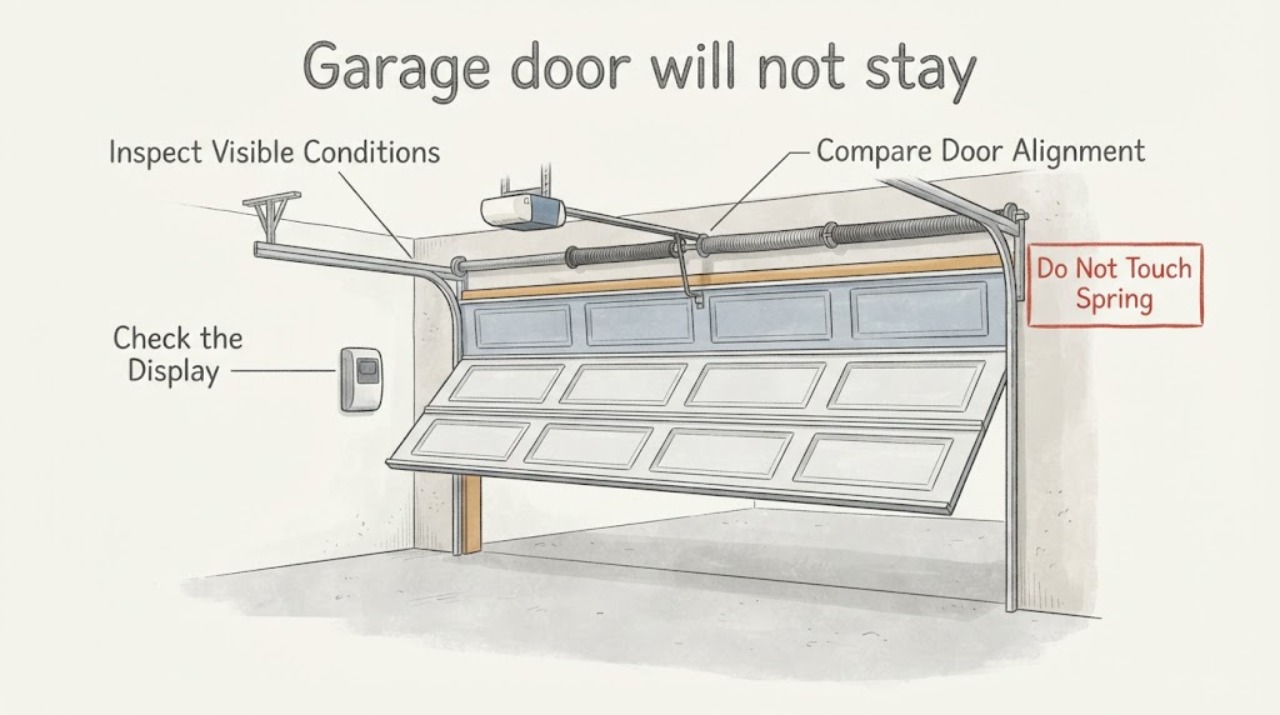
Work through in order
Diagnostic checks
Use only checks that match the exact appliance or system and its official guide.
-
Check 1
Clear people, pets, and vehicles from the door path. Observe one normal attempt from the wall control or remote without standing under the door, and note whether the door closes immediately, reverses, stops short, or moves unevenly.
Expected result: A door that drifts or slams down differs from one that is mechanically steady but is commanded closed or reverses by the opener; scraping, jerking, or a crooked opening is another pattern.
Next step: Stop powered operation if the door is heavy, crooked, noisy, or falling. Continue only with the safe visual and balance checks when the path is clear and the door shows no dangerous damage.
Why this matters
Why: A drift, slam, or uneven movement points toward door balance, spring, cable, track, or roller trouble. A steady door with an opener-only symptom points more toward opener controls or settings.
-
Check 2
With the door fully closed and only if the owner's manual describes the release procedure, disengage the opener and use the door handle to raise the door partway. Keep a firm, controlled grip and never place any person beneath a released door.
Expected result: A door that stays in place differs from one that slowly drops, rises on its own, becomes very heavy, binds, or cannot be moved smoothly by hand.
Next step: If the door does not hold, lower it carefully only if it remains controlled, keep it out of service, and call a qualified garage door technician. Do not adjust springs or cables to correct the balance.
Why this matters
Why: Holding partway supports a balanced door. Drifting, sudden movement, or excessive weight makes an out-of-balance door or damaged spring and cable system more likely; binding suggests track, roller, or hardware trouble.
-
Check 3
From the side of the closed or stationary door, visually inspect springs, lift cables, drums, rollers, pulleys, hinges, brackets, and tracks for a gap, fraying, kinks, rust, a loose part, a cable off its drum, or a crooked panel. Do not touch or move these components.
Expected result: A broken spring, frayed or off-drum cable, separated hardware, or a door panel sitting crooked is different from clean, aligned hardware with no visible damage.
Next step: Do not operate a door with a broken spring, frayed or displaced cable, loose high-tension hardware, or an off-track panel. Call a qualified technician and keep the area clear.
Why this matters
Why: Visible damage can remove the system's counterbalance or make the door bind, causing it to fall or overload the opener. No visible damage does not prove that a spring or cable is safe internally.
-
Check 4
With the opener still disengaged and no damaged hardware present, look for visible debris in the tracks, an object against the panels, or a roller that is visibly out of its track. Do not straighten a track, pull a cable, or force a stiff section.
Expected result: A clear path and smooth movement differ from scraping, a crooked panel, repeated binding at one location, or a roller outside the track.
Next step: Remove only loose debris that is safely reachable without tools. If the door remains crooked, binds, or is off track, stop and call a garage door professional.
Why this matters
Why: A localized obstruction or track and roller problem can make a balanced door appear unable to stay open. Persistent binding after a visible obstruction is removed suggests alignment or hardware service.
-
Check 5
If the door holds position by hand and moves smoothly while disconnected, reconnect it only according to the owner's manual, keeping the doorway clear. Observe whether the opener closes the door, reverses, or stops at a repeatable point.
Expected result: A balanced door with a repeatable powered-only failure differs from a door that fails the manual balance check or binds without the opener.
Next step: Use only the model manual's opener adjustment and reversal-test instructions. If the opener still behaves incorrectly, disengage it and arrange professional service rather than overriding a safety feature.
Why this matters
Why: Powered-only behavior makes opener travel, force, control, or sensor behavior more likely; it does not justify increasing force when the door's balance is uncertain.
-
Check 6
Record the door's manual balance result, visible spring or cable condition, binding location, opener behavior, and any recent impact or weather event. Keep the door closed and out of service while requesting a written diagnosis if the symptom persists.
Expected result: A single isolated opener setting issue differs from repeated balance failure, multiple worn components, a broken cable or spring, or structural panel damage.
Next step: Give the technician the model information and observations. Do not order springs, cables, or opener parts by appearance or attempt a high-tension repair.
Why this matters
Why: The repair may involve adjustment, a spring or cable service, track or roller repair, an opener diagnosis, a door section, or a complete system assessment. The observation pattern is needed before selecting a part.
Use your observations
Decision map
Find the observation that best matches what you see, then follow the next safe action.
-
PATH 01Next step
What you see
The door drifts down, rises on its own, slams, or feels unusually heavy during the manual balance check.
Do this next
Keep the door out of service and call a qualified garage door technician. Do not wind, unwind, remove, or replace springs or cables.
-
PATH 02Next step
What you see
A spring is visibly broken, a cable is frayed or off its drum, high-tension hardware is loose, or the door is off track.
Do this next
Do not operate or manually force the door. Keep people clear and arrange qualified service for the spring, cable, track, and door system.
-
PATH 03Next step
What you see
The door holds partway open by hand and moves smoothly, but the powered opener closes, reverses, or stops at a repeatable point.
Do this next
Follow the Amarr or opener manual's model-specific adjustment and reversal-test instructions. If behavior remains incorrect, leave the opener disengaged and call a technician.
-
PATH 04Next step
What you see
The door binds, scrapes, opens crooked, or stops at one location even with the opener disengaged.
Do this next
Remove only loose visible debris without tools. Do not straighten tracks or force rollers; arrange professional inspection if movement is not smooth.
-
PATH 05Next step
What you see
The door has impact damage, a visibly bent or sagging section, repeated failures after service, or several worn components.
Do this next
Ask a professionally trained Amarr dealer or garage door technician to compare a component repair, section replacement, and door or opener replacement where appropriate.
-
PATH 06Next step
What you see
The door is unpredictable, a person or vehicle is in the path, or any spring, cable, track, or high-tension hardware is exposed or damaged.
Do this next
Stop operation, keep everyone clear, and call qualified garage door service. Do not bypass safety features or attempt a spring, cable, or track repair.
Helpful context
Understand the symptom
Separate door balance from opener behavior
The panels, tracks, rollers, cables, springs, and opener work as one system. The door should be mechanically balanced before the opener is asked to hold or move it. If the door drifts down when disconnected, the problem is not solved by increasing opener force. If it holds its position by hand but behaves incorrectly under power, the opener's travel, force, or control behavior becomes more relevant.
Springs and cables are not homeowner adjustments
Garage-door springs and lift cables store or transmit enough force to move a heavy door. Keep hands away from springs, drums, cables, brackets, and red-marked high-tension hardware. A visual inspection and a model-directed balance observation are useful; winding, unwinding, removing, or replacing spring hardware belongs to a trained technician.
Only after diagnosis
Potential parts
- garage door spring
Consider this only when a qualified technician confirms a broken, worn, or incorrectly matched spring is causing the door to be out of balance.
Spring selection depends on the complete door size, weight, lift arrangement, and hardware. Do not order or install from appearance alone. - garage door lift cable
Consider this only when service confirms fraying, displacement, damage, or incorrect routing of the lift cable.
Cable length, diameter, drum, and lift configuration are model- and door-specific; have the technician identify the correct replacement. - garage door roller or track hardware
Consider this only when a technician traces binding or crooked movement to a worn roller, damaged track, hinge, or related hardware.
Track and roller geometry must match the door system. Do not substitute parts or straighten a loaded track without professional support.
When checks do not resolve it
Need a professional?
Call a qualified garage door technician when an Amarr door will not stay balanced, drifts or slams, feels heavy, binds, opens crooked, has a broken or frayed spring or cable, has a roller or panel off track, or behaves incorrectly after a model-directed opener check. Stop immediately for unpredictable movement, exposed high-tension hardware, a fallen or damaged panel, or anyone in the door path. Do not adjust or replace springs and cables, straighten tracks, bypass safety sensors, or increase opener force to mask a mechanical fault.
Safety scope: Homeowner checks are limited to clearing the path, visual observation, and a manual balance observation only when the door is closed first, the release procedure is documented, and the door remains controlled. No spring or cable work, track straightening, panel removal, or safety-feature bypass.
Common questions
FAQ
Why does my Amarr garage door close instead of staying open?
The door may be out of balance from a spring or cable problem, or it may bind from track, roller, or panel damage. If it is balanced by hand but fails only under power, opener travel, force, control, or safety-sensor behavior may be involved.
Can I adjust the garage door spring so it stays open?
No. Springs and lift cables are high-force components. Keep the door out of service and call a qualified garage door technician for an out-of-balance door, broken spring, frayed cable, or off-track hardware.
How do I tell if the opener or the door is the problem?
With the door closed and only when the owner's manual describes the release procedure, a qualified or comfortable homeowner may observe whether the door holds partway open and moves smoothly by hand. A manual balance failure points to the door system; a balanced door with powered-only trouble points more toward the opener.
Should I increase opener force when the door will not stay open?
Do not use force to hide a balance, track, spring, or cable fault. Only follow the model manual's opener settings after the door is confirmed balanced, and call a technician if the powered behavior remains abnormal.
Read the exact guide
Official sources
- FAQsAmarr · Amarr garage door opening, closing, balance, spring, cable, track, and repair-versus-replacement questions
- Care & MaintenanceAmarr · Amarr residential garage door balance, visual inspection, opener maintenance, and safety guidance
- Publication - 523 Non-Reversing Automatic Garage Door Openers Are a HazardU.S. Consumer Product Safety Commission · garage door balance, falling-door hazard, manual balance checks, and professional service boundary
Community feedback
Share a repair observation
Share a plain-text repair observation. Accepted observations are published automatically; this page may take a moment to update.