
On this page
Start here
Quick answer
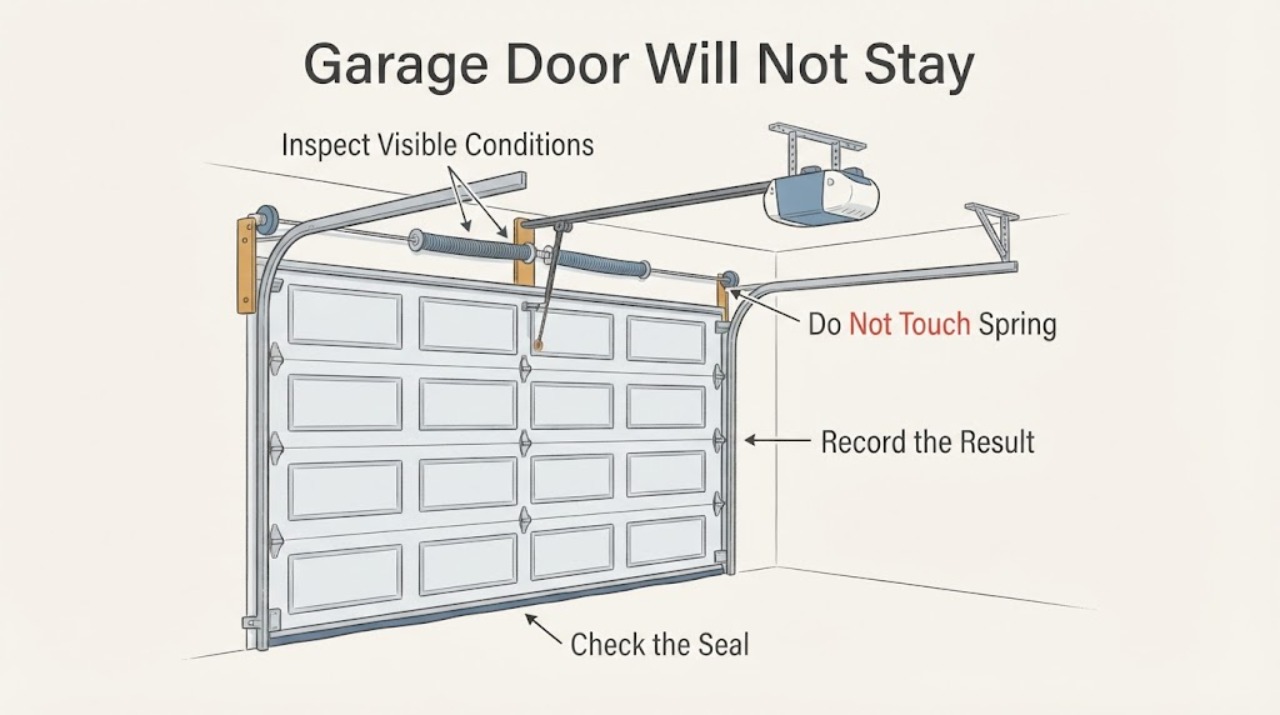
A Clopay garage door that rises and then falls, or will not remain open halfway, is often out of balance rather than suffering from a simple remote or sensor fault. Springs counterbalance the door, and a broken, weak, or misadjusted spring or cable can make the door heavy, uneven, or unsafe. First keep people and vehicles out of the door path, observe whether the opener runs and whether the door reverses, and visually check for an obstruction, off-track roller, bent track, broken spring, or frayed cable. Photo-eye sensors usually affect closing and reversing, not whether a sound door can stay open. Do not force or catch the door, pull an emergency release on an elevated or partly open door, adjust springs, cables, bottom brackets, tracks, or opener force settings, or stand beneath a stopped door. If the door is heavy, crooked, stuck above the floor, falls by itself, or shows spring/cable damage, stop operating it and arrange a trained garage-door professional.
Before you begin
Safety first
- Do not stand under a stopped or moving door, catch or force the panels, pull the emergency release on an elevated or partly open door, adjust or replace springs or cables, loosen tracks or bottom brackets, reseat rollers, defeat photo eyes, or change opener force to overpower a door. Keep people and vehicles clear until inspection.
Work through in order
Diagnostic checks
Use only checks that match the exact appliance or system and its official guide.
-
Check 1
Keep the door path clear and observe one command from the side, never beneath the door. Record whether the Clopay door rises and falls, stops partway, reverses, slams down, remains open only while the opener is engaged, or will not move at all; note whether the door is fully closed, partly open, or stuck above the floor.
Expected result: The door rises then falls; it will not hold halfway; it is heavy or crooked; it stops at one height; or the opener runs without moving the door.
Next step: Stop repeated commands and use the movement pattern to choose the balance, track, sensor, or opener branch. Do not push, catch, pull down, or stand under an elevated or partly open door.
Stop if: Stop immediately for sudden movement, a loud bang, a door that is unsupported or crooked, or any position in which a falling door could strike a person, vehicle, or stored item.
Why this matters
Why: A door that cannot hold position, falls, feels heavy, or sits crooked makes balance, spring, cable, track, or panel trouble more likely. A running opener with no door movement can instead involve the trolley or door connection. Reversal during closing keeps obstruction and photo-eye causes in play.
-
Check 2
Inspect the visible door hardware without touching it. From a safe standing position, look for a gap or break in a spring, slack or frayed lift cable, a displaced bottom bracket, panels that lean, or a roller outside the track. Do not loosen, adjust, lubricate, or pull any spring, cable, pulley, bracket, or tensioned part.
Expected result: A spring has a visible gap or damage; a cable is slack, frayed, or off its drum; a bracket is bent or displaced; a panel is uneven; or no visible damage is found.
Next step: Keep the door stationary and arrange trained garage-door service for any spring, cable, bracket, panel, or balance symptom. Do not pull the emergency release to confirm the diagnosis or attempt a replacement.
Stop if: Stop all operation for frayed or slack cable, a broken or displaced spring, a loose bottom bracket, a partially open door, or any hardware that appears under load.
Why this matters
Why: A broken spring or cable can remove the support that lets the door stay open and can allow sudden movement. A bent bracket or uneven panel can bind the door. No visible damage does not clear hidden spring tension or a balance fault when the door still falls.
-
Check 3
Check the travel path and tracks visually. Look for ice, a box, vehicle, tool, bent or dented track, loose-looking hardware, a roller outside the track, or a panel rubbing one side. Remove only a loose object that is fully away from the door mechanism; do not pry the panel, reseat a roller, straighten a track, or loosen track brackets.
Expected result: An object blocks the path; the door binds at one height; a track is bent or loose; a roller is displaced; or the path looks clear and the panels remain aligned.
Next step: Leave bent, loose, or off-track hardware untouched and arrange a trained inspection. If a fully external object was removed and the door still will not hold position, stop using the opener rather than increasing force.
Stop if: Stop if an object is trapped under load, the door is off track, the track is bent, or clearing the path would require reaching under or between door sections.
Why this matters
Why: A path obstruction or track/roller bind can stop or tilt the door and may make it appear unable to stay open. A clear path with a door that falls or drifts still favors balance or counterbalance trouble over a simple obstruction.
-
Check 4
Check the opener and photo eyes without opening the motor housing. Note whether the wall control and remote produce the same response, whether the opener lights or diagnostic indicators change, and whether the two photo-eye lenses are clean, facing each other, and free of an object in the beam. Do not bypass the sensors or change force and travel settings to overpower the door.
Expected result: The opener is silent; the trolley moves but the door does not; the door reverses only while closing; a photo-eye indicator is abnormal; or the controls and sensors appear normal but the door falls.
Next step: Replace only a clearly exhausted remote battery with the documented type or clean an accessible photo-eye lens with a soft cloth if the manual permits. Arrange service for abnormal sensor behavior, a moving trolley with no door movement, or a door that remains unbalanced.
Why this matters
Why: A remote or control issue can prevent a command, and a sensor issue commonly affects closing or reversal. A trolley that moves without the door can indicate a connection or lock problem. Normal controls and sensors with a door that cannot stay open point back to balance or door hardware.
-
Check 5
Use the Clopay owner manual to determine whether a safe balance check is provided for this exact door and opener. Do not disconnect an opener or manually lift a door that is open, partly open, crooked, damaged, unusually heavy, or showing spring or cable symptoms. If the manual does not clearly permit a user check in a fully closed, stable condition, skip movement testing.
Expected result: The manual provides a model-specific balance procedure and the door is fully closed and stable; the door is not safe to move manually; or no reliable manual is available.
Next step: Follow only the documented, low-risk procedure if all safety conditions are met; otherwise leave the door alone and arrange trained service. Do not perform a balance test by improvising with the emergency release, clamps, ropes, or extra people.
Stop if: Stop before any manual movement if the door is elevated, partly open, heavy, crooked, damaged, or near a person or vehicle.
Why this matters
Why: A proper balance check can distinguish a door that stays near its midpoint from one that moves by itself, but an unsafe or unknown door should not be disconnected or lifted. If it cannot safely hold position, spring tension or another door-system problem is more likely than an opener setting.
-
Check 6
Prepare a service handoff instead of repeating the test. Photograph the door position, panel alignment, tracks, rollers, photo eyes, visible springs and cables, opener indicators, and any obstruction from a safe location; record the Clopay door or opener model information from its normal label and whether a loud sound or impact preceded the failure.
Expected result: The problem followed a loud bang, impact, cold weather, a sensor reversal, or no obvious event; or the photos show visible hardware damage or an otherwise intact-looking door that still will not hold open.
Next step: Give the photos, timeline, and model information to a trained garage-door professional and keep the area isolated. Do not open covers, release tension, force the door, or keep cycling the opener to collect more evidence.
Stop if: Stop and seek prompt service for an elevated door, broken or frayed cable, spring damage, off-track roller, bent track, uncontrolled movement, or failed safety reversal.
Why this matters
Why: A loud bang or new heavy/uneven movement increases concern for spring or cable failure. Impact or ice can produce a track or path bind. Reversal without physical imbalance favors sensor or obstruction evidence, while a quiet falling door still requires balance and counterbalance assessment.
Use your observations
Decision map
Find the observation that best matches what you see, then follow the next safe action.
-
PATH 01Next step
What you see
The Clopay door rises and falls, will not remain near halfway, is suddenly heavy, sags, or moves unevenly while the controls and travel path look normal.
Do this next
Keep the door in its current safe position and arrange trained garage-door service. Do not disconnect an elevated door, adjust springs, handle cables, or change opener force settings.
Why this path and its safety boundary
Why it matters: A spring, cable, pulley, bracket, panel, or other balance problem is more likely than a remote or sensor fault. The door can move unexpectedly and the opener should not be used to overpower it.
-
PATH 02Next step
What you see
A loud bang preceded the problem, a spring has a visible gap, a lift cable is slack or frayed, or the door became heavy or crooked abruptly.
Do this next
Keep everyone away from the door and arrange prompt professional repair. Do not pull the release, lift the door, touch the cable, loosen a bracket, or attempt spring replacement.
Why this path and its safety boundary
Why it matters: A broken or damaged counterbalance component is strongly suspected. Clopay identifies heavy doors and visible spring or cable wear as professional-service conditions.
-
PATH 03Next step
What you see
The door catches at one height, leans to one side, a roller is outside the track, or the track is bent, loose, dirty, iced, or impacted.
Do this next
Remove only a loose object away from the mechanism; leave bent, loose, or off-track hardware untouched and arrange trained service. Do not pry, straighten, reseat, or loosen the track.
Why this path and its safety boundary
Why it matters: A mechanical path bind can stop the door and prevent stable travel. Forcing it can worsen panel, roller, track, or opener damage.
-
PATH 04Next step
What you see
The opener responds but the door reverses or refuses to close, a photo-eye indicator is abnormal, or an object interrupts the beam while the door itself is not heavy or crooked.
Do this next
Clear only an external obstruction and clean an accessible lens as the manual permits. If the sensor indication or reversal remains abnormal, stop using the opener and arrange professional inspection; never bypass the sensors.
Why this path and its safety boundary
Why it matters: An obstruction or photo-eye alignment/cleanliness issue is more likely than a balance fault. These safeguards commonly stop closing to prevent an unsafe cycle.
-
PATH 05Next step
What you see
The wall control or remote is unresponsive, the trolley moves without moving the door, or the controls work but the door hardware appears stable and aligned.
Do this next
Check the documented remote battery and visible power once, then arrange opener service for a persistent no-response or disconnected movement. Keep a mechanically stable door closed and do not open the motor housing.
Why this path and its safety boundary
Why it matters: A power, remote, wall-control, trolley, lock, or opener-connection issue is more likely than a spring problem, but changing force or travel cannot safely diagnose it.
Helpful context
Understand the symptom
A door that will not stay open is a balance clue
The springs and cables counterbalance a garage door so an opener does not carry the full door weight. If a door rises and then drifts down, slams shut, feels unusually heavy, or stays open only when the opener is attached, the counterbalance or door hardware deserves priority. A remote battery or a photo-eye can stop a command, but neither should be used as an excuse to overpower a mechanically unsafe door.
Observe the door without putting it under a new load
Keep the opening clear and make observations from the side. Look for a visible obstruction, sensor indication, crooked panels, a roller outside its track, or a broken-looking spring or cable. Do not catch a falling door, put fingers between sections, pull the release while the door is raised, or loosen any hardware. An elevated door can move unexpectedly when the opener is disconnected.
Do not solve a balance fault with opener settings
Increasing force or changing travel can make an opener drive against a heavy, binding, or off-track door and can defeat safe operation. If a safe, fully closed, model-specific manual procedure permits a balance check, use only that procedure; otherwise leave the door in its current safe position and arrange trained service.
Only after diagnosis
Potential parts
- garage door remote or keypad battery
Consider this category only when the wall control and opener respond normally but one remote or keypad is inactive and its battery is confirmed exhausted.
Match the exact remote or keypad model and documented battery type. A battery cannot correct a door that falls, binds, is unbalanced, or has damaged hardware. - photo-eye safety sensor or mounting hardware
Consider this category only when the opener indication and a clear beam point to a failed sensor or mount, not simply because the door will not stay open.
Confirm the exact opener model, sensor technology, wiring, mounting, and safety requirements. Never bypass the photo-eye system to make the door operate. - garage door roller or track component
Consider this category only after a trained technician identifies a worn roller or damaged track and determines that replacement is appropriate.
Match the Clopay door model, section, roller stem, track geometry, load, and fasteners. Do not remove bottom roller brackets or loosen track hardware as a user test. - Clopay counterbalance spring or lift cable assembly
Consider this category only after a trained door-systems professional confirms a failed spring or cable and identifies the exact Clopay door system.
Confirm door model, height, weight, spring configuration, cable routing, and manufacturer service procedure. Springs, cables, pulleys, and bottom brackets are tensioned and are not user-installation parts.
When checks do not resolve it
Need a professional?
Stop and arrange trained garage-door service for a Clopay door that will not stay open, falls or moves by itself, is unusually heavy or crooked, is stuck halfway or above the floor, has a broken or frayed cable or spring, a loose bottom bracket, bent track, displaced roller, uncontrolled movement, or a failed safety-reversal test. Do not pull the emergency release on an elevated door, force the panels, adjust springs or cables, loosen tracks, or bypass photo-eye sensors.
Safety scope: Do not stand under a stopped or moving door, catch or force the panels, pull the emergency release on an elevated or partly open door, adjust or replace springs or cables, loosen tracks or bottom brackets, reseat rollers, defeat photo eyes, or change opener force to overpower a door. Keep people and vehicles clear until inspection.
Common questions
FAQ
Why will my Clopay garage door not stay open?
The most important possibility is a balance or counterbalance problem: a broken, weak, or misadjusted spring or cable can make the door heavy and unable to hold position. A track bind, displaced roller, panel problem, or opener connection can look similar. Observe the door's physical behavior and inspect visible damage without forcing it, then arrange trained service for a falling, heavy, crooked, or elevated door.
Could a garage-door sensor make the door not stay open?
Photo-eye sensors primarily protect the closing cycle: an obstruction or misalignment can make the opener refuse to close or reverse. They do not explain a mechanically heavy door that rises and falls or cannot hold halfway. Check the beam and lenses visually, but do not bypass the sensors or use them to explain away a balance problem.
Should I disconnect the opener and test the Clopay door by hand?
Only follow a balance procedure stated for the exact model and only when the door is fully closed, stable, undamaged, and safe to move. Do not disconnect or lift a door that is open, partly open, crooked, unusually heavy, off track, or showing spring or cable damage. If any condition is uncertain, leave it alone and call a trained professional.
Can I increase the opener force so the door stays open?
No. Increasing force can make an opener drive against a binding, unbalanced, or damaged door and can defeat safe operation. Check only the normal controls and visible path, then have a trained technician correct the door balance, hardware, or opener fault.
When is a Clopay garage door that will not stay open unsafe to use?
Treat a door that falls, is heavy, crooked, stuck above the floor, off track, or has a broken or frayed spring or cable as unsafe. Keep people and vehicles clear, do not pull the release or touch tensioned hardware, and arrange trained service. A persistent sensor, opener, or safety-reversal fault also requires repair before normal use.
Read the exact guide
Official sources
- Understanding Garage Door Springs: Types, Functions and Maintenance TipsClopay · Manufacturer guidance explaining why a garage door that will not stay open can indicate a spring or balance problem
- Why Garage Doors Get Stuck - Causes & FixesClopay · Manufacturer guidance directly addressing garage doors that stick, stop, reverse, or will not open or close fully
- Garage Door Safety ChecklistClopay · Official Clopay safety checklist for distinguishing visual inspections from tensioned-hardware work and for recognizing unsafe balance or opener conditions
Community feedback
Share a repair observation
Share a plain-text repair observation. Accepted observations are published automatically; this page may take a moment to update.